Computer Organization
and Architecture

Introduction

Yanmin Zhu
yzhu@cs.sjtu.edu.cn
Question
           • Is a computer intelligent?


           NO! It is you that make a
           compute to appear to be
           intelligent
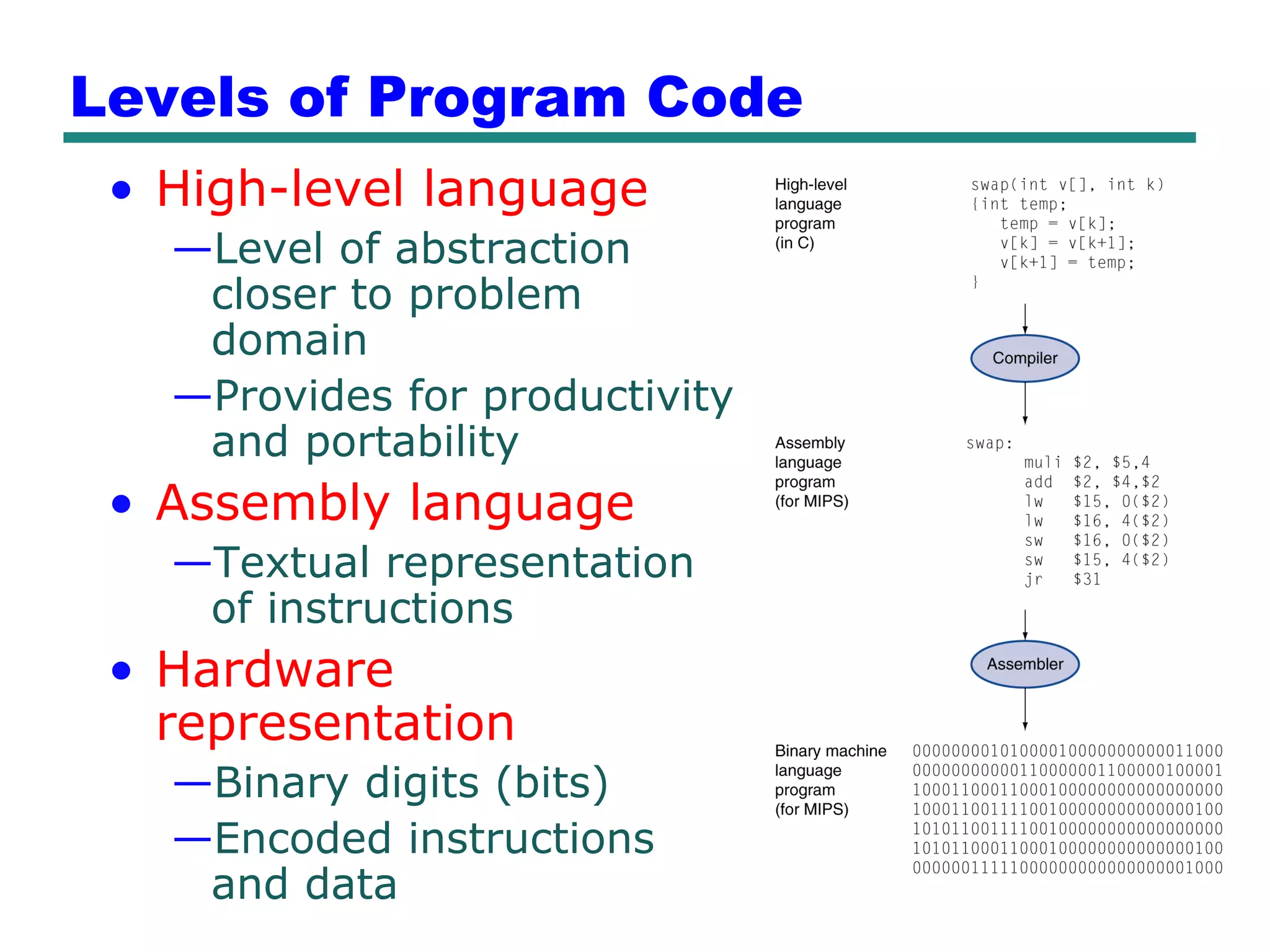
Levels of Program Code
 • High-level language
   —Level of abstraction
    closer to problem
    domain
   —Provides for productivity
    and portability
 • Assembly language
   —Textual representation
    of instructions
 • Hardware
   representation
   —Binary digits (bits)
   —Encoded instructions
    and data
§ Below Your Program
                                               1.2
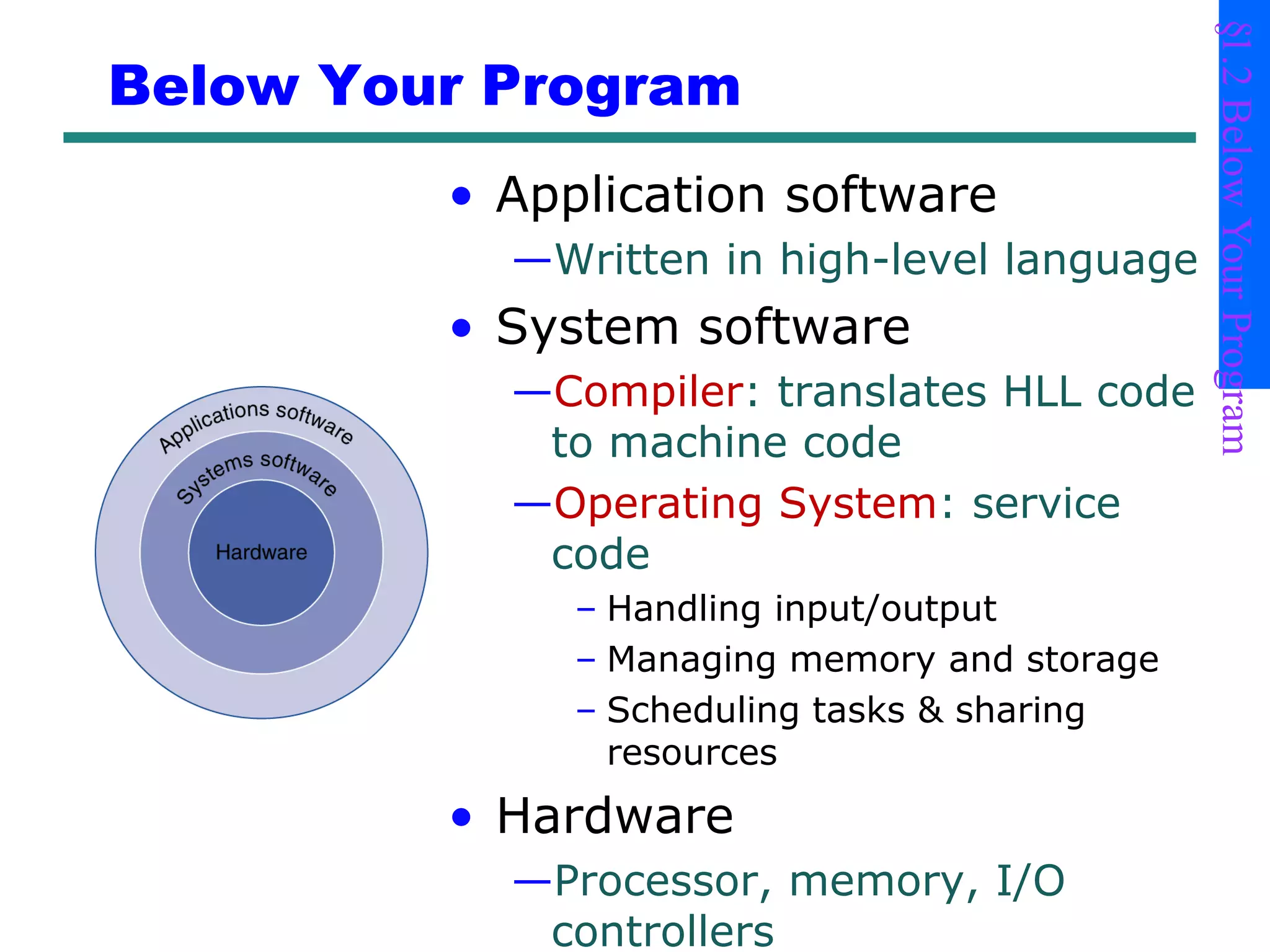
Below Your Program
         • Application software
           —Written in high-level language
         • System software
           —Compiler: translates HLL code
            to machine code
           —Operating System: service
            code
              – Handling input/output
              – Managing memory and storage
              – Scheduling tasks & sharing
                resources
         • Hardware
           —Processor, memory, I/O
            controllers
Relation


           APPLICATIONS


           OS


            HARDWARE
Question
           • You develop a program
             and run it on a computer.

           • What factors affect the
             performance of your
             program?
Understanding Performance
• Algorithm
  —Determines number of operations executed
• Programming language, compiler,
  architecture
  —Determine number of machine instructions
   executed per operation
• Processor and memory system
  —Determine how fast instructions are executed
• I/O system (including OS)
  —Determines how fast I/O operations are
   executed
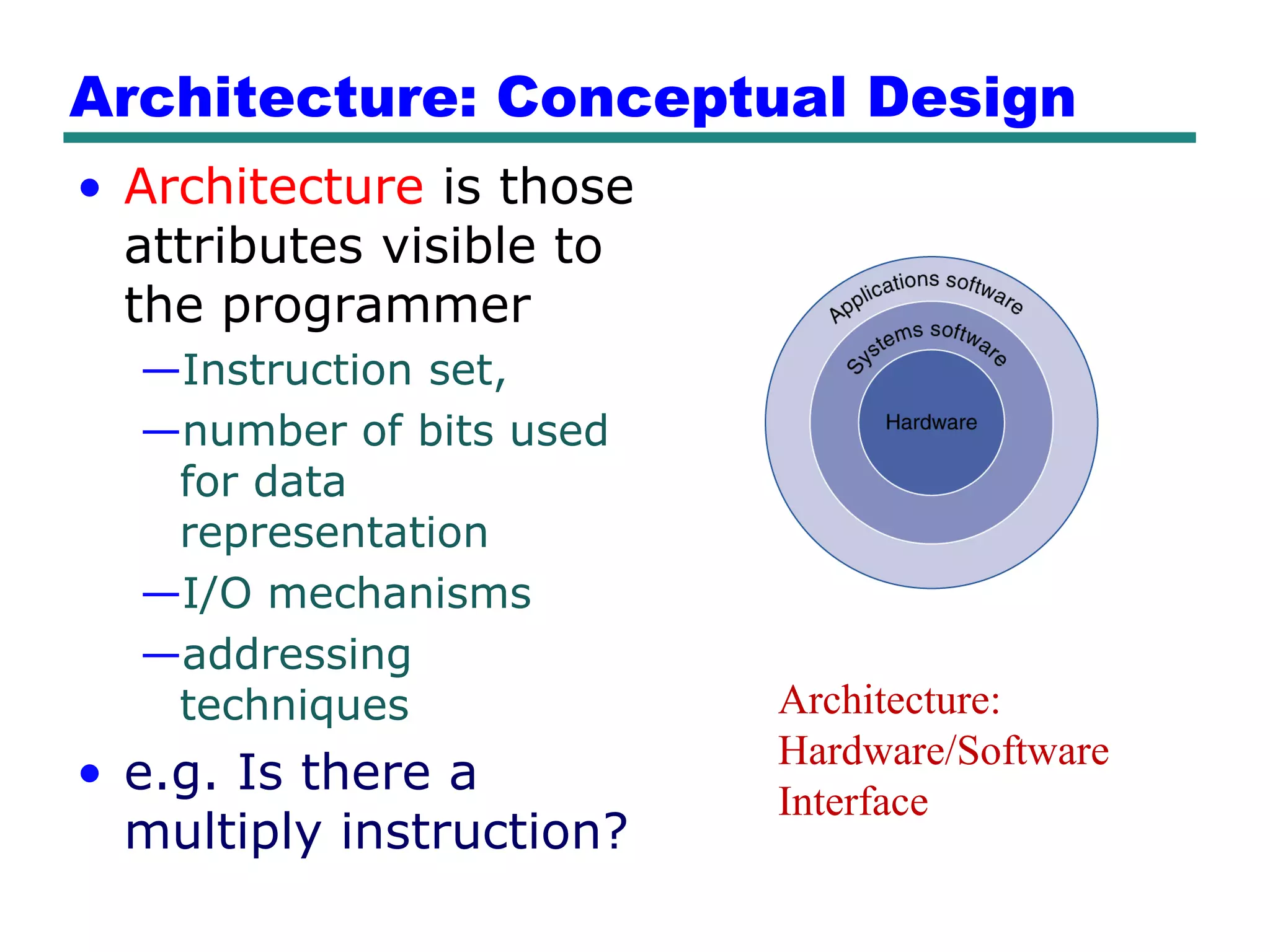
Architecture: Conceptual Design
• Architecture is those
  attributes visible to
  the programmer
  —Instruction set,
  —number of bits used
   for data
   representation
  —I/O mechanisms
  —addressing
   techniques             Architecture:
                          Hardware/Software
• e.g. Is there a
                          Interface
  multiply instruction?
Organization
• Organization is how features are
  implemented
  —Control signals
  —Interfaces
  —Memory technology
• e.g. Is there a hardware multiply unit or is
  it done by repeated addition?
Architecture & Organization
• Contents of computer architecture
  —Instruction set design, performance
   evaluation, pipelining, vector machine, SMP,
   clusters, parallel processing


• Contents of computer organization
  —Arithmetic operations, ALU
  —Memory and memory organization
  —Instruction set and addressing
  —Central processing unit (CPU)
  —Bus
  —I/O
Architecture & Organization
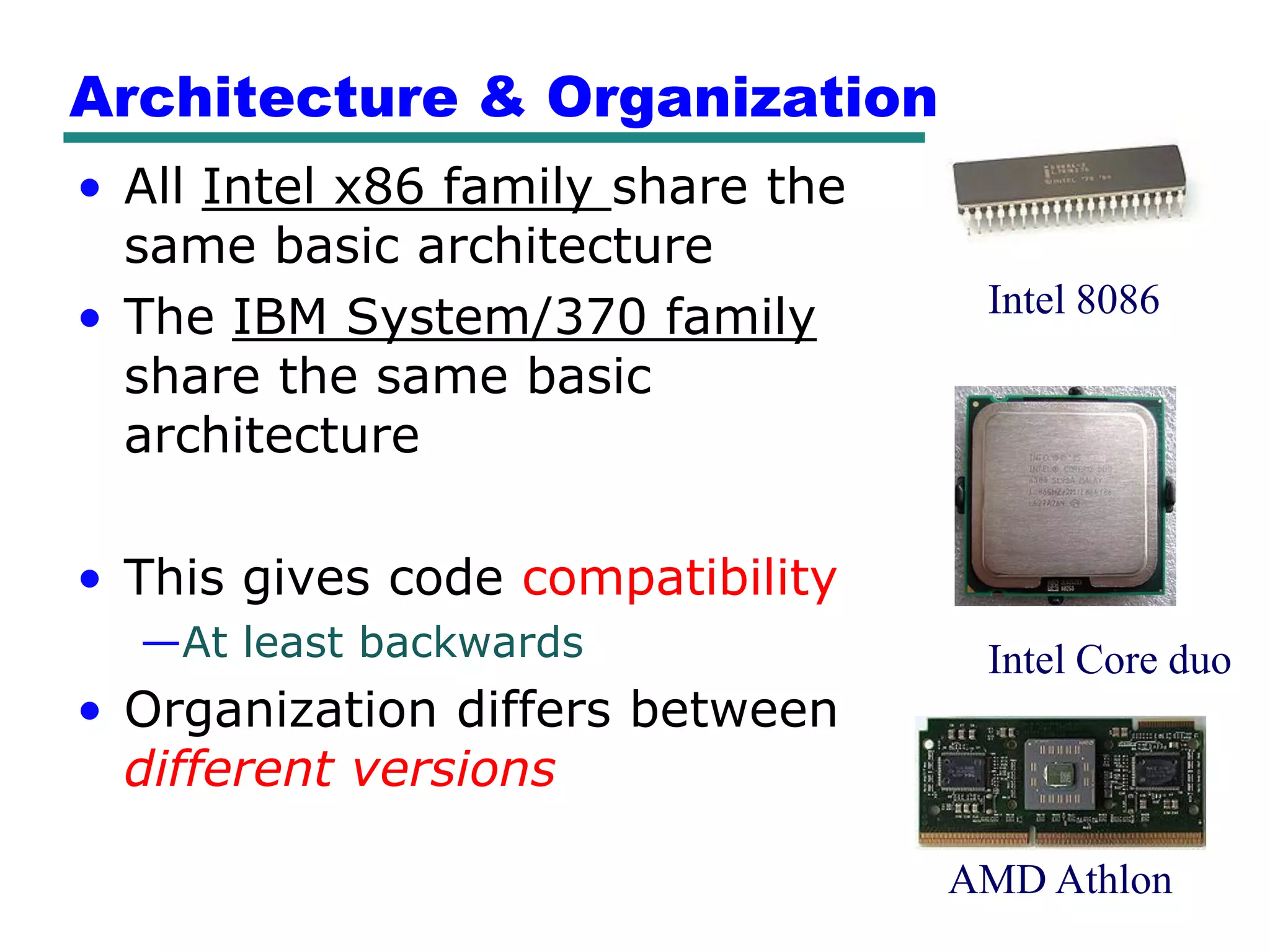
• All Intel x86 family share the
  same basic architecture
• The IBM System/370 family         Intel 8086
  share the same basic
  architecture

• This gives code compatibility
  —At least backwards               Intel Core duo
• Organization differs between
  different versions

                                   AMD Athlon
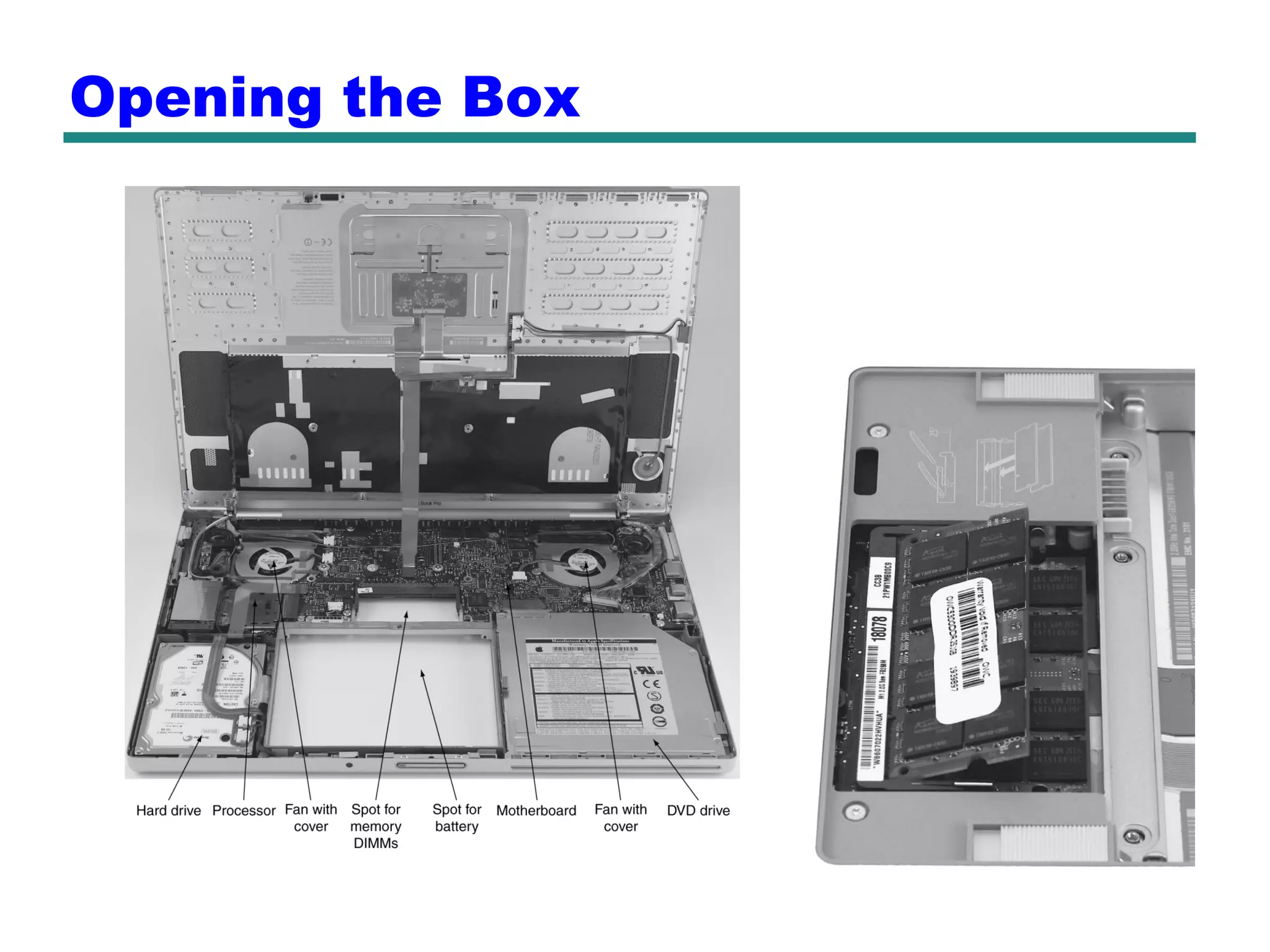
Opening the Box
§ Under the Covers
                                                    1.3
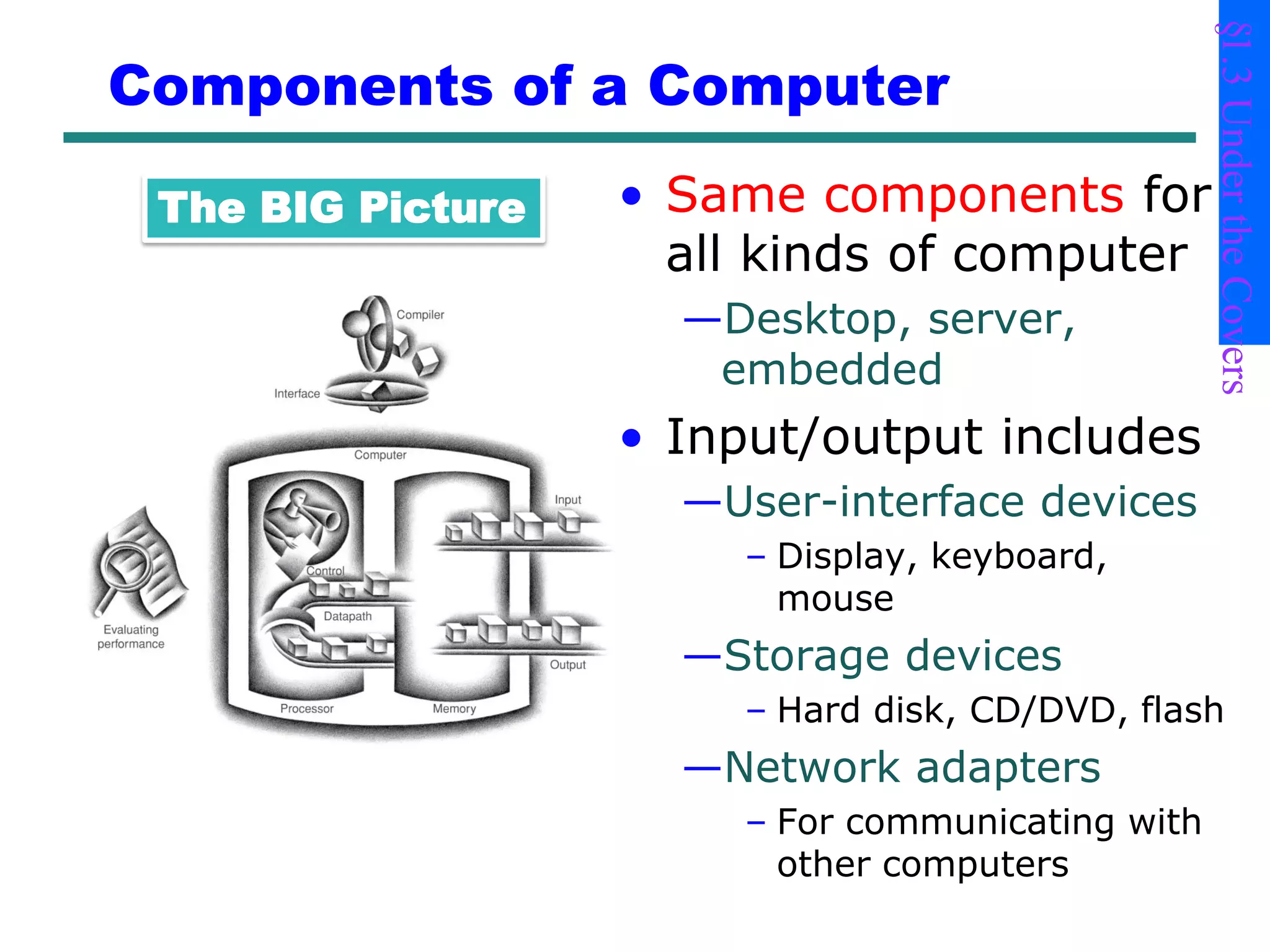
Components of a Computer

 The BIG Picture   • Same components for
                     all kinds of computer
                     —Desktop, server,
                      embedded
                   • Input/output includes
                     —User-interface devices
                        – Display, keyboard,
                          mouse
                     —Storage devices
                        – Hard disk, CD/DVD, flash
                     —Network adapters
                        – For communicating with
                          other computers
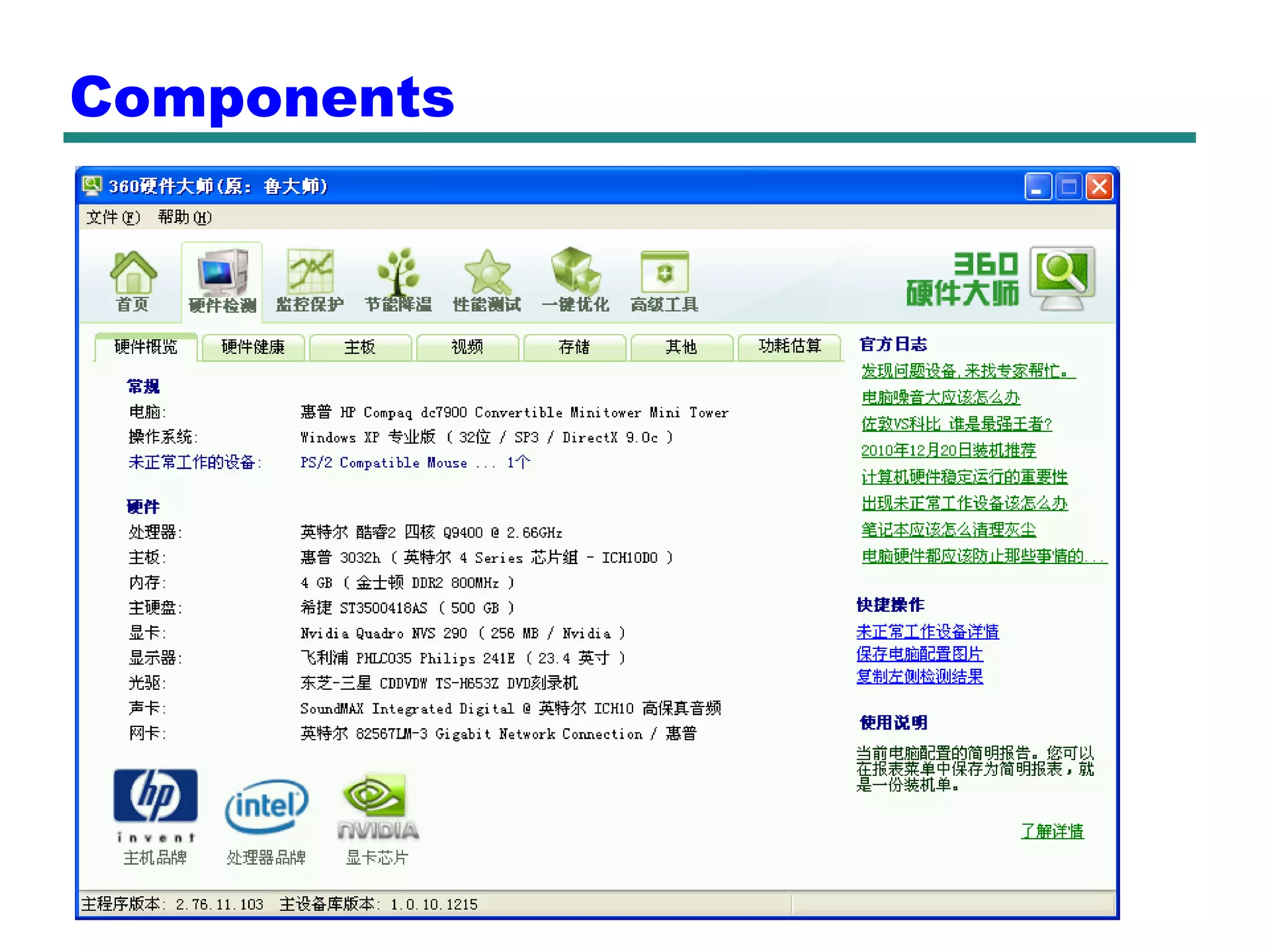
Components
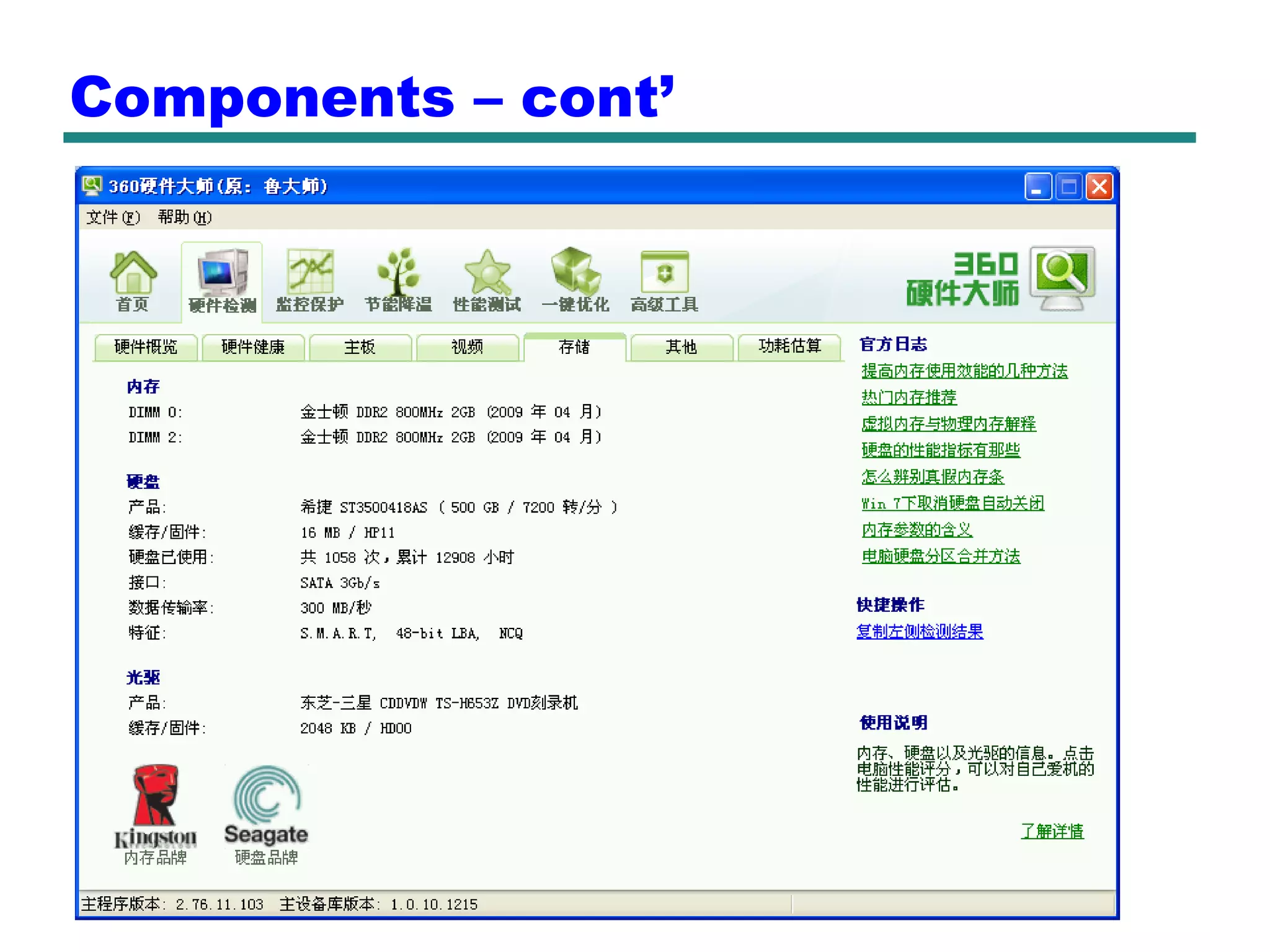
Components – cont’
Inside the Processor (CPU)
• Datapath: performs operations on data
• Control: sequences datapath, memory, ...
• Cache memory
  —Small fast SRAM memory for immediate
   access to data
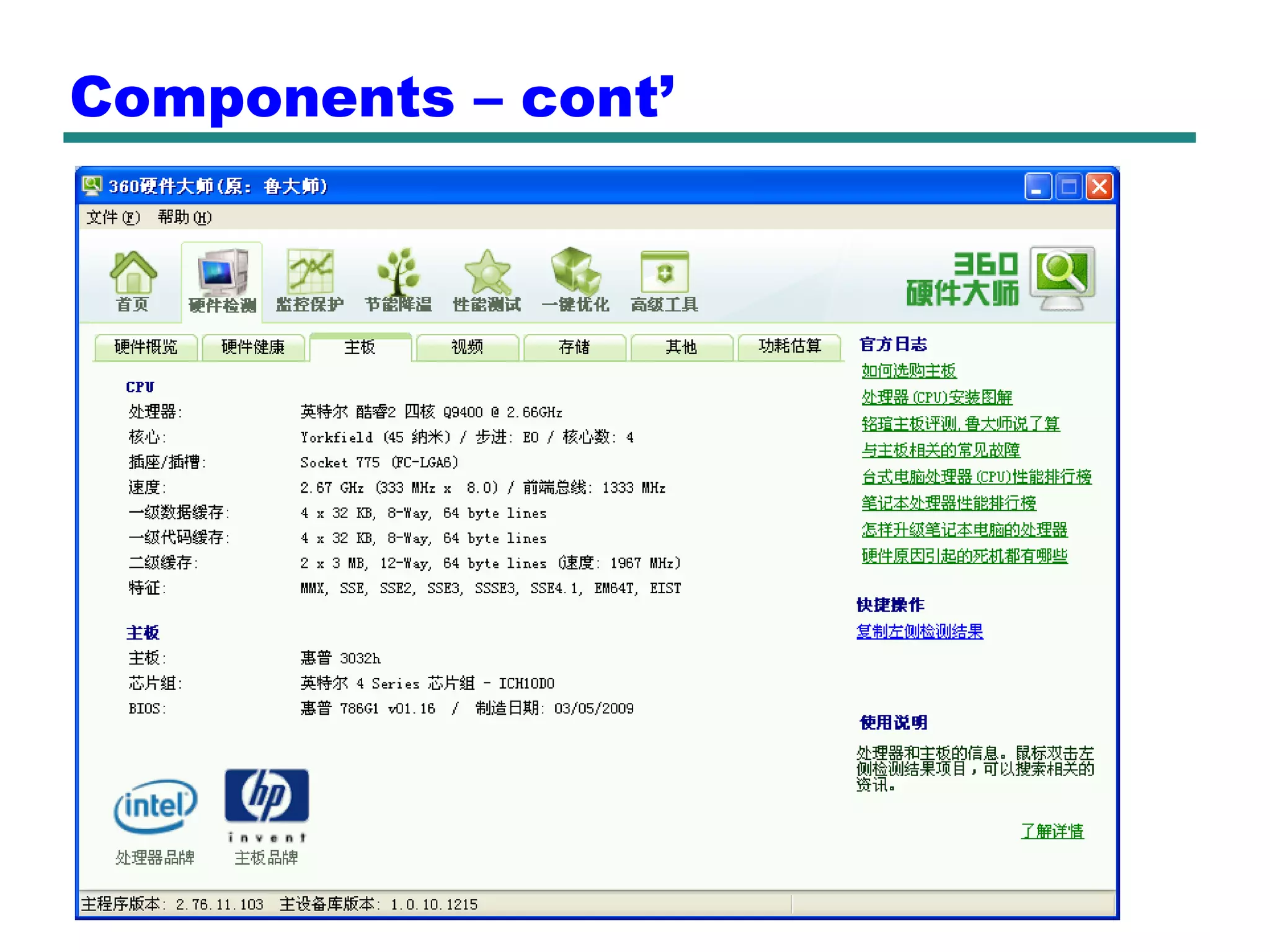
Components – cont’
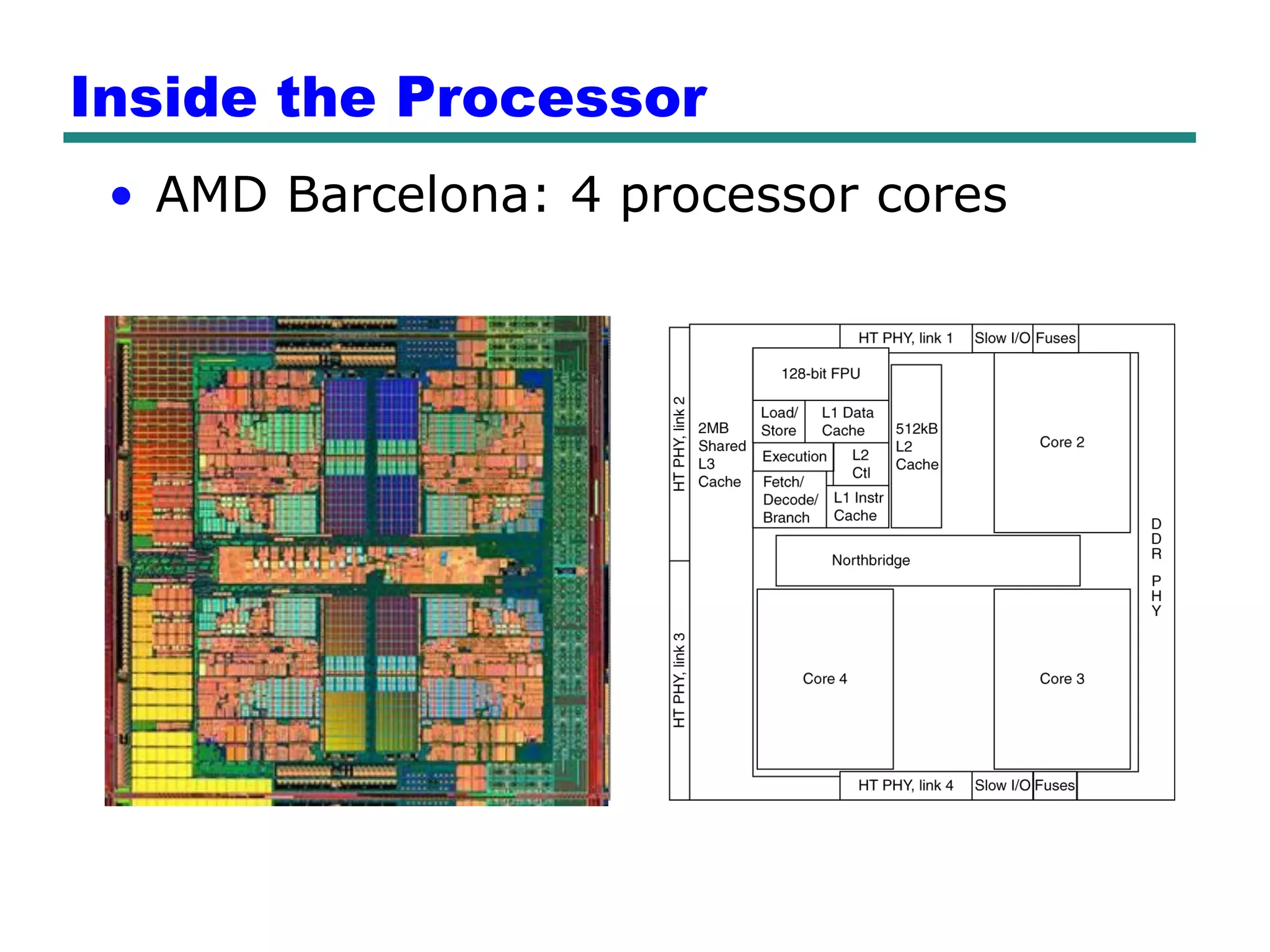
Inside the Processor
 • AMD Barcelona: 4 processor cores
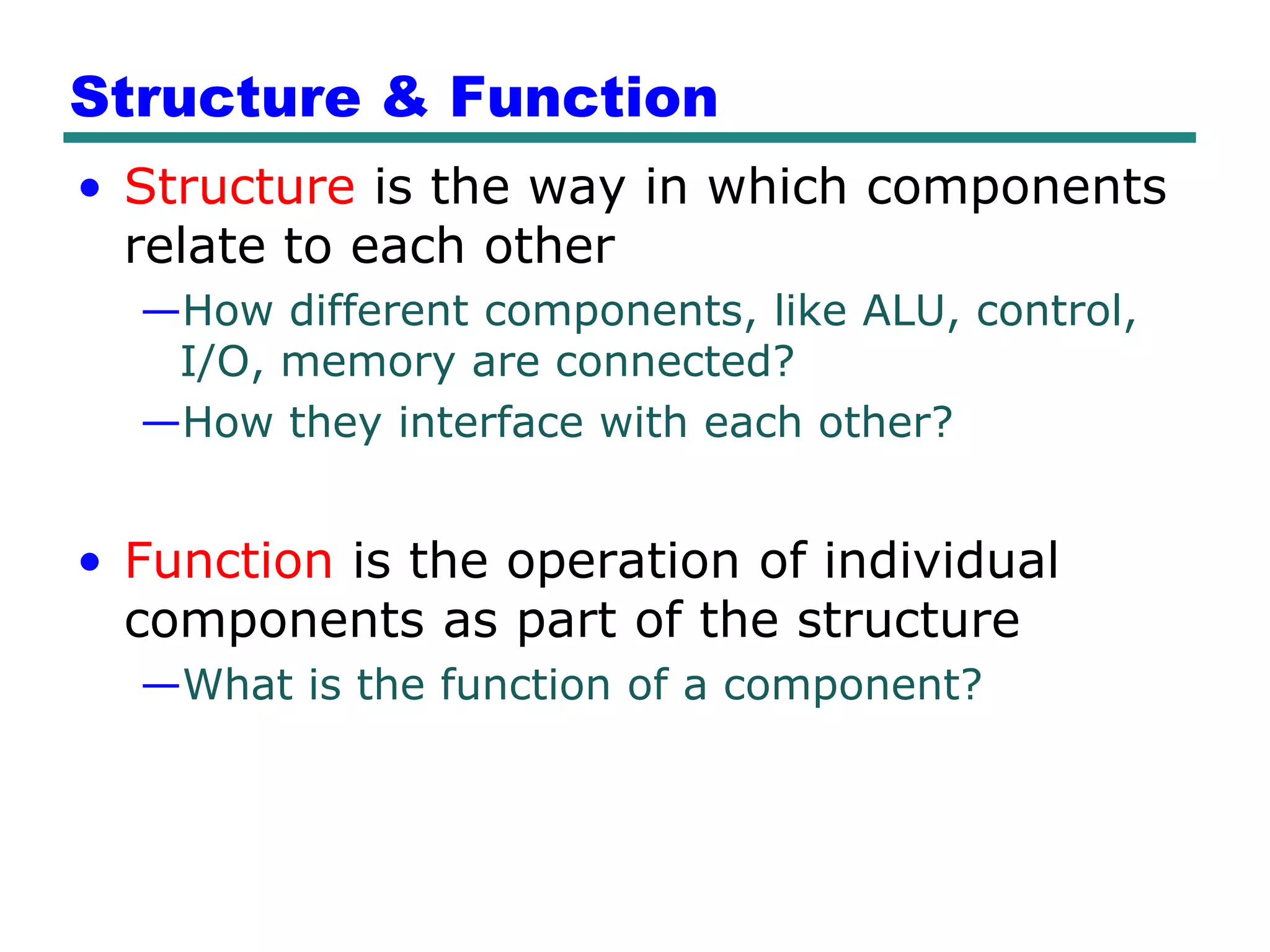
Structure & Function
• Structure is the way in which components
  relate to each other
  —How different components, like ALU, control,
   I/O, memory are connected?
  —How they interface with each other?


• Function is the operation of individual
  components as part of the structure
  —What is the function of a component?
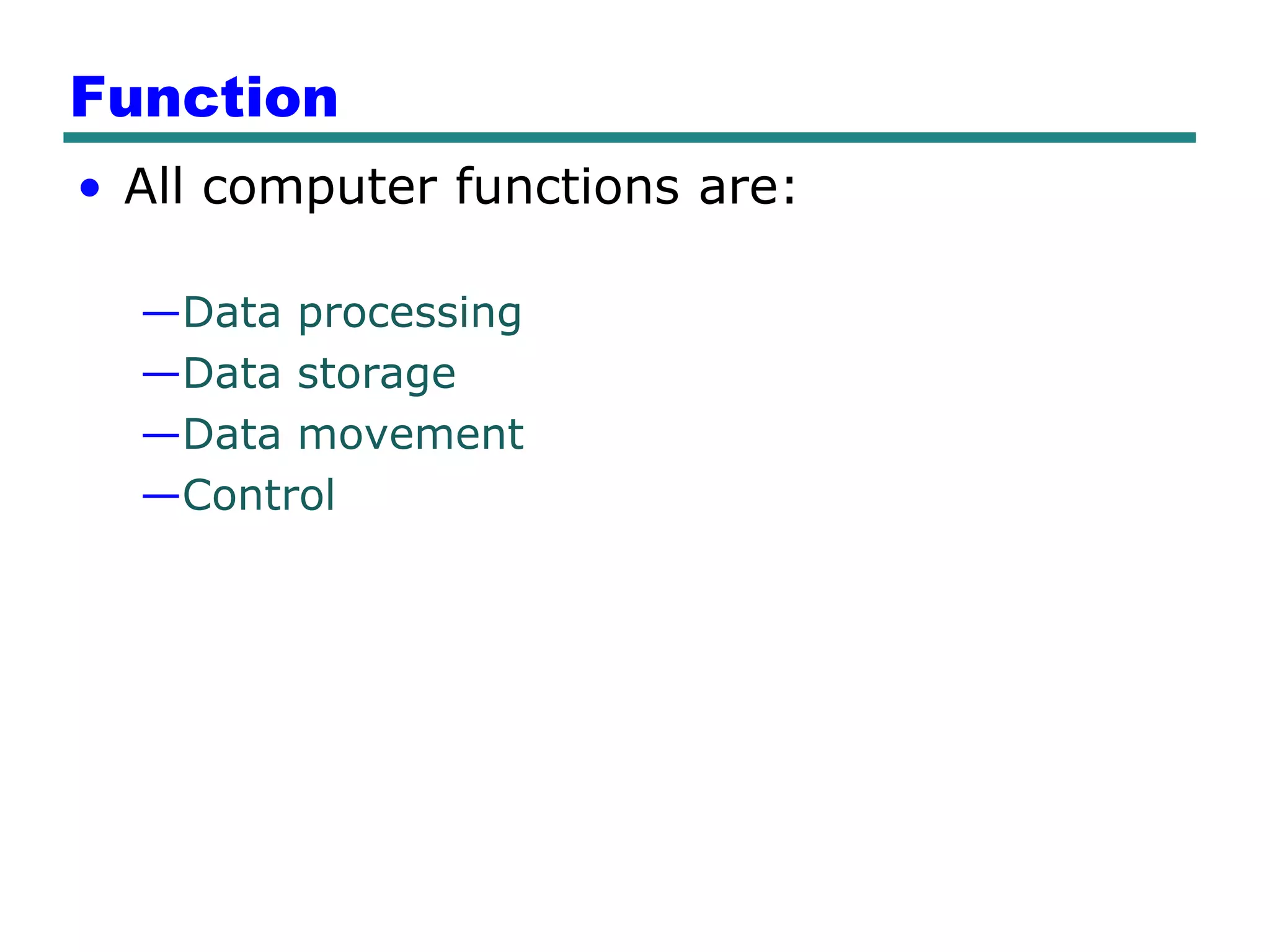
Function
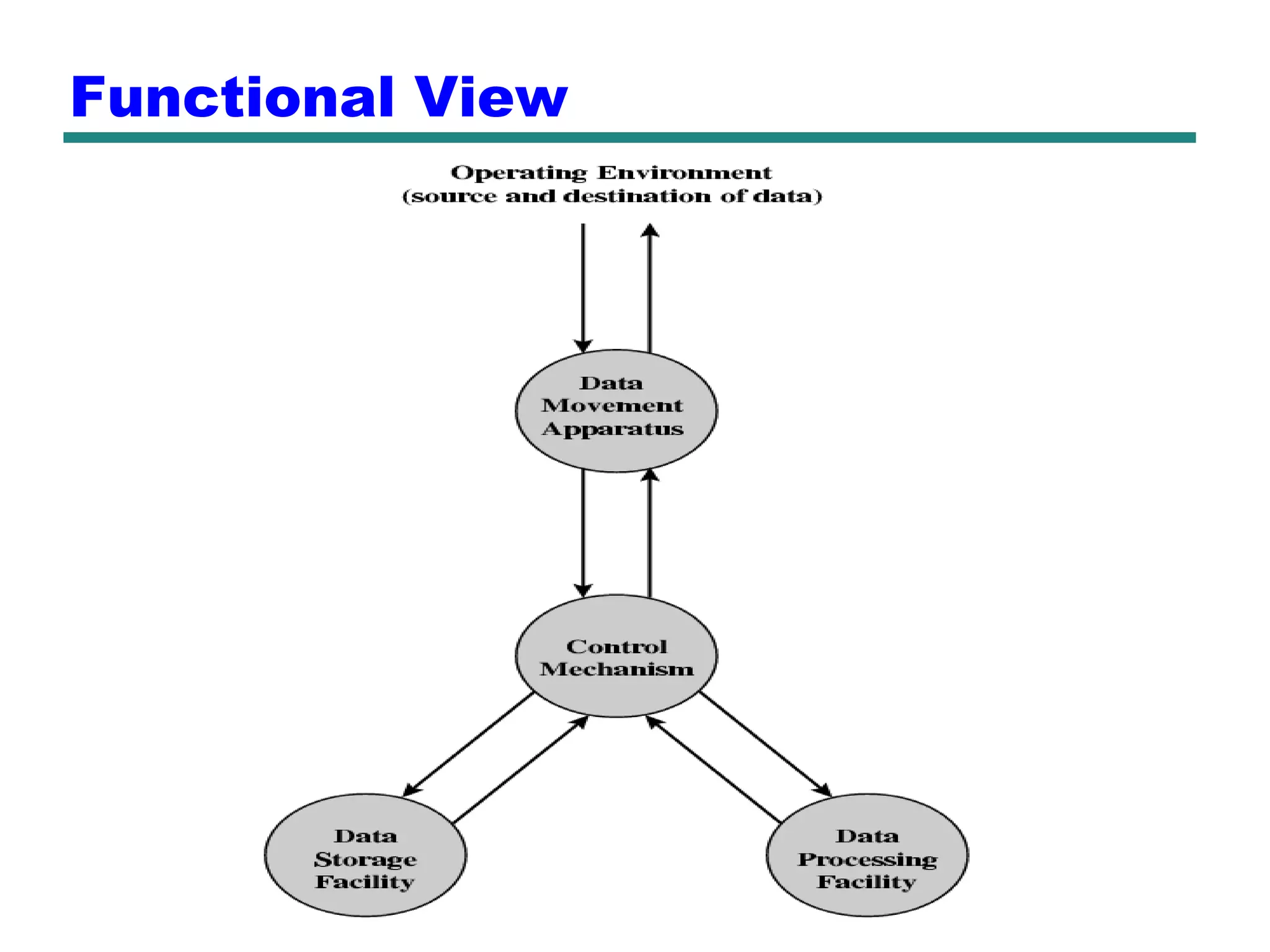
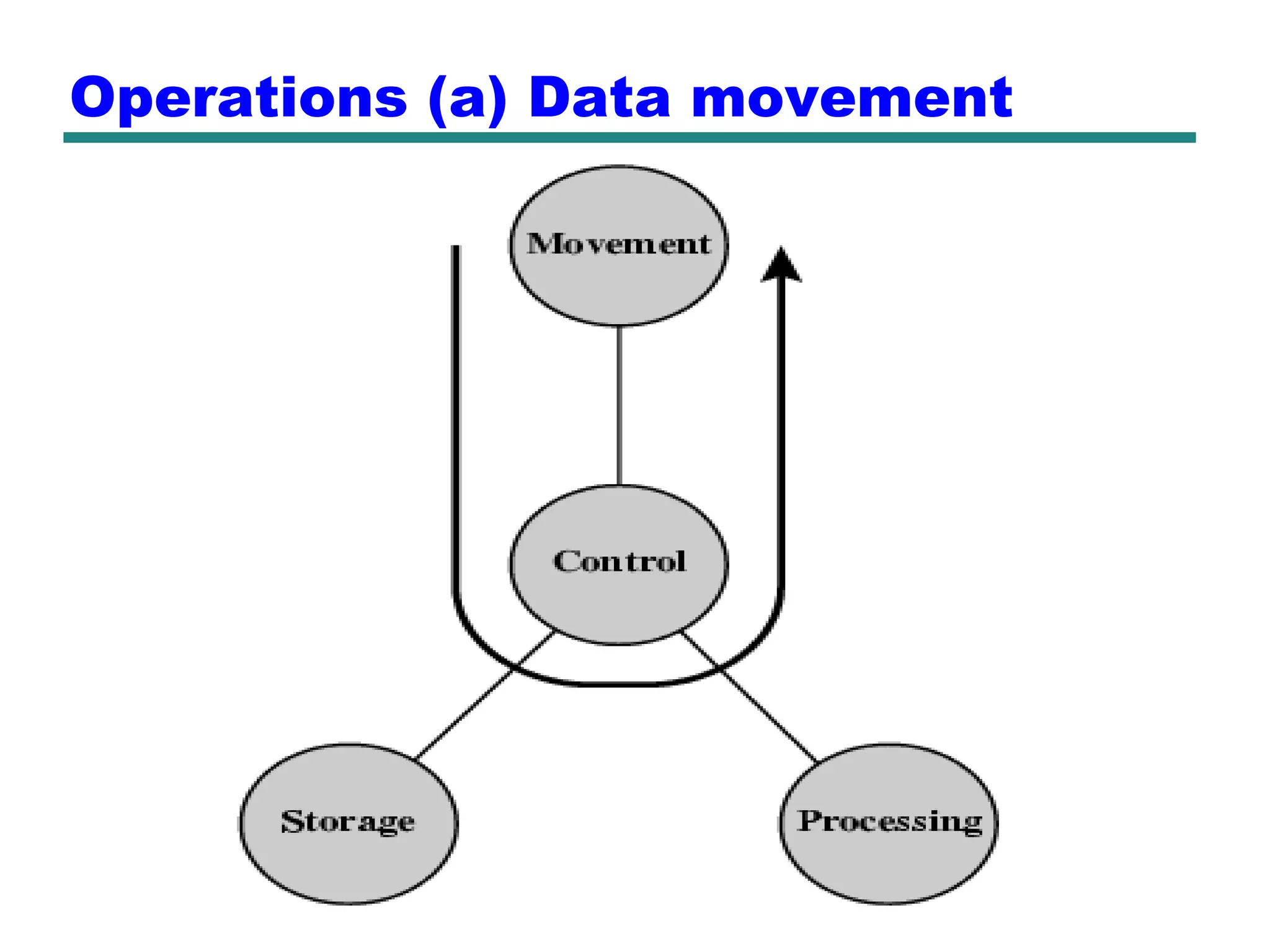
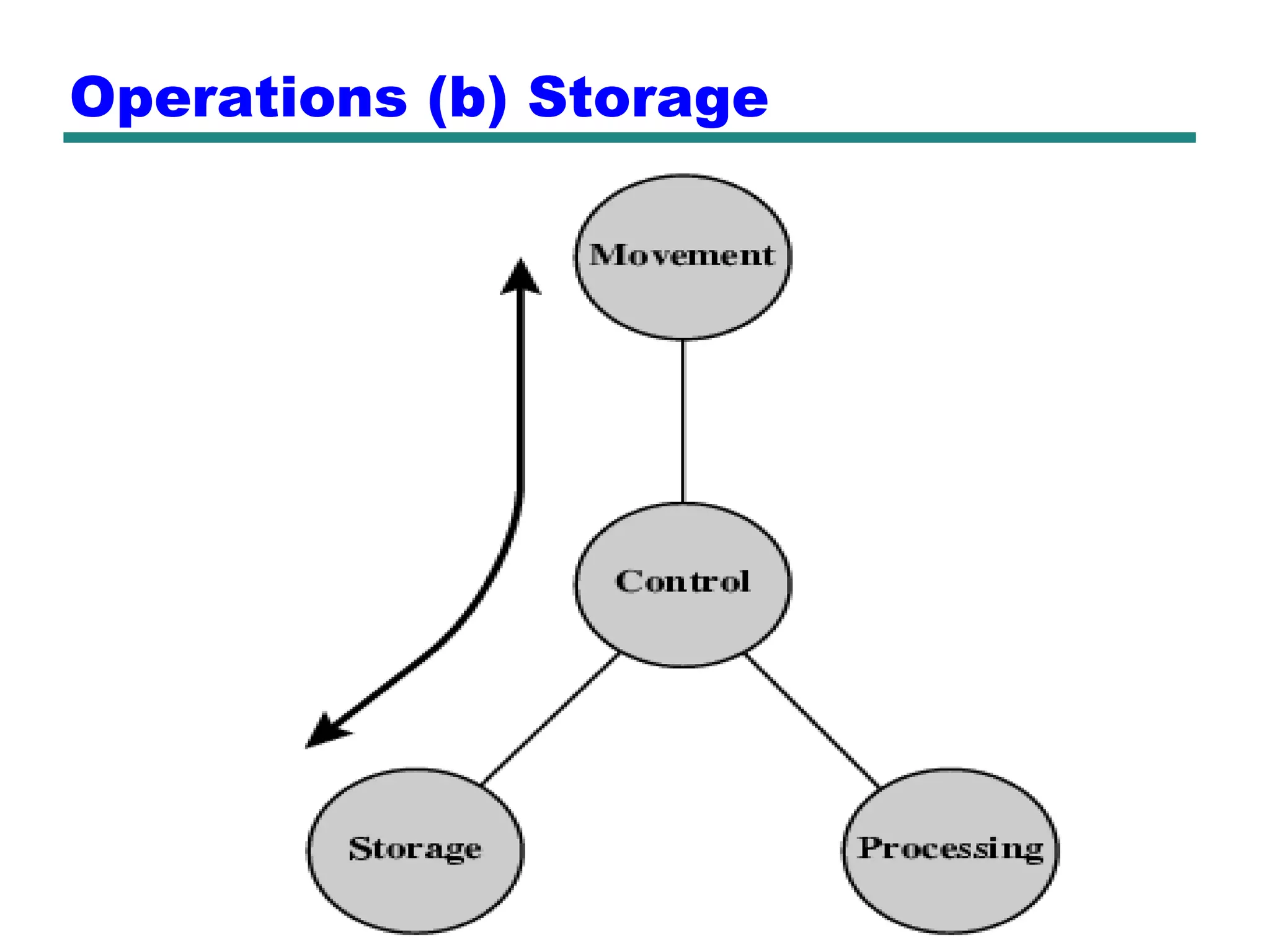
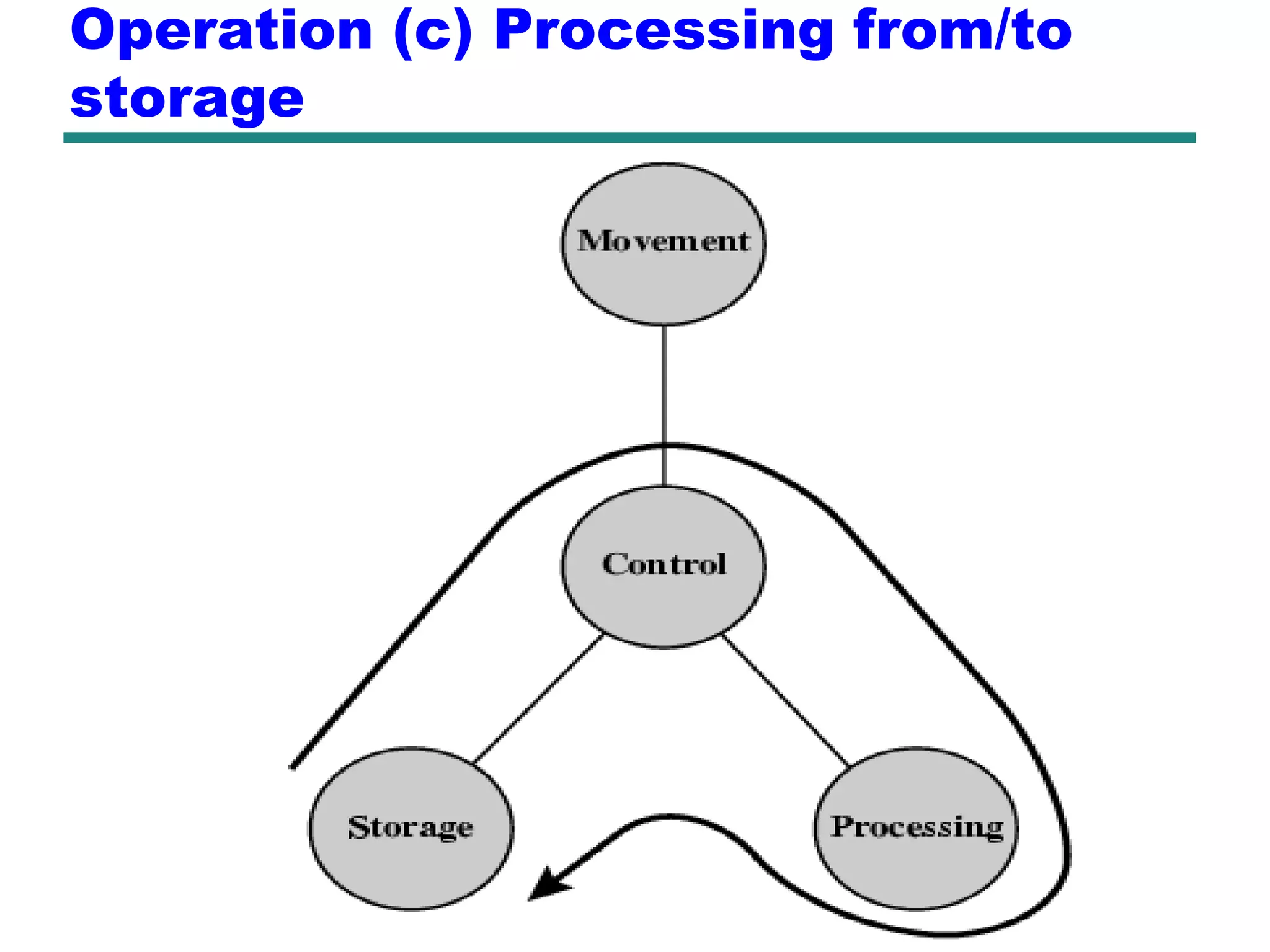
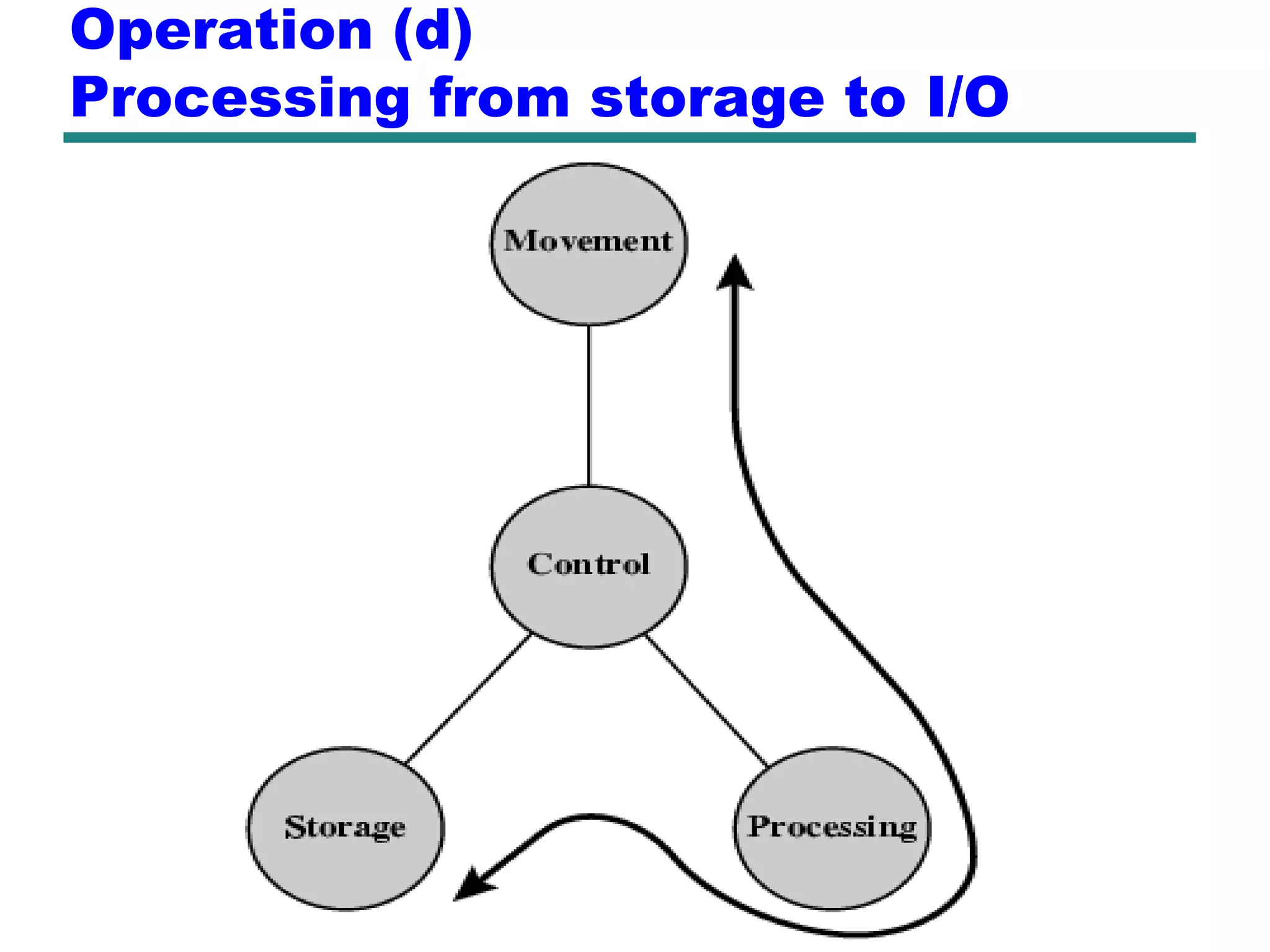
• All computer functions are:

  —Data processing
  —Data storage
  —Data movement
  —Control
Functional View
Operations (a) Data movement
Operations (b) Storage
Operation (c) Processing from/to
storage
Operation (d)
Processing from storage to I/O
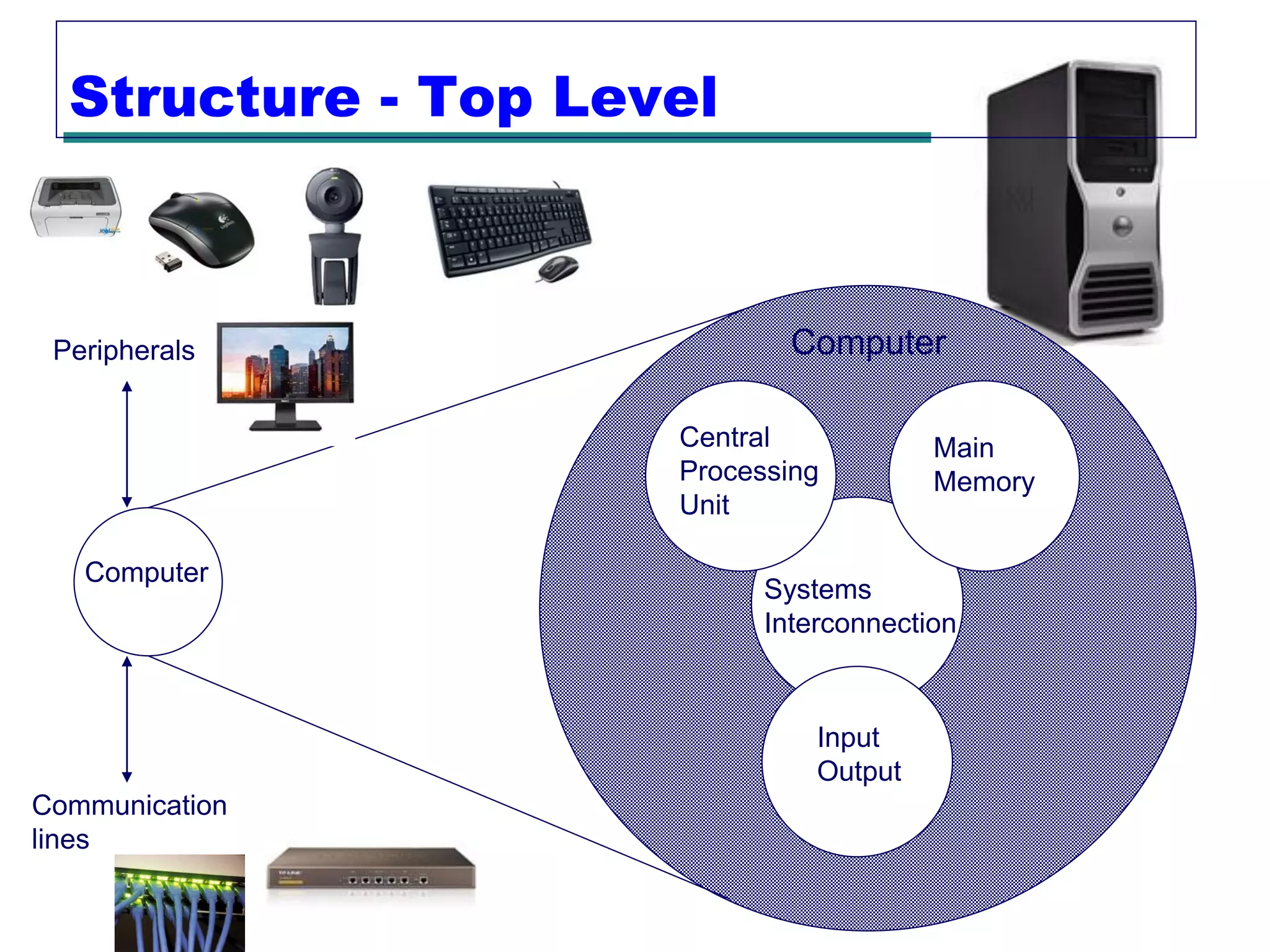
Structure - Top Level


 Peripherals                 Computer

                     Central            Main
                     Processing         Memory
                     Unit

   Computer
                           Systems
                           Interconnection


                               Input
                               Output
Communication
lines
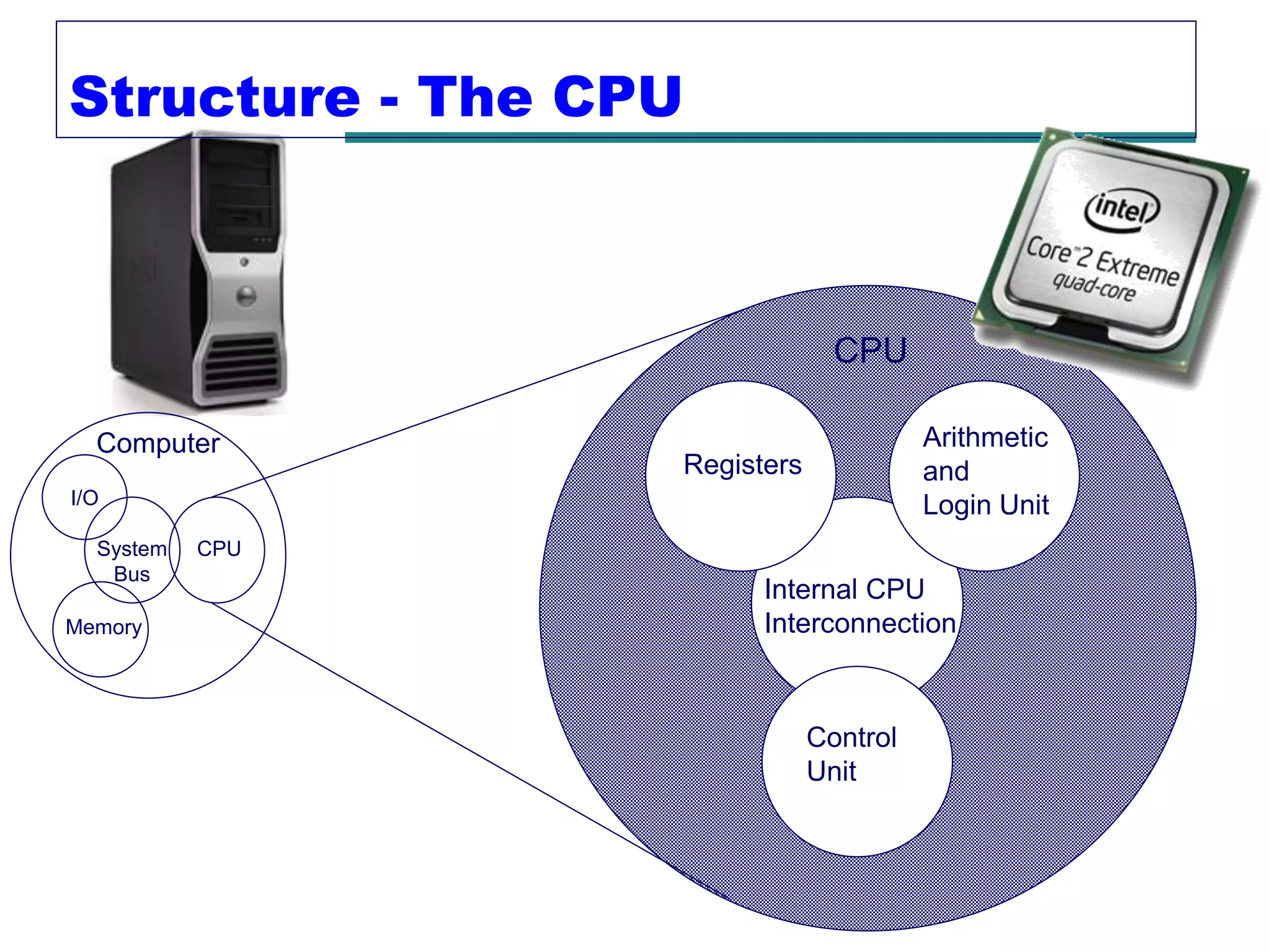
Structure - The CPU


                                CPU

  Computer                              Arithmetic
                  Registers             and
I/O                                     Login Unit
  System   CPU
   Bus
                        Internal CPU
Memory                  Interconnection


                              Control
                              Unit
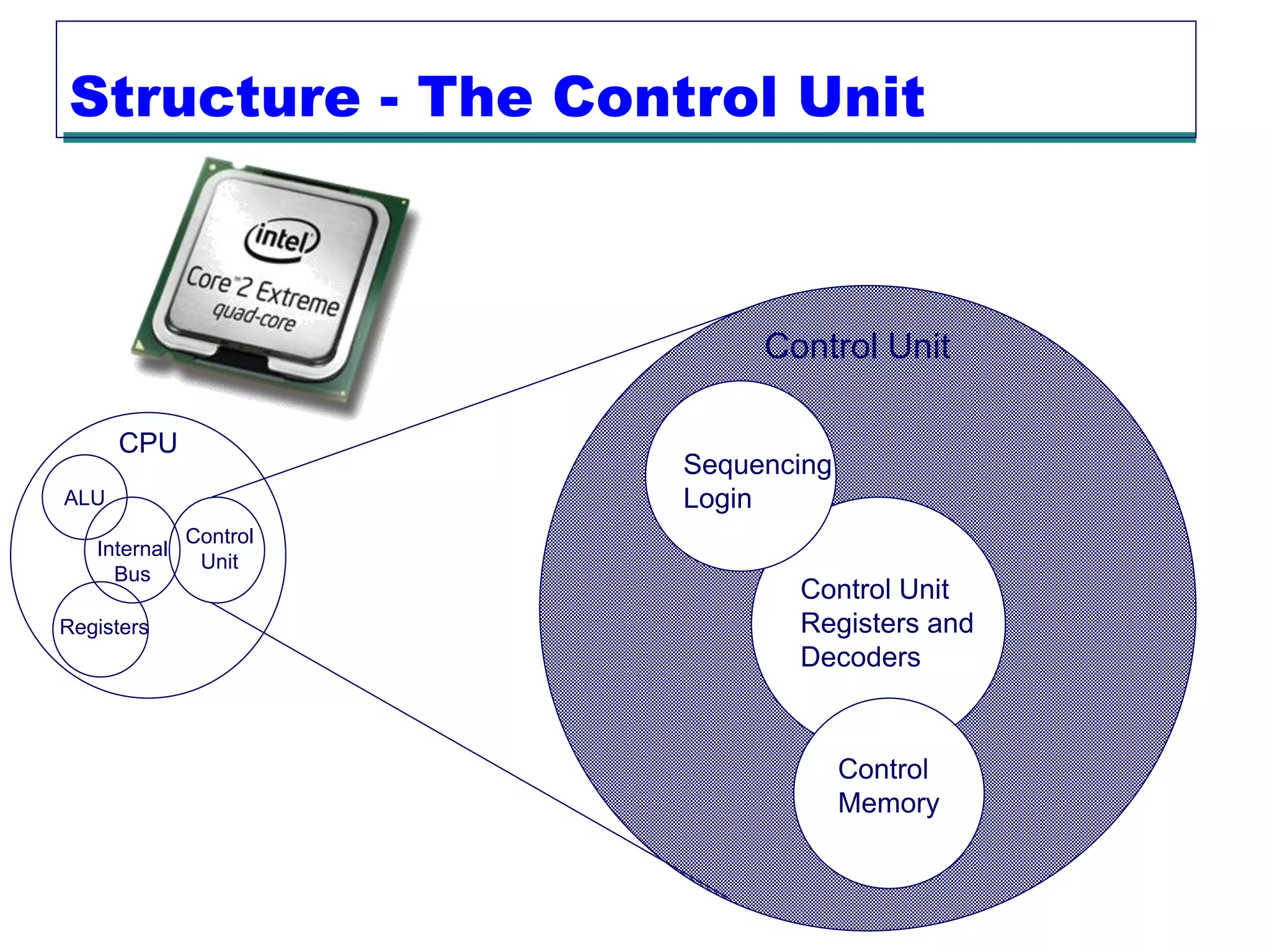
Structure - The Control Unit


                             Control Unit

      CPU
                        Sequencing
ALU                     Login
              Control
   Internal
               Unit
     Bus
                               Control Unit
Registers                      Registers and
                               Decoders


                                     Control
                                     Memory
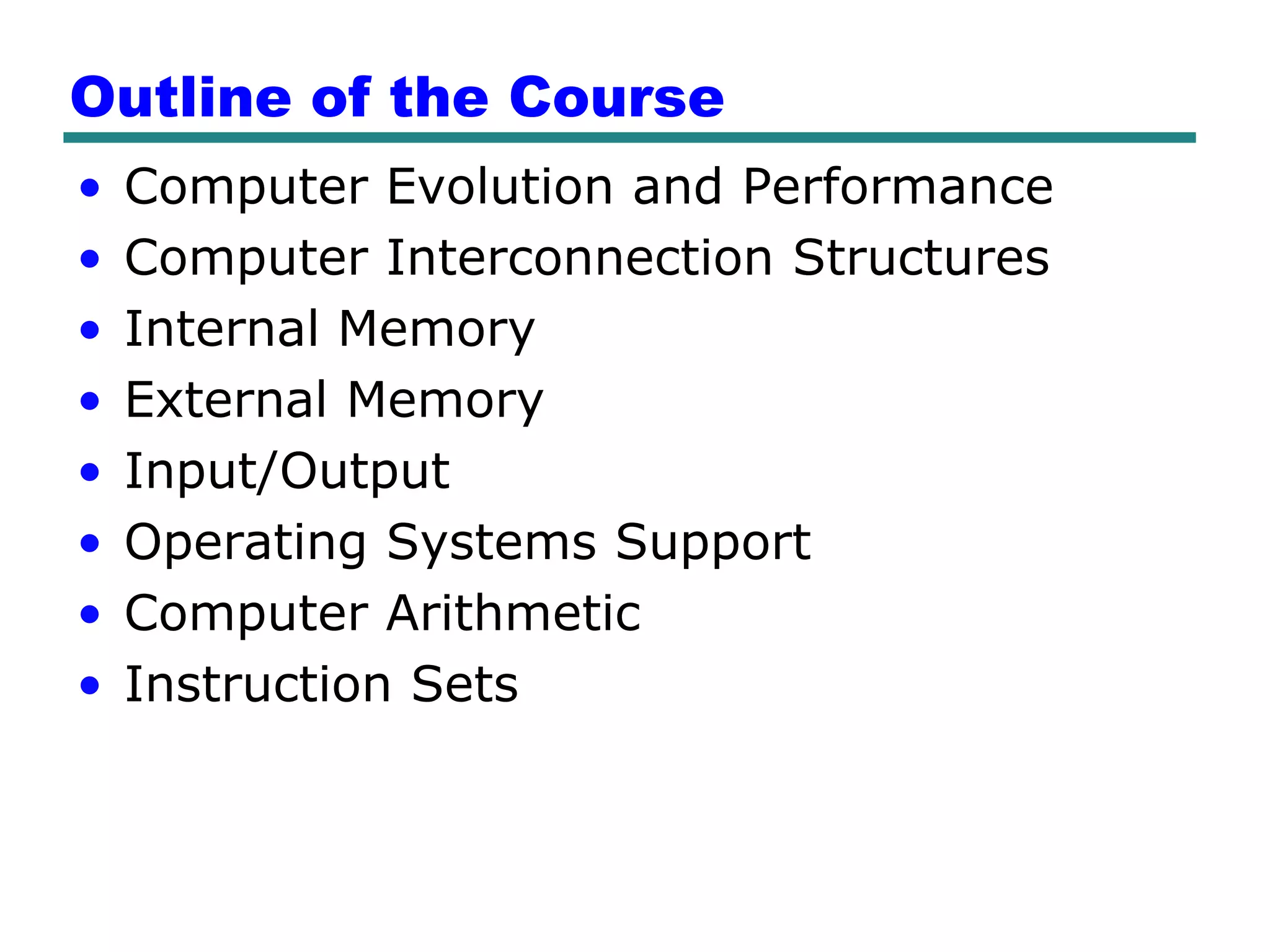
Outline of the Course
•   Computer Evolution and Performance
•   Computer Interconnection Structures
•   Internal Memory
•   External Memory
•   Input/Output
•   Operating Systems Support
•   Computer Arithmetic
•   Instruction Sets
Outline of the Course (2)
•   CPU Structure and Function
•   Reduced Instruction Set Computers
•   Superscalar Processors
•   Control Unit Operation
•   Microprogrammed Control
•   Multiprocessors and Vector Processing
Why Study COA?
• It is a core course for computer science or
  computer engineering
  —As recommended by IEEE/ACM Curricula 2008
• To write better programs that run more
  efficiently on a real machine
• To understand the tradeoff among various
  components, such as CPU speeds and
  memory size
  —Spending more for various alternatives
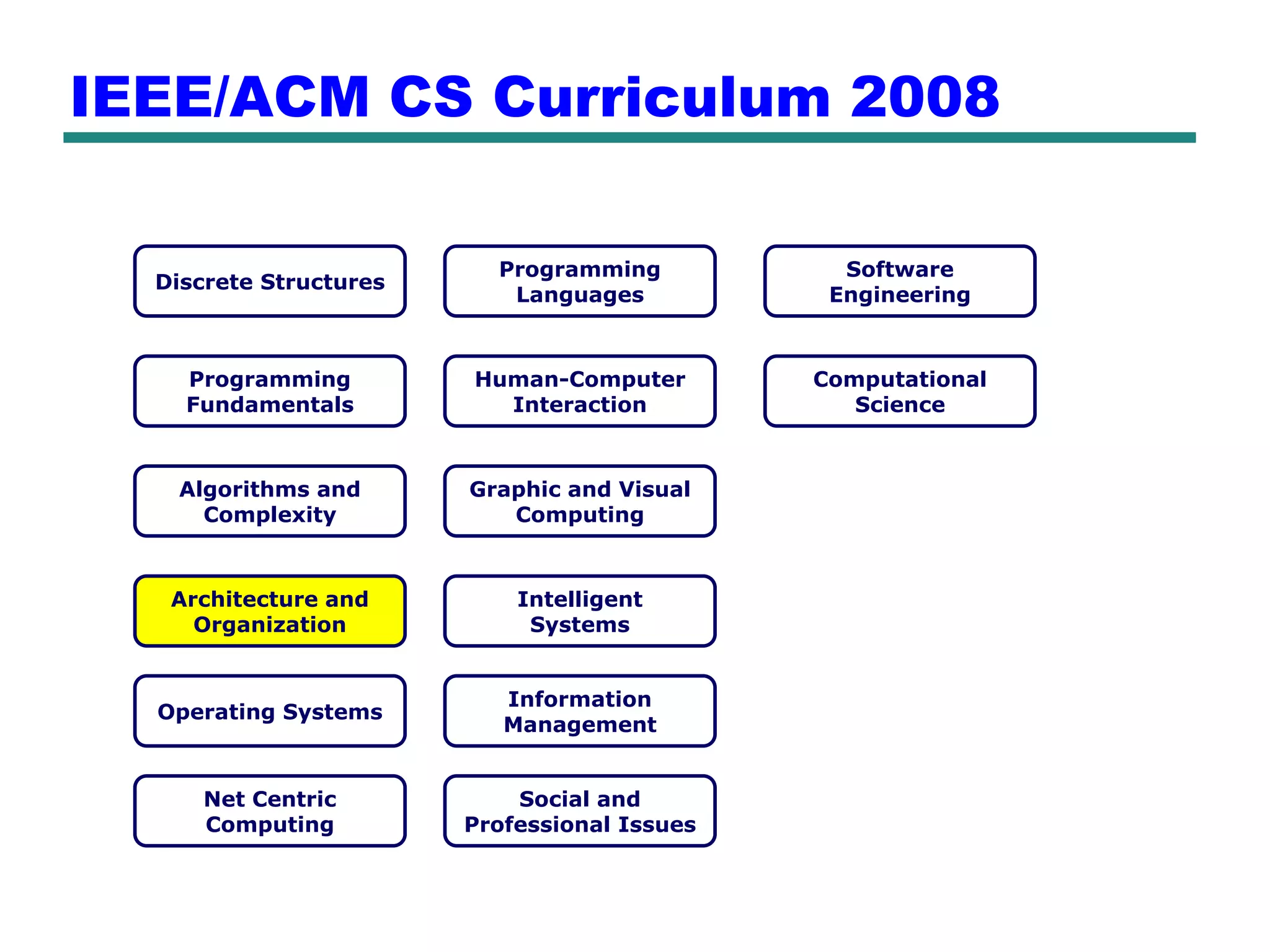
IEEE/ACM CS Curriculum 2008

                          Programming           Software
  Discrete Structures
                           Languages           Engineering


    Programming         Human-Computer        Computational
    Fundamentals          Interaction            Science


   Algorithms and       Graphic and Visual
     Complexity            Computing


   Architecture and         Intelligent
     Organization            Systems


                           Information
  Operating Systems
                           Management


      Net Centric           Social and
      Computing         Professional Issues
What You Will Learn
• How programs are translated into the
  machine language
  —And how the hardware executes them
• The hardware/software interface
• What determines program performance
  —And how it can be improved
• How hardware designers improve
  performance
• What is parallel processing

01 introduction zhu

  • 1.
  • 2.
    Question • Is a computer intelligent? NO! It is you that make a compute to appear to be intelligent
  • 3.
    Levels of ProgramCode • High-level language —Level of abstraction closer to problem domain —Provides for productivity and portability • Assembly language —Textual representation of instructions • Hardware representation —Binary digits (bits) —Encoded instructions and data
  • 4.
    § Below YourProgram 1.2 Below Your Program • Application software —Written in high-level language • System software —Compiler: translates HLL code to machine code —Operating System: service code – Handling input/output – Managing memory and storage – Scheduling tasks & sharing resources • Hardware —Processor, memory, I/O controllers
  • 5.
    Relation APPLICATIONS OS HARDWARE
  • 6.
    Question • You develop a program and run it on a computer. • What factors affect the performance of your program?
  • 7.
    Understanding Performance • Algorithm —Determines number of operations executed • Programming language, compiler, architecture —Determine number of machine instructions executed per operation • Processor and memory system —Determine how fast instructions are executed • I/O system (including OS) —Determines how fast I/O operations are executed
  • 8.
    Architecture: Conceptual Design •Architecture is those attributes visible to the programmer —Instruction set, —number of bits used for data representation —I/O mechanisms —addressing techniques Architecture: Hardware/Software • e.g. Is there a Interface multiply instruction?
  • 9.
    Organization • Organization ishow features are implemented —Control signals —Interfaces —Memory technology • e.g. Is there a hardware multiply unit or is it done by repeated addition?
  • 10.
    Architecture & Organization •Contents of computer architecture —Instruction set design, performance evaluation, pipelining, vector machine, SMP, clusters, parallel processing • Contents of computer organization —Arithmetic operations, ALU —Memory and memory organization —Instruction set and addressing —Central processing unit (CPU) —Bus —I/O
  • 11.
    Architecture & Organization •All Intel x86 family share the same basic architecture • The IBM System/370 family Intel 8086 share the same basic architecture • This gives code compatibility —At least backwards Intel Core duo • Organization differs between different versions AMD Athlon
  • 12.
  • 13.
    § Under theCovers 1.3 Components of a Computer The BIG Picture • Same components for all kinds of computer —Desktop, server, embedded • Input/output includes —User-interface devices – Display, keyboard, mouse —Storage devices – Hard disk, CD/DVD, flash —Network adapters – For communicating with other computers
  • 14.
  • 15.
  • 16.
    Inside the Processor(CPU) • Datapath: performs operations on data • Control: sequences datapath, memory, ... • Cache memory —Small fast SRAM memory for immediate access to data
  • 17.
  • 18.
    Inside the Processor • AMD Barcelona: 4 processor cores
  • 19.
    Structure & Function •Structure is the way in which components relate to each other —How different components, like ALU, control, I/O, memory are connected? —How they interface with each other? • Function is the operation of individual components as part of the structure —What is the function of a component?
  • 20.
    Function • All computerfunctions are: —Data processing —Data storage —Data movement —Control
  • 21.
  • 22.
  • 23.
  • 24.
    Operation (c) Processingfrom/to storage
  • 25.
  • 26.
    Structure - TopLevel Peripherals Computer Central Main Processing Memory Unit Computer Systems Interconnection Input Output Communication lines
  • 27.
    Structure - TheCPU CPU Computer Arithmetic Registers and I/O Login Unit System CPU Bus Internal CPU Memory Interconnection Control Unit
  • 28.
    Structure - TheControl Unit Control Unit CPU Sequencing ALU Login Control Internal Unit Bus Control Unit Registers Registers and Decoders Control Memory
  • 29.
    Outline of theCourse • Computer Evolution and Performance • Computer Interconnection Structures • Internal Memory • External Memory • Input/Output • Operating Systems Support • Computer Arithmetic • Instruction Sets
  • 30.
    Outline of theCourse (2) • CPU Structure and Function • Reduced Instruction Set Computers • Superscalar Processors • Control Unit Operation • Microprogrammed Control • Multiprocessors and Vector Processing
  • 31.
    Why Study COA? •It is a core course for computer science or computer engineering —As recommended by IEEE/ACM Curricula 2008 • To write better programs that run more efficiently on a real machine • To understand the tradeoff among various components, such as CPU speeds and memory size —Spending more for various alternatives
  • 32.
    IEEE/ACM CS Curriculum2008 Programming Software Discrete Structures Languages Engineering Programming Human-Computer Computational Fundamentals Interaction Science Algorithms and Graphic and Visual Complexity Computing Architecture and Intelligent Organization Systems Information Operating Systems Management Net Centric Social and Computing Professional Issues
  • 33.
    What You WillLearn • How programs are translated into the machine language —And how the hardware executes them • The hardware/software interface • What determines program performance —And how it can be improved • How hardware designers improve performance • What is parallel processing