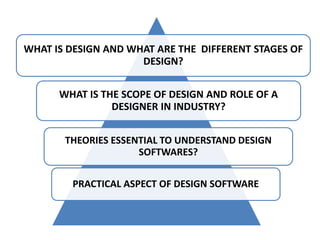
WHAT IS DESIGN AND WHAT ARE THE DIFFERENT STAGES OF
DESIGN?
WHAT IS THE SCOPE OF DESIGN AND ROLE OF A
DESIGNER IN INDUSTRY?
THEORIES ESSENTIAL TO UNDERSTAND DESIGN
SOFTWARES?
PRACTICAL ASPECT OF DESIGN SOFTWARE
INTRODUCTION TO THE TERM DESIGN:
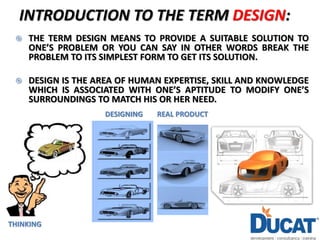
 THE TERM DESIGN MEANS TO PROVIDE A SUITABLE SOLUTION TO
ONE’S PROBLEM OR YOU CAN SAY IN OTHER WORDS BREAK THE
PROBLEM TO ITS SIMPLEST FORM TO GET ITS SOLUTION.
 DESIGN IS THE AREA OF HUMAN EXPERTISE, SKILL AND KNOWLEDGE
WHICH IS ASSOCIATED WITH ONE’S APTITUDE TO MODIFY ONE’S
SURROUNDINGS TO MATCH HIS OR HER NEED.
THINKING
DESIGNING REAL PRODUCT
DESIGN PROCEDURE USED IN
INDUSTRIES:
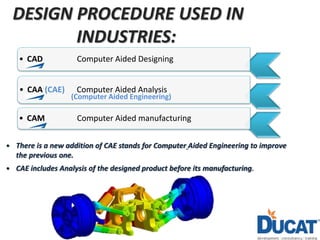
• CAD Computer Aided Designing
• CAA (CAE) Computer Aided Analysis
• CAM Computer Aided manufacturing
 There is a new addition of CAE stands for Computer Aided Engineering to improve
the previous one.
 CAE includes Analysis of the designed product before its manufacturing.
(Computer Aided Engineering)
OK
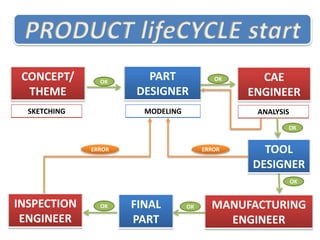
PRODUCT lifeCYCLE start
MODELING ANALYSIS
MANUFACTURING
ENGINEER
FINAL
PART
INSPECTION
ENGINEER
CAE
ENGINEER
TOOL
DESIGNER
PART
DESIGNER
CONCEPT/
THEME
SKETCHING
OK
OK
OK
OKOK
ERRORERROR
Challenges
 Stiff competition
 Tight Budget
 Design failures
 Manufacturing wastes
 Faster time to market
 Adherence to global standards
Current Trends
 Goodbye to 2D
 Design products; not modeling
 Better products, first time
 Less manufacturing wastes
 Global standardisation
 Fool proof data management system
NX
Formally Unigraphics
BY: Siemens
LATEST VERSION NX 11
FIRST RELEASED October 1973; 43 years ago
NX Overview
NX INTRODUCTION
Key functions
1. Computer-aided Design (CAD)
• Parametric solid modeling (feature-based and direct modeling)
• Freeform surface modelling, class A surfaces.
• Reverse engineering
• Styling and computer-aided industrial design
• Engineering drawing (Drafting)
• Product and manufacturing information (PMI)
• Reporting and analytics, verification and validation
• Knowledge reuse, including knowledge-based engineering
• Sheet metal design
• Assembly modelling and digital mockup
• Routing for electrical wiring and mechanical piping
2.Computer-aided engineering (CAE)
(Simulation)
• Stress analysis / finite element method (FEM)
• Kinematics
• Computational fluid dynamics (CFD) and thermal
analysis
3.Computer-aided manufacturing (CAM)
(Manufacturing)
• Numerical control (NC) programming
2-Axis, 3-Axis, 4-Axis and 5-Axis(with turbo machining)
• NC machine builder
SCOPE
 MECHANICAL ENGG.
 AUTOMOTIVE ENGG
 AEROSPACE ENGG.
 INDUSTRIAL DESIGNERS
MECHANTONICS
AND MANY MORE
Skills Needed for Design job
There is a Pattern in job Description for position of Design Engineer.
• B.Tech
• Domain theory
1. Industrial Design
2. Product Design
3. Tool Design
4. Machine Design
5. Automotive Design
6. Aerospace Design
• GD&T
• Tolerance Stack-up
• DFA, DFM, DFMEA, VE-VA etc
• Tool (NX, Catia, SW, CREO AutoCAD etc.) At Advance Level
• PLM Software (Team centre, Enovia etc.)
Targeted learning goal in software
• Standard Syllabus
1. Sketching
2. Part Modeling
3. Surface Modeling
4. Sheet metal
5. Assembly
6. Drafting
• Advance Syllabus
1. Advance Assembly with wave linking
2. Advance Surfacing with Reverse
Engineering
3. Nx freeform Modeling(Realise shape)
4. Expressions
5. Weld design
6. Pmi
7. Wire and pipe routing
8. CAM 2d,3d,4d,5d
9. Motion Analysis
10. FEA
11. Mould wizard
12. Die Design wizards
AUTOMOTIVE DESIGN DOMAIN
TOPICS
• CHASSIS DESIGN
• BIW
• WIRE HARNESS AND PIPE ROUTING
• POWER TRAIN DESIGN
• SUSPENSION DESIGN
• LIGHT DESIGN
• AERODYNAMICS CFD
• COMPOSIT DESIGN
• INTERIOR TRIM
• EXTERIOR TRIM
• SEAR DESIGN
• BUMPER DESIGN
THANKYOU
NX 10 Feedback
Contact:
Simranjit Singh
Ph:9650399230
email- Samseehra@gmail.com

Nx workshop

  • 2.
    WHAT IS DESIGNAND WHAT ARE THE DIFFERENT STAGES OF DESIGN? WHAT IS THE SCOPE OF DESIGN AND ROLE OF A DESIGNER IN INDUSTRY? THEORIES ESSENTIAL TO UNDERSTAND DESIGN SOFTWARES? PRACTICAL ASPECT OF DESIGN SOFTWARE
  • 3.
    INTRODUCTION TO THETERM DESIGN:  THE TERM DESIGN MEANS TO PROVIDE A SUITABLE SOLUTION TO ONE’S PROBLEM OR YOU CAN SAY IN OTHER WORDS BREAK THE PROBLEM TO ITS SIMPLEST FORM TO GET ITS SOLUTION.  DESIGN IS THE AREA OF HUMAN EXPERTISE, SKILL AND KNOWLEDGE WHICH IS ASSOCIATED WITH ONE’S APTITUDE TO MODIFY ONE’S SURROUNDINGS TO MATCH HIS OR HER NEED. THINKING DESIGNING REAL PRODUCT
  • 4.
    DESIGN PROCEDURE USEDIN INDUSTRIES: • CAD Computer Aided Designing • CAA (CAE) Computer Aided Analysis • CAM Computer Aided manufacturing  There is a new addition of CAE stands for Computer Aided Engineering to improve the previous one.  CAE includes Analysis of the designed product before its manufacturing. (Computer Aided Engineering)
  • 5.
    OK PRODUCT lifeCYCLE start MODELINGANALYSIS MANUFACTURING ENGINEER FINAL PART INSPECTION ENGINEER CAE ENGINEER TOOL DESIGNER PART DESIGNER CONCEPT/ THEME SKETCHING OK OK OK OKOK ERRORERROR
  • 6.
    Challenges  Stiff competition Tight Budget  Design failures  Manufacturing wastes  Faster time to market  Adherence to global standards
  • 7.
    Current Trends  Goodbyeto 2D  Design products; not modeling  Better products, first time  Less manufacturing wastes  Global standardisation  Fool proof data management system
  • 8.
  • 9.
    LATEST VERSION NX11 FIRST RELEASED October 1973; 43 years ago NX Overview NX INTRODUCTION
  • 10.
    Key functions 1. Computer-aidedDesign (CAD) • Parametric solid modeling (feature-based and direct modeling) • Freeform surface modelling, class A surfaces. • Reverse engineering • Styling and computer-aided industrial design • Engineering drawing (Drafting) • Product and manufacturing information (PMI) • Reporting and analytics, verification and validation • Knowledge reuse, including knowledge-based engineering • Sheet metal design • Assembly modelling and digital mockup • Routing for electrical wiring and mechanical piping
  • 11.
    2.Computer-aided engineering (CAE) (Simulation) •Stress analysis / finite element method (FEM) • Kinematics • Computational fluid dynamics (CFD) and thermal analysis 3.Computer-aided manufacturing (CAM) (Manufacturing) • Numerical control (NC) programming 2-Axis, 3-Axis, 4-Axis and 5-Axis(with turbo machining) • NC machine builder
  • 12.
    SCOPE  MECHANICAL ENGG. AUTOMOTIVE ENGG  AEROSPACE ENGG.  INDUSTRIAL DESIGNERS MECHANTONICS AND MANY MORE
  • 13.
    Skills Needed forDesign job There is a Pattern in job Description for position of Design Engineer. • B.Tech • Domain theory 1. Industrial Design 2. Product Design 3. Tool Design 4. Machine Design 5. Automotive Design 6. Aerospace Design • GD&T • Tolerance Stack-up • DFA, DFM, DFMEA, VE-VA etc • Tool (NX, Catia, SW, CREO AutoCAD etc.) At Advance Level • PLM Software (Team centre, Enovia etc.)
  • 14.
    Targeted learning goalin software • Standard Syllabus 1. Sketching 2. Part Modeling 3. Surface Modeling 4. Sheet metal 5. Assembly 6. Drafting • Advance Syllabus 1. Advance Assembly with wave linking 2. Advance Surfacing with Reverse Engineering 3. Nx freeform Modeling(Realise shape) 4. Expressions 5. Weld design 6. Pmi 7. Wire and pipe routing 8. CAM 2d,3d,4d,5d 9. Motion Analysis 10. FEA 11. Mould wizard 12. Die Design wizards
  • 15.
    AUTOMOTIVE DESIGN DOMAIN TOPICS •CHASSIS DESIGN • BIW • WIRE HARNESS AND PIPE ROUTING • POWER TRAIN DESIGN • SUSPENSION DESIGN • LIGHT DESIGN • AERODYNAMICS CFD • COMPOSIT DESIGN • INTERIOR TRIM • EXTERIOR TRIM • SEAR DESIGN • BUMPER DESIGN
  • 16.
  • 18.
    NX 10 Feedback Contact: SimranjitSingh Ph:9650399230 email- Samseehra@gmail.com

Editor's Notes

  • #3 WHAT IS DESIGN AND WHAT ARE THE DIFFERENT STAGES OF DESIGN?