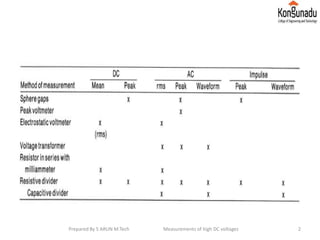
Measurement Of High Dc Voltage
Contents
•Series resistance micrometer
•Resistance potential divider
•Generating voltmeter
•Sphere gaps
•Conclusion and Reference
1Prepared By S ARUN M.Tech Measurements of high DC voltages
2Prepared By S ARUN M.Tech Measurements of high DC voltages
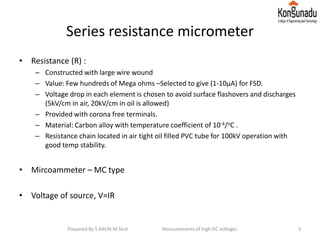
Series resistance micrometer
• Resistance (R) :
– Constructed with large wire wound
– Value: Few hundreds of Mega ohms –Selected to give (1-10μA) for FSD.
– Voltage drop in each element is chosen to avoid surface flashovers and discharges
(5kV/cm in air, 20kV/cm in oil is allowed)
– Provided with corona free terminals.
– Material: Carbon alloy with temperature coefficient of 10-4/oC .
– Resistance chain located in air tight oil filled PVC tube for 100kV operation with
good temp stability.
• Mircoammeter – MC type
• Voltage of source, V=IR
3Prepared By S ARUN M.Tech Measurements of high DC voltages
• Impedance of the meter is few ohms. i.e., very less compared to R so the
drop across the meter is negligible.
• Protection: Paper gap, Neon Glow tube, a zener diode with series
resistance – Gives protection when R fails.
• Maximum voltage: 500kV with  0.2% accuracy.
• Limitations:
– Power dissipation & source loading
– Temp effects
4Prepared By S ARUN M.Tech Measurements of high DC voltages
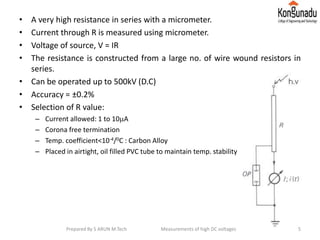
• A very high resistance in series with a micrometer.
• Current through R is measured using micrometer.
• Voltage of source, V = IR
• The resistance is constructed from a large no. of wire wound resistors in
series.
• Can be operated up to 500kV (D.C)
• Accuracy = ±0.2%
• Selection of R value:
– Current allowed: 1 to 10A
– Corona free termination
– Temp. coefficient<10-4/0C : Carbon Alloy
– Placed in airtight, oil filled PVC tube to maintain temp. stability
5Prepared By S ARUN M.Tech Measurements of high DC voltages
Resistance potential divider
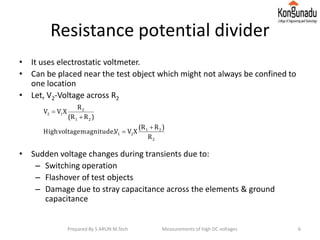
• It uses electrostatic voltmeter.
• Can be placed near the test object which might not always be confined to
one location
• Let, V2-Voltage across R2
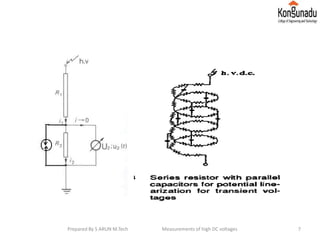
• Sudden voltage changes during transients due to:
– Switching operation
– Flashover of test objects
– Damage due to stray capacitance across the elements & ground
capacitance
2
21
21
21
2
12
R
)R(R
XVVmagnitude,voltageHigh
)R(R
R
XVV




6Prepared By S ARUN M.Tech Measurements of high DC voltages
7Prepared By S ARUN M.Tech Measurements of high DC voltages
Generating voltmeter
• Generating principle is used where direct loading or direct
connection is to be avoided.
• Generating voltmeter: A variable capacitor electrostatic voltage
generator.
• It generates current proportional to voltage under measurement
• This arrangement provides loss free measurement of DC and AC
voltages
• It is driven by synch. motor, so doesn’t observe power from the
voltage measuring source
• The high voltage electrode and the grounded electrode in fact
constitute a capacitance system.
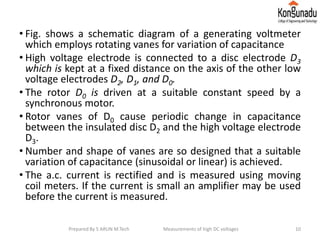
• The capacitance is a function of time as the area A varies with time
and, therefore, the charge q(t) is given as,
8Prepared By S ARUN M.Tech Measurements of high DC voltages
Schematic of generating voltmeter
9Prepared By S ARUN M.Tech Measurements of high DC voltages
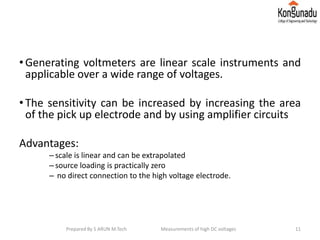
• Fig. shows a schematic diagram of a generating voltmeter
which employs rotating vanes for variation of capacitance
• High voltage electrode is connected to a disc electrode D3
which is kept at a fixed distance on the axis of the other low
voltage electrodes D2, D1, and D0.
• The rotor D0 is driven at a suitable constant speed by a
synchronous motor.
• Rotor vanes of D0 cause periodic change in capacitance
between the insulated disc D2 and the high voltage electrode
D3.
• Number and shape of vanes are so designed that a suitable
variation of capacitance (sinusoidal or linear) is achieved.
• The a.c. current is rectified and is measured using moving
coil meters. If the current is small an amplifier may be used
before the current is measured.
10Prepared By S ARUN M.Tech Measurements of high DC voltages
• Generating voltmeters are linear scale instruments and
applicable over a wide range of voltages.
• The sensitivity can be increased by increasing the area
of the pick up electrode and by using amplifier circuits
Advantages:
– scale is linear and can be extrapolated
– source loading is practically zero
– no direct connection to the high voltage electrode.
11Prepared By S ARUN M.Tech Measurements of high DC voltages
Sphere Gaps
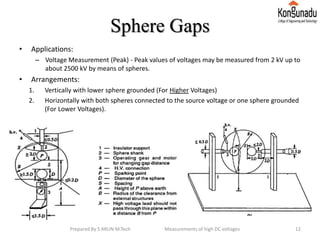
• Applications:
– Voltage Measurement (Peak) - Peak values of voltages may be measured from 2 kV up to
about 2500 kV by means of spheres.
• Arrangements:
1. Vertically with lower sphere grounded (For Higher Voltages)
2. Horizontally with both spheres connected to the source voltage or one sphere grounded
(For Lower Voltages).
12Prepared By S ARUN M.Tech Measurements of high DC voltages
• The arrangement is selected based on the relation
between the peak voltage, determined by spark over
between the spheres, and the reading of a voltmeter
on the primary or input side of the high-voltage source.
This relation should be within 3% (IEC, 1973).
• Standard values of sphere diameter are 6.25, 12.5, 25,
50, 75, 100, 150, and 200 cm.
• The effect of humidity is to increase the breakdown
voltage of sphere gaps by up to 3%.
• Temperature and pressure, however, have significant
influence in breakdown voltage.
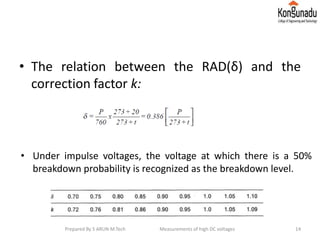
• Breakdown Voltage under normal atmospheric
conditions is, Vs=kVn where k is a factor related to the
relative air density (RAD) δ.
13Prepared By S ARUN M.Tech Measurements of high DC voltages
• The relation between the RAD(δ) and the
correction factor k:
• Under impulse voltages, the voltage at which there is a 50%
breakdown probability is recognized as the breakdown level.
14Prepared By S ARUN M.Tech Measurements of high DC voltages
• Factors Influencing the Spark over Voltage of Sphere Gaps
i. Nearby earthed objects,
ii. Atmospheric conditions and humidity,
iii. Irradiation, and
iv. Polarity and rise time of voltage waveforms.
• The limits of accuracy are dependant on the ratio of the spacing d to the
sphere diameter D, as follows:
– d < 0.5 D Accuracy = ± 3 %
– 0.75 D > d > 0.5 D Accuracy = ± 5 %
• For accurate measurement purposes, gap distances in excess of 0.75D are
not used
15Prepared By S ARUN M.Tech Measurements of high DC voltages
• Conclusion
From these we conclude that how to measure
varies measurements of how to generate high
DC voltage in power system engineering.
• References
“High voltage engineering ” by M S Naidu and
V Kamaraju, Tata McGraw Hill Education, 5th
edition.
16Prepared By S ARUN M.Tech Measurements of high DC voltages

Dc voltage

  • 1.
    Measurement Of HighDc Voltage Contents •Series resistance micrometer •Resistance potential divider •Generating voltmeter •Sphere gaps •Conclusion and Reference 1Prepared By S ARUN M.Tech Measurements of high DC voltages
  • 2.
    2Prepared By SARUN M.Tech Measurements of high DC voltages
  • 3.
    Series resistance micrometer •Resistance (R) : – Constructed with large wire wound – Value: Few hundreds of Mega ohms –Selected to give (1-10μA) for FSD. – Voltage drop in each element is chosen to avoid surface flashovers and discharges (5kV/cm in air, 20kV/cm in oil is allowed) – Provided with corona free terminals. – Material: Carbon alloy with temperature coefficient of 10-4/oC . – Resistance chain located in air tight oil filled PVC tube for 100kV operation with good temp stability. • Mircoammeter – MC type • Voltage of source, V=IR 3Prepared By S ARUN M.Tech Measurements of high DC voltages
  • 4.
    • Impedance ofthe meter is few ohms. i.e., very less compared to R so the drop across the meter is negligible. • Protection: Paper gap, Neon Glow tube, a zener diode with series resistance – Gives protection when R fails. • Maximum voltage: 500kV with  0.2% accuracy. • Limitations: – Power dissipation & source loading – Temp effects 4Prepared By S ARUN M.Tech Measurements of high DC voltages
  • 5.
    • A veryhigh resistance in series with a micrometer. • Current through R is measured using micrometer. • Voltage of source, V = IR • The resistance is constructed from a large no. of wire wound resistors in series. • Can be operated up to 500kV (D.C) • Accuracy = ±0.2% • Selection of R value: – Current allowed: 1 to 10A – Corona free termination – Temp. coefficient<10-4/0C : Carbon Alloy – Placed in airtight, oil filled PVC tube to maintain temp. stability 5Prepared By S ARUN M.Tech Measurements of high DC voltages
  • 6.
    Resistance potential divider •It uses electrostatic voltmeter. • Can be placed near the test object which might not always be confined to one location • Let, V2-Voltage across R2 • Sudden voltage changes during transients due to: – Switching operation – Flashover of test objects – Damage due to stray capacitance across the elements & ground capacitance 2 21 21 21 2 12 R )R(R XVVmagnitude,voltageHigh )R(R R XVV     6Prepared By S ARUN M.Tech Measurements of high DC voltages
  • 7.
    7Prepared By SARUN M.Tech Measurements of high DC voltages
  • 8.
    Generating voltmeter • Generatingprinciple is used where direct loading or direct connection is to be avoided. • Generating voltmeter: A variable capacitor electrostatic voltage generator. • It generates current proportional to voltage under measurement • This arrangement provides loss free measurement of DC and AC voltages • It is driven by synch. motor, so doesn’t observe power from the voltage measuring source • The high voltage electrode and the grounded electrode in fact constitute a capacitance system. • The capacitance is a function of time as the area A varies with time and, therefore, the charge q(t) is given as, 8Prepared By S ARUN M.Tech Measurements of high DC voltages
  • 9.
    Schematic of generatingvoltmeter 9Prepared By S ARUN M.Tech Measurements of high DC voltages
  • 10.
    • Fig. showsa schematic diagram of a generating voltmeter which employs rotating vanes for variation of capacitance • High voltage electrode is connected to a disc electrode D3 which is kept at a fixed distance on the axis of the other low voltage electrodes D2, D1, and D0. • The rotor D0 is driven at a suitable constant speed by a synchronous motor. • Rotor vanes of D0 cause periodic change in capacitance between the insulated disc D2 and the high voltage electrode D3. • Number and shape of vanes are so designed that a suitable variation of capacitance (sinusoidal or linear) is achieved. • The a.c. current is rectified and is measured using moving coil meters. If the current is small an amplifier may be used before the current is measured. 10Prepared By S ARUN M.Tech Measurements of high DC voltages
  • 11.
    • Generating voltmetersare linear scale instruments and applicable over a wide range of voltages. • The sensitivity can be increased by increasing the area of the pick up electrode and by using amplifier circuits Advantages: – scale is linear and can be extrapolated – source loading is practically zero – no direct connection to the high voltage electrode. 11Prepared By S ARUN M.Tech Measurements of high DC voltages
  • 12.
    Sphere Gaps • Applications: –Voltage Measurement (Peak) - Peak values of voltages may be measured from 2 kV up to about 2500 kV by means of spheres. • Arrangements: 1. Vertically with lower sphere grounded (For Higher Voltages) 2. Horizontally with both spheres connected to the source voltage or one sphere grounded (For Lower Voltages). 12Prepared By S ARUN M.Tech Measurements of high DC voltages
  • 13.
    • The arrangementis selected based on the relation between the peak voltage, determined by spark over between the spheres, and the reading of a voltmeter on the primary or input side of the high-voltage source. This relation should be within 3% (IEC, 1973). • Standard values of sphere diameter are 6.25, 12.5, 25, 50, 75, 100, 150, and 200 cm. • The effect of humidity is to increase the breakdown voltage of sphere gaps by up to 3%. • Temperature and pressure, however, have significant influence in breakdown voltage. • Breakdown Voltage under normal atmospheric conditions is, Vs=kVn where k is a factor related to the relative air density (RAD) δ. 13Prepared By S ARUN M.Tech Measurements of high DC voltages
  • 14.
    • The relationbetween the RAD(δ) and the correction factor k: • Under impulse voltages, the voltage at which there is a 50% breakdown probability is recognized as the breakdown level. 14Prepared By S ARUN M.Tech Measurements of high DC voltages
  • 15.
    • Factors Influencingthe Spark over Voltage of Sphere Gaps i. Nearby earthed objects, ii. Atmospheric conditions and humidity, iii. Irradiation, and iv. Polarity and rise time of voltage waveforms. • The limits of accuracy are dependant on the ratio of the spacing d to the sphere diameter D, as follows: – d < 0.5 D Accuracy = ± 3 % – 0.75 D > d > 0.5 D Accuracy = ± 5 % • For accurate measurement purposes, gap distances in excess of 0.75D are not used 15Prepared By S ARUN M.Tech Measurements of high DC voltages
  • 16.
    • Conclusion From thesewe conclude that how to measure varies measurements of how to generate high DC voltage in power system engineering. • References “High voltage engineering ” by M S Naidu and V Kamaraju, Tata McGraw Hill Education, 5th edition. 16Prepared By S ARUN M.Tech Measurements of high DC voltages