COMPOTATIONAL PHYSICS
Presented By :- Muhammad Umair
Roll Number :- 27
Instructor :- Ma’am Atika Firdos
Dept. Physics University Of Sahiwal
QUESTIONS DEVELOPED IN MIND
WHY COMPOTATIONAL PHYSICS?
 1: Definition
 2: Purpose of Course
 3: Scientific Programming Methodology And Languages
 4: Applications
DEFINATION
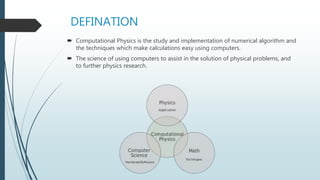
 Computational Physics is the study and implementation of numerical algorithm and
the techniques which make calculations easy using computers.
 The science of using computers to assist in the solution of physical problems, and
to further physics research.
PURPOSE OF COURSE
 The purpose of this course is demonstrate to students how computers can enable
us to both broaden and deepen our understanding of physics by vastly increasing
the range of mathematical calculations which we can conveniently perform.
Scientific Programming Methodology
Basically, there are two possible methods by which we could perform the numerical
calculations which we are going to encounter during this course
 First, we could use a mathematical software package, such as MATHEMATICA,
MAPLE or MATLAB. The main advantage of these packages is that they facilitate
the very rapid coding up of numerical problems.
 We could write our own programs in a high-level languages as FORTRAN 77, C,
C++,(oop) object oriented program
APPLICATIONS
Due to the broad class of problems computational physics deals, it is an essential
component of modern research in different areas of physics, namely
 Accelerator Physics
 Astrophysics
 Plasma Physics
ACCELERATOR PHYSICS
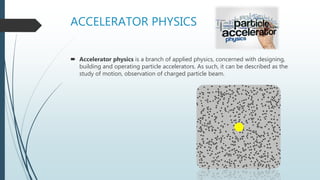
 Accelerator physics is a branch of applied physics, concerned with designing,
building and operating particle accelerators. As such, it can be described as the
study of motion, observation of charged particle beam.
PARTICLES SIMULATIONS
ASTROPHYSICS
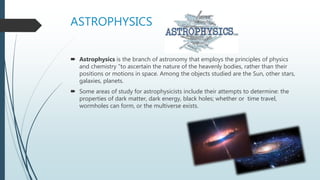
 Astrophysics is the branch of astronomy that employs the principles of physics
and chemistry "to ascertain the nature of the heavenly bodies, rather than their
positions or motions in space. Among the objects studied are the Sun, other stars,
galaxies, planets.
 Some areas of study for astrophysicists include their attempts to determine: the
properties of dark matter, dark energy, black holes; whether or time travel,
wormholes can form, or the multiverse exists.
ASTRO COMPTATIONAL PHYSICS
PLASMA PHYSICS
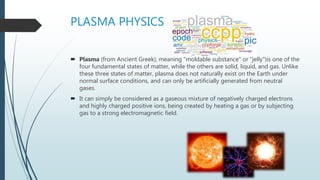
 Plasma (from Ancient Greek), meaning "moldable substance" or "jelly")is one of the
four fundamental states of matter, while the others are solid, liquid, and gas. Unlike
these three states of matter, plasma does not naturally exist on the Earth under
normal surface conditions, and can only be artificially generated from neutral
gases.
 It can simply be considered as a gaseous mixture of negatively charged electrons
and highly charged positive ions, being created by heating a gas or by subjecting
gas to a strong electromagnetic field.
REFRENCES
http://farside.ph.utexas.edu/teaching/329/329.pdf
https://www.physicsforums.com/threads/applications-of-computational-
physics.94527/
https://en.wikibooks.org
http://www.iop.org/activity/groups/subject/comp/
https://en.wikipedia.org/wiki/compotational_(physics)
https://en.wikipedia.org/wiki/accelerator_(physics)
https://en.wikipedia.org/wiki/astro_(physics)
https://en.wikipedia.org/wiki/Plasma_(physics)
https://www.youtube.com/watch?v=5t4XSFC4Yhk
https://www.youtube.com/watch?v=x8Fo2slT2WA
THanK yOu For Your
Attention

Computational physics