SCI 110Course
http://create.mcgraw-hill.com
Copyright by The McGraw-Hill Companies, Inc. All rights
reserved. Printed in the United States of America. Except as
permitted under the United States Copyright Act of 1976, no
part
of this publication may be reproduced or distributed in any form
or by any means, or stored in a database or retrieval system,
without prior written permission of the publisher.
This McGraw-Hill Create text may include materials submitted
to
McGraw-Hill for publication by the instructor of this course.
The instructor is solely responsible for the editorial content of
such
materials. Instructors retain copyright of these additional
materials.
ISBN-10: ISBN-13:
2013
1121838936 9781121838932
Contents
1. The Scientific Method 1
2. Section for Chapter 1 27
3. Motion 29
4. Section for Chapter 2 65
5. Energy 68
6. Section for Chapter 3 97
iii
Credits
1. The Scientific Method: Chapter 1 from The Physical
Universe, 15th Edition by Krauskopf, Beiser, 2014 1
2. Section for Chapter 1: Chapter from The Physical Universe,
15th Edition by Krauskopf, Beiser, 2014 27
3. Motion: Chapter 2 from The Physical Universe, 15th Edition
by Krauskopf, Beiser, 2014 29
4. Section for Chapter 2: Chapter from The Physical Universe,
15th Edition by Krauskopf, Beiser, 2014 65
5. Energy: Chapter 3 from The Physical Universe, 15th Edition
by Krauskopf, Beiser, 2014 68
6. Section for Chapter 3: Chapter from The Physical Universe,
15th Edition by Krauskopf, Beiser, 2014 97
iv
Hell
I Sphe
re of the Moon
II Sphe
re of Mercury
III Sph
ere of Venus
IV Sph
ere of the Sun
V Spher
e of Mars
VI Spher
e of Jupiter
of SaturnVI
II Sph
ere of the fixed stars. The Zodiac
IX Cry
stalline sphere. Primum Mobile
VII Sphe
re
Purgatory
He
mis
pher
e
of
wa
ter
The D
ark
W
oo
d
Ai
r
Jerusalem
Earthly
Paradise
H
em
isphere
of Earth
Fire
Confirming Pages
1
1
How Scientists Study Nature
1.1 The Scientific Method
Four Steps
• What the scientific method is.
• The difference between a law and a
theory.
• The role of models in science.
1.2 Why Science Is Successful
Science Is a Living Body of Knowledge,
Not a Set of Frozen Ideas
• Why the scientific method is so success-
ful in understanding the natural world.
The Solar System
1.3 A Survey of the Sky
Everything Seems to Circle the North
Star
• Why Polaris seems almost stationary in
the sky.
• How to distinguish planets from stars
without a telescope.
1.4 The Ptolemaic System
The Earth as the Center of the Universe
• How the ptolemaic system explains the
astronomical universe.
1.5 The Copernican System
A Spinning Earth That Circles the Sun
• How the copernican system explains
the astronomical system.
1.6 Kepler’s Laws
How the Planets Actually Move
• The significance of Kepler’s laws.
1.7 Why Copernicus Was Right
Evidence Was Needed That Supported
His Model While Contradicting
Ptolemy’s Model
• How parallax decides which system
provides the best explanation for what
we see.
Universal Gravitation
1.8 What Is Gravity?
A Fundamental Force
• Why gravity is a fundamental force.
1.9 Why the Earth Is Round
The Big Squeeze
• What keeps the earth from being
a perfect sphere.
1.10 The Tides
Up and Down Twice a Day
• The origin of the tides.
• The difference between spring and
neap tides and how it comes about.
1.11 The Discovery of Neptune
Another Triumph for the Law of Gravity
• The role of the scientific method in
finding a hitherto unknown planet.
How Many of What
1.12 The SI System
All Scientists Use These Units
• How to go from one system of units to
another.
• The use of metric prefixes for small and
large quantities.
• What significant figures are and how to
calculate with them.
CHAPTER OUTLINE AND GOALS
Your chief goal in reading each section
should be to understand the important
findings and ideas indicated (•) below.
The Scientific Method
Medieval picture of the universe.
kra1392X_ch01_001-026.indd 1kra1392X_ch01_001-026.indd
1 30/11/12 7:31 PM30/11/12 7:31 PM
The Physical Universe, 15th Edition 1
Confirming Pages
2 Chapter 1 The Scientific Method
All of us belong to two worlds, the world of people and the
world of nature. As mem-
bers of the world of people, we take an interest in human events
of the past and present
and find such matters as politics and economics worth knowing
about. As members
of the world of nature, we also owe ourselves some knowledge
of the sciences that
seek to understand this world. It is not idle curiosity to ask why
the sun shines, why
the sky is blue, how old the earth is, why things fall down.
These are serious ques-
tions, and to know their answers adds an important dimension to
our personal lives.
We are made of atoms linked together into molecules, and we
live on a planet
circling a star—the sun—that is a member of one of the many
galaxies of stars in the
universe. It is the purpose of this book to survey what physics,
chemistry, geology,
and astronomy have to tell us about atoms and molecules, stars
and galaxies, and
everything in between. No single volume can cover all that is
significant in this vast
span, but the basic ideas of each science can be summarized
along with the raw mate-
rial of observation and reasoning that led to them.
Like any other voyage into the unknown, the exploration of
nature is an adven-
ture. This book records that adventure and contains many tales
of wonder and dis-
covery. The search for knowledge is far from over, with no end
of exciting things still
to be found. What some of these things might be and where they
are being looked for
are part of the story in the chapters to come.
Every scientist dreams of lighting up some dark corner of the
natural world—or,
almost as good, of finding a dark corner where none had been
suspected. The most
careful observations, the most elaborate calculations will not be
fruitful unless the
right questions are asked. Here is where creative imagination
enters science, which is
why many of the greatest scientific advances have been made by
young, nimble minds.
Scientists study nature in a variety of ways. Some approaches
are quite direct: a
geologist takes a rock sample to a laboratory and, by inspection
and analysis, finds
out what it is made of and how and when it was probably
formed. Other approaches
are indirect: nobody has ever visited the center of the earth or
ever will, but by com-
bining a lot of thought with clues from different sources, a
geologist can say with near
certainty that the earth has a core of molten iron.
No matter what the approaches to particular problems may be,
however, the
work scientists do always fits into a certain pattern of steps.
This pattern, a general
scheme for gaining reliable information about the universe, has
become known as the
scientific method.
1.1 The Scientific Method
Four Steps
We can think of the scientific method in terms of four steps:
(1) formulating a problem,
(2) observation and experiment, (3) interpreting the data, and
(4) testing the interpre-
tation by further observation and experiment to check its
predictions. These steps are
often carried out by different scientists, sometimes many years
apart and not always
in this order. Whatever way it is carried out, though, the
scientific method is not a
mechanical process but a human activity that needs creative
thinking in all its steps.
Looking at the natural world is at the heart of the scientific
method, because the results
of observation and experiment serve not only as the foundations
on which scientists
build their ideas but also as the means by which these ideas are
checked ( Fig. 1-1 ).
1. Formulating a problem may mean no more than
choosing a certain field to work
in, but more often a scientist has in mind some specific idea he
or she wishes to
investigate. In many cases formulating a problem and
interpreting the data overlap.
HOW SCIENTISTS STUDY NATURE
kra1392X_ch01_001-026.indd 2kra1392X_ch01_001-026.indd
2 30/11/12 7:31 PM30/11/12 7:31 PM
2 SCI 110
Confirming Pages
How Scientists Study Nature 3
The scientist has a speculation, perhaps only a hunch, perhaps a
fully developed
hypothesis, about some aspect of nature but cannot come to a
definite conclusion
without further study.
2. Observation and experiment are carried out with great
care. Facts about nature
are the building blocks of science and the ultimate test of its
results. This insis-
tence on accurate, objective data is what sets science apart from
other modes of
intellectual endeavor.
3. Interpretation may lead to a general rule or law to which
the data seem to con-
form. Or it may be a theory, which is a more ambitious attempt
to account for
what has been found in terms of how nature works. In any case,
the interpreta-
tion must be able to cover new data obtained under different
circumstances. As
put forward orginally, a scientific interpretation is usually
called a hypothesis.
4. Testing the interpretation involves making new
observations or performing
new experiments to see whether the interpretation correctly
predicts the results.
If the results agree with the predictions, the scientist is clearly
on the right track.
The new data may well lead to refinements of the original idea,
which in turn
must be checked, and so on indefinitely.
The Laws of Nature The laws of a country tell its citizens
how they are supposed
to behave. Different countries have different laws, and even in
one country laws are
changed from time to time. Furthermore, though he or she may
be caught and pun-
ished for doing so, anybody can break any law at any time.
The laws of nature are different. Everything in the universe,
from atoms to gal-
axies of stars, behaves in certain regular ways, and these
regularities are the laws of
nature. To be considered a law of nature, a given regularity
must hold everywhere at
all times within its range of applicability.
The laws of nature are worth knowing for two reasons apart
from satisfying our
curiosity about how the universe works. First, we can use them
to predict phenomena
not yet discovered. Thus Isaac Newton’s law of gravity was
applied over a century
ago to apparent irregularities in the motion of the planet
Uranus, then the farthest
known planet from the sun. Calculations not only showed that
another, more distant
planet should exist but also indicated where in the sky to look
for it. Astronomers
who looked there found a new planet, which was named
Neptune.
Figure 1-1 The scientific method.
No hypothesis is ever final because
future data may show that it is incorrect
or incomplete. Unless it turns out to
be wrong, a hypothesis never leaves
the loop of experiment, interpretation,
testing. Of course, the more times
the hypothesis goes around the loop
successfully, the more likely it is to
be a valid interpretation of nature.
Experiment and hypothesis thus evolve
together, with experiment having
the final word. Although a hypothesis
may occur to a scientist as he or she
studies experimental results, often the
hypothesis comes first and relevant
data are sought afterward to test it.
Observation and Experiment
Collecting the data that
bear upon the problem
Testing the Interpretation
Predicting the results of
new experiments on the
basis of the hypothesis
Interpretation
Explaining the data in
terms of a hypothesis about
how nature works
Statement of Problem
What is the question being
asked of nature? Are there
any preliminary hypotheses?
Finding the Royal Road
Hermann von Helmholtz, a nine-
teenth century German physicist
and biologist, summed up his
experience of scientific research
in these words: “I would compare
myself to a mountain climber
who, not knowing the way,
ascends slowly and toilsomely
and is often compelled to retrace
his steps because his progress is
blocked; who, sometimes by rea-
soning and sometimes by acci-
dent, hits upon signs of a fresh
path, which leads him a little
farther; and who, finally, when
he has reached his goal, discov-
ers to his annoyance a royal road
which he might have followed
if he had been clever enough to
find the right starting point at
the beginning.”
kra1392X_ch01_001-026.indd 3kra1392X_ch01_001-026.indd
3 30/11/12 7:31 PM30/11/12 7:31 PM
The Physical Universe, 15th Edition 3
Confirming Pages
4 Chapter 1 The Scientific Method
Second, the laws of nature can give us an idea of what goes on
in places we cannot
examine directly. We will never visit the sun’s interior (much
too hot) or the interior
of an atom (much too small), but we know a lot about both
regions. The evidence is
indirect but persuasive.
Theories A law tells us what; a theory tells us why. A
theory explains why cer-
tain events take place and, if they obey a particular law, how
that law originates
in terms of broader considerations. For example, Albert
Einstein’s general theory
of relativity interprets gravity as a distortion in the properties
of space and time
around a body of matter. This theory not only accounts for
Newton’s law of gravity
but goes further, including the prediction—later confirmed—
that light should be
affected by gravity.
As the French mathematician Henri Poincaré once remarked,
“Science is built
with facts just as a house is built with bricks, but a collection of
facts is not a science
any more than a pile of bricks is a house.”
Models It may not be easy to get a firm intellectual grip on
some aspect of nature.
Therefore a model —a simplified version of reality—is often
part of a hypothesis or
theory. In developing the law of gravity, Newton considered the
earth to be perfectly
round, even though it is actually more like a grapefruit than like
a billiard ball. New-
ton regarded the path of the earth around the sun as an oval
called an ellipse, but the
actual orbit has wiggles no ellipse ever had. By choosing a
sphere as a model for the
earth and an ellipse as a model for its orbit, Newton isolated the
most important fea-
tures of the earth and its path and used them to arrive at the law
of gravity.
If Newton had started with a more realistic model—a somewhat
squashed earth
moving somewhat irregularly around the sun—he probably
would have made little
progress. Once he had formulated the law of gravity, Newton
was then able to explain
how the spinning of the earth causes it to become distorted into
the shape of a grape-
fruit and how the attractions of the other planets cause the
earth’s orbit to differ from
a perfect ellipse.
1.2 Why Science Is Successful
Science Is a Living Body of Knowledge, Not a Set of Frozen
Ideas
What has made science such a powerful tool for investigating
nature is the constant
testing and retesting of its findings. As a result, science is a
living body of information
and not a collection of dogmas. The laws and theories of
science are not necessarily
the final word on a subject: they are valid only as long as no
contrary evidence comes
to light. If such contrary evidence does turn up, the law or
theory must be modified
or even discarded. To rock the boat is part of the game; to
overturn it is one way to
win. Thus science is a self-correcting search for better
understanding of the natural
world, a search with no end in sight.
Experiment Is the Test
A master of several sciences,
Michael Faraday is best remem-
bered for his discoveries in
electricity and magnetism (see
biography in Sec. 6.18). This
statement appears in the entry
for March 19, 1849 in his labora-
tory notebook: “Nothing is too
wonderful to be true if it be con-
sistent with the laws of nature,
and . . . experiment is the best test
of such consistency.”
Faraday was a Fellow of Brit-
ain’s Royal Society, which was
founded in 1660 to promote the
use of observation and experi-
ment to study the natural world.
The oldest scientific organiza-
tion in the world, the Royal
Society has as its motto Nullus in
Verba —Latin for “Take nobody’s
word for it.” On its 350th anni-
versary, the Royal Society held a
celebration of “the joy and vital-
ity of science, its importance to
society and culture, and its role
in shaping who we are and who
we will become.”
the point is that it is a large-scale
framework of ideas and relationships.
To people ignorant of science,
a theory is a suggestion, a proposal,
what in science is called a hypothesis.
For instance, believers in creationism,
the unsupported notion that all living
things simultaneously appeared on
earth a few thousand years ago, scorn
Darwin’s theory of evolution (see
Sec. 16.8) as “just a theory” despite the
wealth of evidence in its favor and its
bedrock position in modern biology.
In fact, few aspects of our knowledge
of the natural world are as solidly
established as the theory of evolution.
In science a theory is a fully developed
logical structure based on general
principles that ties together a variety
of observations and experimental
findings and permits as-yet-unknown
phenomena and connections to be
predicted. A theory may be more or
less speculative when proposed, but
Theory
kra1392X_ch01_001-026.indd 4kra1392X_ch01_001-026.indd
4 30/11/12 7:31 PM30/11/12 7:31 PM
4 SCI 110
Confirming Pages
How Scientists Study Nature 5
Scientists are open about the details of their work, so that
others can follow their
thinking and repeat their experiments and observations. Nothing
is accepted on any-
body’s word alone, or because it is part of a religious or
political doctrine. “Com-
mon sense” is not a valid argument, either; if common sense
were a reliable guide, we
would not need science. What counts are definite measurements
and clear reasoning,
not vague notions that vary from person to person.
The power of the scientific approach is shown not only by its
success in under-
standing the natural world but also by the success of the
technology based on sci-
ence. It is hard to think of any aspect of life today untouched in
some way by science.
The synthetic clothing we wear, the medicines that lengthen our
lives, the cars and
airplanes we travel in, the telephone, Internet, radio, and
television by which we
communicate—all are ultimately the products of a certain way
of thinking. Curiosity
and imagination are part of that way of thinking, but the most
important part is that
nothing is ever taken for granted but is always subject to test
and change.
Religion and Science In the past, scientists were sometimes
punished for daring
to make their own interpretations of what they saw. Galileo, the
first modern scientist
(see biography in Sec. 2.5), was forced by the Roman Catholic
Church in 1633 under
threat of torture to deny that the earth moves about the sun.
Even today, attempts are
being made to compel the teaching of religious beliefs—for
instance, the story of the
Creation as given in the Bible—under the name of science. But
“creation science” is
a contradiction in terms. The essence of science is that its
results are open to change
in the light of new evidence, whereas the essence of creationism
is that it is a fixed
doctrine with no basis in observation. The scientific method has
been the means of
liberating the world from ignorance and superstition. To discard
this method in favor
of taking at face value every word in the Bible is to replace the
inquiring mind with a
closed mind.
Those who wish to believe that the entire universe came into
being in 6 days
a few thousand years ago are free to do so. What is not proper is
for certain politi-
cians (whom Galileo would recognize if he were alive today) to
try to turn back the
intellectual clock and compel such matters of faith to be taught
in schools along-
side or even in place of scientific concepts, such as evolution
(see Sec. 16.8), that
have abundant support in the world around us. To anyone with
an open mind, the
evidence that the universe and its inhabitants have developed
over time and con-
tinue to do so is overwhelming, as we shall see in later chapters.
Nothing stands
still. The ongoing evolution of living things is central to
biology; the ongoing evo-
lution of the earth is central to geology; the ongoing evolution
of the universe is
central to astronomy.
Many people find religious beliefs important in their lives, but
such beliefs are
not part of science because they are matters of faith with ideas
that are meant to be
accepted without question. Skepticism, on the other hand, is at
the heart of science.
Science follows where evidence leads; religion has fixed
principles. It is entirely
possible—and indeed most religious people do this—to consult
sacred texts for
inspiration and guidance while accepting that observation and
reason represent
the path to another kind of understanding. But religion and
science are not inter-
changeable because their routes and destinations are different—
which means that
science classrooms are not the place to teach religion. To mix
the religious and the
scientific ways of looking at the world is good for neither,
particularly if compul-
sion is involved.
Advocates of creationism (or “intelligent design”) assert that
evolution is an
atheistic concept. Yet religious leaders of almost all faiths see
no conflict between
evolution and religious belief. According to Cardinal Paul
Poupard, head of the
Roman Catholic Church’s Pontifical Council for Culture,
“we . . . know the dan-
gers of a religion that severs its links with reason and becomes
prey to fundamen-
talism. The faithful have the obligation to listen to that which
secular modern
science has to offer.”
Degrees of Doubt
Although in principle every-
thing in science is open to ques-
tion, in practice many ideas are
not really in doubt. The earth
is certainly round, for instance,
and the planets certainly revolve
around the sun. Even though the
earth is not a perfect sphere and
the planetary orbits are not per-
fect ellipses, the basic models will
always be valid.
Other beliefs are less firm.
An example is the current picture
of the future of the universe. Quite
convincing data suggest that
the universe has been expand-
ing since its start in a “big bang”
about 13.7 billion years ago. What
about the future? It seems likely
from the latest measurements
that the expansion will continue
forever, but this conclusion is still
tentative and is under active study
by astronomers today.
kra1392X_ch01_001-026.indd 5kra1392X_ch01_001-026.indd
5 30/11/12 7:31 PM30/11/12 7:31 PM
The Physical Universe, 15th Edition 5
Confirming Pages
6 Chapter 1 The Scientific Method
Each day the sun rises in the east, sweeps across the sky, and
sets in the west. The
moon, planets, and most stars do the same. These heavenly
bodies also move relative
to one another, though more slowly.
There are two ways to explain the general east-to-west motion.
The most obvi-
ous is that the earth is stationary and all that we see in the sky
revolves around it. The
other possibility is that the earth itself turns once a day, so that
the heavenly bodies
only appear to circle it. How the second alternative came to be
seen as correct and
how this finding led to the discovery of the law of gravity are
important chapters in
the history of the scientific method.
1.3 A Survey of the Sky
Everything Seems to Circle the North Star
One star in the northern sky seems barely to move at all. This
is the North Star, or
Polaris, long used as a guide by travelers because of its nearly
unchanging position.
Stars near Polaris do not rise or set but instead move around it
in circles ( Fig. 1-2 ).
These circles carry the stars under Polaris from west to east and
over it from east to
west. Farther from Polaris the circles get larger and larger, until
eventually they dip
below the horizon. Sun, moon, and stars rise and set because
their circles lie partly
below the horizon. Thus, to an observer north of the equator,
the whole sky appears
to revolve once a day about this otherwise ordinary star.
Why does Polaris occupy such a central position? The earth
rotates once a day
on its axis, and Polaris happens by chance to lie almost directly
over the North Pole.
As the earth turns, everything else around it seems to be
moving. Except for their
circular motion around Polaris, the stars appear fixed in their
positions with respect
to one another. Stars of the Big Dipper move halfway around
Polaris between every
sunset and sunrise, but the shape of the Dipper itself remains
unaltered. (Actually,
as discussed later, the stars do change their relative positions,
but the stars are so far
away that these changes are not easy to detect.)
Constellations Easily recognized groups of stars, like those
that form the Big Dip-
per, are called constellations ( Fig. 1-3 ). Near the Big Dipper
is the less conspicuous
Little Dipper with Polaris at the end of its handle. On the other
side of Polaris from
Figure 1-2 Time exposure of stars
in the northern sky. The trail of Polaris is
the bright arc slightly to the left of the
center of the larger arcs. The dome in
the foreground houses one of the many
telescopes on the summit of Mauna
Kea, Hawaii. This location is favored
by astronomers because observing
conditions are excellent there. The
lights of cars that moved during the
exposure are responsible for the yellow
traces near the dome.
THE SOLAR SYSTEM
What the
Constitution Says
The founders of the United
States of America insisted on the
separation of church and state, a
separation that is part of the Con-
stitution. What happens in coun-
tries with no such separation, in
the past and in the present, testi-
fies to the wisdom of the founders.
In 1987 the U.S. Supreme
Court ruled that teaching cre-
ationism in the public schools is
illegal because it is a purely reli-
gious doctrine. In response, the
believers in creationism changed
its name to “intelligent design”
without specifying who the
designer was or how the design
was put into effect. Their sole
argument is that life is too com-
plex and diverse to be explained
by evolution, when in fact this
is precisely what evolution does
with overwhelming success. Nev-
ertheless, attempts have continued
to be made to include intelligent
design in science classes in public
schools. All such attempts have
been ruled illegal by the courts.
(For more, see Sec. 1.2 at www.
mhhe.com/krauskopf .)
kra1392X_ch01_001-026.indd 6kra1392X_ch01_001-026.indd
6 30/11/12 7:31 PM30/11/12 7:31 PM
6 SCI 110
Confirming Pages
The Solar System 7
the Big Dipper are Cepheus and the W-shaped Cassiopeia,
named, respectively, for an
ancient king and queen of Ethiopia. Next to Cepheus is Draco,
which means dragon.
Elsewhere in the sky are dozens of other constellations that
represent animals,
heroes, and beautiful women. An especially easy one to
recognize on winter eve-
nings is Orion, the mighty hunter of legend. Orion has four
stars, three of them quite
bright, at the corners of a warped rectangle with a belt of three
stars in line across its
middle ( Fig. 1-4 ). Except for the Dippers, a lot of imagination
is needed to connect
a given star pattern with its corresponding figure, but the
constellations nevertheless
are useful as convenient labels for regions of the sky.
Sun and Moon In their daily east-west crossing of the sky,
the sun and moon
move more slowly than the stars and so appear to drift eastward
relative to the con-
stellations. In the same way, a person on a train traveling west
who walks toward
the rear car is moving east relative to the train although still
moving west relative to
the ground. In the sky, the apparent eastward motion is most
easily observed for the
moon. If the moon is seen near a bright star on one evening, by
the next evening it
will be some distance east of that star, and on later nights it will
be farther and farther
to the east. In about 4 weeks the moon drifts eastward
completely around the sky and
returns to its starting point.
The sun’s relative motion is less easy to follow because we
cannot observe directly
which stars it is near. But if we note which constellations
appear where the sun has
just set, we can estimate the sun’s location among the stars and
follow it from day
to day. We find that the sun drifts eastward more slowly than
the moon, so slowly
that the day-to-day change is scarcely noticeable. Because of
the sun’s motion each
constellation appears to rise about 4 min earlier each night, and
so, after a few weeks
or months, the appearance of the night sky becomes quite
different from what it was
when we started our observations.
By the time the sun has migrated eastward completely around
the sky, a year has
gone by. In fact, the year is defined as the time needed for the
sun to make such an
apparent circuit of the stars.
Figure 1-4 Orion, the mighty
hunter. Betelgeuse is a bright red star,
and Bellatrix and Rigel are bright blue
stars. Stars that seem near one another
in the sky may actually be far apart in
space. The three stars in Orion’s belt, for
instance, are in reality at very different
distances from us.
Figure 1-3 Constellations near
Polaris as they appear in the early
evening to an observer who faces
north with the figure turned so that the
current month is at the bottom. Polaris
is located on an imaginary line drawn
through the two “pointer” stars at the
end of the bowl of the Big Dipper. The
brighter stars are shown larger in size.
kra1392X_ch01_001-026.indd 7kra1392X_ch01_001-026.indd
7 30/11/12 7:31 PM30/11/12 7:31 PM
The Physical Universe, 15th Edition 7
Confirming Pages
8 Chapter 1 The Scientific Method
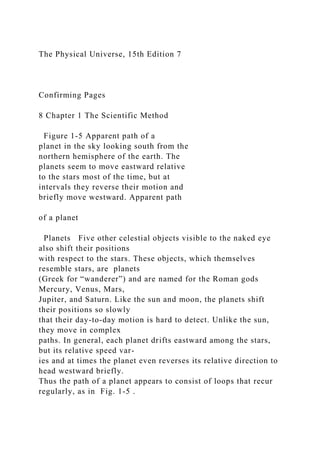
Figure 1-5 Apparent path of a
planet in the sky looking south from the
northern hemisphere of the earth. The
planets seem to move eastward relative
to the stars most of the time, but at
intervals they reverse their motion and
briefly move westward. Apparent path
of a planet
Planets Five other celestial objects visible to the naked eye
also shift their positions
with respect to the stars. These objects, which themselves
resemble stars, are planets
(Greek for “wanderer”) and are named for the Roman gods
Mercury, Venus, Mars,
Jupiter, and Saturn. Like the sun and moon, the planets shift
their positions so slowly
that their day-to-day motion is hard to detect. Unlike the sun,
they move in complex
paths. In general, each planet drifts eastward among the stars,
but its relative speed var-
ies and at times the planet even reverses its relative direction to
head westward briefly.
Thus the path of a planet appears to consist of loops that recur
regularly, as in Fig. 1-5 .
1.4 The Ptolemaic System
The Earth as the Center of the Universe
Although the philosophers of ancient Greece knew that the
apparent daily rotation of the
sky could be explained by a rotation of the earth, most of them
preferred to regard the
earth as stationary. The scheme most widely accepted was
originally the work of Hippar-
chus. Ptolemy of Alexandria ( Fig. 1-6 ) later included
Hipparchus’s ideas into his Almagest,
a survey of astronomy that was to be the standard reference on
the subject for over a thou-
sand years. This model of the universe became known as the
ptolemaic system.
The model was intricate and ingenious ( Fig. 1-7 ). Our earth
stands at the center,
motionless, with everything else in the universe moving about it
either in circles or in
combinations of circles. (To the Greeks, the circle was the only
“perfect” curve, hence the
only possible path for a celestial object.) The fixed stars are
embedded in a huge crystal
sphere that makes a little more than a complete turn around the
earth each day. Inside
the crystal sphere is the sun, which moves around the earth
exactly once a day. The dif-
ference in speed between sun and stars is just enough so that the
sun appears to move
eastward past the stars, returning to a given point among them
once a year. Near the
earth in a small orbit is the moon, revolving more slowly than
the sun. The planets Venus
and Mercury come between moon and sun, the other planets
between sun and stars.
To account for irregularities in the motions of the planets,
Ptolemy imagined that
each planet moves in a small circle about a point that in turn
follows a large circle
about the earth. By a combination of these circular motions a
planet travels in a series
of loops. Since we observe these loops edgewise, it appears to
us as if the planets move
with variable speeds and sometimes even reverse their
directions of motion in the sky.
From observations made by himself and by others, Ptolemy
calculated the speed
of each celestial object in its assumed orbit. Using these speeds
he could then figure
out the location in the sky of any object at any time, past or
future. These calcu-
lated positions checked fairly well, though not perfectly, with
positions that had been
recorded centuries earlier, and the predictions also agreed at
first with observations
made in later years. So Ptolemy’s system fulfilled all the
requirements of a scientific
theory: it was based on observation, it accounted for the
celestial motions known in
his time, and it made predictions that could be tested in the
future.
1.5 The Copernican System
A Spinning Earth That Circles the Sun
By the sixteenth century it had become clear that something
was seriously wrong
with the ptolemaic model. The planets were simply not in the
positions in the sky
predicted for them. The errors could be removed in two ways:
either the ptolemaic
Figure 1-6 Ptolemy ( A.D. 100–170).
The Temple of the Sun
Here is how Copernicus summed
up his picture of the solar system:
“Of the moving bodies first comes
Saturn, who completes his circuit
in 30 years. After him Jupiter,
moving in a 12-year revolution.
Then Mars, who revolves bien-
nially. Fourth in order an annual
cycle takes place, in which we
have said is contained the earth,
with the lunar orbit as an epicy-
cle, that is, with the moon mov-
ing in a circle around the earth.
In the fifth place Venus is carried
around in 9 months. Then Mer-
cury holds the sixth place, circu-
lating in the space of 80 days. In
the middle of all dwells the Sun.
Who indeed in this most beauti-
ful temple would place the torch
in any other or better place than
one whence it can illuminate the
whole at the same time?”
kra1392X_ch01_001-026.indd 8kra1392X_ch01_001-026.indd
8 30/11/12 7:31 PM30/11/12 7:31 PM
8 SCI 110
Confirming Pages
The Solar System 9
system could be made still more complicated, or it could be
replaced by a different
model of the universe.
Nicolaus Copernicus, a versatile and energetic Pole of the early
sixteenth century,
chose the second approach. Let us consider the earth, said
Copernicus, as one of the
planets, a sphere rotating once a day on its axis. Let us imagine
that all the planets,
including the earth, circle the sun ( Fig. 1-8 ), that the moon
circles the earth, and
that the stars are all far away. In this model, it is the earth’s
rotation that explains
Figure 1-7 The ptolemaic system,
showing the assumed arrangement
of the members of the solar system
within the celestial sphere. Each planet
is supposed to travel around the earth
in a series of loops, while the orbits of
the sun and moon are circular. Only the
planets known in Ptolemy’s time are
shown. The stars are all supposed to be
at the same distance from the earth.
Figure 1-8 The copernican system.
The planets, including the earth, are
supposed to travel around the sun in
circular orbits. The earth rotates daily
on its axis, the moon revolves around
the earth, and the stars are far away. All
planets in the solar system are shown
here. There are also a number of dwarf
planets, such as Pluto; see Sec. 17.11. The
actual orbits are ellipses and are not
spaced as shown here, though they do
lie in approximately the same plane.
kra1392X_ch01_001-026.indd 9kra1392X_ch01_001-026.indd
9 30/11/12 7:31 PM30/11/12 7:31 PM
The Physical Universe, 15th Edition 9
Confirming Pages
10 Chapter 1 The Scientific Method
the daily rising and setting of celestial objects, not the motions
of these objects. The
apparent shifting of the sun among the stars is due to the earth’s
motion in its orbit.
As the earth swings around the sun, we see the sun changing its
position against the
background of the stars. The moon’s gradual eastward drift is
mainly due to its orbital
motion. Apparently irregular movements of the planets are
really just combinations
of their motions with our own shifts of position as the earth
moves.
The copernican system offended both Protestant and Catholic
religious lead-
ers, who did not want to see the earth taken from its place at the
hub of the universe.
The publication of Copernicus’s manuscript began a long and
bitter argument. To us,
growing up with the knowledge that the earth moves, it seems
odd that this straight-
forward idea was so long and so violently opposed. But in the
sixteenth century good
arguments were available to both sides.
Consider, said supporters of Ptolemy, how fast the earth’s
surface must move to
complete a full turn every 24 h. Would not everything loose be
flung into space by
this whirling ball, just as mud is thrown from the rim of a
carriage wheel? And would
not such dizzying speeds produce a great wind to blow down
buildings, trees, plants?
The earth does spin rapidly, replied the followers of
Copernicus, but the effects are
counterbalanced by whatever force it is that holds our feet to
the ground. Besides, if
the speed of the earth’s rotation is a problem, how much more
of a problem would
be the tremendous speeds of the sun, stars, and planets if they
revolve, as Ptolemy
thought, once a day around a fixed earth?
1.6 Kepler’s Laws
How the Planets Actually Move
Fortunately, improvements in astronomical measurements—the
first since the time
of the Greeks—were not long in coming. Tycho Brahe (1546–
1601), an astronomer
working for the Danish king, built an observatory on the island
of Hven near Copen-
hagen in which the instruments were remarkably precise (
Fig. 1-9 ). With the help
of these instruments, Brahe, blessed with exceptional eyesight
and patience, made
thousands of measurements, a labor that occupied much of his
life. Even without the
B I O G R A P H Y
currency reform, but much of his time
was devoted to developing the idea
that the planets move around the sun
rather than around the earth. The idea
was not new—the ancient Greeks were
aware of it—but Copernicus went fur-
ther and worked out the planetary
orbits and speeds in detail. Although
a summary of his results had been
circulated in manuscript form earlier,
not until a few weeks before his death
was Copernicus’s De Revolutionibus
Orbium Coelestium published in book
form.
Today De Revolutionibus is recog-
nized as one of the foundation stones
of modern science, but soon after
its appearance it was condemned by
the Catholic Church (which did not
lift its ban until 1835) and had little
impact on astronomy until Kepler
further developed its concepts over a
half century later.
When Columbus made his first voy-
age to the New World Copernicus
was a student in his native Poland.
In the years that followed intellec-
tual as well as geographical horizons
receded before eager explorers. In
1496 Copernicus went to Italy to
learn medicine, theology, and astron-
omy. Italy was then an exciting place
to be, a place of business expansion
and conflicts between rival cities,
great fortunes and corrupt govern-
ments, brilliant thinkers and inspired
artists such as Leonardo da Vinci and
Michelangelo.
After 10 years in Italy Copernicus
returned to Poland where he prac-
ticed medicine, served as a canon in
the cathedral of which his uncle was
the bishop, and became involved in
Nicolaus Copernicus (1473–1543)
Leap Years
A day is the time needed for the
earth to make a complete turn on
its axis, and a year is the time it
needs to complete an orbit around
the sun. The length of the year is
slightly less than 365 days and
6 hours. Thus adding an extra day
to February every 4 years (namely
those years evenly divisible by 4,
which are accordingly called leap
years ) keeps the seasons from
shifting around the calendar.
The remaining discrepancy
adds up to a full day too much
every 128 years. To take care of
most of this discrepancy, century
years not divisible by 400 will not
be leap years; thus 2000 was a leap
year but 2100 will not be one.
kra1392X_ch01_001-026.indd 10kra1392X_ch01_001-
026.indd 10 30/11/12 7:31 PM30/11/12 7:31 PM
10 SCI 110
Confirming Pages
The Solar System 11
telescope, which had not yet been invented, Tycho’s
observatory was able to deter-
mine celestial angles to better than 1 __ 100 of a degree.
At his death in 1601, Brahe left behind his own somewhat
peculiar model of
the solar system, a body of superb data extending over many
years, and an assistant
named Johannes Kepler. Kepler regarded the copernican scheme
“with incredible
and ravishing delight,” in his words, and fully expected that
Brahe’s improved figures
would prove Copernicus correct once and for all. But this was
not the case; after
4 years of work on the orbit of Mars alone, Kepler could not get
Brahe’s data to fit any
of the models of the solar system that had by then been
proposed.
If the facts do not agree with the theory, then the scientific
method requires that
the theory, no matter how attractive, must be modified or
discarded. Kepler then
began to look for a new cosmic design that would fit Brahe’s
observations better.
The First Law After considering every possibility, which
meant years of drudg-
ery in making calculations by hand, Kepler found that circular
orbits for the planets
were out of the question even when modified in various ways.
He abandoned circular
orbits reluctantly, for he was something of a mystic and
believed, like Copernicus and
the Greeks, that circles were the only fitting type of path for
celestial bodies. Kepler
then examined other geometrical figures, and here he found the
key to the puzzle
( Fig. 1-10 ). According to Kepler’s first law:
The Second Law Even this crucial discovery was not enough,
as Kepler realized,
to establish the courses of the planets through the sky. What
was needed next was
a way to relate the speeds of the planets to their positions in
their elliptical orbits.
Kepler could not be sure a general relationship of this kind even
existed, and he was
overjoyed when he had figured out the answer, known today as
Kepler’s second law:
The paths of the planets around the sun are ellipses with the
sun at one focus.
Figure 1-9 A 1598 portrait of Tycho
Brahe in his observatory. The man at
the right is determining the position of
a celestial body by shifting a sighting
vane along a giant protractor until the
body is visible through the aperture at
upper left. There were four of each kind
of instrument in the observatory, which
were used simultaneously for reliable
measurements.
Figure 1-10 To draw an ellipse,
place a loop of string over two tacks
a short distance apart. Then move a
pencil as shown, keeping the string
taut. By varying the length of the
string, ellipses of different shapes can
be drawn. The points in an ellipse
corresponding to the positions of the
tacks are called focuses; the orbits of
the planets are ellipses with the sun at
one focus, which is Kepler’s first law.
A planet moves so that its radius vector sweeps out equal
areas in equal times.
kra1392X_ch01_001-026.indd 11kra1392X_ch01_001-
026.indd 11 30/11/12 7:31 PM30/11/12 7:31 PM
The Physical Universe, 15th Edition 11
Confirming Pages
12 Chapter 1 The Scientific Method
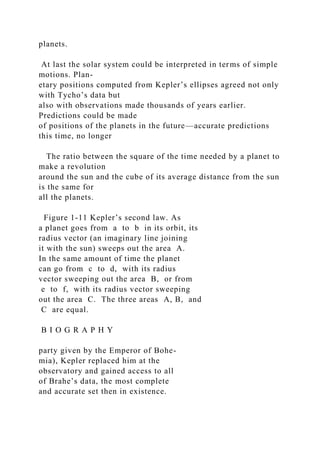
The radius vector of a planet is an imaginary line between it
and the sun. Thus in
Fig. 1-11 each of the shaded areas is covered in the same
period of time. This means
that each planet travels faster when it is near the sun than when
it is far away. The
earth, for instance, has a speed of 30 km/s when it is nearest the
sun and 29 km/s
when it is farthest away, a difference of over 3 percent.
The Third Law A great achievement, but Kepler was not
satisfied. He was
obsessed with the idea of order and regularity in the universe,
and spent 10 more
years making calculations. It was already known that, the
farther a planet is from
the sun, the longer it takes to orbit the sun. Kepler’s third law
of planetary motion
gives the exact relationship:
In equation form, this law states that
(Period of planet)2
___________________
(Average orbit radius)3
5 same value for all the planets
The period of a planet is the time needed for it to go once
around the sun; in the case
of the earth, the period is 1 year. Figure 1-12 illustrates
Kepler’s third law. Table 17-1
gives the values of the periods and average orbit radii for the
planets.
At last the solar system could be interpreted in terms of simple
motions. Plan-
etary positions computed from Kepler’s ellipses agreed not only
with Tycho’s data but
also with observations made thousands of years earlier.
Predictions could be made
of positions of the planets in the future—accurate predictions
this time, no longer
The ratio between the square of the time needed by a planet to
make a revolution
around the sun and the cube of its average distance from the sun
is the same for
all the planets.
Figure 1-11 Kepler’s second law. As
a planet goes from a to b in its orbit, its
radius vector (an imaginary line joining
it with the sun) sweeps out the area A.
In the same amount of time the planet
can go from c to d, with its radius
vector sweeping out the area B, or from
e to f, with its radius vector sweeping
out the area C. The three areas A, B, and
C are equal.
B I O G R A P H Y
party given by the Emperor of Bohe-
mia), Kepler replaced him at the
observatory and gained access to all
of Brahe’s data, the most complete
and accurate set then in existence.
Kepler felt that the copernican
model of the solar system was not
only capable of better agreement with
the data than had yet been achieved
but also contained within it yet-
undiscovered regularities. Many years
of labor resulted in three laws of plan-
etary motion that fulfilled Kepler’s
vision and were to bear their ultimate
fruit in Newton’s law of gravity.
Kepler also found time to prepare
new tables of planetary positions,
to explain how telescopes produce
magnified images, to father 13 chil-
dren, and to prepare horoscopes for
the Emperor of Bohemia, the main
reason for his employment (as it had
been for Brahe). In 1619 he suggested
that comet tails point away from
the sun because of a “solar breeze,”
a good guess (see Sec. 17.2) though
he could not know its nature. A year
later Kepler’s mother was accused of
being a witch, but he was able to get
her acquitted.
As a child, Kepler, who was born in
Germany, was much impressed by
seeing a comet and a total eclipse of
the moon. In college, where astron-
omy was his worst subject, Kepler
concentrated on theology, but his first
job was as a teacher of mathematics
and science in Graz, Austria. There
he pondered the copernican system
and concluded that the sun must
exert a force (which he later thought
was magnetic) on the planets to keep
them in their orbits.
Kepler also devised a geometri-
cal scheme to account for the spacing
of the planetary orbits and put all his
ideas into a book called The Cosmic
Mystery. Tycho Brahe, the Danish
astronomer, read the book and took
Kepler on as an assistant in his new
observatory in Prague in what was
then Bohemia. Upon Brahe’s death
(the result of drinking too much at a
Johannes Kepler (1571–1630)
kra1392X_ch01_001-026.indd 12kra1392X_ch01_001-
026.indd 12 30/11/12 7:31 PM30/11/12 7:31 PM
12 SCI 110
Confirming Pages
The Solar System 13
approximations. Furthermore, Kepler’s laws showed that the
speed of a planet in dif-
ferent parts of its orbit was governed by a simple rule and that
the speed was related
to the size of the orbit.
1.7 Why Copernicus Was Right
Evidence Was Needed That Supported His Model
While Contradicting Ptolemy’s Model
It is often said that Kepler proved that Copernicus was “right”
and that Ptolemy
was “wrong.” True enough, the copernican system, by having
the planets move
around the sun rather than around the earth, was simpler than
the ptolemaic
system. As modified by Kepler, the copernican system was also
more accurate.
However, the ptolemaic system could also be modified to be
just as accurate,
though in a very much more complicated way. Astronomers of
the time squared
themselves both with the practical needs of their profession and
with the Church
by using the copernican system for calculations while asserting
the truth of the
ptolemaic system.
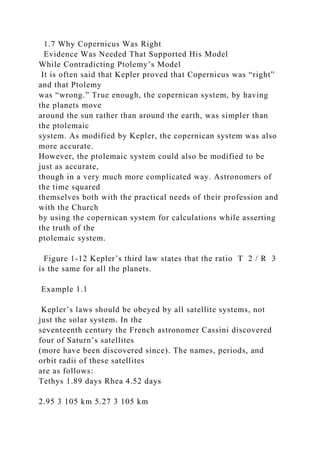
Figure 1-12 Kepler’s third law states that the ratio T 2 / R 3
is the same for all the planets.
Example 1.1
Kepler’s laws should be obeyed by all satellite systems, not
just the solar system. In the
seventeenth century the French astronomer Cassini discovered
four of Saturn’s satellites
(more have been discovered since). The names, periods, and
orbit radii of these satellites
are as follows:
Tethys 1.89 days Rhea 4.52 days
2.95 3 105 km 5.27 3 105 km
Dione 2.74 days Iapetus 79.30 days
3.77 3 105 km 35.60 3 105 km
Verify that Kepler’s third law holds for these satellites.
Solution
What we must do is calculate the ratio T 2 / R 3 for each
satellite. The result for Tethys is
(1.89 days)2
______________
(2.95 3 105 km)3
5 1.40 3 10216 days2/km3
The ratio turns out to be the same for the other satellites as
well, so we conclude that
Kepler’s third law holds for this satellite system. [Calculations
that involve powers of 10 are
discussed in the Math Refresher at the end of this book. We
note that (10 5 ) 3 5 10 3(5) 5 10 15
and 1/10 15 5 10 2 15 .]
Occam’s Razor
In science, as a general rule, the
simplest explanation for a phe-
nomenon is most likely to be cor-
rect: less is more. This principle
was first clearly expressed by the
medieval philosopher William of
Occam (or Ockham), who was
born in England in 1280. In 1746
the French philosopher Etienne
de Condillac called the prin-
ciple Occam’s razor, an elegant
metaphor that suggests cutting
away unnecessary complications
to get at the heart of the matter.
Copernicus was one of many
successful users of Occam’s razor.
To be sure, as when shaving with
an actual razor, it is possible to
go too far; as the mathematician
Alfred Whitehead said, “Seek
simplicity, and distrust it.”
kra1392X_ch01_001-026.indd 13kra1392X_ch01_001-
026.indd 13 30/11/12 7:31 PM30/11/12 7:31 PM
The Physical Universe, 15th Edition 13
Confirming Pages
14 Chapter 1 The Scientific Method
The copernican system is attractive because it accounts in a
straightforward way
for many aspects of what we see in the sky. However, only
observations that contradict
the ptolemaic system can prove it wrong. The copernican system
is today considered
correct because there is direct evidence of various kinds for the
motions of the planets
around the sun and for the rotation of the earth. An example of
such evidence is the
change in apparent position of nearby stars relative to the
background of distant ones
as the earth revolves around the sun ( Fig. 1-13 ), an effect
called parallax; see Sec. 18.8.
Shifts of this kind are small because all stars are far away, but
they have been found.
As we know from everyday experience, and as we shall learn in
a more precise way in
Chap. 2, a force is needed to cause something to move in a
curved path ( Fig. 1-14 ).
The planets are no exception to this rule: a force of some kind
must be acting to
hold them in their orbits around the sun. Three centuries ago
Isaac Newton had the
inspired idea that this force must have the same character as the
familiar force of
gravity that pulls things to the earth’s surface.
1.8 What Is Gravity?
A Fundamental Force
Perhaps, thought Newton, the moon revolves around the earth
much as the ball in
Fig. 1-14 revolves around the hand holding the string, with
gravity taking the place
UNIVERSAL GRAVITATION
Figure 1-13 As a consequence of
the earth’s motion around the sun,
nearby stars shift in apparent position
relative to distant stars. The effect is
known as parallax.
Distant stars
Nearby star
Sun
As seen
from earth
1
2
E1
E2
Until only a few hundred years
ago, astronomy was almost entirely in
the service of astrology. The wealth of
precise astronomical measurements
that ancient civilizations compiled
had as their purpose interpreting the
ways of the gods.
Almost nobody today takes seri-
ously the mythology of old. Although
the basis of the connection has dis-
appeared, however, some people still
believe that the position in the sky
of various celestial bodies at certain
times controls the world we live in
and our individual destinies as well.
It does not seem very gracious
for contemporary science to dismiss
astrology in view of the great debt
astronomy owes its practitioners of
long ago. However, it is hard to have
confidence in a doctrine that, for all its
internal consistency and often delight-
ful notions, nevertheless lacks any basis
in scientific theory or observation and
has proved no more useful in predict-
ing the future than a crystal ball.
To our ancestors of thousands of years
ago, things happened in the world
because gods caused them to hap-
pen. Famine and war, earthquake and
eclipse—any conceivable catastrophe—
all occurred under divine control. In
time the chief gods were identified
with the sun, the moon, and the five
planets visible to the naked eye: Mer-
cury, Venus, Mars, Jupiter, and Saturn.
Early observers of the sky were primar-
ily interested in finding links between
celestial events and earthly ones, a
study that became known as astrology.
Astrology
kra1392X_ch01_001-026.indd 14kra1392X_ch01_001-
026.indd 14 30/11/12 7:31 PM30/11/12 7:31 PM
14 SCI 110
Confirming Pages
Universal Gravitation 15
of the pull of the string. In other words, perhaps the moon is a
falling object, pulled
to the earth just as we are, but moving so fast in its orbit that
the earth’s pull is just
enough to keep the moon from flying off ( Fig. 1-15 ). The earth
and its sister planets
might well be held in their orbits by a stronger gravitational
pull from the sun. These
notions turned out to be true, and Newton was able to show that
his detailed theory
of gravity accounts for Kepler’s laws.
It is worth noting that Newton’s discovery of the law of
gravity depended on
the copernican model of the solar system. “Common sense” tells
us that the earth
is the stationary center of the universe, and people were once
severely punished for
believing otherwise. Clearly the progress of our knowledge
about the world we live
in depends upon people, like Copernicus, who are able to look
behind the screen of
appearances that make up everyday life and who are willing to
think for themselves.
Fundamental Forces Gravity is a fundamental force in the
sense that it can-
not be explained in terms of any other force. Only four
fundamental forces are
known: gravitational, electromagnetic, weak, and strong. These
forces are respon-
sible for everything that happens in the universe. Gravitational
forces act between
all bodies everywhere and hold together planets, stars, and the
giant groups of stars
called galaxies. Electromagnetic forces, which (like gravity) are
unlimited in range,
act between electrically charged particles and govern the
structures and behav-
ior of atoms, molecules, solids, and liquids. When a bat hits a
ball, the interaction
between them can be traced to electromagnetic forces. The weak
and strong forces
have very short ranges and act inside atomic nuclei.
(Fundamental forces are fur-
ther discussed in Sec. 8.14.)
The Law of Gravity Is the Same Everywhere How can we be
sure that New-
ton’s law of gravity, which fits data on the solar system, also
holds throughout the
rest of the universe? The evidence for this generalization is
indirect but persua-
sive. For instance, many double stars are known in which each
member of the pair
revolves around the other, which means some force holds them
together. Through-
out the universe stars occur in galaxies, and only gravity could
keep them assem-
bled in this way.
But is the gravity that acts between stars the same as the
gravity that acts in the
solar system? Analyzing the light and radio waves that reach us
from space shows that
the matter in the rest of the universe is the same as the matter
found on the earth. If we
are to believe that the universe contains objects that do not obey
Newton’s law of grav-
ity, we must have evidence for such a belief—and there is none.
This line of thought
may not seem as positive as we might prefer, but taken together
with various theoreti-
cal arguments, it has convinced nearly all scientists that gravity
is the same everywhere.
Figure 1-14 An inward force is
needed to keep an object moving in a
curved path. The force here is provided
by the string. If no force acts on it, a
moving object will continue moving in
a straight line at constant speed. (This
is Newton’s first law of motion and is
discussed in Sec. 2.7.)
Figure 1-15 The gravitational pull
of the earth on the moon causes the
moon to move in an orbit around the
earth. If the earth exerted no force on
the moon, the moon would fly off
into space. If the moon had no orbital
motion, it would fall directly to the earth.
kra1392X_ch01_001-026.indd 15kra1392X_ch01_001-
026.indd 15 30/11/12 7:31 PM30/11/12 7:31 PM
The Physical Universe, 15th Edition 15
Confirming Pages
16 Chapter 1 The Scientific Method
1.9 Why the Earth Is Round
The Big Squeeze
A sign of success of any scientific theory is its ability to
account for previously myste-
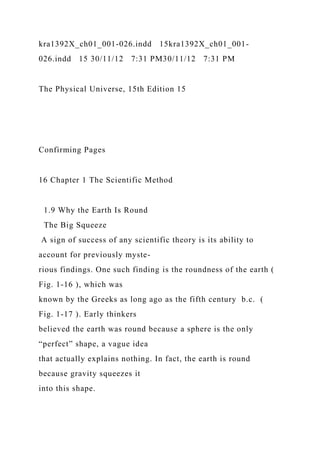
rious findings. One such finding is the roundness of the earth (
Fig. 1-16 ), which was
known by the Greeks as long ago as the fifth century b.c. (
Fig. 1-17 ). Early thinkers
believed the earth was round because a sphere is the only
“perfect” shape, a vague idea
that actually explains nothing. In fact, the earth is round
because gravity squeezes it
into this shape.
As shown in Fig. 1-18 , if any part of the earth were to stick
out very much, the
gravitational attraction of the rest of the earth would pull
downward on the projec-
tion. The material underneath would then flow out sideways
until the projection
became level or nearly so. The downward forces around the rim
of a deep hole would
similarly cause the surrounding material to flow into it. The
same argument applies
to the moon, the sun, and the stars.
Such irregularities as mountains and ocean basins are on a very
small scale
compared with the earth’s size. The total range from the Pacific
depths to the
summit of Everest is less than 20 km, not much compared with
the earth’s radius
of 6400 km.
Figure 1-16 Astronauts in the Apollo
11 spacecraft saw this view of the
earth as they orbited the moon, part of
whose bleak landscape appears in the
foreground. The earth is indeed round.
B I O G R A P H Y
tea, under some apple trees . . . he told
me he was just in the same situation
when the notion of gravitation came
into his mind. ‘Why should that apple
always descend perpendicularly to
the ground,’ thought he to himself.”
When Cambridge University
reopened, Newton went back and
2 years later became professor of
mathematics there. He lived qui-
etly and never married, carrying out
experimental as well as theoretical
research in many areas of physics; a
reflecting telescope he made with his
own hands was widely admired.
Especially significant was New-
ton’s development of the laws of
motion (see Chap. 2), which showed
exactly how force and motion are
related, and his application of them
to a variety of problems. Newton
collected the results of his work on
mechanics in the Principia, a sci-
entific classic that was published in
1687. A later book, Opticks, summa-
rized his efforts in this field. Newton
also spent much time on chemistry,
though here with little success.
After writing the Principia, New-
ton began to drift away from science.
He became a member of Parliament
in 1689 and later an official, eventu-
ally the Master, of the British Mint. At
the Mint Newton helped reform the
currency (one of Kepler’s interests,
too) and fought counterfeiters. New-
ton’s spare time in his last 30 years
was mainly spent in trying to date
events in the Bible. He died at 85, a
figure of honor whose stature remains
great to this day.
Although his mother wanted him to
stay on the family farm in England,
the young Newton showed a talent for
science and went to Cambridge Uni-
versity for further study. An outbreak
of plague led the university to close in
1665, the year Newton graduated, and
he returned home for 18 months.
In that period Newton came up
with the binomial theorem of algebra;
invented calculus, which gave science
and engineering a new and powerful
mathematical tool; discovered the law
of gravity, thereby not only showing
why the planets move as they do but
also providing the key to understand-
ing much else about the universe;
and demonstrated that white light is
a composite of light of all colors—an
amazing list. As Newton later wrote,
“In those days I was in the prime of
my age for invention, and minded
mathematics and philosophy more
than at any time since.”
Legend has it that Newton’s inter-
est turned to gravity when he was
struck on the head by a falling apple.
Newton’s own recollection was given
to a visiting friend, who reported that
“We went into the garden and drank
Isaac Newton (1642–1727)
kra1392X_ch01_001-026.indd 16kra1392X_ch01_001-
026.indd 16 30/11/12 7:31 PM30/11/12 7:31 PM
16 SCI 110
Confirming Pages
Universal Gravitation 17
Figure 1-17 In the distant past
evidence for the spherical shape of the
earth came from travelers who found
that, when they went north, more stars
stayed above the horizon all night, and
that, when they went south, additional
stars became visible. Eratosthenes
(276–194 B.C. ) determined the earth’s size
with remarkable accuracy by comparing
the length of the sun’s shadow at noon
on the same day in two places on the
same north-south line.
Polaris
Horizon
Horizon
View from B
View from A
Polaris
H
orizon A
Apparent paths
of stars
Horizon B
Figure 1-18 Gravity forces the earth
to be round. (a) How a large bump
would be pulled down. (b) How a large
hole would be filled in.
The earth is not a perfect sphere. The reason was apparent to
Newton: since the
earth is spinning rapidly, inertia causes the equatorial portion to
swing outward,
just as a ball on a string does when it is whirled around. As a
result the earth bulges
slightly at the equator and is slightly flattened at the poles,
much like a grapefruit.
The total distortion is not great, for the earth is only 43 km
wider than it is high
( Fig. 1-19 ). Venus, whose “day” is 243 of our days, turns so
slowly that it has almost
no distortion. Saturn, at the other extreme, spins so rapidly that
it is almost 10 per-
cent out of round.
kra1392X_ch01_001-026.indd 17kra1392X_ch01_001-
026.indd 17 30/11/12 7:31 PM30/11/12 7:31 PM
The Physical Universe, 15th Edition 17
Confirming Pages
18 Chapter 1 The Scientific Method
Figure 1-19 The influence of its
rotation distorts the earth. The effect
is greatly exaggerated in the figure;
the equatorial diameter of the earth is
actually only 43 km (27 mi) more than
its polar diameter.
Actual shape of earth
Perfect sphere 1.10 The Tides
Up and Down Twice a Day
Those of us who live near an ocean know well the rhythm of
the tides, the twice-daily
rise and fall of water level. Usually the change in height is no
more than a few meters,
but in some regions—the Bay of Fundy in eastern Canada is
one—the total range
can be over 20 m. The gravitational pull of the moon is what
causes the advance and
retreat of the oceans on this grand scale.
The moon gravitationally attracts different parts of the earth to
different extents. In
Fig. 1-20 the moon’s tug is strongest at A, which is closest,
and weakest at B, which is far-
thest away. Also, the rotation of the moon around the earth is
too simple a picture—what
actually happens is that both bodies rotate around the center of
mass (CM) of the earth-
moon system. (Think of the earth and the moon as opposite ends
of a dumbbell. The
CM is the balance point of the dumbbell; it is inside the earth
4700 km from its center.)
As it wobbles around the CM, the solid earth is pulled away
from the water at B,
where the moon’s tug is weakest, to leave the water there
heaped up in a tidal bulge.
At A, the greater tug of the moon dominates to cause a tidal
bulge there as well. The
bulges stay in place as the earth revolves under them to produce
two high tides and
two low tides at a given place every day ( Fig. 1-21 ).
Figure 1-20 The origin of the tides. The moon’s attraction for
the waters of the earth is greatest
at A, least at B. As the earth and moon rotate around the
center of mass of the earth-moon system,
which is located inside the earth, water is heaped up at A and
B. The water bulges stay in place
as the earth turns on its axis to produce two high and two low
tides every day. As the earth turns
under the bulges, friction between the oceans and the ocean
floors slows down the earth’s
rotation. As a result the tidal bulges lag slightly behind the
earth-moon line. One effect of tidal
friction is thus to lengthen the day. The rate of increase is a
mere 1 s per day in every 43,500 years,
but it adds up. Measurements of the daily growth markings on
fossil corals show that the day was
only 22 h long 380 million years ago. The other effect is that,
because the tidal bulge facing the
moon is behind the earth-moon line, the bulge exerts a force on
the moon that pulls it slightly
forward in its orbit, which causes the orbit to grow larger. As a
result the moon is moving away
from the earth at about 4 cm per year.
Figure 1-21 High and low water in the Bay of Fundy at Blacks
Harbour in New Brunswick, Canada. Two tidal cycles occur
daily.
kra1392X_ch01_001-026.indd 18kra1392X_ch01_001-
026.indd 18 30/11/12 7:31 PM30/11/12 7:31 PM
18 SCI 110
Confirming Pages
Universal Gravitation 19
Spring and Neap Tides
There is more to the story. The sun also affects the waters of
the earth, but to a
smaller extent than the moon even though the gravitational tug
of the sun exceeds
that of the moon. The reason is that what is involved in the tides
is the difference
between the attractions on the near and far sides of the earth,
and this difference
is greater for the moon because it is closer to the earth than the
sun. About twice
a month—when the sun, moon, and earth are in a straight line—
solar tides add to
lunar tides to give the especially high (and low) spring tides;
see Fig. 1-22 . When
the line between moon and earth is perpendicular to that
between sun and earth,
the tide-raising forces partly cancel to give neap tides, whose
range is smaller
than average.
1.11 The Discovery of Neptune
Another Triumph for the Law of Gravity
In Newton’s time, as in Ptolemy’s, only six planets were
known: Mercury, Venus,
Earth, Mars, Jupiter, and Saturn. In 1781 a seventh, Uranus, was
identified. Measure-
ments during the next few years enabled astronomers to work
out details of the new
planet’s orbit and to predict its future positions in the sky. To
make these predictions,
not only the sun’s attraction but also the smaller attractions of
the nearby planets
Jupiter and Saturn had to be considered. For 40 years, about
half the time needed for
Uranus to make one complete revolution around the sun,
calculated positions of the
planet agreed well with observed positions.
Then a discrepancy crept in. Little by little Uranus moved away
from its predicted
path among the stars. The calculations were checked and
rechecked, but no mistake
could be found. There were two possibilities: either the law of
gravity, on which the
Figure 1-22 Variation of the tides.
Spring tides are produced when the
moon is at M 1 or M 2 , neap tides when
the moon is at M 3 or M 4 . The range
between high and low water is greatest
for spring tides.
kra1392X_ch01_001-026.indd 19kra1392X_ch01_001-
026.indd 19 30/11/12 7:32 PM30/11/12 7:32 PM
The Physical Universe, 15th Edition 19
Confirming Pages
20 Chapter 1 The Scientific Method
calculations were based, was wrong, or else some unknown
body was pulling Uranus
away from its predicted path.
So firmly established was the law of gravitation that two young
men, Urbain
Leverrier in France and John Couch Adams in England, set
themselves the task of
calculating the orbit of an unknown body that might be
responsible for the discrepan-
cies in Uranus’s position. Adams sent a sketchy account of his
studies to George Airy,
England’s Astronomer Royal. Because the calculations were
incomplete, although
later found to be correct as far as they went, Airy asked for
further details. Adams
(who later blamed habitual lateness and a dislike of writing) did
not respond.
A year later, in 1846, Leverrier, with no knowledge of Adams’s
work, went further
and proposed an actual position in the sky where the new planet
should be found.
He sent his result to a German astronomer, Johan Gottlieb
Galle, who turned his
telescope to the part of the sky where the new planet should
appear. Very close to the
position predicted by Leverrier, Galle found a faint object,
which had moved slightly
by the following night. This was indeed the eighth member of
the sun’s family and
was called Neptune. The theory of gravity had again
successfully gone around the
loop of the scientific method shown in Fig. 1-1 . In 2011
Neptune completed the first
circuit of the sun since its discovery 165 years earlier.
When we say that the distance between Chicago and
Minneapolis is 405 miles, what
we are really doing is comparing this distance with a certain
standard length called
the mile. Standard quantities such as the mile are known as
units. The result of every
measurement thus has two parts. One is a number (405 for the
Chicago-Minneapolis
distance) to answer the question “How many?” The other is a
unit (the mile in this
case) to answer the question “Of what?”
1.12 The SI System
All Scientists Use These Units
The most widely used units today are those of the International
System, abbreviated
SI after its French name Système International d’Unités.
Examples of SI units are the
meter (m) for length, the second (s) for time, the kilogram
(kg) for mass, the joule
(J) for energy, and the watt (W) for power. SI units are used
universally by scien-
tists and in most of the world in everyday life as well. Although
the British system of
units, with its familiar foot and pound, remains in common use
only in a few English-
speaking countries, it is on the way out and eventually will be
replaced by the SI.
Since this is a book about science, only SI units will be used
from here on.
The great advantage of SI units is that their subdivisions and
multiples are in
steps of 10, 100, 1000, and so on, in contrast to the irregularity
of British units. In the
case of lengths, for instance ( Fig. 1-23 ),
1 meter (m) 5 100 centimeters (cm)
1 kilometer (km) 5 1000 meters
whereas
1 foot (ft) 5 12 inches (in.)
1 mile (mi) 5 5280 feet
Table 1-1 lists the most common subdivisions and multiples
of SI units. Each is
designated by a prefix according to the corresponding power of
10. (Powers of 10 are
widely used in science. What they mean and how to make
calculations with them are
reviewed in the Math Refresher at the back of the book starting
on p. A-1.)
HOW MANY OF WHAT
kra1392X_ch01_001-026.indd 20kra1392X_ch01_001-
026.indd 20 30/11/12 7:32 PM30/11/12 7:32 PM
20 SCI 110
Confirming Pages
How Many of What 21
Table 1-2 contains conversion factors for changing a length
expressed in one sys-
tem to its equivalent in the other. (More conversion factors are
given inside the back
cover of this book.) We note from the table that there are about
2 1 _ 2 cm in an inch,
so a centimeter is roughly the width of a shirt button; a meter is
a few inches longer than
3 feet; and a kilometer is nearly 2 _ 3 mile. Example 1.3
shows how conversion factors
are used.
The meter and gram were new units.
The ancient division of a day into
24 hours, an hour into 60 minutes,
and a minute into 60 seconds was
kept for the definition of the second
as 1/(24)(60)(60) 5 1/86,400 of a day.
As more and more precision
became needed, these definitions
were modified several times. Today
the second is specified in terms of the
microwave radiation given off under
certain circumstances by one type
of cesium atom, 133Cs: 1 s equals the
time needed for 9,192,631,770 cycles
of this radiation to be emitted.
The meter, which for convenience
had become the distance between two
scratches on a platinum-iridium bar
kept at Sèvres, France, is now the dis-
tance traveled in 1/299,792,458 s by
light in a vacuum. There are approxi-
mately 3.28 feet in a meter.
The kilogram (km) is the mass
of a platinum-iridium cylinder
39 mm in diameter and 39 mm
high at Sèvres. Despite much effort,
a unit of mass based on a physical
property measurable anywhere has
not proved practical as yet. As dis-
cussed in Sec. 2.10, mass and weight
are not the same. The weight of a
given mass is the force with which
gravity attracts it to the earth; the
weight of 1 kg is 2.2 pounds on the
earth’s surface and decreases with
altitude (see Fig. 2-38).
SI units are derived from the units of
the older metric system. This system
was introduced in France at the end
of the eighteenth century to replace
the hodgepodge of traditional units,
often different in different countries
and even in different parts of the same
country, that was making commerce
and industry difficult.
The meter (m), the standard of
length, was originally defined as one
ten-millionth of the distance from
the equator to the North Pole. The
gram (g), the standard of mass, was
defined as the mass of 1 cubic centi-
meter (cm3) of water; 1 cm3 is the vol-
ume of a cube 1 cm (0.01 m) on each
edge, and 1 kilogram 5 1000 grams.
Meter, Kilogram, Second
Figure 1-23 There are 1000 meters
in a kilometer and 100 centimeters in
a meter.
Table 1-1 Subdivisions and Multiples of SI Units (The Symbol
m
Is the Greek Letter “mu”)
Prefix Power of 10 Abbreviation Pronunciation Common Name
Pico- 10−12 p pee’ koe Trillionth
Nano- 10−9 n nan’ oe Billionth
Micro- 10−6 m my’ kroe Millionth
Milli- 10−3 m mil’ i Thousandth
Centi- 10−2 c sen’ ti Hundredth
Hecto- 102 h hec’ toe Hundred
Kilo- 103 k kil’ oe Thousand
Mega- 106 M meg’ a Million
Giga- 109 G ji’ ga Billion
Tera- 1012 T ter’ a Trillion
kra1392X_ch01_001-026.indd 21kra1392X_ch01_001-
026.indd 21 30/11/12 7:32 PM30/11/12 7:32 PM
The Physical Universe, 15th Edition 21
Confirming Pages
22 Chapter 1 The Scientific Method
Significant Figures In Example 1-3 the distance expressed in
centimeters is
8.78 3 10 4 cm. Does this mean that d 5 87,800 cm exactly?
The answer is, not necessarily. We are only sure of the three
digits 8, 7, and 8. By
writing d 5 8.78 3 10 4 cm we can see just how precisely
the distance is being expressed.
If we needed less precision, we could round off the value of d
to 8.8 3 10 4 cm. How-
ever, we could not write d 5 8.780 3 10 4 cm because this
implies greater precision
than that of the original statement.
The accurately known digits in a number, plus one uncertain
digit, are its
significant figures. When quantities are used in calculations,
the result is no more
accurate than the quantity with the largest uncertainty. Suppose
a 65-lb girl picks up
a 0.23-lb apple. The total weight of the girl 1 apple is still 65
lb because all we know
about the girl’s weight is that it is somewhere between 64.5 and
65.5 lb, which means
an uncertainty greater than the apple’s weight. If the girl’s
weight is instead known
to be 65.0 lb, the mass of girl 1 apple is 65.2 lb; if her weight
is instead known to be
65.00 kg, the weight of girl 1 apple is 65.23 kg. Thus
65 lb 1 0.23 lb 5 65 lb
65.0 lb 1 0.23 lb 5 65.2 lb
65.00 lb 1 0.23 lb 5 65.23 lb
Significant figures must be taken into account in multiplication
and division also.
For example, in part (b) of Example 1-3, the actual result of the
calculation is
d 5 (0.878 km)(0.621 mi/km) 5 0.545238 mi
Example 1.2
How many nanometers are in a kilometer?

SCI 110Coursehttpcreate.mcgraw-hill.comCopyrigh.docx

  • 1.
    SCI 110Course http://create.mcgraw-hill.com Copyright byThe McGraw-Hill Companies, Inc. All rights reserved. Printed in the United States of America. Except as permitted under the United States Copyright Act of 1976, no part of this publication may be reproduced or distributed in any form or by any means, or stored in a database or retrieval system, without prior written permission of the publisher. This McGraw-Hill Create text may include materials submitted to McGraw-Hill for publication by the instructor of this course. The instructor is solely responsible for the editorial content of such materials. Instructors retain copyright of these additional materials. ISBN-10: ISBN-13: 2013 1121838936 9781121838932 Contents
  • 2.
    1. The ScientificMethod 1 2. Section for Chapter 1 27 3. Motion 29 4. Section for Chapter 2 65 5. Energy 68 6. Section for Chapter 3 97 iii Credits 1. The Scientific Method: Chapter 1 from The Physical Universe, 15th Edition by Krauskopf, Beiser, 2014 1 2. Section for Chapter 1: Chapter from The Physical Universe, 15th Edition by Krauskopf, Beiser, 2014 27 3. Motion: Chapter 2 from The Physical Universe, 15th Edition by Krauskopf, Beiser, 2014 29 4. Section for Chapter 2: Chapter from The Physical Universe, 15th Edition by Krauskopf, Beiser, 2014 65 5. Energy: Chapter 3 from The Physical Universe, 15th Edition by Krauskopf, Beiser, 2014 68 6. Section for Chapter 3: Chapter from The Physical Universe, 15th Edition by Krauskopf, Beiser, 2014 97 iv Hell I Sphe re of the Moon II Sphe
  • 3.
    re of Mercury IIISph ere of Venus IV Sph ere of the Sun V Spher e of Mars VI Spher e of Jupiter of SaturnVI II Sph ere of the fixed stars. The Zodiac IX Cry stalline sphere. Primum Mobile VII Sphe re Purgatory He mis pher e of wa
  • 4.
    ter The D ark W oo d Ai r Jerusalem Earthly Paradise H em isphere of Earth Fire ConfirmingPages 1 1 How Scientists Study Nature 1.1 The Scientific Method
  • 5.
    Four Steps • Whatthe scientific method is. • The difference between a law and a theory. • The role of models in science. 1.2 Why Science Is Successful Science Is a Living Body of Knowledge, Not a Set of Frozen Ideas • Why the scientific method is so success- ful in understanding the natural world. The Solar System 1.3 A Survey of the Sky Everything Seems to Circle the North Star • Why Polaris seems almost stationary in the sky. • How to distinguish planets from stars without a telescope. 1.4 The Ptolemaic System The Earth as the Center of the Universe • How the ptolemaic system explains the astronomical universe. 1.5 The Copernican System A Spinning Earth That Circles the Sun • How the copernican system explains
  • 6.
    the astronomical system. 1.6Kepler’s Laws How the Planets Actually Move • The significance of Kepler’s laws. 1.7 Why Copernicus Was Right Evidence Was Needed That Supported His Model While Contradicting Ptolemy’s Model • How parallax decides which system provides the best explanation for what we see. Universal Gravitation 1.8 What Is Gravity? A Fundamental Force • Why gravity is a fundamental force. 1.9 Why the Earth Is Round The Big Squeeze • What keeps the earth from being a perfect sphere. 1.10 The Tides Up and Down Twice a Day • The origin of the tides. • The difference between spring and neap tides and how it comes about.
  • 7.
    1.11 The Discoveryof Neptune Another Triumph for the Law of Gravity • The role of the scientific method in finding a hitherto unknown planet. How Many of What 1.12 The SI System All Scientists Use These Units • How to go from one system of units to another. • The use of metric prefixes for small and large quantities. • What significant figures are and how to calculate with them. CHAPTER OUTLINE AND GOALS Your chief goal in reading each section should be to understand the important findings and ideas indicated (•) below. The Scientific Method Medieval picture of the universe. kra1392X_ch01_001-026.indd 1kra1392X_ch01_001-026.indd 1 30/11/12 7:31 PM30/11/12 7:31 PM The Physical Universe, 15th Edition 1
  • 8.
    Confirming Pages 2 Chapter1 The Scientific Method All of us belong to two worlds, the world of people and the world of nature. As mem- bers of the world of people, we take an interest in human events of the past and present and find such matters as politics and economics worth knowing about. As members of the world of nature, we also owe ourselves some knowledge of the sciences that seek to understand this world. It is not idle curiosity to ask why the sun shines, why the sky is blue, how old the earth is, why things fall down. These are serious ques- tions, and to know their answers adds an important dimension to our personal lives. We are made of atoms linked together into molecules, and we live on a planet circling a star—the sun—that is a member of one of the many galaxies of stars in the universe. It is the purpose of this book to survey what physics, chemistry, geology, and astronomy have to tell us about atoms and molecules, stars and galaxies, and everything in between. No single volume can cover all that is significant in this vast span, but the basic ideas of each science can be summarized along with the raw mate- rial of observation and reasoning that led to them. Like any other voyage into the unknown, the exploration of nature is an adven-
  • 9.
    ture. This bookrecords that adventure and contains many tales of wonder and dis- covery. The search for knowledge is far from over, with no end of exciting things still to be found. What some of these things might be and where they are being looked for are part of the story in the chapters to come. Every scientist dreams of lighting up some dark corner of the natural world—or, almost as good, of finding a dark corner where none had been suspected. The most careful observations, the most elaborate calculations will not be fruitful unless the right questions are asked. Here is where creative imagination enters science, which is why many of the greatest scientific advances have been made by young, nimble minds. Scientists study nature in a variety of ways. Some approaches are quite direct: a geologist takes a rock sample to a laboratory and, by inspection and analysis, finds out what it is made of and how and when it was probably formed. Other approaches are indirect: nobody has ever visited the center of the earth or ever will, but by com- bining a lot of thought with clues from different sources, a geologist can say with near certainty that the earth has a core of molten iron. No matter what the approaches to particular problems may be, however, the work scientists do always fits into a certain pattern of steps. This pattern, a general scheme for gaining reliable information about the universe, has
  • 10.
    become known asthe scientific method. 1.1 The Scientific Method Four Steps We can think of the scientific method in terms of four steps: (1) formulating a problem, (2) observation and experiment, (3) interpreting the data, and (4) testing the interpre- tation by further observation and experiment to check its predictions. These steps are often carried out by different scientists, sometimes many years apart and not always in this order. Whatever way it is carried out, though, the scientific method is not a mechanical process but a human activity that needs creative thinking in all its steps. Looking at the natural world is at the heart of the scientific method, because the results of observation and experiment serve not only as the foundations on which scientists build their ideas but also as the means by which these ideas are checked ( Fig. 1-1 ). 1. Formulating a problem may mean no more than choosing a certain field to work in, but more often a scientist has in mind some specific idea he or she wishes to investigate. In many cases formulating a problem and interpreting the data overlap. HOW SCIENTISTS STUDY NATURE kra1392X_ch01_001-026.indd 2kra1392X_ch01_001-026.indd 2 30/11/12 7:31 PM30/11/12 7:31 PM
  • 11.
    2 SCI 110 ConfirmingPages How Scientists Study Nature 3 The scientist has a speculation, perhaps only a hunch, perhaps a fully developed hypothesis, about some aspect of nature but cannot come to a definite conclusion without further study. 2. Observation and experiment are carried out with great care. Facts about nature are the building blocks of science and the ultimate test of its results. This insis- tence on accurate, objective data is what sets science apart from other modes of intellectual endeavor. 3. Interpretation may lead to a general rule or law to which the data seem to con- form. Or it may be a theory, which is a more ambitious attempt to account for what has been found in terms of how nature works. In any case, the interpreta- tion must be able to cover new data obtained under different circumstances. As put forward orginally, a scientific interpretation is usually called a hypothesis. 4. Testing the interpretation involves making new observations or performing new experiments to see whether the interpretation correctly
  • 12.
    predicts the results. Ifthe results agree with the predictions, the scientist is clearly on the right track. The new data may well lead to refinements of the original idea, which in turn must be checked, and so on indefinitely. The Laws of Nature The laws of a country tell its citizens how they are supposed to behave. Different countries have different laws, and even in one country laws are changed from time to time. Furthermore, though he or she may be caught and pun- ished for doing so, anybody can break any law at any time. The laws of nature are different. Everything in the universe, from atoms to gal- axies of stars, behaves in certain regular ways, and these regularities are the laws of nature. To be considered a law of nature, a given regularity must hold everywhere at all times within its range of applicability. The laws of nature are worth knowing for two reasons apart from satisfying our curiosity about how the universe works. First, we can use them to predict phenomena not yet discovered. Thus Isaac Newton’s law of gravity was applied over a century ago to apparent irregularities in the motion of the planet Uranus, then the farthest known planet from the sun. Calculations not only showed that another, more distant planet should exist but also indicated where in the sky to look for it. Astronomers who looked there found a new planet, which was named
  • 13.
    Neptune. Figure 1-1 Thescientific method. No hypothesis is ever final because future data may show that it is incorrect or incomplete. Unless it turns out to be wrong, a hypothesis never leaves the loop of experiment, interpretation, testing. Of course, the more times the hypothesis goes around the loop successfully, the more likely it is to be a valid interpretation of nature. Experiment and hypothesis thus evolve together, with experiment having the final word. Although a hypothesis may occur to a scientist as he or she studies experimental results, often the hypothesis comes first and relevant data are sought afterward to test it. Observation and Experiment Collecting the data that bear upon the problem Testing the Interpretation Predicting the results of new experiments on the basis of the hypothesis Interpretation Explaining the data in terms of a hypothesis about how nature works
  • 14.
    Statement of Problem Whatis the question being asked of nature? Are there any preliminary hypotheses? Finding the Royal Road Hermann von Helmholtz, a nine- teenth century German physicist and biologist, summed up his experience of scientific research in these words: “I would compare myself to a mountain climber who, not knowing the way, ascends slowly and toilsomely and is often compelled to retrace his steps because his progress is blocked; who, sometimes by rea- soning and sometimes by acci- dent, hits upon signs of a fresh path, which leads him a little farther; and who, finally, when he has reached his goal, discov- ers to his annoyance a royal road which he might have followed if he had been clever enough to find the right starting point at the beginning.” kra1392X_ch01_001-026.indd 3kra1392X_ch01_001-026.indd 3 30/11/12 7:31 PM30/11/12 7:31 PM The Physical Universe, 15th Edition 3
  • 15.
    Confirming Pages 4 Chapter1 The Scientific Method Second, the laws of nature can give us an idea of what goes on in places we cannot examine directly. We will never visit the sun’s interior (much too hot) or the interior of an atom (much too small), but we know a lot about both regions. The evidence is indirect but persuasive. Theories A law tells us what; a theory tells us why. A theory explains why cer- tain events take place and, if they obey a particular law, how that law originates in terms of broader considerations. For example, Albert Einstein’s general theory of relativity interprets gravity as a distortion in the properties of space and time around a body of matter. This theory not only accounts for Newton’s law of gravity but goes further, including the prediction—later confirmed— that light should be affected by gravity. As the French mathematician Henri Poincaré once remarked, “Science is built with facts just as a house is built with bricks, but a collection of facts is not a science any more than a pile of bricks is a house.” Models It may not be easy to get a firm intellectual grip on some aspect of nature. Therefore a model —a simplified version of reality—is often
  • 16.
    part of ahypothesis or theory. In developing the law of gravity, Newton considered the earth to be perfectly round, even though it is actually more like a grapefruit than like a billiard ball. New- ton regarded the path of the earth around the sun as an oval called an ellipse, but the actual orbit has wiggles no ellipse ever had. By choosing a sphere as a model for the earth and an ellipse as a model for its orbit, Newton isolated the most important fea- tures of the earth and its path and used them to arrive at the law of gravity. If Newton had started with a more realistic model—a somewhat squashed earth moving somewhat irregularly around the sun—he probably would have made little progress. Once he had formulated the law of gravity, Newton was then able to explain how the spinning of the earth causes it to become distorted into the shape of a grape- fruit and how the attractions of the other planets cause the earth’s orbit to differ from a perfect ellipse. 1.2 Why Science Is Successful Science Is a Living Body of Knowledge, Not a Set of Frozen Ideas What has made science such a powerful tool for investigating nature is the constant testing and retesting of its findings. As a result, science is a living body of information and not a collection of dogmas. The laws and theories of science are not necessarily the final word on a subject: they are valid only as long as no
  • 17.
    contrary evidence comes tolight. If such contrary evidence does turn up, the law or theory must be modified or even discarded. To rock the boat is part of the game; to overturn it is one way to win. Thus science is a self-correcting search for better understanding of the natural world, a search with no end in sight. Experiment Is the Test A master of several sciences, Michael Faraday is best remem- bered for his discoveries in electricity and magnetism (see biography in Sec. 6.18). This statement appears in the entry for March 19, 1849 in his labora- tory notebook: “Nothing is too wonderful to be true if it be con- sistent with the laws of nature, and . . . experiment is the best test of such consistency.” Faraday was a Fellow of Brit- ain’s Royal Society, which was founded in 1660 to promote the use of observation and experi- ment to study the natural world. The oldest scientific organiza- tion in the world, the Royal Society has as its motto Nullus in Verba —Latin for “Take nobody’s word for it.” On its 350th anni- versary, the Royal Society held a celebration of “the joy and vital-
  • 18.
    ity of science,its importance to society and culture, and its role in shaping who we are and who we will become.” the point is that it is a large-scale framework of ideas and relationships. To people ignorant of science, a theory is a suggestion, a proposal, what in science is called a hypothesis. For instance, believers in creationism, the unsupported notion that all living things simultaneously appeared on earth a few thousand years ago, scorn Darwin’s theory of evolution (see Sec. 16.8) as “just a theory” despite the wealth of evidence in its favor and its bedrock position in modern biology. In fact, few aspects of our knowledge of the natural world are as solidly established as the theory of evolution. In science a theory is a fully developed logical structure based on general principles that ties together a variety of observations and experimental findings and permits as-yet-unknown phenomena and connections to be predicted. A theory may be more or less speculative when proposed, but Theory kra1392X_ch01_001-026.indd 4kra1392X_ch01_001-026.indd
  • 19.
    4 30/11/12 7:31PM30/11/12 7:31 PM 4 SCI 110 Confirming Pages How Scientists Study Nature 5 Scientists are open about the details of their work, so that others can follow their thinking and repeat their experiments and observations. Nothing is accepted on any- body’s word alone, or because it is part of a religious or political doctrine. “Com- mon sense” is not a valid argument, either; if common sense were a reliable guide, we would not need science. What counts are definite measurements and clear reasoning, not vague notions that vary from person to person. The power of the scientific approach is shown not only by its success in under- standing the natural world but also by the success of the technology based on sci- ence. It is hard to think of any aspect of life today untouched in some way by science. The synthetic clothing we wear, the medicines that lengthen our lives, the cars and airplanes we travel in, the telephone, Internet, radio, and television by which we communicate—all are ultimately the products of a certain way of thinking. Curiosity and imagination are part of that way of thinking, but the most important part is that
  • 20.
    nothing is evertaken for granted but is always subject to test and change. Religion and Science In the past, scientists were sometimes punished for daring to make their own interpretations of what they saw. Galileo, the first modern scientist (see biography in Sec. 2.5), was forced by the Roman Catholic Church in 1633 under threat of torture to deny that the earth moves about the sun. Even today, attempts are being made to compel the teaching of religious beliefs—for instance, the story of the Creation as given in the Bible—under the name of science. But “creation science” is a contradiction in terms. The essence of science is that its results are open to change in the light of new evidence, whereas the essence of creationism is that it is a fixed doctrine with no basis in observation. The scientific method has been the means of liberating the world from ignorance and superstition. To discard this method in favor of taking at face value every word in the Bible is to replace the inquiring mind with a closed mind. Those who wish to believe that the entire universe came into being in 6 days a few thousand years ago are free to do so. What is not proper is for certain politi- cians (whom Galileo would recognize if he were alive today) to try to turn back the intellectual clock and compel such matters of faith to be taught in schools along- side or even in place of scientific concepts, such as evolution
  • 21.
    (see Sec. 16.8),that have abundant support in the world around us. To anyone with an open mind, the evidence that the universe and its inhabitants have developed over time and con- tinue to do so is overwhelming, as we shall see in later chapters. Nothing stands still. The ongoing evolution of living things is central to biology; the ongoing evo- lution of the earth is central to geology; the ongoing evolution of the universe is central to astronomy. Many people find religious beliefs important in their lives, but such beliefs are not part of science because they are matters of faith with ideas that are meant to be accepted without question. Skepticism, on the other hand, is at the heart of science. Science follows where evidence leads; religion has fixed principles. It is entirely possible—and indeed most religious people do this—to consult sacred texts for inspiration and guidance while accepting that observation and reason represent the path to another kind of understanding. But religion and science are not inter- changeable because their routes and destinations are different— which means that science classrooms are not the place to teach religion. To mix the religious and the scientific ways of looking at the world is good for neither, particularly if compul- sion is involved. Advocates of creationism (or “intelligent design”) assert that
  • 22.
    evolution is an atheisticconcept. Yet religious leaders of almost all faiths see no conflict between evolution and religious belief. According to Cardinal Paul Poupard, head of the Roman Catholic Church’s Pontifical Council for Culture, “we . . . know the dan- gers of a religion that severs its links with reason and becomes prey to fundamen- talism. The faithful have the obligation to listen to that which secular modern science has to offer.” Degrees of Doubt Although in principle every- thing in science is open to ques- tion, in practice many ideas are not really in doubt. The earth is certainly round, for instance, and the planets certainly revolve around the sun. Even though the earth is not a perfect sphere and the planetary orbits are not per- fect ellipses, the basic models will always be valid. Other beliefs are less firm. An example is the current picture of the future of the universe. Quite convincing data suggest that the universe has been expand- ing since its start in a “big bang” about 13.7 billion years ago. What about the future? It seems likely from the latest measurements
  • 23.
    that the expansionwill continue forever, but this conclusion is still tentative and is under active study by astronomers today. kra1392X_ch01_001-026.indd 5kra1392X_ch01_001-026.indd 5 30/11/12 7:31 PM30/11/12 7:31 PM The Physical Universe, 15th Edition 5 Confirming Pages 6 Chapter 1 The Scientific Method Each day the sun rises in the east, sweeps across the sky, and sets in the west. The moon, planets, and most stars do the same. These heavenly bodies also move relative to one another, though more slowly. There are two ways to explain the general east-to-west motion. The most obvi- ous is that the earth is stationary and all that we see in the sky revolves around it. The other possibility is that the earth itself turns once a day, so that the heavenly bodies only appear to circle it. How the second alternative came to be seen as correct and how this finding led to the discovery of the law of gravity are important chapters in the history of the scientific method. 1.3 A Survey of the Sky Everything Seems to Circle the North Star
  • 24.
    One star inthe northern sky seems barely to move at all. This is the North Star, or Polaris, long used as a guide by travelers because of its nearly unchanging position. Stars near Polaris do not rise or set but instead move around it in circles ( Fig. 1-2 ). These circles carry the stars under Polaris from west to east and over it from east to west. Farther from Polaris the circles get larger and larger, until eventually they dip below the horizon. Sun, moon, and stars rise and set because their circles lie partly below the horizon. Thus, to an observer north of the equator, the whole sky appears to revolve once a day about this otherwise ordinary star. Why does Polaris occupy such a central position? The earth rotates once a day on its axis, and Polaris happens by chance to lie almost directly over the North Pole. As the earth turns, everything else around it seems to be moving. Except for their circular motion around Polaris, the stars appear fixed in their positions with respect to one another. Stars of the Big Dipper move halfway around Polaris between every sunset and sunrise, but the shape of the Dipper itself remains unaltered. (Actually, as discussed later, the stars do change their relative positions, but the stars are so far away that these changes are not easy to detect.) Constellations Easily recognized groups of stars, like those that form the Big Dip- per, are called constellations ( Fig. 1-3 ). Near the Big Dipper is the less conspicuous
  • 25.
    Little Dipper withPolaris at the end of its handle. On the other side of Polaris from Figure 1-2 Time exposure of stars in the northern sky. The trail of Polaris is the bright arc slightly to the left of the center of the larger arcs. The dome in the foreground houses one of the many telescopes on the summit of Mauna Kea, Hawaii. This location is favored by astronomers because observing conditions are excellent there. The lights of cars that moved during the exposure are responsible for the yellow traces near the dome. THE SOLAR SYSTEM What the Constitution Says The founders of the United States of America insisted on the separation of church and state, a separation that is part of the Con- stitution. What happens in coun- tries with no such separation, in the past and in the present, testi- fies to the wisdom of the founders. In 1987 the U.S. Supreme Court ruled that teaching cre- ationism in the public schools is illegal because it is a purely reli- gious doctrine. In response, the believers in creationism changed
  • 26.
    its name to“intelligent design” without specifying who the designer was or how the design was put into effect. Their sole argument is that life is too com- plex and diverse to be explained by evolution, when in fact this is precisely what evolution does with overwhelming success. Nev- ertheless, attempts have continued to be made to include intelligent design in science classes in public schools. All such attempts have been ruled illegal by the courts. (For more, see Sec. 1.2 at www. mhhe.com/krauskopf .) kra1392X_ch01_001-026.indd 6kra1392X_ch01_001-026.indd 6 30/11/12 7:31 PM30/11/12 7:31 PM 6 SCI 110 Confirming Pages The Solar System 7 the Big Dipper are Cepheus and the W-shaped Cassiopeia, named, respectively, for an ancient king and queen of Ethiopia. Next to Cepheus is Draco, which means dragon. Elsewhere in the sky are dozens of other constellations that represent animals, heroes, and beautiful women. An especially easy one to
  • 27.
    recognize on wintereve- nings is Orion, the mighty hunter of legend. Orion has four stars, three of them quite bright, at the corners of a warped rectangle with a belt of three stars in line across its middle ( Fig. 1-4 ). Except for the Dippers, a lot of imagination is needed to connect a given star pattern with its corresponding figure, but the constellations nevertheless are useful as convenient labels for regions of the sky. Sun and Moon In their daily east-west crossing of the sky, the sun and moon move more slowly than the stars and so appear to drift eastward relative to the con- stellations. In the same way, a person on a train traveling west who walks toward the rear car is moving east relative to the train although still moving west relative to the ground. In the sky, the apparent eastward motion is most easily observed for the moon. If the moon is seen near a bright star on one evening, by the next evening it will be some distance east of that star, and on later nights it will be farther and farther to the east. In about 4 weeks the moon drifts eastward completely around the sky and returns to its starting point. The sun’s relative motion is less easy to follow because we cannot observe directly which stars it is near. But if we note which constellations appear where the sun has just set, we can estimate the sun’s location among the stars and follow it from day to day. We find that the sun drifts eastward more slowly than
  • 28.
    the moon, soslowly that the day-to-day change is scarcely noticeable. Because of the sun’s motion each constellation appears to rise about 4 min earlier each night, and so, after a few weeks or months, the appearance of the night sky becomes quite different from what it was when we started our observations. By the time the sun has migrated eastward completely around the sky, a year has gone by. In fact, the year is defined as the time needed for the sun to make such an apparent circuit of the stars. Figure 1-4 Orion, the mighty hunter. Betelgeuse is a bright red star, and Bellatrix and Rigel are bright blue stars. Stars that seem near one another in the sky may actually be far apart in space. The three stars in Orion’s belt, for instance, are in reality at very different distances from us. Figure 1-3 Constellations near Polaris as they appear in the early evening to an observer who faces north with the figure turned so that the current month is at the bottom. Polaris is located on an imaginary line drawn through the two “pointer” stars at the end of the bowl of the Big Dipper. The brighter stars are shown larger in size. kra1392X_ch01_001-026.indd 7kra1392X_ch01_001-026.indd 7 30/11/12 7:31 PM30/11/12 7:31 PM
  • 29.
    The Physical Universe,15th Edition 7 Confirming Pages 8 Chapter 1 The Scientific Method Figure 1-5 Apparent path of a planet in the sky looking south from the northern hemisphere of the earth. The planets seem to move eastward relative to the stars most of the time, but at intervals they reverse their motion and briefly move westward. Apparent path of a planet Planets Five other celestial objects visible to the naked eye also shift their positions with respect to the stars. These objects, which themselves resemble stars, are planets (Greek for “wanderer”) and are named for the Roman gods Mercury, Venus, Mars, Jupiter, and Saturn. Like the sun and moon, the planets shift their positions so slowly that their day-to-day motion is hard to detect. Unlike the sun, they move in complex paths. In general, each planet drifts eastward among the stars, but its relative speed var- ies and at times the planet even reverses its relative direction to head westward briefly. Thus the path of a planet appears to consist of loops that recur regularly, as in Fig. 1-5 .
  • 30.
    1.4 The PtolemaicSystem The Earth as the Center of the Universe Although the philosophers of ancient Greece knew that the apparent daily rotation of the sky could be explained by a rotation of the earth, most of them preferred to regard the earth as stationary. The scheme most widely accepted was originally the work of Hippar- chus. Ptolemy of Alexandria ( Fig. 1-6 ) later included Hipparchus’s ideas into his Almagest, a survey of astronomy that was to be the standard reference on the subject for over a thou- sand years. This model of the universe became known as the ptolemaic system. The model was intricate and ingenious ( Fig. 1-7 ). Our earth stands at the center, motionless, with everything else in the universe moving about it either in circles or in combinations of circles. (To the Greeks, the circle was the only “perfect” curve, hence the only possible path for a celestial object.) The fixed stars are embedded in a huge crystal sphere that makes a little more than a complete turn around the earth each day. Inside the crystal sphere is the sun, which moves around the earth exactly once a day. The dif- ference in speed between sun and stars is just enough so that the sun appears to move eastward past the stars, returning to a given point among them once a year. Near the earth in a small orbit is the moon, revolving more slowly than the sun. The planets Venus and Mercury come between moon and sun, the other planets between sun and stars.
  • 31.
    To account forirregularities in the motions of the planets, Ptolemy imagined that each planet moves in a small circle about a point that in turn follows a large circle about the earth. By a combination of these circular motions a planet travels in a series of loops. Since we observe these loops edgewise, it appears to us as if the planets move with variable speeds and sometimes even reverse their directions of motion in the sky. From observations made by himself and by others, Ptolemy calculated the speed of each celestial object in its assumed orbit. Using these speeds he could then figure out the location in the sky of any object at any time, past or future. These calcu- lated positions checked fairly well, though not perfectly, with positions that had been recorded centuries earlier, and the predictions also agreed at first with observations made in later years. So Ptolemy’s system fulfilled all the requirements of a scientific theory: it was based on observation, it accounted for the celestial motions known in his time, and it made predictions that could be tested in the future. 1.5 The Copernican System A Spinning Earth That Circles the Sun By the sixteenth century it had become clear that something was seriously wrong with the ptolemaic model. The planets were simply not in the positions in the sky predicted for them. The errors could be removed in two ways: either the ptolemaic
  • 32.
    Figure 1-6 Ptolemy( A.D. 100–170). The Temple of the Sun Here is how Copernicus summed up his picture of the solar system: “Of the moving bodies first comes Saturn, who completes his circuit in 30 years. After him Jupiter, moving in a 12-year revolution. Then Mars, who revolves bien- nially. Fourth in order an annual cycle takes place, in which we have said is contained the earth, with the lunar orbit as an epicy- cle, that is, with the moon mov- ing in a circle around the earth. In the fifth place Venus is carried around in 9 months. Then Mer- cury holds the sixth place, circu- lating in the space of 80 days. In the middle of all dwells the Sun. Who indeed in this most beauti- ful temple would place the torch in any other or better place than one whence it can illuminate the whole at the same time?” kra1392X_ch01_001-026.indd 8kra1392X_ch01_001-026.indd 8 30/11/12 7:31 PM30/11/12 7:31 PM 8 SCI 110
  • 33.
    Confirming Pages The SolarSystem 9 system could be made still more complicated, or it could be replaced by a different model of the universe. Nicolaus Copernicus, a versatile and energetic Pole of the early sixteenth century, chose the second approach. Let us consider the earth, said Copernicus, as one of the planets, a sphere rotating once a day on its axis. Let us imagine that all the planets, including the earth, circle the sun ( Fig. 1-8 ), that the moon circles the earth, and that the stars are all far away. In this model, it is the earth’s rotation that explains Figure 1-7 The ptolemaic system, showing the assumed arrangement of the members of the solar system within the celestial sphere. Each planet is supposed to travel around the earth in a series of loops, while the orbits of the sun and moon are circular. Only the planets known in Ptolemy’s time are shown. The stars are all supposed to be at the same distance from the earth. Figure 1-8 The copernican system. The planets, including the earth, are supposed to travel around the sun in circular orbits. The earth rotates daily on its axis, the moon revolves around the earth, and the stars are far away. All
  • 34.
    planets in thesolar system are shown here. There are also a number of dwarf planets, such as Pluto; see Sec. 17.11. The actual orbits are ellipses and are not spaced as shown here, though they do lie in approximately the same plane. kra1392X_ch01_001-026.indd 9kra1392X_ch01_001-026.indd 9 30/11/12 7:31 PM30/11/12 7:31 PM The Physical Universe, 15th Edition 9 Confirming Pages 10 Chapter 1 The Scientific Method the daily rising and setting of celestial objects, not the motions of these objects. The apparent shifting of the sun among the stars is due to the earth’s motion in its orbit. As the earth swings around the sun, we see the sun changing its position against the background of the stars. The moon’s gradual eastward drift is mainly due to its orbital motion. Apparently irregular movements of the planets are really just combinations of their motions with our own shifts of position as the earth moves. The copernican system offended both Protestant and Catholic religious lead- ers, who did not want to see the earth taken from its place at the hub of the universe. The publication of Copernicus’s manuscript began a long and
  • 35.
    bitter argument. Tous, growing up with the knowledge that the earth moves, it seems odd that this straight- forward idea was so long and so violently opposed. But in the sixteenth century good arguments were available to both sides. Consider, said supporters of Ptolemy, how fast the earth’s surface must move to complete a full turn every 24 h. Would not everything loose be flung into space by this whirling ball, just as mud is thrown from the rim of a carriage wheel? And would not such dizzying speeds produce a great wind to blow down buildings, trees, plants? The earth does spin rapidly, replied the followers of Copernicus, but the effects are counterbalanced by whatever force it is that holds our feet to the ground. Besides, if the speed of the earth’s rotation is a problem, how much more of a problem would be the tremendous speeds of the sun, stars, and planets if they revolve, as Ptolemy thought, once a day around a fixed earth? 1.6 Kepler’s Laws How the Planets Actually Move Fortunately, improvements in astronomical measurements—the first since the time of the Greeks—were not long in coming. Tycho Brahe (1546– 1601), an astronomer working for the Danish king, built an observatory on the island of Hven near Copen- hagen in which the instruments were remarkably precise ( Fig. 1-9 ). With the help of these instruments, Brahe, blessed with exceptional eyesight
  • 36.
    and patience, made thousandsof measurements, a labor that occupied much of his life. Even without the B I O G R A P H Y currency reform, but much of his time was devoted to developing the idea that the planets move around the sun rather than around the earth. The idea was not new—the ancient Greeks were aware of it—but Copernicus went fur- ther and worked out the planetary orbits and speeds in detail. Although a summary of his results had been circulated in manuscript form earlier, not until a few weeks before his death was Copernicus’s De Revolutionibus Orbium Coelestium published in book form. Today De Revolutionibus is recog- nized as one of the foundation stones of modern science, but soon after its appearance it was condemned by the Catholic Church (which did not lift its ban until 1835) and had little impact on astronomy until Kepler further developed its concepts over a half century later. When Columbus made his first voy- age to the New World Copernicus was a student in his native Poland. In the years that followed intellec-
  • 37.
    tual as wellas geographical horizons receded before eager explorers. In 1496 Copernicus went to Italy to learn medicine, theology, and astron- omy. Italy was then an exciting place to be, a place of business expansion and conflicts between rival cities, great fortunes and corrupt govern- ments, brilliant thinkers and inspired artists such as Leonardo da Vinci and Michelangelo. After 10 years in Italy Copernicus returned to Poland where he prac- ticed medicine, served as a canon in the cathedral of which his uncle was the bishop, and became involved in Nicolaus Copernicus (1473–1543) Leap Years A day is the time needed for the earth to make a complete turn on its axis, and a year is the time it needs to complete an orbit around the sun. The length of the year is slightly less than 365 days and 6 hours. Thus adding an extra day to February every 4 years (namely those years evenly divisible by 4, which are accordingly called leap years ) keeps the seasons from shifting around the calendar. The remaining discrepancy
  • 38.
    adds up toa full day too much every 128 years. To take care of most of this discrepancy, century years not divisible by 400 will not be leap years; thus 2000 was a leap year but 2100 will not be one. kra1392X_ch01_001-026.indd 10kra1392X_ch01_001- 026.indd 10 30/11/12 7:31 PM30/11/12 7:31 PM 10 SCI 110 Confirming Pages The Solar System 11 telescope, which had not yet been invented, Tycho’s observatory was able to deter- mine celestial angles to better than 1 __ 100 of a degree. At his death in 1601, Brahe left behind his own somewhat peculiar model of the solar system, a body of superb data extending over many years, and an assistant named Johannes Kepler. Kepler regarded the copernican scheme “with incredible and ravishing delight,” in his words, and fully expected that Brahe’s improved figures would prove Copernicus correct once and for all. But this was not the case; after 4 years of work on the orbit of Mars alone, Kepler could not get Brahe’s data to fit any of the models of the solar system that had by then been proposed.
  • 39.
    If the factsdo not agree with the theory, then the scientific method requires that the theory, no matter how attractive, must be modified or discarded. Kepler then began to look for a new cosmic design that would fit Brahe’s observations better. The First Law After considering every possibility, which meant years of drudg- ery in making calculations by hand, Kepler found that circular orbits for the planets were out of the question even when modified in various ways. He abandoned circular orbits reluctantly, for he was something of a mystic and believed, like Copernicus and the Greeks, that circles were the only fitting type of path for celestial bodies. Kepler then examined other geometrical figures, and here he found the key to the puzzle ( Fig. 1-10 ). According to Kepler’s first law: The Second Law Even this crucial discovery was not enough, as Kepler realized, to establish the courses of the planets through the sky. What was needed next was a way to relate the speeds of the planets to their positions in their elliptical orbits. Kepler could not be sure a general relationship of this kind even existed, and he was overjoyed when he had figured out the answer, known today as Kepler’s second law: The paths of the planets around the sun are ellipses with the sun at one focus.
  • 40.
    Figure 1-9 A1598 portrait of Tycho Brahe in his observatory. The man at the right is determining the position of a celestial body by shifting a sighting vane along a giant protractor until the body is visible through the aperture at upper left. There were four of each kind of instrument in the observatory, which were used simultaneously for reliable measurements. Figure 1-10 To draw an ellipse, place a loop of string over two tacks a short distance apart. Then move a pencil as shown, keeping the string taut. By varying the length of the string, ellipses of different shapes can be drawn. The points in an ellipse corresponding to the positions of the tacks are called focuses; the orbits of the planets are ellipses with the sun at one focus, which is Kepler’s first law. A planet moves so that its radius vector sweeps out equal areas in equal times. kra1392X_ch01_001-026.indd 11kra1392X_ch01_001- 026.indd 11 30/11/12 7:31 PM30/11/12 7:31 PM The Physical Universe, 15th Edition 11 Confirming Pages 12 Chapter 1 The Scientific Method
  • 41.
    The radius vectorof a planet is an imaginary line between it and the sun. Thus in Fig. 1-11 each of the shaded areas is covered in the same period of time. This means that each planet travels faster when it is near the sun than when it is far away. The earth, for instance, has a speed of 30 km/s when it is nearest the sun and 29 km/s when it is farthest away, a difference of over 3 percent. The Third Law A great achievement, but Kepler was not satisfied. He was obsessed with the idea of order and regularity in the universe, and spent 10 more years making calculations. It was already known that, the farther a planet is from the sun, the longer it takes to orbit the sun. Kepler’s third law of planetary motion gives the exact relationship: In equation form, this law states that (Period of planet)2 ___________________ (Average orbit radius)3 5 same value for all the planets The period of a planet is the time needed for it to go once around the sun; in the case of the earth, the period is 1 year. Figure 1-12 illustrates Kepler’s third law. Table 17-1 gives the values of the periods and average orbit radii for the
  • 42.
    planets. At last thesolar system could be interpreted in terms of simple motions. Plan- etary positions computed from Kepler’s ellipses agreed not only with Tycho’s data but also with observations made thousands of years earlier. Predictions could be made of positions of the planets in the future—accurate predictions this time, no longer The ratio between the square of the time needed by a planet to make a revolution around the sun and the cube of its average distance from the sun is the same for all the planets. Figure 1-11 Kepler’s second law. As a planet goes from a to b in its orbit, its radius vector (an imaginary line joining it with the sun) sweeps out the area A. In the same amount of time the planet can go from c to d, with its radius vector sweeping out the area B, or from e to f, with its radius vector sweeping out the area C. The three areas A, B, and C are equal. B I O G R A P H Y party given by the Emperor of Bohe- mia), Kepler replaced him at the observatory and gained access to all of Brahe’s data, the most complete and accurate set then in existence.
  • 43.
    Kepler felt thatthe copernican model of the solar system was not only capable of better agreement with the data than had yet been achieved but also contained within it yet- undiscovered regularities. Many years of labor resulted in three laws of plan- etary motion that fulfilled Kepler’s vision and were to bear their ultimate fruit in Newton’s law of gravity. Kepler also found time to prepare new tables of planetary positions, to explain how telescopes produce magnified images, to father 13 chil- dren, and to prepare horoscopes for the Emperor of Bohemia, the main reason for his employment (as it had been for Brahe). In 1619 he suggested that comet tails point away from the sun because of a “solar breeze,” a good guess (see Sec. 17.2) though he could not know its nature. A year later Kepler’s mother was accused of being a witch, but he was able to get her acquitted. As a child, Kepler, who was born in Germany, was much impressed by seeing a comet and a total eclipse of the moon. In college, where astron- omy was his worst subject, Kepler concentrated on theology, but his first job was as a teacher of mathematics and science in Graz, Austria. There
  • 44.
    he pondered thecopernican system and concluded that the sun must exert a force (which he later thought was magnetic) on the planets to keep them in their orbits. Kepler also devised a geometri- cal scheme to account for the spacing of the planetary orbits and put all his ideas into a book called The Cosmic Mystery. Tycho Brahe, the Danish astronomer, read the book and took Kepler on as an assistant in his new observatory in Prague in what was then Bohemia. Upon Brahe’s death (the result of drinking too much at a Johannes Kepler (1571–1630) kra1392X_ch01_001-026.indd 12kra1392X_ch01_001- 026.indd 12 30/11/12 7:31 PM30/11/12 7:31 PM 12 SCI 110 Confirming Pages The Solar System 13 approximations. Furthermore, Kepler’s laws showed that the speed of a planet in dif- ferent parts of its orbit was governed by a simple rule and that the speed was related to the size of the orbit.
  • 45.
    1.7 Why CopernicusWas Right Evidence Was Needed That Supported His Model While Contradicting Ptolemy’s Model It is often said that Kepler proved that Copernicus was “right” and that Ptolemy was “wrong.” True enough, the copernican system, by having the planets move around the sun rather than around the earth, was simpler than the ptolemaic system. As modified by Kepler, the copernican system was also more accurate. However, the ptolemaic system could also be modified to be just as accurate, though in a very much more complicated way. Astronomers of the time squared themselves both with the practical needs of their profession and with the Church by using the copernican system for calculations while asserting the truth of the ptolemaic system. Figure 1-12 Kepler’s third law states that the ratio T 2 / R 3 is the same for all the planets. Example 1.1 Kepler’s laws should be obeyed by all satellite systems, not just the solar system. In the seventeenth century the French astronomer Cassini discovered four of Saturn’s satellites (more have been discovered since). The names, periods, and orbit radii of these satellites are as follows: Tethys 1.89 days Rhea 4.52 days 2.95 3 105 km 5.27 3 105 km
  • 46.
    Dione 2.74 daysIapetus 79.30 days 3.77 3 105 km 35.60 3 105 km Verify that Kepler’s third law holds for these satellites. Solution What we must do is calculate the ratio T 2 / R 3 for each satellite. The result for Tethys is (1.89 days)2 ______________ (2.95 3 105 km)3 5 1.40 3 10216 days2/km3 The ratio turns out to be the same for the other satellites as well, so we conclude that Kepler’s third law holds for this satellite system. [Calculations that involve powers of 10 are discussed in the Math Refresher at the end of this book. We
  • 47.
    note that (105 ) 3 5 10 3(5) 5 10 15 and 1/10 15 5 10 2 15 .] Occam’s Razor In science, as a general rule, the simplest explanation for a phe- nomenon is most likely to be cor- rect: less is more. This principle was first clearly expressed by the medieval philosopher William of Occam (or Ockham), who was born in England in 1280. In 1746 the French philosopher Etienne de Condillac called the prin- ciple Occam’s razor, an elegant metaphor that suggests cutting away unnecessary complications to get at the heart of the matter. Copernicus was one of many successful users of Occam’s razor. To be sure, as when shaving with an actual razor, it is possible to go too far; as the mathematician Alfred Whitehead said, “Seek
  • 48.
    simplicity, and distrustit.” kra1392X_ch01_001-026.indd 13kra1392X_ch01_001- 026.indd 13 30/11/12 7:31 PM30/11/12 7:31 PM The Physical Universe, 15th Edition 13 Confirming Pages 14 Chapter 1 The Scientific Method The copernican system is attractive because it accounts in a straightforward way for many aspects of what we see in the sky. However, only observations that contradict the ptolemaic system can prove it wrong. The copernican system is today considered correct because there is direct evidence of various kinds for the motions of the planets around the sun and for the rotation of the earth. An example of such evidence is the change in apparent position of nearby stars relative to the background of distant ones
  • 49.
    as the earthrevolves around the sun ( Fig. 1-13 ), an effect called parallax; see Sec. 18.8. Shifts of this kind are small because all stars are far away, but they have been found. As we know from everyday experience, and as we shall learn in a more precise way in Chap. 2, a force is needed to cause something to move in a curved path ( Fig. 1-14 ). The planets are no exception to this rule: a force of some kind must be acting to hold them in their orbits around the sun. Three centuries ago Isaac Newton had the inspired idea that this force must have the same character as the familiar force of gravity that pulls things to the earth’s surface. 1.8 What Is Gravity? A Fundamental Force Perhaps, thought Newton, the moon revolves around the earth much as the ball in Fig. 1-14 revolves around the hand holding the string, with gravity taking the place UNIVERSAL GRAVITATION
  • 50.
    Figure 1-13 Asa consequence of the earth’s motion around the sun, nearby stars shift in apparent position relative to distant stars. The effect is known as parallax. Distant stars Nearby star Sun As seen from earth 1 2 E1 E2 Until only a few hundred years
  • 51.
    ago, astronomy wasalmost entirely in the service of astrology. The wealth of precise astronomical measurements that ancient civilizations compiled had as their purpose interpreting the ways of the gods. Almost nobody today takes seri- ously the mythology of old. Although the basis of the connection has dis- appeared, however, some people still believe that the position in the sky of various celestial bodies at certain times controls the world we live in and our individual destinies as well. It does not seem very gracious for contemporary science to dismiss astrology in view of the great debt astronomy owes its practitioners of long ago. However, it is hard to have confidence in a doctrine that, for all its internal consistency and often delight- ful notions, nevertheless lacks any basis
  • 52.
    in scientific theoryor observation and has proved no more useful in predict- ing the future than a crystal ball. To our ancestors of thousands of years ago, things happened in the world because gods caused them to hap- pen. Famine and war, earthquake and eclipse—any conceivable catastrophe— all occurred under divine control. In time the chief gods were identified with the sun, the moon, and the five planets visible to the naked eye: Mer- cury, Venus, Mars, Jupiter, and Saturn. Early observers of the sky were primar- ily interested in finding links between celestial events and earthly ones, a study that became known as astrology. Astrology kra1392X_ch01_001-026.indd 14kra1392X_ch01_001- 026.indd 14 30/11/12 7:31 PM30/11/12 7:31 PM 14 SCI 110
  • 53.
    Confirming Pages Universal Gravitation15 of the pull of the string. In other words, perhaps the moon is a falling object, pulled to the earth just as we are, but moving so fast in its orbit that the earth’s pull is just enough to keep the moon from flying off ( Fig. 1-15 ). The earth and its sister planets might well be held in their orbits by a stronger gravitational pull from the sun. These notions turned out to be true, and Newton was able to show that his detailed theory of gravity accounts for Kepler’s laws. It is worth noting that Newton’s discovery of the law of gravity depended on the copernican model of the solar system. “Common sense” tells us that the earth is the stationary center of the universe, and people were once severely punished for
  • 54.
    believing otherwise. Clearlythe progress of our knowledge about the world we live in depends upon people, like Copernicus, who are able to look behind the screen of appearances that make up everyday life and who are willing to think for themselves. Fundamental Forces Gravity is a fundamental force in the sense that it can- not be explained in terms of any other force. Only four fundamental forces are known: gravitational, electromagnetic, weak, and strong. These forces are respon- sible for everything that happens in the universe. Gravitational forces act between all bodies everywhere and hold together planets, stars, and the giant groups of stars called galaxies. Electromagnetic forces, which (like gravity) are unlimited in range, act between electrically charged particles and govern the structures and behav- ior of atoms, molecules, solids, and liquids. When a bat hits a ball, the interaction between them can be traced to electromagnetic forces. The weak and strong forces
  • 55.
    have very shortranges and act inside atomic nuclei. (Fundamental forces are fur- ther discussed in Sec. 8.14.) The Law of Gravity Is the Same Everywhere How can we be sure that New- ton’s law of gravity, which fits data on the solar system, also holds throughout the rest of the universe? The evidence for this generalization is indirect but persua- sive. For instance, many double stars are known in which each member of the pair revolves around the other, which means some force holds them together. Through- out the universe stars occur in galaxies, and only gravity could keep them assem- bled in this way. But is the gravity that acts between stars the same as the gravity that acts in the solar system? Analyzing the light and radio waves that reach us from space shows that the matter in the rest of the universe is the same as the matter found on the earth. If we are to believe that the universe contains objects that do not obey
  • 56.
    Newton’s law ofgrav- ity, we must have evidence for such a belief—and there is none. This line of thought may not seem as positive as we might prefer, but taken together with various theoreti- cal arguments, it has convinced nearly all scientists that gravity is the same everywhere. Figure 1-14 An inward force is needed to keep an object moving in a curved path. The force here is provided by the string. If no force acts on it, a moving object will continue moving in a straight line at constant speed. (This is Newton’s first law of motion and is discussed in Sec. 2.7.) Figure 1-15 The gravitational pull of the earth on the moon causes the moon to move in an orbit around the earth. If the earth exerted no force on the moon, the moon would fly off into space. If the moon had no orbital motion, it would fall directly to the earth.
  • 57.
    kra1392X_ch01_001-026.indd 15kra1392X_ch01_001- 026.indd 1530/11/12 7:31 PM30/11/12 7:31 PM The Physical Universe, 15th Edition 15 Confirming Pages 16 Chapter 1 The Scientific Method 1.9 Why the Earth Is Round The Big Squeeze A sign of success of any scientific theory is its ability to account for previously myste- rious findings. One such finding is the roundness of the earth ( Fig. 1-16 ), which was known by the Greeks as long ago as the fifth century b.c. ( Fig. 1-17 ). Early thinkers believed the earth was round because a sphere is the only “perfect” shape, a vague idea that actually explains nothing. In fact, the earth is round because gravity squeezes it into this shape.
  • 58.
    As shown inFig. 1-18 , if any part of the earth were to stick out very much, the gravitational attraction of the rest of the earth would pull downward on the projec- tion. The material underneath would then flow out sideways until the projection became level or nearly so. The downward forces around the rim of a deep hole would similarly cause the surrounding material to flow into it. The same argument applies to the moon, the sun, and the stars. Such irregularities as mountains and ocean basins are on a very small scale compared with the earth’s size. The total range from the Pacific depths to the summit of Everest is less than 20 km, not much compared with the earth’s radius of 6400 km. Figure 1-16 Astronauts in the Apollo 11 spacecraft saw this view of the earth as they orbited the moon, part of whose bleak landscape appears in the foreground. The earth is indeed round.
  • 59.
    B I OG R A P H Y tea, under some apple trees . . . he told me he was just in the same situation when the notion of gravitation came into his mind. ‘Why should that apple always descend perpendicularly to the ground,’ thought he to himself.” When Cambridge University reopened, Newton went back and 2 years later became professor of mathematics there. He lived qui- etly and never married, carrying out experimental as well as theoretical research in many areas of physics; a reflecting telescope he made with his own hands was widely admired. Especially significant was New- ton’s development of the laws of motion (see Chap. 2), which showed exactly how force and motion are related, and his application of them
  • 60.
    to a varietyof problems. Newton collected the results of his work on mechanics in the Principia, a sci- entific classic that was published in 1687. A later book, Opticks, summa- rized his efforts in this field. Newton also spent much time on chemistry, though here with little success. After writing the Principia, New- ton began to drift away from science. He became a member of Parliament in 1689 and later an official, eventu- ally the Master, of the British Mint. At the Mint Newton helped reform the currency (one of Kepler’s interests, too) and fought counterfeiters. New- ton’s spare time in his last 30 years was mainly spent in trying to date events in the Bible. He died at 85, a figure of honor whose stature remains great to this day. Although his mother wanted him to
  • 61.
    stay on thefamily farm in England, the young Newton showed a talent for science and went to Cambridge Uni- versity for further study. An outbreak of plague led the university to close in 1665, the year Newton graduated, and he returned home for 18 months. In that period Newton came up with the binomial theorem of algebra; invented calculus, which gave science and engineering a new and powerful mathematical tool; discovered the law of gravity, thereby not only showing why the planets move as they do but also providing the key to understand- ing much else about the universe; and demonstrated that white light is a composite of light of all colors—an amazing list. As Newton later wrote, “In those days I was in the prime of my age for invention, and minded mathematics and philosophy more than at any time since.”
  • 62.
    Legend has itthat Newton’s inter- est turned to gravity when he was struck on the head by a falling apple. Newton’s own recollection was given to a visiting friend, who reported that “We went into the garden and drank Isaac Newton (1642–1727) kra1392X_ch01_001-026.indd 16kra1392X_ch01_001- 026.indd 16 30/11/12 7:31 PM30/11/12 7:31 PM 16 SCI 110 Confirming Pages Universal Gravitation 17 Figure 1-17 In the distant past evidence for the spherical shape of the earth came from travelers who found that, when they went north, more stars stayed above the horizon all night, and
  • 63.
    that, when theywent south, additional stars became visible. Eratosthenes (276–194 B.C. ) determined the earth’s size with remarkable accuracy by comparing the length of the sun’s shadow at noon on the same day in two places on the same north-south line. Polaris Horizon Horizon View from B View from A Polaris H orizon A Apparent paths of stars
  • 64.
    Horizon B Figure 1-18Gravity forces the earth to be round. (a) How a large bump would be pulled down. (b) How a large hole would be filled in. The earth is not a perfect sphere. The reason was apparent to Newton: since the earth is spinning rapidly, inertia causes the equatorial portion to swing outward, just as a ball on a string does when it is whirled around. As a result the earth bulges slightly at the equator and is slightly flattened at the poles, much like a grapefruit. The total distortion is not great, for the earth is only 43 km wider than it is high ( Fig. 1-19 ). Venus, whose “day” is 243 of our days, turns so slowly that it has almost no distortion. Saturn, at the other extreme, spins so rapidly that it is almost 10 per- cent out of round. kra1392X_ch01_001-026.indd 17kra1392X_ch01_001-
  • 65.
    026.indd 17 30/11/127:31 PM30/11/12 7:31 PM The Physical Universe, 15th Edition 17 Confirming Pages 18 Chapter 1 The Scientific Method Figure 1-19 The influence of its rotation distorts the earth. The effect is greatly exaggerated in the figure; the equatorial diameter of the earth is actually only 43 km (27 mi) more than its polar diameter. Actual shape of earth Perfect sphere 1.10 The Tides Up and Down Twice a Day Those of us who live near an ocean know well the rhythm of the tides, the twice-daily rise and fall of water level. Usually the change in height is no more than a few meters,
  • 66.
    but in someregions—the Bay of Fundy in eastern Canada is one—the total range can be over 20 m. The gravitational pull of the moon is what causes the advance and retreat of the oceans on this grand scale. The moon gravitationally attracts different parts of the earth to different extents. In Fig. 1-20 the moon’s tug is strongest at A, which is closest, and weakest at B, which is far- thest away. Also, the rotation of the moon around the earth is too simple a picture—what actually happens is that both bodies rotate around the center of mass (CM) of the earth- moon system. (Think of the earth and the moon as opposite ends of a dumbbell. The CM is the balance point of the dumbbell; it is inside the earth 4700 km from its center.) As it wobbles around the CM, the solid earth is pulled away from the water at B, where the moon’s tug is weakest, to leave the water there heaped up in a tidal bulge. At A, the greater tug of the moon dominates to cause a tidal bulge there as well. The
  • 67.
    bulges stay inplace as the earth revolves under them to produce two high tides and two low tides at a given place every day ( Fig. 1-21 ). Figure 1-20 The origin of the tides. The moon’s attraction for the waters of the earth is greatest at A, least at B. As the earth and moon rotate around the center of mass of the earth-moon system, which is located inside the earth, water is heaped up at A and B. The water bulges stay in place as the earth turns on its axis to produce two high and two low tides every day. As the earth turns under the bulges, friction between the oceans and the ocean floors slows down the earth’s rotation. As a result the tidal bulges lag slightly behind the earth-moon line. One effect of tidal friction is thus to lengthen the day. The rate of increase is a mere 1 s per day in every 43,500 years, but it adds up. Measurements of the daily growth markings on fossil corals show that the day was only 22 h long 380 million years ago. The other effect is that, because the tidal bulge facing the moon is behind the earth-moon line, the bulge exerts a force on the moon that pulls it slightly forward in its orbit, which causes the orbit to grow larger. As a
  • 68.
    result the moonis moving away from the earth at about 4 cm per year. Figure 1-21 High and low water in the Bay of Fundy at Blacks Harbour in New Brunswick, Canada. Two tidal cycles occur daily. kra1392X_ch01_001-026.indd 18kra1392X_ch01_001- 026.indd 18 30/11/12 7:31 PM30/11/12 7:31 PM 18 SCI 110 Confirming Pages Universal Gravitation 19 Spring and Neap Tides There is more to the story. The sun also affects the waters of the earth, but to a smaller extent than the moon even though the gravitational tug of the sun exceeds that of the moon. The reason is that what is involved in the tides is the difference
  • 69.
    between the attractionson the near and far sides of the earth, and this difference is greater for the moon because it is closer to the earth than the sun. About twice a month—when the sun, moon, and earth are in a straight line— solar tides add to lunar tides to give the especially high (and low) spring tides; see Fig. 1-22 . When the line between moon and earth is perpendicular to that between sun and earth, the tide-raising forces partly cancel to give neap tides, whose range is smaller than average. 1.11 The Discovery of Neptune Another Triumph for the Law of Gravity In Newton’s time, as in Ptolemy’s, only six planets were known: Mercury, Venus, Earth, Mars, Jupiter, and Saturn. In 1781 a seventh, Uranus, was identified. Measure- ments during the next few years enabled astronomers to work out details of the new planet’s orbit and to predict its future positions in the sky. To make these predictions, not only the sun’s attraction but also the smaller attractions of
  • 70.
    the nearby planets Jupiterand Saturn had to be considered. For 40 years, about half the time needed for Uranus to make one complete revolution around the sun, calculated positions of the planet agreed well with observed positions. Then a discrepancy crept in. Little by little Uranus moved away from its predicted path among the stars. The calculations were checked and rechecked, but no mistake could be found. There were two possibilities: either the law of gravity, on which the Figure 1-22 Variation of the tides. Spring tides are produced when the moon is at M 1 or M 2 , neap tides when the moon is at M 3 or M 4 . The range between high and low water is greatest for spring tides. kra1392X_ch01_001-026.indd 19kra1392X_ch01_001- 026.indd 19 30/11/12 7:32 PM30/11/12 7:32 PM The Physical Universe, 15th Edition 19
  • 71.
    Confirming Pages 20 Chapter1 The Scientific Method calculations were based, was wrong, or else some unknown body was pulling Uranus away from its predicted path. So firmly established was the law of gravitation that two young men, Urbain Leverrier in France and John Couch Adams in England, set themselves the task of calculating the orbit of an unknown body that might be responsible for the discrepan- cies in Uranus’s position. Adams sent a sketchy account of his studies to George Airy, England’s Astronomer Royal. Because the calculations were incomplete, although later found to be correct as far as they went, Airy asked for further details. Adams (who later blamed habitual lateness and a dislike of writing) did not respond.
  • 72.
    A year later,in 1846, Leverrier, with no knowledge of Adams’s work, went further and proposed an actual position in the sky where the new planet should be found. He sent his result to a German astronomer, Johan Gottlieb Galle, who turned his telescope to the part of the sky where the new planet should appear. Very close to the position predicted by Leverrier, Galle found a faint object, which had moved slightly by the following night. This was indeed the eighth member of the sun’s family and was called Neptune. The theory of gravity had again successfully gone around the loop of the scientific method shown in Fig. 1-1 . In 2011 Neptune completed the first circuit of the sun since its discovery 165 years earlier. When we say that the distance between Chicago and Minneapolis is 405 miles, what we are really doing is comparing this distance with a certain standard length called the mile. Standard quantities such as the mile are known as units. The result of every
  • 73.
    measurement thus hastwo parts. One is a number (405 for the Chicago-Minneapolis distance) to answer the question “How many?” The other is a unit (the mile in this case) to answer the question “Of what?” 1.12 The SI System All Scientists Use These Units The most widely used units today are those of the International System, abbreviated SI after its French name Système International d’Unités. Examples of SI units are the meter (m) for length, the second (s) for time, the kilogram (kg) for mass, the joule (J) for energy, and the watt (W) for power. SI units are used universally by scien- tists and in most of the world in everyday life as well. Although the British system of units, with its familiar foot and pound, remains in common use only in a few English- speaking countries, it is on the way out and eventually will be replaced by the SI. Since this is a book about science, only SI units will be used from here on.
  • 74.
    The great advantageof SI units is that their subdivisions and multiples are in steps of 10, 100, 1000, and so on, in contrast to the irregularity of British units. In the case of lengths, for instance ( Fig. 1-23 ), 1 meter (m) 5 100 centimeters (cm) 1 kilometer (km) 5 1000 meters whereas 1 foot (ft) 5 12 inches (in.) 1 mile (mi) 5 5280 feet Table 1-1 lists the most common subdivisions and multiples of SI units. Each is designated by a prefix according to the corresponding power of 10. (Powers of 10 are widely used in science. What they mean and how to make calculations with them are reviewed in the Math Refresher at the back of the book starting on p. A-1.) HOW MANY OF WHAT
  • 75.
    kra1392X_ch01_001-026.indd 20kra1392X_ch01_001- 026.indd 2030/11/12 7:32 PM30/11/12 7:32 PM 20 SCI 110 Confirming Pages How Many of What 21 Table 1-2 contains conversion factors for changing a length expressed in one sys- tem to its equivalent in the other. (More conversion factors are given inside the back cover of this book.) We note from the table that there are about 2 1 _ 2 cm in an inch, so a centimeter is roughly the width of a shirt button; a meter is a few inches longer than 3 feet; and a kilometer is nearly 2 _ 3 mile. Example 1.3 shows how conversion factors are used. The meter and gram were new units. The ancient division of a day into
  • 76.
    24 hours, anhour into 60 minutes, and a minute into 60 seconds was kept for the definition of the second as 1/(24)(60)(60) 5 1/86,400 of a day. As more and more precision became needed, these definitions were modified several times. Today the second is specified in terms of the microwave radiation given off under certain circumstances by one type of cesium atom, 133Cs: 1 s equals the time needed for 9,192,631,770 cycles of this radiation to be emitted. The meter, which for convenience had become the distance between two scratches on a platinum-iridium bar kept at Sèvres, France, is now the dis- tance traveled in 1/299,792,458 s by light in a vacuum. There are approxi- mately 3.28 feet in a meter. The kilogram (km) is the mass
  • 77.
    of a platinum-iridiumcylinder 39 mm in diameter and 39 mm high at Sèvres. Despite much effort, a unit of mass based on a physical property measurable anywhere has not proved practical as yet. As dis- cussed in Sec. 2.10, mass and weight are not the same. The weight of a given mass is the force with which gravity attracts it to the earth; the weight of 1 kg is 2.2 pounds on the earth’s surface and decreases with altitude (see Fig. 2-38). SI units are derived from the units of the older metric system. This system was introduced in France at the end of the eighteenth century to replace the hodgepodge of traditional units, often different in different countries and even in different parts of the same country, that was making commerce and industry difficult. The meter (m), the standard of
  • 78.
    length, was originallydefined as one ten-millionth of the distance from the equator to the North Pole. The gram (g), the standard of mass, was defined as the mass of 1 cubic centi- meter (cm3) of water; 1 cm3 is the vol- ume of a cube 1 cm (0.01 m) on each edge, and 1 kilogram 5 1000 grams. Meter, Kilogram, Second Figure 1-23 There are 1000 meters in a kilometer and 100 centimeters in a meter. Table 1-1 Subdivisions and Multiples of SI Units (The Symbol m Is the Greek Letter “mu”) Prefix Power of 10 Abbreviation Pronunciation Common Name Pico- 10−12 p pee’ koe Trillionth Nano- 10−9 n nan’ oe Billionth Micro- 10−6 m my’ kroe Millionth Milli- 10−3 m mil’ i Thousandth
  • 79.
    Centi- 10−2 csen’ ti Hundredth Hecto- 102 h hec’ toe Hundred Kilo- 103 k kil’ oe Thousand Mega- 106 M meg’ a Million Giga- 109 G ji’ ga Billion Tera- 1012 T ter’ a Trillion kra1392X_ch01_001-026.indd 21kra1392X_ch01_001- 026.indd 21 30/11/12 7:32 PM30/11/12 7:32 PM The Physical Universe, 15th Edition 21 Confirming Pages 22 Chapter 1 The Scientific Method Significant Figures In Example 1-3 the distance expressed in centimeters is 8.78 3 10 4 cm. Does this mean that d 5 87,800 cm exactly? The answer is, not necessarily. We are only sure of the three digits 8, 7, and 8. By writing d 5 8.78 3 10 4 cm we can see just how precisely
  • 80.
    the distance isbeing expressed. If we needed less precision, we could round off the value of d to 8.8 3 10 4 cm. How- ever, we could not write d 5 8.780 3 10 4 cm because this implies greater precision than that of the original statement. The accurately known digits in a number, plus one uncertain digit, are its significant figures. When quantities are used in calculations, the result is no more accurate than the quantity with the largest uncertainty. Suppose a 65-lb girl picks up a 0.23-lb apple. The total weight of the girl 1 apple is still 65 lb because all we know about the girl’s weight is that it is somewhere between 64.5 and 65.5 lb, which means an uncertainty greater than the apple’s weight. If the girl’s weight is instead known to be 65.0 lb, the mass of girl 1 apple is 65.2 lb; if her weight is instead known to be 65.00 kg, the weight of girl 1 apple is 65.23 kg. Thus 65 lb 1 0.23 lb 5 65 lb 65.0 lb 1 0.23 lb 5 65.2 lb
  • 81.
    65.00 lb 10.23 lb 5 65.23 lb Significant figures must be taken into account in multiplication and division also. For example, in part (b) of Example 1-3, the actual result of the calculation is d 5 (0.878 km)(0.621 mi/km) 5 0.545238 mi Example 1.2 How many nanometers are in a kilometer?