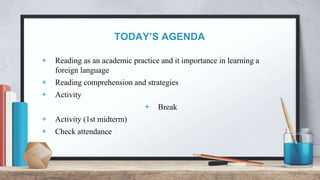
TODAY’S AGENDA
+ Reading as an academic practice and it importance in learning a
foreign language
+ Reading comprehension and strategies
+ Activity
+ Break
+ Activity (1st midterm)
+ Check attendance
READING AS AN
ACADEMIC
PRACTICE
READING AS AN ACADEMIC PRACTICE
+ The key purpose of academic reading is the acquisition and
construction of subject knowledge, however, it also plays a much
broader role in academic development and success.
+ It helps students to interact with and make connections and
judgements between texts, question contributions, and challenge
inherent biases and arguments. In this way, academic reading is
linked to the development of critical thinking.
+ However, it is necessary to practice in order to develop this skill
(reading comprehension)
How important is
reading for learning a
foreign language?
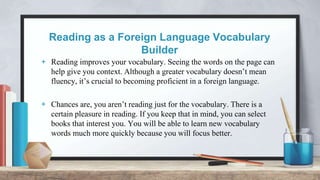
Reading as a Foreign Language Vocabulary
Builder
+ Reading improves your vocabulary. Seeing the words on the page can
help give you context. Although a greater vocabulary doesn’t mean
fluency, it’s crucial to becoming proficient in a foreign language.
+ Chances are, you aren’t reading just for the vocabulary. There is a
certain pleasure in reading. If you keep that in mind, you can select
books that interest you. You will be able to learn new vocabulary
words much more quickly because you will focus better.
Reading as a Foreign Language Vocabulary
Builder
+ You will also pick up idioms and phrases. This directly increases your
fluency. You’ll understand everyday speech easier. When you’re
reading, idioms and phrases are given a context in a safe space. You
won’t feel embarrassed when you’re unfamiliar with a saying. Feel free
to look things up as you go to understand.
+ As you read, focus on ideas and not just words. The point of reading is
to comprehend what you are reading first, which you are much more
likely to do if you aren’t too intent on single words. Vocabulary is just
a great benefit of reading – it is not the sole purpose.
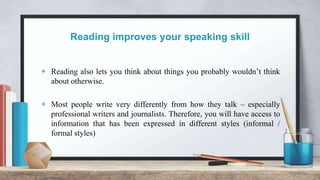
Reading improves your speaking skill
+ Reading also lets you think about things you probably wouldn’t think
about otherwise.
+ Most people write very differently from how they talk – especially
professional writers and journalists. Therefore, you will have access to
information that has been expressed in different styles (informal /
formal styles)
READING COMPREHENSION
+ Reading comprehension is the ability to read text, process it, and
understand its meaning.
+ Proficient reading depends on the ability to recognize words quickly
and effortlessly.
+ Ability of an individual to comprehend text depends upon:
1. Prior knowledge about the subject
2. Well-developed language skills
3. The ability to make inferences
Reading Comprehension Strategies
1. Summarizing
2. Questioning
3. Story mapping
4. Monitoring
5. Question answering
6. Graphic organizers
7. Mental imagery
8. Prior knowledge
1. Summarizing
Students identify what is important in the text by:
 retelling short parts of the text
 identify crucial details
 practice identifying crucial and irrelevant information in
the text
 locate key words and phrases that are meaningful to the
summary
 identify the main idea
2. Questioning
+ Students generate question before reading to increase interest
and motivation as well as activate background knowledge and
schema.
+ During reading students learning to ask questions to themselves
and others in order to focus on meaning and important points
throughout the text.
+ After reading questions can deepen understanding of the text
and clear confusions.
+ Questioning can lead to deep conversations.
3, Story Mapping
+ In story structure instruction, students learn to identify the
categories of content
4. Monitoring
+ Students monitor their own thinking and understanding and make
actionable decisions about what to do when they don’t understand
• Identify what is not understood
• Stop at the end of a smaller section of text to monitor for understanding
• Use fix-up strategies
5. Question Answering
+ Answering questions can:
• Give students a purpose for reading
• Focus students’ attention as they read
• Help students be active thinkers
• Help students self-monitor comprehension
• Make connections to what students know
6. Graphic Organizers
+ Illustrate concepts and relationships between concepts in a
text or using diagrams.
7. Mental Imagery
+ Visualize parts of the story in ones mind to increase
understanding.
• Talk about particularly descriptive information
• Share the image and compare people’s images
• Keep track of how images change as students continue to read
• Practice and encourage students to integrate on their own
8. Prior Knowledge
+ All of the experiences readers have had, including information they
have learned. This knowledge is used to bring texts to life and to
make them more relevant to the reader – activating allows students
to make more connections to the new information with connections
that allow them to access their schema.
+ Help students “think about their thinking”
9. Fluency
+ Fluency is “reasonably accurate reading, at an appropriate rate,
with suitable expression, that leads to accurate and deep
comprehension and motivation to read” (Hasbrouck & Glaser,
2012, p. 13).
+ Fluency is NOT just reading words fast.
Building Fluency
+ Don’t abandon foundational instruction of phonemics,
high-frequency word practice & vocabulary.
+ Provide extensive opportunities for students to read and
reread texts – practice orally
• Practice with shorter familiar passages
• Read familiar poems and song lyrics
• Practice short highly used phrases
• Reader’s Theater
Building Fluency
+ Expand vocabulary instruction in the context of authentic
reading – engage in rich discussions about words and building
meaning
+ Provide access to media and models that allow students to hear
fluent reading
• Reading along with audio books and videos
• Shared Reading
• Echo Reading
LET’S REFLECT ON THIS…
+ Reading and writing skills play an important role in keeping and
transmiting information from one generation to another.
+ The reality of the digital age is finally triggering the changes in
formal education settings that research has demanded for at least a
decade (knowledge vs digital age)

READING AS AN ACADEMIC PRACTICE.pptx

  • 1.
    TODAY’S AGENDA + Readingas an academic practice and it importance in learning a foreign language + Reading comprehension and strategies + Activity + Break + Activity (1st midterm) + Check attendance
  • 2.
  • 3.
    READING AS ANACADEMIC PRACTICE + The key purpose of academic reading is the acquisition and construction of subject knowledge, however, it also plays a much broader role in academic development and success. + It helps students to interact with and make connections and judgements between texts, question contributions, and challenge inherent biases and arguments. In this way, academic reading is linked to the development of critical thinking. + However, it is necessary to practice in order to develop this skill (reading comprehension)
  • 4.
    How important is readingfor learning a foreign language?
  • 5.
    Reading as aForeign Language Vocabulary Builder + Reading improves your vocabulary. Seeing the words on the page can help give you context. Although a greater vocabulary doesn’t mean fluency, it’s crucial to becoming proficient in a foreign language. + Chances are, you aren’t reading just for the vocabulary. There is a certain pleasure in reading. If you keep that in mind, you can select books that interest you. You will be able to learn new vocabulary words much more quickly because you will focus better.
  • 6.
    Reading as aForeign Language Vocabulary Builder + You will also pick up idioms and phrases. This directly increases your fluency. You’ll understand everyday speech easier. When you’re reading, idioms and phrases are given a context in a safe space. You won’t feel embarrassed when you’re unfamiliar with a saying. Feel free to look things up as you go to understand. + As you read, focus on ideas and not just words. The point of reading is to comprehend what you are reading first, which you are much more likely to do if you aren’t too intent on single words. Vocabulary is just a great benefit of reading – it is not the sole purpose.
  • 7.
    Reading improves yourspeaking skill + Reading also lets you think about things you probably wouldn’t think about otherwise. + Most people write very differently from how they talk – especially professional writers and journalists. Therefore, you will have access to information that has been expressed in different styles (informal / formal styles)
  • 8.
    READING COMPREHENSION + Readingcomprehension is the ability to read text, process it, and understand its meaning. + Proficient reading depends on the ability to recognize words quickly and effortlessly. + Ability of an individual to comprehend text depends upon: 1. Prior knowledge about the subject 2. Well-developed language skills 3. The ability to make inferences
  • 9.
    Reading Comprehension Strategies 1.Summarizing 2. Questioning 3. Story mapping 4. Monitoring 5. Question answering 6. Graphic organizers 7. Mental imagery 8. Prior knowledge
  • 10.
    1. Summarizing Students identifywhat is important in the text by:  retelling short parts of the text  identify crucial details  practice identifying crucial and irrelevant information in the text  locate key words and phrases that are meaningful to the summary  identify the main idea
  • 11.
    2. Questioning + Studentsgenerate question before reading to increase interest and motivation as well as activate background knowledge and schema. + During reading students learning to ask questions to themselves and others in order to focus on meaning and important points throughout the text. + After reading questions can deepen understanding of the text and clear confusions. + Questioning can lead to deep conversations.
  • 12.
    3, Story Mapping +In story structure instruction, students learn to identify the categories of content
  • 13.
    4. Monitoring + Studentsmonitor their own thinking and understanding and make actionable decisions about what to do when they don’t understand • Identify what is not understood • Stop at the end of a smaller section of text to monitor for understanding • Use fix-up strategies
  • 14.
    5. Question Answering +Answering questions can: • Give students a purpose for reading • Focus students’ attention as they read • Help students be active thinkers • Help students self-monitor comprehension • Make connections to what students know
  • 15.
    6. Graphic Organizers +Illustrate concepts and relationships between concepts in a text or using diagrams.
  • 16.
    7. Mental Imagery +Visualize parts of the story in ones mind to increase understanding. • Talk about particularly descriptive information • Share the image and compare people’s images • Keep track of how images change as students continue to read • Practice and encourage students to integrate on their own
  • 17.
    8. Prior Knowledge +All of the experiences readers have had, including information they have learned. This knowledge is used to bring texts to life and to make them more relevant to the reader – activating allows students to make more connections to the new information with connections that allow them to access their schema. + Help students “think about their thinking”
  • 18.
    9. Fluency + Fluencyis “reasonably accurate reading, at an appropriate rate, with suitable expression, that leads to accurate and deep comprehension and motivation to read” (Hasbrouck & Glaser, 2012, p. 13). + Fluency is NOT just reading words fast.
  • 19.
    Building Fluency + Don’tabandon foundational instruction of phonemics, high-frequency word practice & vocabulary. + Provide extensive opportunities for students to read and reread texts – practice orally • Practice with shorter familiar passages • Read familiar poems and song lyrics • Practice short highly used phrases • Reader’s Theater
  • 20.
    Building Fluency + Expandvocabulary instruction in the context of authentic reading – engage in rich discussions about words and building meaning + Provide access to media and models that allow students to hear fluent reading • Reading along with audio books and videos • Shared Reading • Echo Reading
  • 21.
    LET’S REFLECT ONTHIS… + Reading and writing skills play an important role in keeping and transmiting information from one generation to another. + The reality of the digital age is finally triggering the changes in formal education settings that research has demanded for at least a decade (knowledge vs digital age)