STRATEGIES FOR READING
COMPREHENSION
Saira
Shaza
Sana
Zahra
Eifa
STRATEGIES FOR READING COMPREHENSION
1. Comprehension Monitoring
 Reading activities can be divided into three
categories, depending on when they take place:
 Pre-reading
 During-reading
 Post-reading
CONTD..
 Pre-Reading
Preview and set a purpose
Activate prior knowledge
Wonder
Set a speed
CONTD..
 During-reading
 Teachers can guide students' interaction with the
text by asking questions about literary elements,
having students present oral summaries of the plot,
or asking them to collect details or write
observations on post-it notes.
 If students have previewed comprehension
questions, they can answer these questions as they
read.
 Always remember “Reading is Thinking”
CONTD..
 Elements which affect comprehension during
reading:
Monitoring
Visualizing
Questioning
Connecting
Inferring
CONTD..
 Post-Reading
 Reflect on what the text was mainly about through
talking, writing or drawing.
 Summarize the most important points.
 Reread for clarification.
 Evaluate
2. SEQUENCING
 Sequencing is a skill that can be incorporated into
any subject area, but it is often associated with
teaching early readers.
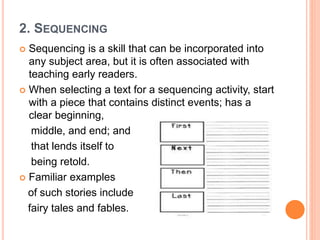
 When selecting a text for a sequencing activity, start
with a piece that contains distinct events; has a
clear beginning,
middle, and end; and
that lends itself to
being retold.
 Familiar examples
of such stories include
fairy tales and fables.
3. COOPERATIVE LEARNING
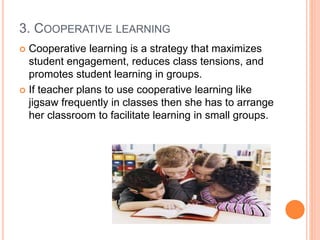
 Cooperative learning is a strategy that maximizes
student engagement, reduces class tensions, and
promotes student learning in groups.
 If teacher plans to use cooperative learning like
jigsaw frequently in classes then she has to arrange
her classroom to facilitate learning in small groups.
4. GRAPHIC ORGANIZERS AND STORY STRUCTURE
 Graphic organizers, which provide a visual map for
the reader.
 It can be placed next to the text as learners read in
groups or individually, aloud or silently.
 Following are descriptions of three types of
organizers.
 Comparison/Contrast
 Hierarchy Diagram
 Matrix Diagram
CONTD..
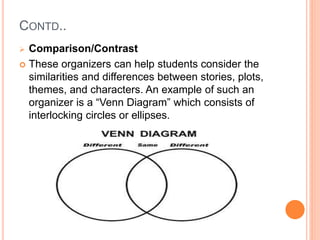
 Comparison/Contrast
 These organizers can help students consider the
similarities and differences between stories, plots,
themes, and characters. An example of such an
organizer is a “Venn Diagram” which consists of
interlocking circles or ellipses.
CONTD..
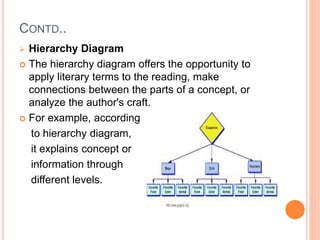
 Hierarchy Diagram
 The hierarchy diagram offers the opportunity to
apply literary terms to the reading, make
connections between the parts of a concept, or
analyze the author's craft.
 For example, according
to hierarchy diagram,
it explains concept or
information through
different levels.
CONTD..
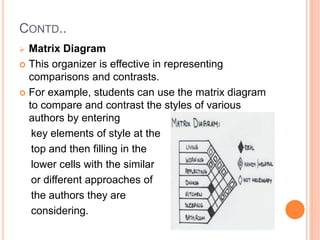
 Matrix Diagram
 This organizer is effective in representing
comparisons and contrasts.
 For example, students can use the matrix diagram
to compare and contrast the styles of various
authors by entering
key elements of style at the
top and then filling in the
lower cells with the similar
or different approaches of
the authors they are
considering.
5. QUESTION ANSWERING
 The typical approach to question answering is to
answer comprehension questions upon completion
of the selection, but questions can be a part of a
reading lesson at many points.
 Previewing questions can help students focus their
reading.
 Following are examples:
 Explain why….
 Explain how….
 How does…affect…?
 What is the meaning of…?
 Why is …important?
 What is the difference between … and…?
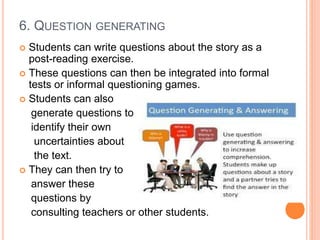
6. QUESTION GENERATING
 Students can write questions about the story as a
post-reading exercise.
 These questions can then be integrated into formal
tests or informal questioning games.
 Students can also
generate questions to
identify their own
uncertainties about
the text.
 They can then try to
answer these
questions by
consulting teachers or other students.
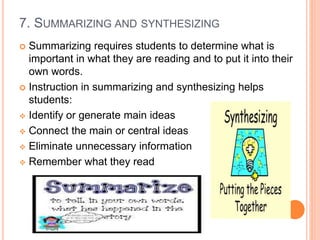
7. SUMMARIZING AND SYNTHESIZING
 Summarizing requires students to determine what is
important in what they are reading and to put it into their
own words.
 Instruction in summarizing and synthesizing helps
students:
 Identify or generate main ideas
 Connect the main or central ideas
 Eliminate unnecessary information
 Remember what they read
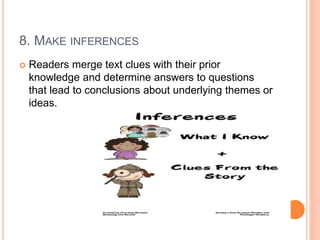
8. MAKE INFERENCES
 Readers merge text clues with their prior
knowledge and determine answers to questions
that lead to conclusions about underlying themes or
ideas.
9. MAIN IDEAS AND SUPPORTING IDEAS IN
READING COMPREHENSION
 The main idea, also called the central idea or main
point, is the primary concept of a passage.
 It represents the essential point that the author is
trying to convey.
 The main idea is usually reinforced by a series of
other points or details which support the premise of
the main idea.
 These are called supporting ideas and may also be
stated or implied.
 The main idea is the most important piece of
information the author wants you to know about the
concept of that paragraph.
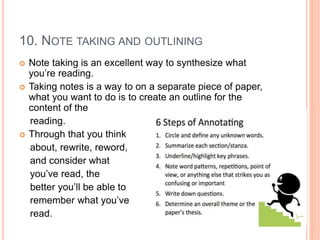
10. NOTE TAKING AND OUTLINING
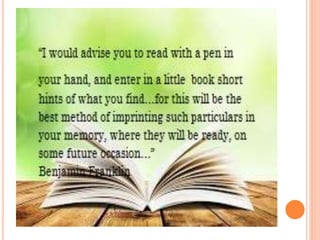
 Note taking is an excellent way to synthesize what
you’re reading.
 Taking notes is a way to on a separate piece of paper,
what you want to do is to create an outline for the
content of the
reading.
 Through that you think
about, rewrite, reword,
and consider what
you’ve read, the
better you’ll be able to
remember what you’ve
read.
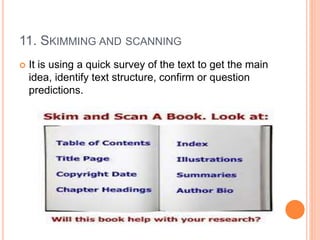
11. SKIMMING AND SCANNING
 It is using a quick survey of the text to get the main
idea, identify text structure, confirm or question
predictions.

Strategies for reading comprehension

  • 1.
  • 2.
    STRATEGIES FOR READINGCOMPREHENSION 1. Comprehension Monitoring  Reading activities can be divided into three categories, depending on when they take place:  Pre-reading  During-reading  Post-reading
  • 3.
    CONTD..  Pre-Reading Preview andset a purpose Activate prior knowledge Wonder Set a speed
  • 4.
    CONTD..  During-reading  Teacherscan guide students' interaction with the text by asking questions about literary elements, having students present oral summaries of the plot, or asking them to collect details or write observations on post-it notes.  If students have previewed comprehension questions, they can answer these questions as they read.  Always remember “Reading is Thinking”
  • 5.
    CONTD..  Elements whichaffect comprehension during reading: Monitoring Visualizing Questioning Connecting Inferring
  • 6.
    CONTD..  Post-Reading  Reflecton what the text was mainly about through talking, writing or drawing.  Summarize the most important points.  Reread for clarification.  Evaluate
  • 7.
    2. SEQUENCING  Sequencingis a skill that can be incorporated into any subject area, but it is often associated with teaching early readers.  When selecting a text for a sequencing activity, start with a piece that contains distinct events; has a clear beginning, middle, and end; and that lends itself to being retold.  Familiar examples of such stories include fairy tales and fables.
  • 8.
    3. COOPERATIVE LEARNING Cooperative learning is a strategy that maximizes student engagement, reduces class tensions, and promotes student learning in groups.  If teacher plans to use cooperative learning like jigsaw frequently in classes then she has to arrange her classroom to facilitate learning in small groups.
  • 9.
    4. GRAPHIC ORGANIZERSAND STORY STRUCTURE  Graphic organizers, which provide a visual map for the reader.  It can be placed next to the text as learners read in groups or individually, aloud or silently.  Following are descriptions of three types of organizers.  Comparison/Contrast  Hierarchy Diagram  Matrix Diagram
  • 10.
    CONTD..  Comparison/Contrast  Theseorganizers can help students consider the similarities and differences between stories, plots, themes, and characters. An example of such an organizer is a “Venn Diagram” which consists of interlocking circles or ellipses.
  • 11.
    CONTD..  Hierarchy Diagram The hierarchy diagram offers the opportunity to apply literary terms to the reading, make connections between the parts of a concept, or analyze the author's craft.  For example, according to hierarchy diagram, it explains concept or information through different levels.
  • 12.
    CONTD..  Matrix Diagram This organizer is effective in representing comparisons and contrasts.  For example, students can use the matrix diagram to compare and contrast the styles of various authors by entering key elements of style at the top and then filling in the lower cells with the similar or different approaches of the authors they are considering.
  • 13.
    5. QUESTION ANSWERING The typical approach to question answering is to answer comprehension questions upon completion of the selection, but questions can be a part of a reading lesson at many points.  Previewing questions can help students focus their reading.  Following are examples:  Explain why….  Explain how….  How does…affect…?  What is the meaning of…?  Why is …important?  What is the difference between … and…?
  • 14.
    6. QUESTION GENERATING Students can write questions about the story as a post-reading exercise.  These questions can then be integrated into formal tests or informal questioning games.  Students can also generate questions to identify their own uncertainties about the text.  They can then try to answer these questions by consulting teachers or other students.
  • 15.
    7. SUMMARIZING ANDSYNTHESIZING  Summarizing requires students to determine what is important in what they are reading and to put it into their own words.  Instruction in summarizing and synthesizing helps students:  Identify or generate main ideas  Connect the main or central ideas  Eliminate unnecessary information  Remember what they read
  • 16.
    8. MAKE INFERENCES Readers merge text clues with their prior knowledge and determine answers to questions that lead to conclusions about underlying themes or ideas.
  • 17.
    9. MAIN IDEASAND SUPPORTING IDEAS IN READING COMPREHENSION  The main idea, also called the central idea or main point, is the primary concept of a passage.  It represents the essential point that the author is trying to convey.  The main idea is usually reinforced by a series of other points or details which support the premise of the main idea.  These are called supporting ideas and may also be stated or implied.  The main idea is the most important piece of information the author wants you to know about the concept of that paragraph.
  • 18.
    10. NOTE TAKINGAND OUTLINING  Note taking is an excellent way to synthesize what you’re reading.  Taking notes is a way to on a separate piece of paper, what you want to do is to create an outline for the content of the reading.  Through that you think about, rewrite, reword, and consider what you’ve read, the better you’ll be able to remember what you’ve read.
  • 20.
    11. SKIMMING ANDSCANNING  It is using a quick survey of the text to get the main idea, identify text structure, confirm or question predictions.