What is Reading?
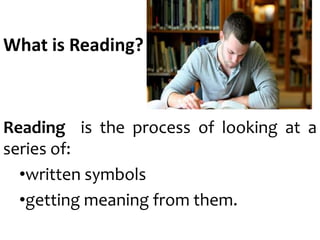
Reading is the process of looking at a
series of:
•written symbols
•getting meaning from them.
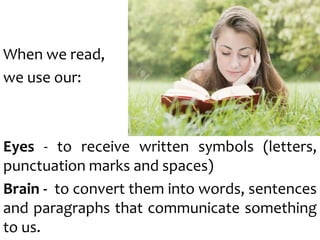
When we read,
we use our:
Eyes - to receive written symbols (letters,
punctuation marks and spaces)
Brain - to convert them into words, sentences
and paragraphs that communicate something
to us.
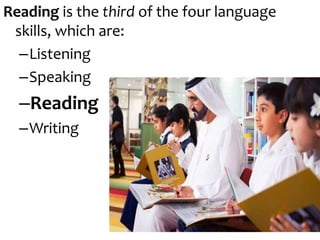
Reading is the third of the four language
skills, which are:
–Listening
–Speaking
–Reading
–Writing
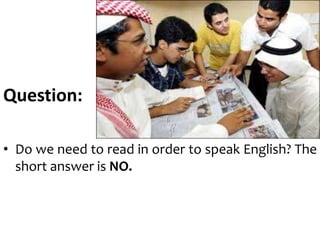
Question:
• Do we need to read in order to speak English? The
short answer is NO.
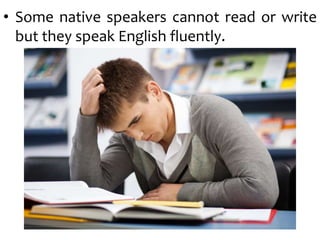
• Some native speakers cannot read or write
but they speak English fluently.
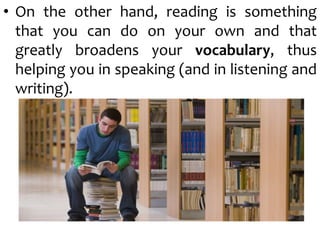
• On the other hand, reading is something
that you can do on your own and that
greatly broadens your vocabulary, thus
helping you in speaking (and in listening and
writing).
10 Reading Tips
• Read at a level slightly lower than what
you understand. You should not have to
look up a lot of words. It's okay to look
up a few words.
• Make reading a ritual. Choose a time
and place to read every day or week.
Commit to this reading time as if it
were a job.
• Read what interests you.
10 Reading Tips
• Understand what you'll be tested on.
There may be specific formats such as
advertisements that you'll have to read in
the test.
• Find free reading materials.
• Visualize what you are reading. Some
people try to imagine they are reading a
movie or a how-to video.
10 Reading Tips
• Listen and read. Find podcasts or videos
that have transcripts and read along
silently. You can also read out loud with
the recording.
• Relate what you read to your own life.
How does the reading apply to you?
10 Reading Tips
• Think about the author or
journalist. How would the reading differ
if you were the author?
• Check your eyesight. If you haven't had
your eyesight checked in the last few
years, make an appointment.
Reading Strategies
Here are some strategies for improving your
comprehension skills.
• Skim: read for the brief idea or overview.
• Scan: read for specific details or a specific reason.
• KWL: determine what you Know about the topic,
what you Want to know, and what you Learned.
• Skip: if you don't understand a word or section,
keep reading ahead. Come back to the section or
word again and try to figure out the meaning. Use a
dictionary if necessary.
Reading Strategies
• Look for headings, subtitles and keywords.
• Read out loud: children read out loud when they
first start reading. You can too. Get comfortable
hearing your English voice.
• Create timelines or charts: reorganize what you
read in a different format.
• Rewrite in a different tense.
• Rewrite in a different format: for example, rewrite
an article in letter or list form.
Reading Strategies
• Illustrate: if you think you're a visual learner, sketch
images or an info graphic related to what you read.
• Write the questions: as you read, think about which
questions you might find on a test or quiz. Write
them down and answer them, or quiz a friend.
• Summarize or retell: you can do this by writing a
letter to a friend, writing a blog post, making a web
cam video, or just starting a conversation on this
topic.
• Learn affixes: knowing prefixes and suffixes will
increase your word recognition.
Reading Strategies
• Keep a vocabulary journal.
• Get a vocabulary partner.
• Use a pen or ruler: some people find it is easier to
read with a pacer. A pen, ruler or fingertip can help
you keep your place and prevent your eyes from
wandering off. This may not be suitable if you are
reading on a computer or mobile device. Adjust the
screen to a larger size if necessary.
Reading Categories
Fiction -writing that describes
imaginary events and people
(such as short stories and
novels):
• classics
• crime and mystery
• fantasy
• horror
• literary fiction
• popular fiction
• romance
• science fiction
• short stories
• women's fiction
• young adult fiction
Reading Categories
• Non-fiction - writing about
facts, real events and real
people (such as history or
biography):
• arts and crafts
• autobiography
• biography
• cooking
• gardening
• history
• how to
• memoir
• science
• self-help
• technology
• travel

Learning Reading

  • 1.
    What is Reading? Readingis the process of looking at a series of: •written symbols •getting meaning from them.
  • 2.
    When we read, weuse our: Eyes - to receive written symbols (letters, punctuation marks and spaces) Brain - to convert them into words, sentences and paragraphs that communicate something to us.
  • 3.
    Reading is thethird of the four language skills, which are: –Listening –Speaking –Reading –Writing
  • 4.
    Question: • Do weneed to read in order to speak English? The short answer is NO.
  • 5.
    • Some nativespeakers cannot read or write but they speak English fluently.
  • 6.
    • On theother hand, reading is something that you can do on your own and that greatly broadens your vocabulary, thus helping you in speaking (and in listening and writing).
  • 7.
    10 Reading Tips •Read at a level slightly lower than what you understand. You should not have to look up a lot of words. It's okay to look up a few words. • Make reading a ritual. Choose a time and place to read every day or week. Commit to this reading time as if it were a job. • Read what interests you.
  • 8.
    10 Reading Tips •Understand what you'll be tested on. There may be specific formats such as advertisements that you'll have to read in the test. • Find free reading materials. • Visualize what you are reading. Some people try to imagine they are reading a movie or a how-to video.
  • 9.
    10 Reading Tips •Listen and read. Find podcasts or videos that have transcripts and read along silently. You can also read out loud with the recording. • Relate what you read to your own life. How does the reading apply to you?
  • 10.
    10 Reading Tips •Think about the author or journalist. How would the reading differ if you were the author? • Check your eyesight. If you haven't had your eyesight checked in the last few years, make an appointment.
  • 11.
    Reading Strategies Here aresome strategies for improving your comprehension skills. • Skim: read for the brief idea or overview. • Scan: read for specific details or a specific reason. • KWL: determine what you Know about the topic, what you Want to know, and what you Learned. • Skip: if you don't understand a word or section, keep reading ahead. Come back to the section or word again and try to figure out the meaning. Use a dictionary if necessary.
  • 12.
    Reading Strategies • Lookfor headings, subtitles and keywords. • Read out loud: children read out loud when they first start reading. You can too. Get comfortable hearing your English voice. • Create timelines or charts: reorganize what you read in a different format. • Rewrite in a different tense. • Rewrite in a different format: for example, rewrite an article in letter or list form.
  • 13.
    Reading Strategies • Illustrate:if you think you're a visual learner, sketch images or an info graphic related to what you read. • Write the questions: as you read, think about which questions you might find on a test or quiz. Write them down and answer them, or quiz a friend. • Summarize or retell: you can do this by writing a letter to a friend, writing a blog post, making a web cam video, or just starting a conversation on this topic. • Learn affixes: knowing prefixes and suffixes will increase your word recognition.
  • 14.
    Reading Strategies • Keepa vocabulary journal. • Get a vocabulary partner. • Use a pen or ruler: some people find it is easier to read with a pacer. A pen, ruler or fingertip can help you keep your place and prevent your eyes from wandering off. This may not be suitable if you are reading on a computer or mobile device. Adjust the screen to a larger size if necessary.
  • 15.
    Reading Categories Fiction -writingthat describes imaginary events and people (such as short stories and novels): • classics • crime and mystery • fantasy • horror • literary fiction • popular fiction • romance • science fiction • short stories • women's fiction • young adult fiction
  • 16.
    Reading Categories • Non-fiction- writing about facts, real events and real people (such as history or biography): • arts and crafts • autobiography • biography • cooking • gardening • history • how to • memoir • science • self-help • technology • travel