Responsibility of Personnel
Training, Evaluation, and Ensuring Aseptic Compounding
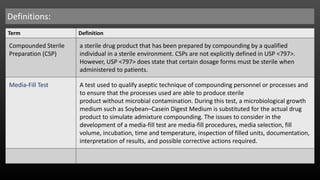
Definitions:
Term Definition
Compounded Sterile
Preparation (CSP)
a sterile drug product that has been prepared by compounding by a qualified
individual in a sterile environment. CSPs are not explicitly defined in USP <797>.
However, USP <797> does state that certain dosage forms must be sterile when
administered to patients.
Media-Fill Test A test used to qualify aseptic technique of compounding personnel or processes and
to ensure that the processes used are able to produce sterile
product without microbial contamination. During this test, a microbiological growth
medium such as Soybean–Casein Digest Medium is substituted for the actual drug
product to simulate admixture compounding. The issues to consider in the
development of a media-fill test are media-fill procedures, media selection, fill
volume, incubation, time and temperature, inspection of filled units, documentation,
interpretation of results, and possible corrective actions required.
Compounding personnel are responsible for
ensuring that CSPs are accurately identified,
measured, diluted, and mixed and are correctly
purified, sterilized, packaged, sealed, labeled,
stored, dispensed, and distributed. These
performance responsibilities include maintaining
appropriate cleanliness conditions and providing
labeling and supplementary instructions for the
proper clinical administration of CSPs.
Personnel who prepare CSPs shall be trained
conscientiously and skillfully by expert
personnel and through audio–video
instructional sources and professional
publications in the theoretical principles and
practical skills of aseptic manipulations and in
achieving and maintaining ISO Class 5
environmental conditions before they begin to
prepare CSPs.
Compounding supervisors shall ensure,
through either direct measurement or
appropriate information sources, that specific
CSPs maintain their labeled strength within
monograph limits for USP articles, or within
10% if not specified, until their BUDs. All CSPs
are prepared in a manner that maintains
sterility and minimizes the introduction of
particulate matter.
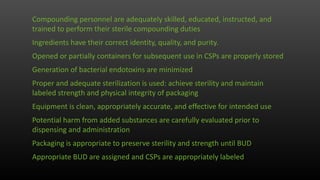
Compounding supervisors must also
ensure the following:
Compounding personnel are adequately skilled, educated, instructed, and
trained to perform their sterile compounding duties
Ingredients have their correct identity, quality, and purity.
Opened or partially containers for subsequent use in CSPs are properly stored
Generation of bacterial endotoxins are minimized
Proper and adequate sterilization is used: achieve sterility and maintain
labeled strength and physical integrity of packaging
Equipment is clean, appropriately accurate, and effective for intended use
Potential harm from added substances are carefully evaluated prior to
dispensing and administration
Packaging is appropriate to preserve sterility and strength until BUD
Appropriate BUD are assigned and CSPs are appropriately labeled
Compounding personnel shall perform didactic
review and pass written and media-fill testing
of aseptic manipulative skills initially, at least
annually thereafter for low- and medium-risk
level compounding, and semiannually for high-
risk level compounding.
Compounding personnel who fail written tests
or whose media-fill test vials result in gross
microbial colonization shall be immediately re-
instructed and re-evaluated by expert
compounding personnel to ensure correction
of all aseptic practice deficiencies.
Media-Fill Challenge Testing
Media-fill testing is used to assess the quality of the aseptic skill of
compounding personnel.
Media-fill tests represent the most challenging or stressful
conditions actually encountered by the personnel being evaluated
when they prepare particular risk level CSPs and when sterilizing
high-risk level CSPs. Media-fill challenge tests that simulate high-risk
level compounding are also used to verify the capability of the
compounding environment and process to produce a sterile
preparation.
Commercially available sterile fluid culture media, such as Soybean–
Casein Digest Medium (a.k.a - trypticase soy broth or trypticase
soy agar [TSA] )shall be able to promote exponential colonization
of bacteria that are most likely to be transmitted to CSPs from the
compounding personnel and environment.
Media-filled vials are generally incubated at 20° to 25° or at 30° to
35° for a minimum of 14 days.
If two temperatures are used for incubation of media-filled samples,
then these filled containers should be incubated for at least 7 days
at each temperature. Failure is indicated by visible turbidity in the
medium on or before 14 days.
Media-Fill Test Procedure
for Low-Risk Level CSPs
LOW-RISK CSPs
Performed at least annually by each person authorized
to compound in a low-risk level environment under
conditions that closely simulate the most challenging or
stressful conditions encountered during compounding
low-risk CSPs.
Once begun, test is completed without interruption.
LOW-RISK CSPs
Example of test procedure:
Within an ISO Class 5 air quality environment:
Three sets of four 5-mL aliquots of sterile Soybean– Casein Digest Medium are
transferred with the same sterile 10-mL syringe and vented needle combination
into separate sealed, empty, sterile 30-mL clear vials (i.e., four 5-mL aliquots into
each of three 30-mL vials).
Sterile adhesive seals are aseptically affixed to the rubber closures on the three
filled vials
Vials incubated at 20° to 25° or at 30° to 35° for a minimum of 14 days. If two
temperatures used for incubation, then containers should be incubated for at least
7 days at each temperature
Inspect for microbial growth over 14 days
LOW-RISK CSPs
Media-Fill Test Procedure
for Medium-Risk Level CSPs
MEDIUM-RISK CSPs
Performed at least annually by each person authorized
to compound in a low-risk level environment under
conditions that closely simulate the most challenging or
stressful conditions encountered during compounding
medium-risk CSPs
Once begun, test is completed without interruption.
Example of test procedure:
Within an ISO Class 5 air quality environment:
Six 100-mL aliquots of sterile Soybean–Casein Digest Medium are aseptically transferred by
gravity through separate tubing sets into separate evacuated sterile containers. The six
containers are then arranged as three pairs, and a sterile 10-mL syringe and 18-gauge needle
combination is used to exchange two 5-mL aliquots of medium from one container to the other
container in the pair. For example, after a 5-mL aliquot from the first container is added to the
second container in the pair, the second container is agitated for 10 seconds, then a 5-mL
aliquot is removed and returned to the first container in the pair. The first container is then
agitated for 10 seconds, and the next 5-mL aliquot is transferred from it back to the second
container in the pair. Following the two 5-mL aliquot exchanges in each pair of containers, a 5-
mL aliquot of medium from each container is aseptically injected into a sealed, empty, sterile
10-mL clear vial, using a sterile 10-mL syringe and vented needle.
Sterile adhesive seals are aseptically affixed to the rubber closures on the three filled vials
Vials incubated at 20° to 25° or at 30° to 35° for a minimum of 14 days. If two temperatures
used for incubation, then containers should be incubated for at least 7 days at each
temperature.
Inspect for microbial growth over 14 days.
MEDIUM-RISK CSPs
MEDIUM-RISK CSPs
Media-Fill Test Procedure
for High-Risk Level CSPs
HIGH-RISK CSPs
Performed semiannually by each person authorized to
compound high-risk level CSPs under conditions that
closely simulate the most challenging or stressful
conditions encountered when compounding high-risk
level CSPs.
Once begun, test is completed without interruption.
HIGH-RISK CSPs
Example of test procedure (in the following sequence):
1. Dissolve 3 g of nonsterile commercially available Soybean–Casein Digest Medium in
100 mL of nonbacteriostatic water to make a 3% nonsterile solution.
2. Draw 25 mL of the medium into each of three 30-mL sterile syringes. Transfer 5 mL
from each syringe into separate sterile 10-mL vials. These vials are the positive controls
to generate exponential microbial growth, which is indicated by visible turbidity upon
incubation.
3. Under aseptic conditions and using aseptic techniques, affix a sterile 0.2-mm or 0.22-
mm nominal pore size filter unit and a 20-gauge needle to each syringe. Inject the next
10 mL from each syringe into three separate 10-mL sterile vials. Repeat the process for
three more vials. Label all vials, affix sterile adhesive seals to the closure of the nine
vials, and incubate them at 20° to 25° or at 30° to 35° for a minimum of 14 days. If two
temperatures used for incubation, then containers should be incubated for at least 7
days at each temperature. Inspect for microbial growth over 14 days.
HIGH-RISK CSPs
JERRY FAHRNI, PHARM.D.

Compounding personnel

  • 1.
    Responsibility of Personnel Training,Evaluation, and Ensuring Aseptic Compounding
  • 2.
    Definitions: Term Definition Compounded Sterile Preparation(CSP) a sterile drug product that has been prepared by compounding by a qualified individual in a sterile environment. CSPs are not explicitly defined in USP <797>. However, USP <797> does state that certain dosage forms must be sterile when administered to patients. Media-Fill Test A test used to qualify aseptic technique of compounding personnel or processes and to ensure that the processes used are able to produce sterile product without microbial contamination. During this test, a microbiological growth medium such as Soybean–Casein Digest Medium is substituted for the actual drug product to simulate admixture compounding. The issues to consider in the development of a media-fill test are media-fill procedures, media selection, fill volume, incubation, time and temperature, inspection of filled units, documentation, interpretation of results, and possible corrective actions required.
  • 3.
    Compounding personnel areresponsible for ensuring that CSPs are accurately identified, measured, diluted, and mixed and are correctly purified, sterilized, packaged, sealed, labeled, stored, dispensed, and distributed. These performance responsibilities include maintaining appropriate cleanliness conditions and providing labeling and supplementary instructions for the proper clinical administration of CSPs.
  • 4.
    Personnel who prepareCSPs shall be trained conscientiously and skillfully by expert personnel and through audio–video instructional sources and professional publications in the theoretical principles and practical skills of aseptic manipulations and in achieving and maintaining ISO Class 5 environmental conditions before they begin to prepare CSPs.
  • 5.
    Compounding supervisors shallensure, through either direct measurement or appropriate information sources, that specific CSPs maintain their labeled strength within monograph limits for USP articles, or within 10% if not specified, until their BUDs. All CSPs are prepared in a manner that maintains sterility and minimizes the introduction of particulate matter.
  • 6.
    Compounding supervisors mustalso ensure the following:
  • 7.
    Compounding personnel areadequately skilled, educated, instructed, and trained to perform their sterile compounding duties Ingredients have their correct identity, quality, and purity. Opened or partially containers for subsequent use in CSPs are properly stored Generation of bacterial endotoxins are minimized Proper and adequate sterilization is used: achieve sterility and maintain labeled strength and physical integrity of packaging Equipment is clean, appropriately accurate, and effective for intended use Potential harm from added substances are carefully evaluated prior to dispensing and administration Packaging is appropriate to preserve sterility and strength until BUD Appropriate BUD are assigned and CSPs are appropriately labeled
  • 8.
    Compounding personnel shallperform didactic review and pass written and media-fill testing of aseptic manipulative skills initially, at least annually thereafter for low- and medium-risk level compounding, and semiannually for high- risk level compounding.
  • 9.
    Compounding personnel whofail written tests or whose media-fill test vials result in gross microbial colonization shall be immediately re- instructed and re-evaluated by expert compounding personnel to ensure correction of all aseptic practice deficiencies.
  • 10.
    Media-Fill Challenge Testing Media-filltesting is used to assess the quality of the aseptic skill of compounding personnel. Media-fill tests represent the most challenging or stressful conditions actually encountered by the personnel being evaluated when they prepare particular risk level CSPs and when sterilizing high-risk level CSPs. Media-fill challenge tests that simulate high-risk level compounding are also used to verify the capability of the compounding environment and process to produce a sterile preparation. Commercially available sterile fluid culture media, such as Soybean– Casein Digest Medium (a.k.a - trypticase soy broth or trypticase soy agar [TSA] )shall be able to promote exponential colonization of bacteria that are most likely to be transmitted to CSPs from the compounding personnel and environment. Media-filled vials are generally incubated at 20° to 25° or at 30° to 35° for a minimum of 14 days. If two temperatures are used for incubation of media-filled samples, then these filled containers should be incubated for at least 7 days at each temperature. Failure is indicated by visible turbidity in the medium on or before 14 days.
  • 11.
    Media-Fill Test Procedure forLow-Risk Level CSPs
  • 12.
    LOW-RISK CSPs Performed atleast annually by each person authorized to compound in a low-risk level environment under conditions that closely simulate the most challenging or stressful conditions encountered during compounding low-risk CSPs. Once begun, test is completed without interruption.
  • 13.
    LOW-RISK CSPs Example oftest procedure: Within an ISO Class 5 air quality environment: Three sets of four 5-mL aliquots of sterile Soybean– Casein Digest Medium are transferred with the same sterile 10-mL syringe and vented needle combination into separate sealed, empty, sterile 30-mL clear vials (i.e., four 5-mL aliquots into each of three 30-mL vials). Sterile adhesive seals are aseptically affixed to the rubber closures on the three filled vials Vials incubated at 20° to 25° or at 30° to 35° for a minimum of 14 days. If two temperatures used for incubation, then containers should be incubated for at least 7 days at each temperature Inspect for microbial growth over 14 days
  • 14.
  • 15.
    Media-Fill Test Procedure forMedium-Risk Level CSPs
  • 16.
    MEDIUM-RISK CSPs Performed atleast annually by each person authorized to compound in a low-risk level environment under conditions that closely simulate the most challenging or stressful conditions encountered during compounding medium-risk CSPs Once begun, test is completed without interruption.
  • 17.
    Example of testprocedure: Within an ISO Class 5 air quality environment: Six 100-mL aliquots of sterile Soybean–Casein Digest Medium are aseptically transferred by gravity through separate tubing sets into separate evacuated sterile containers. The six containers are then arranged as three pairs, and a sterile 10-mL syringe and 18-gauge needle combination is used to exchange two 5-mL aliquots of medium from one container to the other container in the pair. For example, after a 5-mL aliquot from the first container is added to the second container in the pair, the second container is agitated for 10 seconds, then a 5-mL aliquot is removed and returned to the first container in the pair. The first container is then agitated for 10 seconds, and the next 5-mL aliquot is transferred from it back to the second container in the pair. Following the two 5-mL aliquot exchanges in each pair of containers, a 5- mL aliquot of medium from each container is aseptically injected into a sealed, empty, sterile 10-mL clear vial, using a sterile 10-mL syringe and vented needle. Sterile adhesive seals are aseptically affixed to the rubber closures on the three filled vials Vials incubated at 20° to 25° or at 30° to 35° for a minimum of 14 days. If two temperatures used for incubation, then containers should be incubated for at least 7 days at each temperature. Inspect for microbial growth over 14 days. MEDIUM-RISK CSPs
  • 18.
  • 19.
    Media-Fill Test Procedure forHigh-Risk Level CSPs
  • 20.
    HIGH-RISK CSPs Performed semiannuallyby each person authorized to compound high-risk level CSPs under conditions that closely simulate the most challenging or stressful conditions encountered when compounding high-risk level CSPs. Once begun, test is completed without interruption.
  • 21.
    HIGH-RISK CSPs Example oftest procedure (in the following sequence): 1. Dissolve 3 g of nonsterile commercially available Soybean–Casein Digest Medium in 100 mL of nonbacteriostatic water to make a 3% nonsterile solution. 2. Draw 25 mL of the medium into each of three 30-mL sterile syringes. Transfer 5 mL from each syringe into separate sterile 10-mL vials. These vials are the positive controls to generate exponential microbial growth, which is indicated by visible turbidity upon incubation. 3. Under aseptic conditions and using aseptic techniques, affix a sterile 0.2-mm or 0.22- mm nominal pore size filter unit and a 20-gauge needle to each syringe. Inject the next 10 mL from each syringe into three separate 10-mL sterile vials. Repeat the process for three more vials. Label all vials, affix sterile adhesive seals to the closure of the nine vials, and incubate them at 20° to 25° or at 30° to 35° for a minimum of 14 days. If two temperatures used for incubation, then containers should be incubated for at least 7 days at each temperature. Inspect for microbial growth over 14 days.
  • 22.
  • 23.