
Understanding Beyond-Use Dating
for Sterile Compounding
The beyond-use date (BUD) of a
product is not the same as the
expiration date
A BUD is assigned by the pharmacy for
a compounded sterile product (CSP)
The BUD for a CSP identifies the time by which the
preparation – once mixed – must be used before it
is at risk for chemical degradation, contamination,
and permeability of the packaging.
The BUD date signifies the time after
which a CSP cannot be administered
As described in previous ASHP guidelines and in USP
chapter <797> the BUD is determined from the date or
time the preparation is compounded, its chemical
stability, and the sterility limits described later in these
guidelines. Both the stability of the components and the
sterility limits described must be taken into
consideration when determining BUDs
Am J Health-Syst Pharm. 2014; 71:145-66.
Time and temperature must be
controlled throughout the entire life
cycle of a CSP.
Storage and Beyond-Used Dating. In: The United States pharmacopeia, 37th rev., and The national formulary, 32nd ed. Rockville,MD: The United States Pharmacopeial
Convention; 2014:66.
When CSPs are known to have been exposed to
temperatures warmer than the warmest labeled limit or
to temperatures exceeding 40° for more than 4 hours,
such CSPs should be discarded unless direct assay data
or appropriate documentation confirms their continued
stability.
Storage and Beyond-Used Dating. In: The United States pharmacopeia, 37th rev., and The national formulary, 32nd ed. Rockville, MD: The United States Pharmacopeial
Convention; 2014:66.
The BUD must appear on the label on
the container or package of a
compounded preparation
General notices and requirements. In: The United States pharmacopeia, 37th rev., and The national formulary, 32nd ed. Rockville, MD: The United States Pharmacopeial
Convention; 2014:26.
The BUD must be shorter than the
manufacturer’s expiration date. Often
the BUD is much shorter.
The BUD must be the shorter of the
sterility dating or chemical stability
dating.
Am J Health-Syst Pharm. 2014; 71:145-66.
So even if something is stable for 30
days doesn’t mean it’s sterile for 30
days. You must use the shorter of the
two for BUD.
An expiration date is identified by the
product manufacturer
The FDA defines expiration date as: The date
(usually placed on the containers/labels of an API)
designating the time during which the API is
expected to remain within established shelf-life
specifications if stored under defined conditions
and alter which it should not be used
(API) = Active Pharmaceutical Ingredient
A manufacturer’s expiration date is the date
assigned pursuant to manufacturer testing.
The drug product is guaranteed by the
manufacturer to be safe and effective up to
the listed date when products are stored as
described in the product labeling.
Am J Health-Syst Pharm. 2014; 71:145-66.
The expiration date assigned by the
manufacturer no longer applies once the
manufacture's container is opened and the
drug product is transferred to another
container for dispensing or repackaging
As you can see, the BUD of a product
is not the same as the expiration date
Does USP provide recommendations
for BUDs?
Of course!
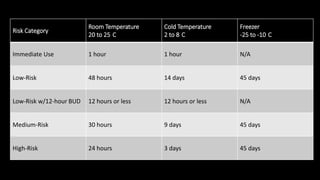
USP <797> provides recommended
BUD guidelines based on CSP
microbial contamination risk category
For more information on CSP risk category……[link to CSP Risk Category presentation]
Risk Category
Room Temperature
20 to 25°C
Cold Temperature
2 to 8°C
Freezer
-25 to -10°C
Immediate Use 1 hour 1 hour N/A
Low-Risk 48 hours 14 days 45 days
Low-Risk w/12-hour BUD 12 hours or less 12 hours or less N/A
Medium-Risk 30 hours 9 days 45 days
High-Risk 24 hours 3 days 45 days
Can BUDs beyond USP guidelines be
used?
Yes, but with a caveat …
Pharmacies may exceed USP <797>’s
recommended BUDs for CSPs as long
as independent sterility testing is
performed according to USP <71>
JERRY FAHRNI, PHARM.D.

Understanding Beyond-Use Dating for Sterile Compounds

  • 1.
  • 2.
    The beyond-use date(BUD) of a product is not the same as the expiration date
  • 3.
    A BUD isassigned by the pharmacy for a compounded sterile product (CSP)
  • 4.
    The BUD fora CSP identifies the time by which the preparation – once mixed – must be used before it is at risk for chemical degradation, contamination, and permeability of the packaging.
  • 5.
    The BUD datesignifies the time after which a CSP cannot be administered
  • 6.
    As described inprevious ASHP guidelines and in USP chapter <797> the BUD is determined from the date or time the preparation is compounded, its chemical stability, and the sterility limits described later in these guidelines. Both the stability of the components and the sterility limits described must be taken into consideration when determining BUDs Am J Health-Syst Pharm. 2014; 71:145-66.
  • 7.
    Time and temperaturemust be controlled throughout the entire life cycle of a CSP. Storage and Beyond-Used Dating. In: The United States pharmacopeia, 37th rev., and The national formulary, 32nd ed. Rockville,MD: The United States Pharmacopeial Convention; 2014:66.
  • 8.
    When CSPs areknown to have been exposed to temperatures warmer than the warmest labeled limit or to temperatures exceeding 40° for more than 4 hours, such CSPs should be discarded unless direct assay data or appropriate documentation confirms their continued stability. Storage and Beyond-Used Dating. In: The United States pharmacopeia, 37th rev., and The national formulary, 32nd ed. Rockville, MD: The United States Pharmacopeial Convention; 2014:66.
  • 9.
    The BUD mustappear on the label on the container or package of a compounded preparation General notices and requirements. In: The United States pharmacopeia, 37th rev., and The national formulary, 32nd ed. Rockville, MD: The United States Pharmacopeial Convention; 2014:26.
  • 10.
    The BUD mustbe shorter than the manufacturer’s expiration date. Often the BUD is much shorter.
  • 11.
    The BUD mustbe the shorter of the sterility dating or chemical stability dating. Am J Health-Syst Pharm. 2014; 71:145-66.
  • 12.
    So even ifsomething is stable for 30 days doesn’t mean it’s sterile for 30 days. You must use the shorter of the two for BUD.
  • 13.
    An expiration dateis identified by the product manufacturer
  • 14.
    The FDA definesexpiration date as: The date (usually placed on the containers/labels of an API) designating the time during which the API is expected to remain within established shelf-life specifications if stored under defined conditions and alter which it should not be used (API) = Active Pharmaceutical Ingredient
  • 15.
    A manufacturer’s expirationdate is the date assigned pursuant to manufacturer testing. The drug product is guaranteed by the manufacturer to be safe and effective up to the listed date when products are stored as described in the product labeling. Am J Health-Syst Pharm. 2014; 71:145-66.
  • 16.
    The expiration dateassigned by the manufacturer no longer applies once the manufacture's container is opened and the drug product is transferred to another container for dispensing or repackaging
  • 17.
    As you cansee, the BUD of a product is not the same as the expiration date
  • 18.
    Does USP providerecommendations for BUDs?
  • 19.
  • 20.
    USP <797> providesrecommended BUD guidelines based on CSP microbial contamination risk category For more information on CSP risk category……[link to CSP Risk Category presentation]
  • 21.
    Risk Category Room Temperature 20to 25°C Cold Temperature 2 to 8°C Freezer -25 to -10°C Immediate Use 1 hour 1 hour N/A Low-Risk 48 hours 14 days 45 days Low-Risk w/12-hour BUD 12 hours or less 12 hours or less N/A Medium-Risk 30 hours 9 days 45 days High-Risk 24 hours 3 days 45 days
  • 22.
    Can BUDs beyondUSP guidelines be used?
  • 23.
    Yes, but witha caveat …
  • 24.
    Pharmacies may exceedUSP <797>’s recommended BUDs for CSPs as long as independent sterility testing is performed according to USP <71>
  • 25.

Editor's Notes

  • #7 American Society of Health-System Pharmacists. ASHP Guidelines on Compounding Sterile Preparations. Am J Health-Syst Pharm. 2014; 71:145-66.
  • #8 ** Storage and Beyond-Used Dating. In: The United States pharmacopeia, 37th rev., and The national formulary, 32nd ed. Rockville, MD: The United States Pharmacopeial Convention; 2014:66.
  • #9 ** Storage and Beyond-Used Dating. In: The United States pharmacopeia, 37th rev., and The national formulary, 32nd ed. Rockville, MD: The United States Pharmacopeial Convention; 2014:66.
  • #12 American Society of Health-System Pharmacists. ASHP Guidelines on Compounding Sterile Preparations. Am J Health-Syst Pharm. 2014; 71:145-66.
  • #15 (API) Active Pharmaceutical Ingredient
  • #16 American Society of Health-System Pharmacists. ASHP Guidelines on Compounding Sterile Preparations. Am J Health-Syst Pharm. 2014; 71:145-66.
  • #22 Temperature ranges: General notices and requirements. In: The United States pharmacopeia, 37th rev., and The national formulary, 32nd ed. Rockville, MD: The United States Pharmacopeial Convention; 2014:66.