














The real work starts after implementation Jerry Fahrni, Pharm.D.  Product Manager Talyst, Inc
Describe components necessary for BCMA success  Describe tools to go beyond traditional troubleshooting Identify need for multi-disciplinary collaborative efforts Identify methods to analyze human factors associated  with BCMA failure Identify tools utilized to go beyond basic data analysis Defend punitive measures
And now for the blah, blah, blah…
BCMA Problematic Valuable A journey Disruptive Experimental Educational Fun Labor intensive Time consuming Resource heavy Lifetime work
5 SUGGESTIONS FOR POST-BCMA SUCCESS
Develop  the right  team …
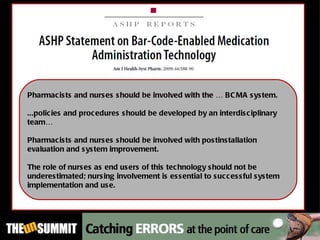
Pharmacists and nurses should be involved with the … BCMA system.  ...policies and procedures should be developed by an interdisciplinary team…  Pharmacists and nurses should be involved with postinstallation evaluation and system improvement. The role of nurses as end users of this technology should not be underestimated; nursing involvement is essential to successful system implementation and use.
“… it isn’t electronic medical records, superstar physicians, adherence to protocols, high-tech equipment, or data on re-admission rates that make a hospital great, it’s the culture - how people communicate and support each other and the organization .”  –  Richard Reece, M.D. Source: http://medinnovationblog.blogspot.com/2011/03/search-for-very-best-hospitals.html
Drag the c-suite into the weeds with you “ Politicians are the same all over. They promise to build a bridge even where there is no river.”  - Nikita Khrushchev
Dig, dig, dig … tunnel if you must
 
DATA MINING
TROUBLESHOOTING
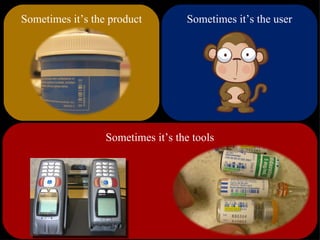
Sometimes it’s the product Sometimes it’s the user Sometimes it’s the tools
THE PRODUCT
THE TOOLS
 
THE HUMAN ELEMENT
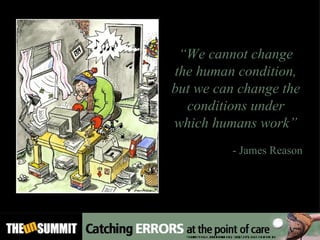
“ We cannot change the human condition, but we can change the conditions under which humans work” - James Reason Source: BMJ. 2000 March 18; 320(7237): 768–770.PMCID: 
Don’t just read the reports….
“ nothing good ever happens  in the office”
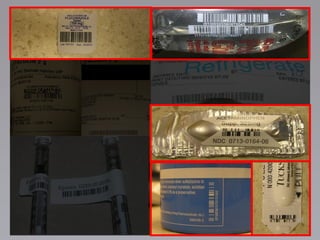
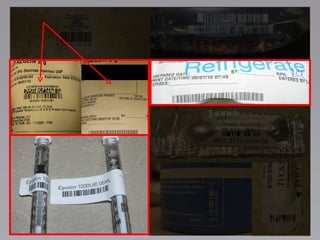
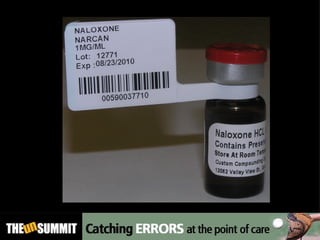
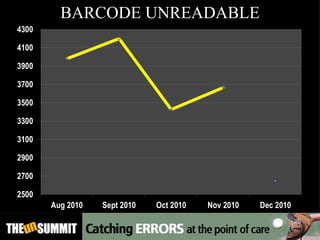
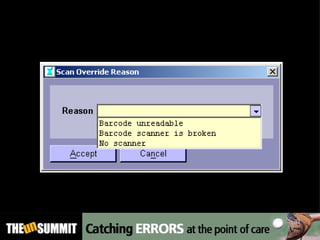
BARCODE UNREADABLE
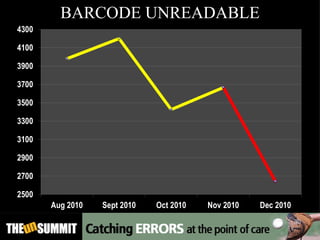
BARCODE UNREADABLE
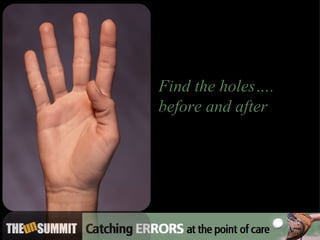
Find the holes…. before and after
F ailure  M odes and  E ffects  A nalysis ( FMEA)
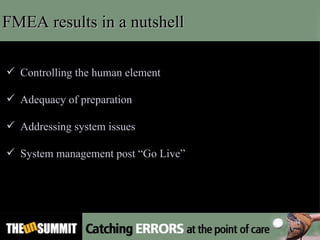
Controlling the human element Adequacy of preparation Addressing system issues System management post “Go Live” FMEA results in a nutshell
 
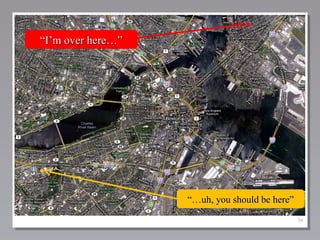
“ I’m over here…” “… uh, you should be here”
Controlling the human element  –   well, sort of… Adequacy of preparation  – bummer Addressing system issues  - nailed it…Yay! System management post “Go Live”  – 50% is good, right? FMEA results in a nutshell
Show a little tough love…
Just Culture – “… A just culture recognizes that competent professionals make mistakes and acknowledges that even competent professionals will develop unhealthy norms (shortcuts, “routine rule violations”), but has zero tolerance for reckless behavior.” Source: California Hospital Patient Safety Organization
WILLFUL :  done deliberately : intentional <as in  willful  disregard> Source: Merriam-Webster
Develop the right team and take it seriously Dig through the data Get out of the office Find the holes in the system Don’t use “just culture” as an excuse to ignore bad behavior Summary
Thank you   for attending this session.     The real work starts after implementation Jerry Fahrni, Pharm.D. Please take a few moments to complete your evaluation form Questions?

The real work starts after implementation

  • 1.
  • 2.
    The real workstarts after implementation Jerry Fahrni, Pharm.D. Product Manager Talyst, Inc
  • 3.
    Describe components necessaryfor BCMA success Describe tools to go beyond traditional troubleshooting Identify need for multi-disciplinary collaborative efforts Identify methods to analyze human factors associated with BCMA failure Identify tools utilized to go beyond basic data analysis Defend punitive measures
  • 4.
    And now forthe blah, blah, blah…
  • 5.
    BCMA Problematic ValuableA journey Disruptive Experimental Educational Fun Labor intensive Time consuming Resource heavy Lifetime work
  • 6.
    5 SUGGESTIONS FORPOST-BCMA SUCCESS
  • 7.
    Develop theright team …
  • 8.
    Pharmacists and nursesshould be involved with the … BCMA system. ...policies and procedures should be developed by an interdisciplinary team… Pharmacists and nurses should be involved with postinstallation evaluation and system improvement. The role of nurses as end users of this technology should not be underestimated; nursing involvement is essential to successful system implementation and use.
  • 9.
    “… it isn’telectronic medical records, superstar physicians, adherence to protocols, high-tech equipment, or data on re-admission rates that make a hospital great, it’s the culture - how people communicate and support each other and the organization .” – Richard Reece, M.D. Source: http://medinnovationblog.blogspot.com/2011/03/search-for-very-best-hospitals.html
  • 11.
    Drag the c-suiteinto the weeds with you “ Politicians are the same all over. They promise to build a bridge even where there is no river.” - Nikita Khrushchev
  • 12.
    Dig, dig, dig… tunnel if you must
  • 13.
  • 14.
  • 15.
  • 16.
    Sometimes it’s theproduct Sometimes it’s the user Sometimes it’s the tools
  • 17.
  • 20.
  • 21.
  • 23.
  • 24.
    “ We cannotchange the human condition, but we can change the conditions under which humans work” - James Reason Source: BMJ. 2000 March 18; 320(7237): 768–770.PMCID: 
  • 25.
    Don’t just readthe reports….
  • 26.
    “ nothing goodever happens in the office”
  • 29.
  • 30.
  • 32.
    Find the holes….before and after
  • 33.
    F ailure M odes and E ffects A nalysis ( FMEA)
  • 34.
    Controlling the humanelement Adequacy of preparation Addressing system issues System management post “Go Live” FMEA results in a nutshell
  • 35.
  • 36.
    “ I’m overhere…” “… uh, you should be here”
  • 37.
    Controlling the humanelement – well, sort of… Adequacy of preparation – bummer Addressing system issues - nailed it…Yay! System management post “Go Live” – 50% is good, right? FMEA results in a nutshell
  • 38.
    Show a littletough love…
  • 39.
    Just Culture –“… A just culture recognizes that competent professionals make mistakes and acknowledges that even competent professionals will develop unhealthy norms (shortcuts, “routine rule violations”), but has zero tolerance for reckless behavior.” Source: California Hospital Patient Safety Organization
  • 40.
    WILLFUL : done deliberately : intentional <as in willful disregard> Source: Merriam-Webster
  • 41.
    Develop the rightteam and take it seriously Dig through the data Get out of the office Find the holes in the system Don’t use “just culture” as an excuse to ignore bad behavior Summary
  • 42.
    Thank you for attending this session.   The real work starts after implementation Jerry Fahrni, Pharm.D. Please take a few moments to complete your evaluation form Questions?

Editor's Notes

  • #9 ASHP Statement on the Pharmacist&apos;s Role in Informatics - American Society of Health-system Pharmacists (ASHP)
  • #10 Richard L. Reece, MD, is pathologist, editor, author, speaker, innovator http://medinnovationblog.blogspot.com/ http://medinnovationblog.blogspot.com/2011/03/search-for-very-best-hospitals.html
  • #20 People – in this case pharmacy personnel
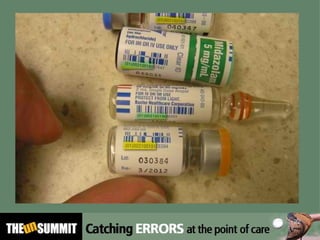
  • #23 The first 11 digits, highlighted in yellow, are the same for the drugs on the top and the bottom. The same is true for the first 11 digits on the second and third drugs, highlighted in green. Completely different drugs. Second item is a 1mL vial of midazolam 5mg/mL inj - third item is a 2mL ampule of fentanyl 50mcg/mL injec. Labeling system truncates the information at 11 digits. So when the pharmacist attached these drugs to our cross-reference file the BCMA system couldn’t tell the difference. (01) – AI for GTIN (Global Trade Item Number) AI is an Application Identifier, which are special prefixes in the EAN.UCC-128 symbology/standard (now called GS1-128) to identify and separate data elements. 01 – is to indicate that the following data field contains the GTIN. Parenthesis is not in the bar code 0 – is a Packaging Level indicator, e.g. item, box, case etc. 03 – EAN.UCC Prefix (number system character) which indicates the type of product, in this case a drug product using an NDC # (always the 10 digit NDC)
  • #25 BMJ. 2000 March 18; 320(7237): 768–770.PMCID: PMC1117770 Copyright  © 2000, British Medical Journal Human error: models and management James Reason,  professor of psychology Person approach and the System approach Evaluating the person approach Person approach has serious shortcomings and is ill suited to the medical domain. Indeed, continued adherence to this approach is likely to thwart the development of safer healthcare institutions. Although some unsafe acts in any sphere are egregious, the vast majority are not. Another serious weakness of the person approach is that by focusing on the individual origins of error it isolates unsafe acts from their system context. Firstly, it is often the best people who make the worst mistakes—error is not the monopoly of an unfortunate few. Secondly, far from being random, mishaps tend to fall into recurrent patterns. The same set of circumstances can provoke similar errors, regardless of the people involved. The pursuit of greater safety is seriously impeded by an approach that does not seek out and remove the error provoking properties within the system at large. Conclusions the pursuit of safety is not so much about preventing isolated failures, either human or technical, as about making the system as robust as is practicable in the face of its human and operational hazards. High reliability organisations are not immune to adverse events, but they have learnt the knack of converting these occasional setbacks into enhanced resilience of the system. ​ Workarounds to BCMA Systems - Koppel JAMIA 07 2008 (PDF)
  • #29 TPN label problems
  • #30 August 2010 - 3980 September 2010 - 4199 October 2010 - 3425 November 2010 - 3667 December 2010 -2642
  • #31 August 2010 - 3980 September 2010 - 4199 October 2010 - 3425 November 2010 - 3667 December 2010 -2642
  • #34 The committee consisted of individuals from quality assurance, pharmacy, internal audit, nursing administration and nurses currently practicing on various units within our facility. The medication administration process was broken down into 16 very distinct steps. Each step was scrutinized for potential weaknesses. In total, we described 100 potential failure modes associated with the medication administration process along with their causes and effects. We used current literature sources to describe known events. Each failure mode was assigned a Risk Priority Number (RPN) based on the product of the occurrence likelihood, detection likelihood and severity (completely subjective). Higher RPN values represented failure modes with greater potential for harm. Failure modes with an RPN greater than 100 were dissected further and recommended actions were developed to mitigate the effects of the failure mode (n = 19). Would you be surprised to learn that almost all the failure modes with an RPN greater than 100 were tied directly to some form of human behavior, i.e. willfully choosing to circumvent the system? http://www.pppmag.com/article_print.php?articleid=833 Using FMEA to Drive BCMA Improvements Pharmacy Purchasing &amp; Products
  • #35 Below are some of the FMEA committee’s observations and recommendations. CONTROLLING THE HUMAN ELEMENT - 12 out of 19, or 63%, are associated with nurse verification of the patient’s identity and nurse verification of the medication. - Underlying the needed updates to the medication administration policy, a thoughtful and comprehensive medication administration procedure covering all 16 process steps is imperative for a successful BCMA implementation. A consistent process that can be repeated will yield predictable, reliable, and measurable results. - determine appropriate and adequate disciplinary action for staff that willfully disregard and fail to follow established medication administration P&amp;P ADEQUACY OF PREPARATION - Adequate time for nurse training on the BCMA system is needed prior to “go live” - The training should include hands-on simulation training using all procedures and equipment under various patient scenarios. Strong consideration should be given to the designation of a BCMA Nurse Administrator during the preparation phases to serve as the point person for the nurses for all phases of the project. ADDRESSING SYSTEM ISSUES SYSTEM MANAGEMENT POST “GO LIVE” - Data management and the production of meaningful reports post “go-live” - Consideration should be given to the use of independent verification of the results of auditing and reporting implemented.
  • #36 Gap analysis
  • #40 Just culture doesn’t mean “Just let it go”. It means understanding when a real mistake occurs and looking into why the system broke down. promote a culture in which employees are willing to come forward in the interests of system safety. Yet, no one can afford to offer a “blame-free” system in which all conduct has impunity — society rightly requires that some actions warrant disciplinary or enforcement action. It is the balancing of the need to learn from our mistakes and the need to take disciplinary action that motivates adoption of a just culture. A just culture recognizes that competent professionals make mistakes and acknowledges that even competent professionals will develop unhealthy norms (shortcuts, “routine rule violations”), but has zero tolerance for reckless behavior.