Primary Engineering Controls
THE BASICS
The area required to accommodate the
preparation of CSPs is the Direct Compounding
Area (DCA) located within the Primary
Engineering Control Area (PEC)
A PEC is a device or room that provides an ISO
Class 5 environment for compounding CSPs.
While a PEC can be a room, it is commonly a
hooded area that is certified to ISO 5 standards
found within the ISO Class 7 Buffer area
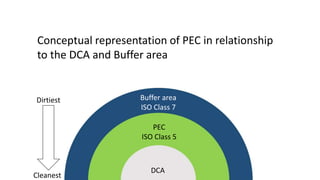
Conceptual representation of PEC in relationship
to the DCA and Buffer area
Dirtiest
Cleanest
Buffer area
ISO Class 7
PEC
ISO Class 5
DCA
PECs rely on high efficiency particle air (HEPA)
filters to maintain ISO Class 5 standards
HEPA filters are >99.99% efficient in removing
particles as small as 0.3 microns in size
The unidirectional (horizontal or vertical) HEPA-
filtered air provides enough velocity to sweep
particles away from the DCA and maintain
unidirectional flow during preparation of CSPs.
PECs typically include
3 types of “hoods”
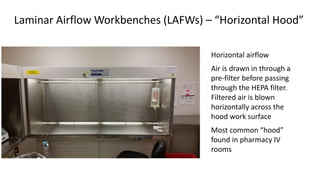
Laminar Airflow Workbenches (LAFWs) – “Horizontal Hood”
Horizontal airflow
Air is drawn in through a
pre-filter before passing
through the HEPA filter.
Filtered air is blown
horizontally across the
hood work surface
Most common “hood”
found in pharmacy IV
rooms
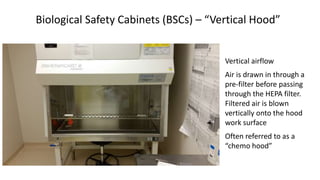
Biological Safety Cabinets (BSCs) – “Vertical Hood”
Vertical airflow
Air is drawn in through a
pre-filter before passing
through the HEPA filter.
Filtered air is blown
vertically onto the hood
work surface
Often referred to as a
“chemo hood”
Compounding Aseptic Isolators (CAIs) and
Compounding Aseptic Containment Isolators
(CACIs)
CAIs and CACIs are commonly referred to as
“glove boxes”
CAIs and CACIs have an anti chamber (pass-
through chamber) and a completely enclosed
compounding chamber
The anti chamber allows access to compounding
material without exposing contents to outside air
CAIs and CACIs are fitted with gloves to
manipulate compounding material inside "the
box“
What’s the difference between a CAI and a CACI?
CACIs use negative pressure and can be used for
hazardous compounding, while CAIs use positive
pressure and cannot be used for hazardous
compounding
USP Chapter <797> states that CAIs and CACIs shall be
placed in an ISO Class 7 buffer area unless they meet
all of the following conditions:
Provides isolation from the room and maintains ISO Class 5 during
dynamic operating conditions
Particle counts sampled upstream of the critical exposure site shall
maintain ISO Class 5 levels during compounding operations
Not more than 3520 particles (0.5 mm and larger) per meter shall
be counted during material transfer
JERRY FAHRNI, PHARM.D.

The Basics of Primary Engineering Controls

  • 1.
  • 2.
    The area requiredto accommodate the preparation of CSPs is the Direct Compounding Area (DCA) located within the Primary Engineering Control Area (PEC)
  • 3.
    A PEC isa device or room that provides an ISO Class 5 environment for compounding CSPs.
  • 4.
    While a PECcan be a room, it is commonly a hooded area that is certified to ISO 5 standards found within the ISO Class 7 Buffer area
  • 5.
    Conceptual representation ofPEC in relationship to the DCA and Buffer area Dirtiest Cleanest Buffer area ISO Class 7 PEC ISO Class 5 DCA
  • 6.
    PECs rely onhigh efficiency particle air (HEPA) filters to maintain ISO Class 5 standards
  • 7.
    HEPA filters are>99.99% efficient in removing particles as small as 0.3 microns in size
  • 8.
    The unidirectional (horizontalor vertical) HEPA- filtered air provides enough velocity to sweep particles away from the DCA and maintain unidirectional flow during preparation of CSPs.
  • 9.
    PECs typically include 3types of “hoods”
  • 10.
    Laminar Airflow Workbenches(LAFWs) – “Horizontal Hood” Horizontal airflow Air is drawn in through a pre-filter before passing through the HEPA filter. Filtered air is blown horizontally across the hood work surface Most common “hood” found in pharmacy IV rooms
  • 11.
    Biological Safety Cabinets(BSCs) – “Vertical Hood” Vertical airflow Air is drawn in through a pre-filter before passing through the HEPA filter. Filtered air is blown vertically onto the hood work surface Often referred to as a “chemo hood”
  • 12.
    Compounding Aseptic Isolators(CAIs) and Compounding Aseptic Containment Isolators (CACIs)
  • 13.
    CAIs and CACIsare commonly referred to as “glove boxes”
  • 14.
    CAIs and CACIshave an anti chamber (pass- through chamber) and a completely enclosed compounding chamber
  • 15.
    The anti chamberallows access to compounding material without exposing contents to outside air
  • 16.
    CAIs and CACIsare fitted with gloves to manipulate compounding material inside "the box“
  • 17.
    What’s the differencebetween a CAI and a CACI?
  • 18.
    CACIs use negativepressure and can be used for hazardous compounding, while CAIs use positive pressure and cannot be used for hazardous compounding
  • 19.
    USP Chapter <797>states that CAIs and CACIs shall be placed in an ISO Class 7 buffer area unless they meet all of the following conditions: Provides isolation from the room and maintains ISO Class 5 during dynamic operating conditions Particle counts sampled upstream of the critical exposure site shall maintain ISO Class 5 levels during compounding operations Not more than 3520 particles (0.5 mm and larger) per meter shall be counted during material transfer
  • 20.