HASEEB KM
S3 ME
November 2016
“With the help of composite material technology, design
engineers will be able to choose material for their product under
consideration”
PARTICLE REINFORCED
COMPOSITES
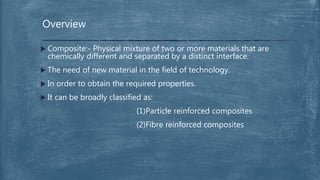
 Composite:- Physical mixture of two or more materials that are
chemically different and separated by a distinct interface.
 The need of new material in the field of technology.
 In order to obtain the required properties.
 It can be broadly classified as:
(1)Particle reinforced composites
(2)Fibre reinforced composites
Overview
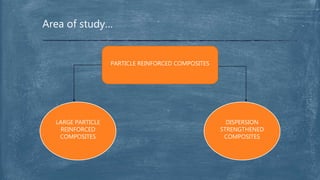
Area of study…
PARTICLE REINFORCED COMPOSITES
LARGE PARTICLE
REINFORCED
COMPOSITES
DISPERSION
STRENGTHENED
COMPOSITES
 The particle-matrix interaction is treated in macroscopic level.
 Particle size=1-50μm.
 Concentration=15-40% by volume.
 Particulate phase is harder and stiffer than matrix.
 Matrix phase transfers applied stress to particle which bears most of the applied
load.
 Reinforcement depends on volume fraction and strength of bonding.
 Particles of different dimensions should be equiaxed.
LARGE PARICLE REINFORCED COMPOSITES
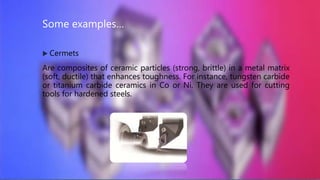
 Cermets
Are composites of ceramic particles (strong, brittle) in a metal matrix
(soft, ductile) that enhances toughness. For instance, tungsten carbide
or titanium carbide ceramics in Co or Ni. They are used for cutting
tools for hardened steels.
Some examples…
 Vulcanized rubber
Vulcanized rubber is a material that undergoes a chemical
process known as vulcanization. This process involves mixing
natural rubber with additives such as sulfur and other curatives.
Also called reinforced rubber.
 Obtained by strengthening with 20-50 nm carbon-black
particles. Used in auto tires.
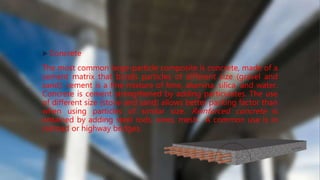
 Concrete
The most common large-particle composite is concrete, made of a
cement matrix that bonds particles of different size (gravel and
sand). cement is a fine mixture of lime, alumina, silica, and water.
Concrete is cement strengthened by adding particulates. The use
of different size (stone and sand) allows better packing factor than
when using particles of similar size. Reinforced concrete is
obtained by adding steel rods, wires, mesh. A common use is in
railroad or highway bridges.
 Uniformly dispersed fine, hard and inert particle is used for
reinforcement
 Particle size<0.1μm
 Volume fraction is between 15-40%.
 More stronger than pure metal.
 Can be metallic, nonmetallic, intermetallic.
 Dispersoids are carbides,oxides,borides.
 Shape can be round, disc, needle(max strength).
DISPERSION STRENGTHENED COMPOSITES
 Matrix-Load bearing phase
 Matrix is strengthened by impeding motion of dislocations or by
the interaction between dispersoids and matrix.
 Strengthening is happened at elevated temperature for extended
periods of time.
 Strengthening depends on size of particle and intermolecular
spacing.
(Use of very hard, small particles to strengthen metals and metal
alloys. The effect is like precipitation hardening but not so strong.
Particles like oxides do not react so the strengthening action is
retained at high temperatures.)
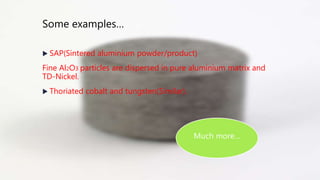
 SAP(Sintered aluminium powder/product)
Fine Al2O3 particles are dispersed in pure aluminium matrix and
TD-Nickel.
 Thoriated cobalt and tungsten(Similar).
Some examples…
Much more…
THANK YOU……
QUERIES

Particle reinforced composites

  • 1.
    HASEEB KM S3 ME November2016 “With the help of composite material technology, design engineers will be able to choose material for their product under consideration” PARTICLE REINFORCED COMPOSITES
  • 2.
     Composite:- Physicalmixture of two or more materials that are chemically different and separated by a distinct interface.  The need of new material in the field of technology.  In order to obtain the required properties.  It can be broadly classified as: (1)Particle reinforced composites (2)Fibre reinforced composites Overview
  • 3.
    Area of study… PARTICLEREINFORCED COMPOSITES LARGE PARTICLE REINFORCED COMPOSITES DISPERSION STRENGTHENED COMPOSITES
  • 4.
     The particle-matrixinteraction is treated in macroscopic level.  Particle size=1-50μm.  Concentration=15-40% by volume.  Particulate phase is harder and stiffer than matrix.  Matrix phase transfers applied stress to particle which bears most of the applied load.  Reinforcement depends on volume fraction and strength of bonding.  Particles of different dimensions should be equiaxed. LARGE PARICLE REINFORCED COMPOSITES
  • 5.
     Cermets Are compositesof ceramic particles (strong, brittle) in a metal matrix (soft, ductile) that enhances toughness. For instance, tungsten carbide or titanium carbide ceramics in Co or Ni. They are used for cutting tools for hardened steels. Some examples…
  • 6.
     Vulcanized rubber Vulcanizedrubber is a material that undergoes a chemical process known as vulcanization. This process involves mixing natural rubber with additives such as sulfur and other curatives. Also called reinforced rubber.  Obtained by strengthening with 20-50 nm carbon-black particles. Used in auto tires.
  • 7.
     Concrete The mostcommon large-particle composite is concrete, made of a cement matrix that bonds particles of different size (gravel and sand). cement is a fine mixture of lime, alumina, silica, and water. Concrete is cement strengthened by adding particulates. The use of different size (stone and sand) allows better packing factor than when using particles of similar size. Reinforced concrete is obtained by adding steel rods, wires, mesh. A common use is in railroad or highway bridges.
  • 8.
     Uniformly dispersedfine, hard and inert particle is used for reinforcement  Particle size<0.1μm  Volume fraction is between 15-40%.  More stronger than pure metal.  Can be metallic, nonmetallic, intermetallic.  Dispersoids are carbides,oxides,borides.  Shape can be round, disc, needle(max strength). DISPERSION STRENGTHENED COMPOSITES
  • 9.
     Matrix-Load bearingphase  Matrix is strengthened by impeding motion of dislocations or by the interaction between dispersoids and matrix.  Strengthening is happened at elevated temperature for extended periods of time.  Strengthening depends on size of particle and intermolecular spacing. (Use of very hard, small particles to strengthen metals and metal alloys. The effect is like precipitation hardening but not so strong. Particles like oxides do not react so the strengthening action is retained at high temperatures.)
  • 10.
     SAP(Sintered aluminiumpowder/product) Fine Al2O3 particles are dispersed in pure aluminium matrix and TD-Nickel.  Thoriated cobalt and tungsten(Similar). Some examples… Much more…
  • 11.