Terminology and Classification Mary-Ellen Wetherspoon Senior Advisor – Clinical Coding New Zealand Health Information Service 14 December 2007
SNOMED CT ® Taking the mystery out of SNOMED CT ®
Is SNOMED CT ®  better than ICD?
Which one is better?
ICD and SNOMED CT ® DIFFERENT: Entities Capability Uses
Definition Basics Coding Classifications Terminology
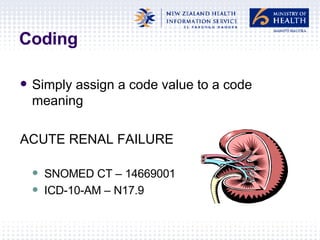
Coding Simply assign a code value to a code meaning ACUTE RENAL FAILURE SNOMED CT – 14669001 ICD-10-AM – N17.9
Classifications Group together concepts for a specified purpose K91.1 Postgastric surgery syndromes Syndrome : dumping postgastrectomy postvagotomy
ICD I nternational Statistical   C lassification   of   D iseases and Health Related Problems
The Family
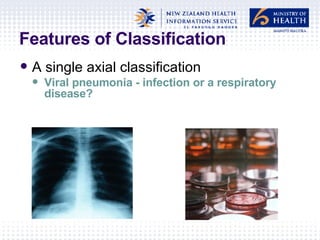
Features of Classification A single axial classification   Viral pneumonia - infection or a respiratory disease?
Respiratory Disease J  = respiratory disease J1  = influenza and pneumonia J12  = viral pneumonia NEC J12.0 = adenoviral pneumonia
But in some instances J10.1 = influenza with pneumonia  (influenza virus identified) B25.0† = cytomegaloviral pneumonitis (J17.1*) P23.0 = congenital pneumonia due to viral agent
MEMBERS NON-MEMBERS
Other =  not  G25.0,  not  G25.1 Other =  not  G25.4 Other specified ‘something’ but  not  anything that is a member of G25.0, G25.1, G25.2, G25.3, G25.4, G25.5, G25.6 We don’t know what this is, but it should be a member here somewhere, but NOT in any other G25.x
How is it used Collection and reporting of basic health statistics Quality database storage for accurate clinical and statistical data Monitoring of public health Model of designing reimbursement systems Information can be used to improve clinical, financial and administrative performance
If it is built for everything it will be fit for nothing! Useful for analysis Stable over time Rules and Standards Reasonably straight forward to implement Specialist skills Not able to be used in a patient record Not elsewhere classified and Not otherwise specified Not enough detail
Terminologies Reference features Inter-relate and define concepts Interface features Synonyms, search keys, subsets, etc to ease consistent entry and display
SNOMED CT ®   S ystematized   NO menclature of  MED icine C linical  T erms
SNOMED CT ® Clinical terminology Consistent storage Enabler of EHR
What it is Ontology Self defining knowledge model Empirical Poly-hierarchical Highly faceted Flexible Agile
What it isn’t Dictionary Lists of terms, codes  Reference tables Classification system Software Information system Simple
Concepts A unit of meaning Distinct Unambiguous Unique numeric identifier Unique name Descriptions
Descriptions Each concept has: Fully Specified Name (FSN) Preferred Term  Concepts may have: One or more synonyms
Hierarchies 19 Upper level hierarchies Sub-hierarchies
Relationships Is_A relationships  link concepts within a hierarchy Attribute relationships  link concepts between other hierarchies
How it works Concepts organised into hierarchies Descriptions or synonyms express clinical concepts Semantic relationships enable robust, reliable and consistent data retrieval Cross mapping
Concept Definitions SNOMED CT ®  defines ‘viral pneumonia’ as follows: viral pneumonia  is a viral respiratory infection is a infective pneumonia causative agent virus associated morphology inflammation associated morphology consolidation finding site lung structure
SNOMED CT ®  – Viral Pneumonia The ‘is a’ relationships represent a hierarchy of subtypes Viral pneumonia Viral respiratory infection Infective pneumonia viral pneumonia  is a viral respiratory infection is a infective pneumonia causative agent virus associated morphology inflammation associated morphology consolidation finding site lung structure
Concept Id 75570004 Viral pneumonia Viral respiratory infection Respiratory  tract infection SNOMED CT® Concept Infection by site Infectious disease Disorder of  respiratory system Respiratory finding Viral infection by site Viral disease Infective pneumonia Infectious disease  of lung Disorder  of lung Disorder of lower respiratory system Lung finding Lower respiratory tract finding Lower respiratory tract infection Pneumonia Pneumonitis Inflammatory disorder of  lower respiratory tract Inflammatory disorder of  the respiratory tract Inflammatory disorder of  the respiratory system Lung consolidation Finding by site Finding of trunk structure Finding of body region Finding of region of thorax Viscus structure finding Clinical finding Disorder by body site Disorder of body system Disorder of thorax Disorder of trunk Disorder of body cavity Disease Inflammation of specific body systems Inflammation of specific body structures or tissue Inflammation of specific body organs Inflammatory  disorder causative agent virus G associated morphology inflammation associated morphology consolidation finding site lung structure
How is this used Supports effective selective retrieval for decision support and research Viral Pneumonia –  All viral diseases All infectious diseases All respiratory disorders All inflammatory disorders All these are true and common to someone who has viral pneumonia
Other Uses Facilitate E – data collection at the point of care Detailed capture of specific clinical information Synergy between different sites and providers
One without the other Terminology and Classification are fundamentally different Not designed to compete Duality = completeness
An example 20-Jul-07:  21522001  |  abdominal pain  |  19:30) 268941000  |  O/E - abdo. pain on palpation  | Diagnosis 196652006  |  acute duodenal ulcer  |  21:45) 8765009  |  haematemesis  |  21-Jul-07 :  79922009  |  epigastric pain  |  01:10)   246112005  |  severity  | =  24484000  |  severe  |  Radiology 17204006  |  pneumoperitoneum  |  Diagnosis 88968005  |  duodenal ulcer with perforation  |  ICD-10-AM  K26.2 Duodenal ulcer, acute with both haemorrhage & perforation
Needing SNOMED CT ® It will be legible Encourages more detail Decrease duplication  Less ambiguous More communicable Consistency leads to better sharing of information Improved granularity for research purposes
Mapping Make SNOMED CT ®  more like ICD? Make ICD more like SNOMED CT ® ? Either approach will corrupt the purpose and power of both!
Challenges Interchangeable Scope, domain, different use cases A continuum Logic, structures, relationships differ, not just a measure of granularity Seamlessly interoperable Words may be common, but context, hierarchical structures and logic alter meaning Stand alone Needs some form of middle tier services and support
SNOMED CT ®  to ICD-10-AM No use case for Australian purposes yet specified Epidemiology? Reimbursement? Semi-automated? Guide for Coders? Feasibility studies – results expose difficulties not yet solutions Share some common ground with US approach
What is needed Formal, well specified use cases Agreed proven and standard mapping methods SNOMED education Terminology and classification knowledge International convergence and co operation Tools, infrastructure, time Governance
Harmonisation Work is underway between the IHSTDO and WHO to develop a SNOMED CT  ®  to ICD-10 map
Differences SNOMED CT ® Inheritance IS-A  Definitions Multi-counting Relationships No nominals Unable to aggregate for statistics ICD Nominals NOT Mutual exclusivity No clinical definitions Clinical face validity  Statistical utility and conventions
ICD 11 Clinical currency, update and enhance Provide more specificity Remove ambiguity Make rules and conventions more explicit Improve index, include greater specificity
Future Prospects Mapping between SNOMED CT ®  and ICD will improve both, WITHOUT wholesale structural change or replication of either instrument
Thanks to NZHIS colleagues NCCH terminology project team especially Donna Truran, Margaret Campbell, Patricia Saad and Kerry Innes International colleagues for public availability of their knowledge and materials

Terminology and Classification

  • 1.
    Terminology and ClassificationMary-Ellen Wetherspoon Senior Advisor – Clinical Coding New Zealand Health Information Service 14 December 2007
  • 2.
    SNOMED CT ®Taking the mystery out of SNOMED CT ®
  • 3.
    Is SNOMED CT® better than ICD?
  • 4.
    Which one isbetter?
  • 5.
    ICD and SNOMEDCT ® DIFFERENT: Entities Capability Uses
  • 6.
    Definition Basics CodingClassifications Terminology
  • 7.
    Coding Simply assigna code value to a code meaning ACUTE RENAL FAILURE SNOMED CT – 14669001 ICD-10-AM – N17.9
  • 8.
    Classifications Group togetherconcepts for a specified purpose K91.1 Postgastric surgery syndromes Syndrome : dumping postgastrectomy postvagotomy
  • 9.
    ICD I nternationalStatistical C lassification of D iseases and Health Related Problems
  • 10.
  • 11.
    Features of ClassificationA single axial classification Viral pneumonia - infection or a respiratory disease?
  • 12.
    Respiratory Disease J = respiratory disease J1 = influenza and pneumonia J12 = viral pneumonia NEC J12.0 = adenoviral pneumonia
  • 13.
    But in someinstances J10.1 = influenza with pneumonia (influenza virus identified) B25.0† = cytomegaloviral pneumonitis (J17.1*) P23.0 = congenital pneumonia due to viral agent
  • 14.
  • 15.
    Other = not G25.0, not G25.1 Other = not G25.4 Other specified ‘something’ but not anything that is a member of G25.0, G25.1, G25.2, G25.3, G25.4, G25.5, G25.6 We don’t know what this is, but it should be a member here somewhere, but NOT in any other G25.x
  • 16.
    How is itused Collection and reporting of basic health statistics Quality database storage for accurate clinical and statistical data Monitoring of public health Model of designing reimbursement systems Information can be used to improve clinical, financial and administrative performance
  • 17.
    If it isbuilt for everything it will be fit for nothing! Useful for analysis Stable over time Rules and Standards Reasonably straight forward to implement Specialist skills Not able to be used in a patient record Not elsewhere classified and Not otherwise specified Not enough detail
  • 18.
    Terminologies Reference featuresInter-relate and define concepts Interface features Synonyms, search keys, subsets, etc to ease consistent entry and display
  • 19.
    SNOMED CT ® S ystematized NO menclature of MED icine C linical T erms
  • 20.
    SNOMED CT ®Clinical terminology Consistent storage Enabler of EHR
  • 21.
    What it isOntology Self defining knowledge model Empirical Poly-hierarchical Highly faceted Flexible Agile
  • 22.
    What it isn’tDictionary Lists of terms, codes Reference tables Classification system Software Information system Simple
  • 23.
    Concepts A unitof meaning Distinct Unambiguous Unique numeric identifier Unique name Descriptions
  • 24.
    Descriptions Each concepthas: Fully Specified Name (FSN) Preferred Term Concepts may have: One or more synonyms
  • 25.
    Hierarchies 19 Upperlevel hierarchies Sub-hierarchies
  • 26.
    Relationships Is_A relationships link concepts within a hierarchy Attribute relationships link concepts between other hierarchies
  • 27.
    How it worksConcepts organised into hierarchies Descriptions or synonyms express clinical concepts Semantic relationships enable robust, reliable and consistent data retrieval Cross mapping
  • 28.
    Concept Definitions SNOMEDCT ® defines ‘viral pneumonia’ as follows: viral pneumonia is a viral respiratory infection is a infective pneumonia causative agent virus associated morphology inflammation associated morphology consolidation finding site lung structure
  • 29.
    SNOMED CT ® – Viral Pneumonia The ‘is a’ relationships represent a hierarchy of subtypes Viral pneumonia Viral respiratory infection Infective pneumonia viral pneumonia is a viral respiratory infection is a infective pneumonia causative agent virus associated morphology inflammation associated morphology consolidation finding site lung structure
  • 30.
    Concept Id 75570004Viral pneumonia Viral respiratory infection Respiratory tract infection SNOMED CT® Concept Infection by site Infectious disease Disorder of respiratory system Respiratory finding Viral infection by site Viral disease Infective pneumonia Infectious disease of lung Disorder of lung Disorder of lower respiratory system Lung finding Lower respiratory tract finding Lower respiratory tract infection Pneumonia Pneumonitis Inflammatory disorder of lower respiratory tract Inflammatory disorder of the respiratory tract Inflammatory disorder of the respiratory system Lung consolidation Finding by site Finding of trunk structure Finding of body region Finding of region of thorax Viscus structure finding Clinical finding Disorder by body site Disorder of body system Disorder of thorax Disorder of trunk Disorder of body cavity Disease Inflammation of specific body systems Inflammation of specific body structures or tissue Inflammation of specific body organs Inflammatory disorder causative agent virus G associated morphology inflammation associated morphology consolidation finding site lung structure
  • 31.
    How is thisused Supports effective selective retrieval for decision support and research Viral Pneumonia – All viral diseases All infectious diseases All respiratory disorders All inflammatory disorders All these are true and common to someone who has viral pneumonia
  • 32.
    Other Uses FacilitateE – data collection at the point of care Detailed capture of specific clinical information Synergy between different sites and providers
  • 33.
    One without theother Terminology and Classification are fundamentally different Not designed to compete Duality = completeness
  • 34.
    An example 20-Jul-07: 21522001 | abdominal pain | 19:30) 268941000 | O/E - abdo. pain on palpation | Diagnosis 196652006 | acute duodenal ulcer | 21:45) 8765009 | haematemesis | 21-Jul-07 : 79922009 | epigastric pain | 01:10) 246112005 | severity | = 24484000 | severe | Radiology 17204006 | pneumoperitoneum | Diagnosis 88968005 | duodenal ulcer with perforation | ICD-10-AM K26.2 Duodenal ulcer, acute with both haemorrhage & perforation
  • 35.
    Needing SNOMED CT® It will be legible Encourages more detail Decrease duplication Less ambiguous More communicable Consistency leads to better sharing of information Improved granularity for research purposes
  • 36.
    Mapping Make SNOMEDCT ® more like ICD? Make ICD more like SNOMED CT ® ? Either approach will corrupt the purpose and power of both!
  • 37.
    Challenges Interchangeable Scope,domain, different use cases A continuum Logic, structures, relationships differ, not just a measure of granularity Seamlessly interoperable Words may be common, but context, hierarchical structures and logic alter meaning Stand alone Needs some form of middle tier services and support
  • 38.
    SNOMED CT ® to ICD-10-AM No use case for Australian purposes yet specified Epidemiology? Reimbursement? Semi-automated? Guide for Coders? Feasibility studies – results expose difficulties not yet solutions Share some common ground with US approach
  • 39.
    What is neededFormal, well specified use cases Agreed proven and standard mapping methods SNOMED education Terminology and classification knowledge International convergence and co operation Tools, infrastructure, time Governance
  • 40.
    Harmonisation Work isunderway between the IHSTDO and WHO to develop a SNOMED CT ® to ICD-10 map
  • 41.
    Differences SNOMED CT® Inheritance IS-A Definitions Multi-counting Relationships No nominals Unable to aggregate for statistics ICD Nominals NOT Mutual exclusivity No clinical definitions Clinical face validity Statistical utility and conventions
  • 42.
    ICD 11 Clinicalcurrency, update and enhance Provide more specificity Remove ambiguity Make rules and conventions more explicit Improve index, include greater specificity
  • 43.
    Future Prospects Mappingbetween SNOMED CT ® and ICD will improve both, WITHOUT wholesale structural change or replication of either instrument
  • 44.
    Thanks to NZHIScolleagues NCCH terminology project team especially Donna Truran, Margaret Campbell, Patricia Saad and Kerry Innes International colleagues for public availability of their knowledge and materials