Presented By
Amol Bhanage& Dr. K. Padmanabhan
SMBS,
VIT University, Vellore
Paper ID : 1007
Design for Fatigue and Simulation of Glass
Fibre / Epoxy Composite Automobile Leaf Spring
International Conference on
“Trends in Product Life Cycle, Modeling, Simulation
and Synthesis”
PLMSS 2014
Contents
• Objective & Background
• Specification & Material properties of Leaf Spring
• FE Modelling of Leaf Spring
• Static analysis & Ride Comfort
• Finite Element Based Fatigue Analysis
• Results and Discussion
• Conclusion & Future scope
• References
2International Conference on Trends in Product Life Cycle, Modeling, Simulation and Synthesis01/25/16
1.Objective
• In the present work, steel leaf spring used in passenger cars is replaced with
a composite leaf spring made of a glass/epoxy composite. The primary
objective is to compare fatigue characteristics of SAE1045-450-QT steel and
E – Glass/ Epoxy Composite material.
• Factors like fatigue life, fatigue damage, biaxiality indication etc. are plotted
for steel and composite materials and predict the fatigue performance
using ANSYS Workbench software.
• Therefore the objective of this paper is to present a design and simulation
study on the fatigue performance of a glass fibre/epoxy composite leaf
spring through design and finite element method and prove the reliability
of the validation methods based only on simulation, thereby saving time,
material and production costs for a complete product realization.
3International Conference on Trends in Product Life Cycle, Modeling, Simulation and Synthesis01/25/16
2. Background
Author Conclusion
Senthilkumar
Mouleeswaran [2]
Composite multi leaf spring using glass fibre reinforced polymer
compared to steel spring, found to have 67.35% lesser stress,
64.95% higher stiffness and 126.98% higher natural frequency and
also weight reduction of 68.15% is achieved compared to steel leaf
spring.
D.N.Dubey,
S.G.Mahakalkar [7]
Composite leaf springs would offer substantial weight savings by
using mono leaf spring in passenger cars. Mono parabolic leaf spring
of a Maruti Omni used HM and HS Carbon polymers composite
material.
Makarand B. Shirke and
Prof. V .D .Wakchaure [5]
The life of the spring is an important criterion. In this aspect as well
composite leaf spring proves to be much better than EN45 steel leaf
spring.
01/25/16 International Conference on Trends in Product Life Cycle, Modeling, Simulation and Synthesis 4
2. Background
Author Conclusion
Shishay Amare Gebremeskel
[4]
Constant cross section design of mono leaf springs is employed to
take advantages of ease of design analysis and its manufacturing
process. Resulting design and simulation stresses are much below
the strength properties of the material, satisfying the maximum
stress failure criterion .
Sachin Kr. Patel,
A.K. Jain and
Pratik Gandhi [9]
Composite materials have high elastic strain energy storage capacity
and high strength to weight ratio Therefore, composite leaf spring is
an effective replacement for the existing steel leaf spring in
automobile.
J.A.M. Ferreira,
J.D.M. Costa,
P.N.B. Reis, M.O.W.
Richardson [8]
The fatigue strength is strongly influenced by the layer design.
0° laminate results have values 1.5-1.8 times higher than +45°/0°/-
45° and +30°/-30°/0° laminates which exhibit similar fatigue
strengths.
01/25/16 International Conference on Trends in Product Life Cycle, Modeling, Simulation and Synthesis 5
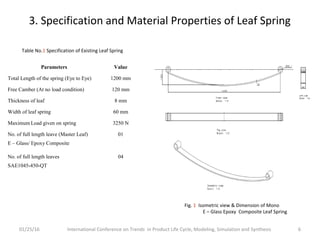
3. Specification and Material Properties of Leaf Spring
Parameters Value
Total Length of the spring (Eye to Eye) 1200 mm
Free Camber (At no load condition) 120 mm
Thickness of leaf 8 mm
Width of leaf spring 60 mm
Maximum Load given on spring 3250 N
No. of full length leave (Master Leaf)
E – Glass/ Epoxy Composite
01
No. of full length leaves
SAE1045-450-QT
04
01/25/16 International Conference on Trends in Product Life Cycle, Modeling, Simulation and Synthesis 6
Table No.1 Specification of Existing Leaf Spring
Fig. 1 Isometric view & Dimension of Mono
E – Glass Epoxy Composite Leaf Spring
3. Specification and Material Properties of Leaf Spring
01/25/16 International Conference on Trends in Product Life Cycle, Modeling, Simulation and Synthesis 7
Material Properties Value
Elastic Modulus (E), GPa 207
Yield Tensile Strength , MPa 1515
Ultimate Tensile Strength, MPa 1584
Cyclic Strength Coefficient (K’) 1874
Fatigue Strength Coefficient (Sf) 1686
Fatigue Strength Exponent (b) -0.06
Fatigue Ductility Exponent (c ) -0.83
Fatigue Ductility Coefficient (Ef) 0.79
Cyclic Strain Hardening Exponent (n’) 0.09
Density , Kg/m3
7.7 × 10³
Possion’s ratio 0.266
Behaviour Isotropic
Table .2: Mechanical and Cyclic Properties of
SAE1045-450- QT [11,12]
Table .3: Mechanical and Cyclic Properties of E glass/ Epoxy
Composite material [11. 12]
Material Properties Value
Tensile modulus along X-direction (Ex), MPa 34000
Tensile modulus along Y-direction (Ey), MPa 6530
Tensile modulus along Z-direction (Ez), MPa 6530
Tensile strength of the material, MPa 900
Compressive strength of the material, MPa 450
Shear modulus along XY-direction (Gxy), MPa 2433
Shear modulus along YZ-direction (Gyz), MPa 1698
Shear modulus along ZX-direction (Gzx), MPa 2433
Poisson ratio along XY-direction (NUxy) 0.217
Poisson ratio along YZ-direction (NUyz) 0.366
• Assumptions:
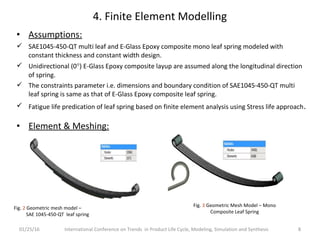
 SAE1045-450-QT multi leaf and E-Glass Epoxy composite mono leaf spring modeled with
constant thickness and constant width design.
 Unidirectional (0°) E-Glass Epoxy composite layup are assumed along the longitudinal direction
of spring.
 The constraints parameter i.e. dimensions and boundary condition of SAE1045-450-QT multi
leaf spring is same as that of E-Glass Epoxy composite leaf spring.
 Fatigue life predication of leaf spring based on finite element analysis using Stress life approach.
• Element & Meshing:
01/25/16 International Conference on Trends in Product Life Cycle, Modeling, Simulation and Synthesis 8
4. Finite Element Modelling
Fig. 2 Geometric mesh model –
SAE 1045-450-QT leaf spring
Fig. 3 Geometric Mesh Model – Mono
Composite Leaf Spring
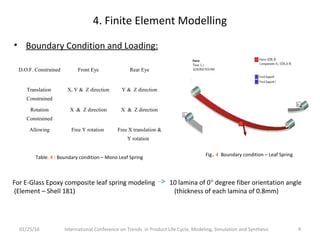
• Boundary Condition and Loading:
01/25/16 International Conference on Trends in Product Life Cycle, Modeling, Simulation and Synthesis 9
4. Finite Element Modelling
Fig.. 4 Boundary condition – Leaf Spring
D.O.F. Constrained Front Eye Rear Eye
Translation
Constrained
X, Y & Z direction Y & Z direction
Rotation
Constrained
X & Z direction X & Z direction
Allowing Free Y rotation Free X translation &
Y rotation
Table. 4 : Boundary condition – Mono Leaf Spring
For E-Glass Epoxy composite leaf spring modeling 10 lamina of 0° degree fiber orientation angle
(Element – Shell 181) (thickness of each lamina of 0.8mm)
5. Static Analysis and Ride Comfort
Parameters
Material
SAE1045-
450-QT
E-Glass Epoxy
Composite
Maximum load in N 3250 3250
Absolute Maximum
Stress , MPa
724.52 715
Stiffness, N/mm 24.33 53.59
01/25/16 International Conference on Trends in Product Life Cycle, Modeling, Simulation and Synthesis 10
Table. 5 Comparison result of Stress for
SAE 1045-450 - QT and E-Glass Epoxy Composite
Modes
SAE1045-450- QT
Frequency Hz
E- Glass Epoxy
Frequency Hz
1 13.13 17.15
2 54.55 56.16
3 78.59 72.19
4 116.89 119.36
5 178.49 202.78
6 243.27 288.43
Table 6 Natural frequency of SAE 1045-450-QT and
E-Glass Epoxy Composite material
Static Results :
Shear stress (τ12= 6.77 MPa) multiplied by a factor
of ‘9’ (9*3 = 60.93 MPa) is much less than the
shear strength (S = 68.95 MPa) of the specified
composite material, E-glass/Epoxy.
Specifying the criteria : (9*τ12< S),
Design is safe even for the flexural failure.
Ride Comfort :
To avoid resonant condition The road
irregularities usually have the maximum
frequency of 12 Hz. [7]
In modal analysis only boundary conditions are
applied and no load is acted on the leaf spring.
6. Finite Element Based Fatigue Analysis
• Main purpose of Finite Element Based Fatigue tool using for leaf spring
simulation – during the design stage of development process to enable
reliable fatigue life calculations.
• Input Parameter and Fatigue Analysis Cycle
01/25/16 International Conference on Trends in Product Life Cycle, Modeling, Simulation and Synthesis 11
Figure 5 Fatigue Analysis Prediction Strategies
Figure 6 FEM Based Fatigue Analysis Cycle [11]
6. Finite Element Based Fatigue Analysis
• Fatigue life criteria and S-N Curves:
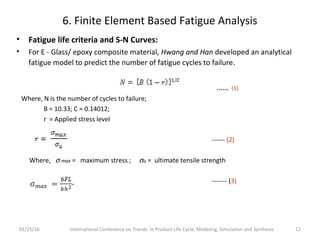
• For E - Glass/ epoxy composite material, Hwang and Han developed an analytical
fatigue model to predict the number of fatigue cycles to failure.
…… (1)
Where, N is the number of cycles to failure;
B = 10.33; C = 0.14012;
r = Applied stress level
------ (2)
Where, σ max = maximum stress ; σu = ultimate tensile strength
------- (3)
01/25/16 International Conference on Trends in Product Life Cycle, Modeling, Simulation and Synthesis 12
6. Finite Element Based Fatigue Analysis
• The life data analysis is a tool to be used here to predict the fatigue life of mono
composite leaf spring.
• Fatigue life results are based on analytical result and resulting S-N graph for
SAE1045-450-QT and E – Glass Composite as shown in Fig. 7 and 8
• E glass-epoxy figure is for tension, torsion or bending ? Specify ! ( Figure 7)
01/25/16 International Conference on Trends in Product Life Cycle, Modeling, Simulation and Synthesis 13
Figure 7 S-N curves for E-Glass/epoxy composite [2] Figure 8 S-N curves for SAE1045-450-QT spring [11]
7. Results and Discussion
• Fatigue Life
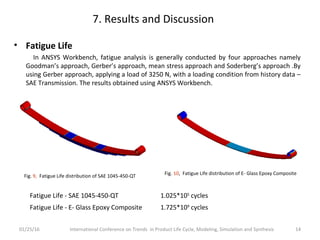
In ANSYS Workbench, fatigue analysis is generally conducted by four approaches namely
Goodman’s approach, Gerber’s approach, mean stress approach and Soderberg’s approach .By
using Gerber approach, applying a load of 3250 N, with a loading condition from history data –
SAE Transmission. The results obtained using ANSYS Workbench.
01/25/16 International Conference on Trends in Product Life Cycle, Modeling, Simulation and Synthesis 14
Fig. 9, Fatigue Life distribution of SAE 1045-450-QT
Fig. 10, Fatigue Life distribution of E- Glass Epoxy Composite
Fatigue Life - SAE 1045-450-QT 1.025*105
cycles
Fatigue Life - E- Glass Epoxy Composite 1.725*109
cycles
7. Results and Discussion
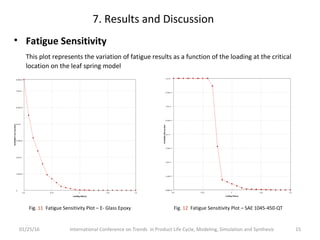
• Fatigue Sensitivity
This plot represents the variation of fatigue results as a function of the loading at the critical
location on the leaf spring model
01/25/16 International Conference on Trends in Product Life Cycle, Modeling, Simulation and Synthesis 15
Fig. 11 Fatigue Sensitivity Plot – E- Glass Epoxy Fig. 12 Fatigue Sensitivity Plot – SAE 1045-450-QT
7. Results and Discussion
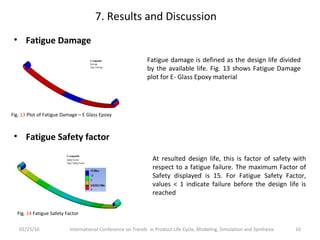
• Fatigue Damage
• Fatigue Safety factor
01/25/16 International Conference on Trends in Product Life Cycle, Modeling, Simulation and Synthesis 16
Fig. 13 Plot of Fatigue Damage – E Glass Epoxy
 
Fatigue damage is defined as the design life divided
by the available life. Fig. 13 shows Fatigue Damage
plot for E- Glass Epoxy material
At resulted design life, this is factor of safety with
respect to a fatigue failure. The maximum Factor of
Safety displayed is 15. For Fatigue Safety Factor,
values < 1 indicate failure before the design life is
reached
Fig. 14 Fatigue Safety Factor
7. Results and Discussion
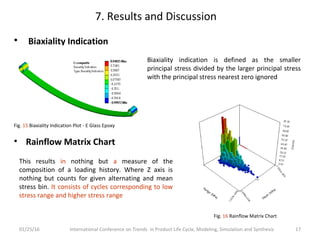
• Biaxiality Indication
• Rainflow Matrix Chart
01/25/16 International Conference on Trends in Product Life Cycle, Modeling, Simulation and Synthesis 17
Fig. 15 Biaxiality Indication Plot - E Glass Epoxy
Biaxiality indication is defined as the smaller
principal stress divided by the larger principal stress
with the principal stress nearest zero ignored
This results in nothing but a measure of the
composition of a loading history. Where Z axis is
nothing but counts for given alternating and mean
stress bin. It consists of cycles corresponding to low
stress range and higher stress range
Fig. 16 Rainflow Matrix Chart
8. Conclusion & Future Scope
• By using Stress Life approach, Absolute Maximum Principal Stress used
basis for calculating E- Glass Epoxy Composites leaf springs life for
passenger vehicles.
• Due to Weight reduction and stress, stiffness criteria, multi steel leaf
spring is proposed to be replaced with E- Glass Epoxy composite leaf
springs.
• It can be shown that, design and simulation stresses satisfy maximum
stress failure criterion; hence design is safe.
• Ride comfort of both Steel SAE1045-450-QT Leaf Spring and unidirectional
E- Glass Composite Leaf Spring was found to be 1.3 times more than the
12Hz produced on road which decreases resonance. This is compared by
using modal analysis for increasing ride comfort.
01/25/16 International Conference on Trends in Product Life Cycle, Modeling, Simulation and Synthesis 18
8. Conclusion & Future Scope
• Finite element analysis can be used directly to calculate fatigue damage
and the damage contour shows that the highest damage value is
inacceptable .
• Finite element method using CAE tool like ANSYS Workbench prove the
reliability of the validation methods based only on simulation, thereby
saving time, material and production costs for a complete product
realization. The fatigue life of the leaf spring has also been improved.
• In future, using different lay ups to calculate fatigue life can lead to the
choice of best lay up configuration. Accurate results can be plotted using
n code Design Life software ?.
• It is proposed to conduct the fatigue analysis of a hygrothermally
saturation conditioned composite leaf spring in order to evaluate its real
environment fatigue life . Himalayan sub zero temperature fatigue
performance will also be evaluated .
01/25/16 International Conference on Trends in Product Life Cycle, Modeling, Simulation and Synthesis 19
9. References
1. G Harinath Gowd et al, “Static Analysis of Leaf Spring”, International Journal of Engineering Science
and Technology (IJEST), ISSN: 0975-5462, Vol. 4 No.08 August 2012, Pg. No (3794-3803)
2. Senthilkumar Mouleeswaran, “Design, Manufacturing and Testing of Polymer Composite Multi-Leaf
Spring for Light Passenger Automobiles - A Review”, Materials Science and Technology, Prof. Sabar
Hutagalung (Ed.), ISBN: 978-953-51-0193-2
3. B. Raghu Kumar, R. Vijaya Prakash, N. Ramesh, “Static analysis of mono leaf spring with different
composite materials”, Journal of Mechanical Engineering Research, ISSN 2141-2383 , Vol. 5(2),
February 2013, pp. 32-37.
4. Shishay Amare Gebremeskel, “Design, Simulation, and Prototyping of Single Composite Leaf Spring for
Light Weight Vehicle”, Global Journal of Researches in Engineering Mechanical and Mechanics
Engineering, Volume 12, Issue 7 ,Year 2012, 21-30
5. Makarand B. Shirke and Prof. V .D .Wakchaure, “Performance Association of Static and Fatigue
Behavior of Steel and Glass Epoxy Composite Leaf Spring of Light Motor Vehicle”, International
Journal of Advanced Research in Science, Engineering and Technology, Vol.01, Issue 04, year ?, pp.
08- 11
6. S. Abdullah, F.N. Ahmad Refngah, A. Jalar, L.B. Chua, A.K. Ariffin And A. “FEA-based durability
assessment: A case study using a parabolic leaf spring”, Proceedings of the 7th WSEAS International
Conference on System Science And Simulation In Engineering (ICOSSSE 2008), ISSN: 1790-2769,
pp-67-72
01/25/16 International Conference on Trends in Product Life Cycle, Modeling, Simulation and Synthesis 20
9. References
7. D.N.Dubey, S.G.Mahakalkar, “Stress Analysis of a Mono-parabolic Leaf Spring–A Review”,
International Journal of Modern Engineering Research (IJMER), ISSN: 2249-6645 Vol.3, Issue.2, March-
April. 2013 pp-769-772
8. J.A.M. Ferreira, J.D.M. Costa, P.N.B. Reis, M.O.W. Richardson, “Analysis of fatigue and damage in
glass-fibre-reinforced polypropylene composite materials”, Composites Science and Technology 59
(1999), 1461-1467
9. Sachin Kr. Patel, A.K. Jain and Pratik Gandhi, “Review of Effect of Material on Fatigue Life of Leaf
Spring”, VSRD International Journal of Mechanical, Civil, Automobile and Production Engineering, Vol.
2 (4), 2012, 161-165
10. Mahmood M. Shokrieh , Davood Rezaei, “Analysis and optimization of a composite leaf spring ”,
Composite Structures 60 (2003), 2003 Elsevier Science Ltd, 317–325
11. J. P. Karthik, K. L. Chaitanya and C. Tara Sasanka, “ Fatigue Life Prediction of a Parabolic Spring under
Non-constant Amplitude Proportional Loading using Finite Element Method”, International Journal of
Advanced Science and Technology, Vol. 46, September, 2012, 143-156
12. M.Venkatesan , D.Helmen Devaraj , “Design And Analysis of Composite Leaf Spring In Light Vehicle”,
International Journal of Modern Engineering Research (IJMER), ISSN: 2249-6645, Vol.2, Issue.1, Jan-
Feb 2012, pp-213-218
13. D. Alfred Hancq, Fatigue Analysis Using ANSYS, Ansys Inc, year ? Vol ?, Issue ? Page ?
01/25/16 International Conference on Trends in Product Life Cycle, Modeling, Simulation and Synthesis 21
Thank you…
01/25/16 International Conference on Trends in Product Life Cycle, Modeling, Simulation and Synthesis 22

Composite automobile leaf spring-Fatigue life

  • 1.
    Presented By Amol Bhanage&Dr. K. Padmanabhan SMBS, VIT University, Vellore Paper ID : 1007 Design for Fatigue and Simulation of Glass Fibre / Epoxy Composite Automobile Leaf Spring International Conference on “Trends in Product Life Cycle, Modeling, Simulation and Synthesis” PLMSS 2014
  • 2.
    Contents • Objective &Background • Specification & Material properties of Leaf Spring • FE Modelling of Leaf Spring • Static analysis & Ride Comfort • Finite Element Based Fatigue Analysis • Results and Discussion • Conclusion & Future scope • References 2International Conference on Trends in Product Life Cycle, Modeling, Simulation and Synthesis01/25/16
  • 3.
    1.Objective • In thepresent work, steel leaf spring used in passenger cars is replaced with a composite leaf spring made of a glass/epoxy composite. The primary objective is to compare fatigue characteristics of SAE1045-450-QT steel and E – Glass/ Epoxy Composite material. • Factors like fatigue life, fatigue damage, biaxiality indication etc. are plotted for steel and composite materials and predict the fatigue performance using ANSYS Workbench software. • Therefore the objective of this paper is to present a design and simulation study on the fatigue performance of a glass fibre/epoxy composite leaf spring through design and finite element method and prove the reliability of the validation methods based only on simulation, thereby saving time, material and production costs for a complete product realization. 3International Conference on Trends in Product Life Cycle, Modeling, Simulation and Synthesis01/25/16
  • 4.
    2. Background Author Conclusion Senthilkumar Mouleeswaran[2] Composite multi leaf spring using glass fibre reinforced polymer compared to steel spring, found to have 67.35% lesser stress, 64.95% higher stiffness and 126.98% higher natural frequency and also weight reduction of 68.15% is achieved compared to steel leaf spring. D.N.Dubey, S.G.Mahakalkar [7] Composite leaf springs would offer substantial weight savings by using mono leaf spring in passenger cars. Mono parabolic leaf spring of a Maruti Omni used HM and HS Carbon polymers composite material. Makarand B. Shirke and Prof. V .D .Wakchaure [5] The life of the spring is an important criterion. In this aspect as well composite leaf spring proves to be much better than EN45 steel leaf spring. 01/25/16 International Conference on Trends in Product Life Cycle, Modeling, Simulation and Synthesis 4
  • 5.
    2. Background Author Conclusion ShishayAmare Gebremeskel [4] Constant cross section design of mono leaf springs is employed to take advantages of ease of design analysis and its manufacturing process. Resulting design and simulation stresses are much below the strength properties of the material, satisfying the maximum stress failure criterion . Sachin Kr. Patel, A.K. Jain and Pratik Gandhi [9] Composite materials have high elastic strain energy storage capacity and high strength to weight ratio Therefore, composite leaf spring is an effective replacement for the existing steel leaf spring in automobile. J.A.M. Ferreira, J.D.M. Costa, P.N.B. Reis, M.O.W. Richardson [8] The fatigue strength is strongly influenced by the layer design. 0° laminate results have values 1.5-1.8 times higher than +45°/0°/- 45° and +30°/-30°/0° laminates which exhibit similar fatigue strengths. 01/25/16 International Conference on Trends in Product Life Cycle, Modeling, Simulation and Synthesis 5
  • 6.
    3. Specification andMaterial Properties of Leaf Spring Parameters Value Total Length of the spring (Eye to Eye) 1200 mm Free Camber (At no load condition) 120 mm Thickness of leaf 8 mm Width of leaf spring 60 mm Maximum Load given on spring 3250 N No. of full length leave (Master Leaf) E – Glass/ Epoxy Composite 01 No. of full length leaves SAE1045-450-QT 04 01/25/16 International Conference on Trends in Product Life Cycle, Modeling, Simulation and Synthesis 6 Table No.1 Specification of Existing Leaf Spring Fig. 1 Isometric view & Dimension of Mono E – Glass Epoxy Composite Leaf Spring
  • 7.
    3. Specification andMaterial Properties of Leaf Spring 01/25/16 International Conference on Trends in Product Life Cycle, Modeling, Simulation and Synthesis 7 Material Properties Value Elastic Modulus (E), GPa 207 Yield Tensile Strength , MPa 1515 Ultimate Tensile Strength, MPa 1584 Cyclic Strength Coefficient (K’) 1874 Fatigue Strength Coefficient (Sf) 1686 Fatigue Strength Exponent (b) -0.06 Fatigue Ductility Exponent (c ) -0.83 Fatigue Ductility Coefficient (Ef) 0.79 Cyclic Strain Hardening Exponent (n’) 0.09 Density , Kg/m3 7.7 × 10³ Possion’s ratio 0.266 Behaviour Isotropic Table .2: Mechanical and Cyclic Properties of SAE1045-450- QT [11,12] Table .3: Mechanical and Cyclic Properties of E glass/ Epoxy Composite material [11. 12] Material Properties Value Tensile modulus along X-direction (Ex), MPa 34000 Tensile modulus along Y-direction (Ey), MPa 6530 Tensile modulus along Z-direction (Ez), MPa 6530 Tensile strength of the material, MPa 900 Compressive strength of the material, MPa 450 Shear modulus along XY-direction (Gxy), MPa 2433 Shear modulus along YZ-direction (Gyz), MPa 1698 Shear modulus along ZX-direction (Gzx), MPa 2433 Poisson ratio along XY-direction (NUxy) 0.217 Poisson ratio along YZ-direction (NUyz) 0.366
  • 8.
    • Assumptions:  SAE1045-450-QTmulti leaf and E-Glass Epoxy composite mono leaf spring modeled with constant thickness and constant width design.  Unidirectional (0°) E-Glass Epoxy composite layup are assumed along the longitudinal direction of spring.  The constraints parameter i.e. dimensions and boundary condition of SAE1045-450-QT multi leaf spring is same as that of E-Glass Epoxy composite leaf spring.  Fatigue life predication of leaf spring based on finite element analysis using Stress life approach. • Element & Meshing: 01/25/16 International Conference on Trends in Product Life Cycle, Modeling, Simulation and Synthesis 8 4. Finite Element Modelling Fig. 2 Geometric mesh model – SAE 1045-450-QT leaf spring Fig. 3 Geometric Mesh Model – Mono Composite Leaf Spring
  • 9.
    • Boundary Conditionand Loading: 01/25/16 International Conference on Trends in Product Life Cycle, Modeling, Simulation and Synthesis 9 4. Finite Element Modelling Fig.. 4 Boundary condition – Leaf Spring D.O.F. Constrained Front Eye Rear Eye Translation Constrained X, Y & Z direction Y & Z direction Rotation Constrained X & Z direction X & Z direction Allowing Free Y rotation Free X translation & Y rotation Table. 4 : Boundary condition – Mono Leaf Spring For E-Glass Epoxy composite leaf spring modeling 10 lamina of 0° degree fiber orientation angle (Element – Shell 181) (thickness of each lamina of 0.8mm)
  • 10.
    5. Static Analysisand Ride Comfort Parameters Material SAE1045- 450-QT E-Glass Epoxy Composite Maximum load in N 3250 3250 Absolute Maximum Stress , MPa 724.52 715 Stiffness, N/mm 24.33 53.59 01/25/16 International Conference on Trends in Product Life Cycle, Modeling, Simulation and Synthesis 10 Table. 5 Comparison result of Stress for SAE 1045-450 - QT and E-Glass Epoxy Composite Modes SAE1045-450- QT Frequency Hz E- Glass Epoxy Frequency Hz 1 13.13 17.15 2 54.55 56.16 3 78.59 72.19 4 116.89 119.36 5 178.49 202.78 6 243.27 288.43 Table 6 Natural frequency of SAE 1045-450-QT and E-Glass Epoxy Composite material Static Results : Shear stress (τ12= 6.77 MPa) multiplied by a factor of ‘9’ (9*3 = 60.93 MPa) is much less than the shear strength (S = 68.95 MPa) of the specified composite material, E-glass/Epoxy. Specifying the criteria : (9*τ12< S), Design is safe even for the flexural failure. Ride Comfort : To avoid resonant condition The road irregularities usually have the maximum frequency of 12 Hz. [7] In modal analysis only boundary conditions are applied and no load is acted on the leaf spring.
  • 11.
    6. Finite ElementBased Fatigue Analysis • Main purpose of Finite Element Based Fatigue tool using for leaf spring simulation – during the design stage of development process to enable reliable fatigue life calculations. • Input Parameter and Fatigue Analysis Cycle 01/25/16 International Conference on Trends in Product Life Cycle, Modeling, Simulation and Synthesis 11 Figure 5 Fatigue Analysis Prediction Strategies Figure 6 FEM Based Fatigue Analysis Cycle [11]
  • 12.
    6. Finite ElementBased Fatigue Analysis • Fatigue life criteria and S-N Curves: • For E - Glass/ epoxy composite material, Hwang and Han developed an analytical fatigue model to predict the number of fatigue cycles to failure. …… (1) Where, N is the number of cycles to failure; B = 10.33; C = 0.14012; r = Applied stress level ------ (2) Where, σ max = maximum stress ; σu = ultimate tensile strength ------- (3) 01/25/16 International Conference on Trends in Product Life Cycle, Modeling, Simulation and Synthesis 12
  • 13.
    6. Finite ElementBased Fatigue Analysis • The life data analysis is a tool to be used here to predict the fatigue life of mono composite leaf spring. • Fatigue life results are based on analytical result and resulting S-N graph for SAE1045-450-QT and E – Glass Composite as shown in Fig. 7 and 8 • E glass-epoxy figure is for tension, torsion or bending ? Specify ! ( Figure 7) 01/25/16 International Conference on Trends in Product Life Cycle, Modeling, Simulation and Synthesis 13 Figure 7 S-N curves for E-Glass/epoxy composite [2] Figure 8 S-N curves for SAE1045-450-QT spring [11]
  • 14.
    7. Results andDiscussion • Fatigue Life In ANSYS Workbench, fatigue analysis is generally conducted by four approaches namely Goodman’s approach, Gerber’s approach, mean stress approach and Soderberg’s approach .By using Gerber approach, applying a load of 3250 N, with a loading condition from history data – SAE Transmission. The results obtained using ANSYS Workbench. 01/25/16 International Conference on Trends in Product Life Cycle, Modeling, Simulation and Synthesis 14 Fig. 9, Fatigue Life distribution of SAE 1045-450-QT Fig. 10, Fatigue Life distribution of E- Glass Epoxy Composite Fatigue Life - SAE 1045-450-QT 1.025*105 cycles Fatigue Life - E- Glass Epoxy Composite 1.725*109 cycles
  • 15.
    7. Results andDiscussion • Fatigue Sensitivity This plot represents the variation of fatigue results as a function of the loading at the critical location on the leaf spring model 01/25/16 International Conference on Trends in Product Life Cycle, Modeling, Simulation and Synthesis 15 Fig. 11 Fatigue Sensitivity Plot – E- Glass Epoxy Fig. 12 Fatigue Sensitivity Plot – SAE 1045-450-QT
  • 16.
    7. Results andDiscussion • Fatigue Damage • Fatigue Safety factor 01/25/16 International Conference on Trends in Product Life Cycle, Modeling, Simulation and Synthesis 16 Fig. 13 Plot of Fatigue Damage – E Glass Epoxy   Fatigue damage is defined as the design life divided by the available life. Fig. 13 shows Fatigue Damage plot for E- Glass Epoxy material At resulted design life, this is factor of safety with respect to a fatigue failure. The maximum Factor of Safety displayed is 15. For Fatigue Safety Factor, values < 1 indicate failure before the design life is reached Fig. 14 Fatigue Safety Factor
  • 17.
    7. Results andDiscussion • Biaxiality Indication • Rainflow Matrix Chart 01/25/16 International Conference on Trends in Product Life Cycle, Modeling, Simulation and Synthesis 17 Fig. 15 Biaxiality Indication Plot - E Glass Epoxy Biaxiality indication is defined as the smaller principal stress divided by the larger principal stress with the principal stress nearest zero ignored This results in nothing but a measure of the composition of a loading history. Where Z axis is nothing but counts for given alternating and mean stress bin. It consists of cycles corresponding to low stress range and higher stress range Fig. 16 Rainflow Matrix Chart
  • 18.
    8. Conclusion &Future Scope • By using Stress Life approach, Absolute Maximum Principal Stress used basis for calculating E- Glass Epoxy Composites leaf springs life for passenger vehicles. • Due to Weight reduction and stress, stiffness criteria, multi steel leaf spring is proposed to be replaced with E- Glass Epoxy composite leaf springs. • It can be shown that, design and simulation stresses satisfy maximum stress failure criterion; hence design is safe. • Ride comfort of both Steel SAE1045-450-QT Leaf Spring and unidirectional E- Glass Composite Leaf Spring was found to be 1.3 times more than the 12Hz produced on road which decreases resonance. This is compared by using modal analysis for increasing ride comfort. 01/25/16 International Conference on Trends in Product Life Cycle, Modeling, Simulation and Synthesis 18
  • 19.
    8. Conclusion &Future Scope • Finite element analysis can be used directly to calculate fatigue damage and the damage contour shows that the highest damage value is inacceptable . • Finite element method using CAE tool like ANSYS Workbench prove the reliability of the validation methods based only on simulation, thereby saving time, material and production costs for a complete product realization. The fatigue life of the leaf spring has also been improved. • In future, using different lay ups to calculate fatigue life can lead to the choice of best lay up configuration. Accurate results can be plotted using n code Design Life software ?. • It is proposed to conduct the fatigue analysis of a hygrothermally saturation conditioned composite leaf spring in order to evaluate its real environment fatigue life . Himalayan sub zero temperature fatigue performance will also be evaluated . 01/25/16 International Conference on Trends in Product Life Cycle, Modeling, Simulation and Synthesis 19
  • 20.
    9. References 1. GHarinath Gowd et al, “Static Analysis of Leaf Spring”, International Journal of Engineering Science and Technology (IJEST), ISSN: 0975-5462, Vol. 4 No.08 August 2012, Pg. No (3794-3803) 2. Senthilkumar Mouleeswaran, “Design, Manufacturing and Testing of Polymer Composite Multi-Leaf Spring for Light Passenger Automobiles - A Review”, Materials Science and Technology, Prof. Sabar Hutagalung (Ed.), ISBN: 978-953-51-0193-2 3. B. Raghu Kumar, R. Vijaya Prakash, N. Ramesh, “Static analysis of mono leaf spring with different composite materials”, Journal of Mechanical Engineering Research, ISSN 2141-2383 , Vol. 5(2), February 2013, pp. 32-37. 4. Shishay Amare Gebremeskel, “Design, Simulation, and Prototyping of Single Composite Leaf Spring for Light Weight Vehicle”, Global Journal of Researches in Engineering Mechanical and Mechanics Engineering, Volume 12, Issue 7 ,Year 2012, 21-30 5. Makarand B. Shirke and Prof. V .D .Wakchaure, “Performance Association of Static and Fatigue Behavior of Steel and Glass Epoxy Composite Leaf Spring of Light Motor Vehicle”, International Journal of Advanced Research in Science, Engineering and Technology, Vol.01, Issue 04, year ?, pp. 08- 11 6. S. Abdullah, F.N. Ahmad Refngah, A. Jalar, L.B. Chua, A.K. Ariffin And A. “FEA-based durability assessment: A case study using a parabolic leaf spring”, Proceedings of the 7th WSEAS International Conference on System Science And Simulation In Engineering (ICOSSSE 2008), ISSN: 1790-2769, pp-67-72 01/25/16 International Conference on Trends in Product Life Cycle, Modeling, Simulation and Synthesis 20
  • 21.
    9. References 7. D.N.Dubey,S.G.Mahakalkar, “Stress Analysis of a Mono-parabolic Leaf Spring–A Review”, International Journal of Modern Engineering Research (IJMER), ISSN: 2249-6645 Vol.3, Issue.2, March- April. 2013 pp-769-772 8. J.A.M. Ferreira, J.D.M. Costa, P.N.B. Reis, M.O.W. Richardson, “Analysis of fatigue and damage in glass-fibre-reinforced polypropylene composite materials”, Composites Science and Technology 59 (1999), 1461-1467 9. Sachin Kr. Patel, A.K. Jain and Pratik Gandhi, “Review of Effect of Material on Fatigue Life of Leaf Spring”, VSRD International Journal of Mechanical, Civil, Automobile and Production Engineering, Vol. 2 (4), 2012, 161-165 10. Mahmood M. Shokrieh , Davood Rezaei, “Analysis and optimization of a composite leaf spring ”, Composite Structures 60 (2003), 2003 Elsevier Science Ltd, 317–325 11. J. P. Karthik, K. L. Chaitanya and C. Tara Sasanka, “ Fatigue Life Prediction of a Parabolic Spring under Non-constant Amplitude Proportional Loading using Finite Element Method”, International Journal of Advanced Science and Technology, Vol. 46, September, 2012, 143-156 12. M.Venkatesan , D.Helmen Devaraj , “Design And Analysis of Composite Leaf Spring In Light Vehicle”, International Journal of Modern Engineering Research (IJMER), ISSN: 2249-6645, Vol.2, Issue.1, Jan- Feb 2012, pp-213-218 13. D. Alfred Hancq, Fatigue Analysis Using ANSYS, Ansys Inc, year ? Vol ?, Issue ? Page ? 01/25/16 International Conference on Trends in Product Life Cycle, Modeling, Simulation and Synthesis 21
  • 22.
    Thank you… 01/25/16 InternationalConference on Trends in Product Life Cycle, Modeling, Simulation and Synthesis 22