DISCOVERY:
• T.H Morgan put forth the theory of linkage and
conclude that coupling and repulsion were two
phases of single phenomena, linkage.
• Any organism has many more genes than
chromosome it follows that each chromosome
has many loci.
• Genes are located in a linear fashion on
chromosome, like beads on string. This was
demonstrated by Sturtevant in 1913.
LINKAGE:
 Coexistence of two or more genes in the same
chromosome and their inheritance in group.
 Tendency of genes to remain to gather in their
original combination during inheritance.
 Existence of genes on the same chromosome by
the failure of independent assortment.
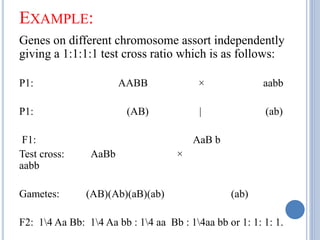
EXAMPLE:
Genes on different chromosome assort independently
giving a 1:1:1:1 test cross ratio which is as follows:
P1: AABB × aabb
P1: (AB) | (ab)
F1: AaB b
Test cross: AaBb ×
aabb
Gametes: (AB)(Ab)(aB)(ab) (ab)
F2: 14 Aa Bb: 14 Aa bb : 14 aa Bb : 14aa bb or 1: 1: 1: 1.
 T.H.Morgan and his co workers by their
investigation on the drosophila and other organisms
have found two types of linkages.i.e.
1. Complete linkage
2. Incomplete linkage
 1. Complete linkages:
 The complete linkage is a phenomenon in which
parental combinations of characters appear together
for two or more generations in a continuous and
regular fashion.
 In this type of linkage genes are closely associated
and tend to transmit together.
 Example:
 The genes of bent wings (bt) and shaven bristles
(svn) of the fourth chromosome mutant of drosophila
melanogaster exhibit complete linkage.
 In 1919, T.H.Morgan mated gray bodied and
vestigial winged fruit flies with flies having black
bogy and normal wings.
 F1 progeny had gray bodies and normal long wings,
indicating thereby that these characters are dominant.
 When F1 males were backcrossed to double recessive
females only two types of progeny (one with gray
body and vestigial wings and other with black body
and normal wings) instead of four types of phenotype
obtained.
 Use of test cross is very important
 Because one parent contributes gametes carrying
only recessive alleles, the phenotypes of the offspring
represent the gametic contribution of the other
heterozygote parent.
 The genetical analysts concentrate on the one meiosis
and forget other.
 This is in contrast to the situation in an F1 selfing
where there are two sets of meiotic divisions to
consider one for the F1 male parental gametes and
one for the F1 female.
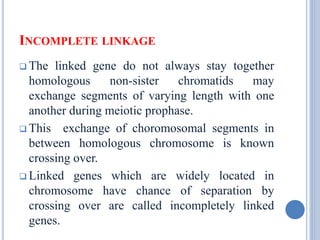
INCOMPLETE LINKAGE
 The linked gene do not always stay together
homologous non-sister chromatids may
exchange segments of varying length with one
another during meiotic prophase.
 This exchange of choromosomal segments in
between homologous chromosome is known
crossing over.
 Linked genes which are widely located in
chromosome have chance of separation by
crossing over are called incompletely linked
genes.
 Phenomena of their inheritance is called incomplete
linkage or partial linkage.
 Incomplete linkagehas been reported in female
drosophila and various organisms such as
tomato,maize,pea,mice,poultry and human being,etc.
 Incomplete Linkage In Maize. When a maize piant
with seeds having coloured and full
endosperm(CS/CS) crossed with another plant having
recessive alleles for colourless,shrunken seeds (cs/cs)
the F1 hybrid is test crossed with double recessive
parent (cs/cs) four classes of descendents are obtained
instead of two as shown in following
 Parents: coloured full x colourless shrunken
CS/CS cs/cs
F1: Coloured full
(CS/cs)
 Test Cross : F1 coloured full x colourless shrunken
CS/CS cs/cs
 Test cross results: coloured coloured shrunken: coloureless full: coloureless
full: full shrunken
 CS/cs Cs/cs cS/cs cs/cs
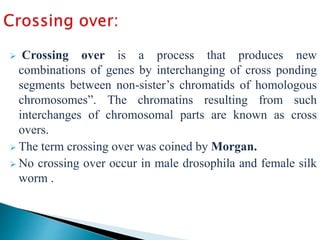
 Crossing over is a process that produces new
combinations of genes by interchanging of cross ponding
segments between non-sister’s chromatids of homologous
chromosomes”. The chromatins resulting from such
interchanges of chromosomal parts are known as cross
overs.
 The term crossing over was coined by Morgan.
 No crossing over occur in male drosophila and female silk
worm .
Heat
shock
Chemicals
Radiations
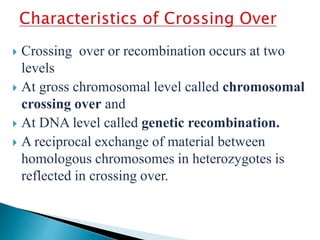
 Crossing over or recombination occurs at two
levels
 At gross chromosomal level called chromosomal
crossing over and
 At DNA level called genetic recombination.
 A reciprocal exchange of material between
homologous chromosomes in heterozygotes is
reflected in crossing over.
 The crossing over results basically from an exchange
of genetic material between non -sisters chromatids
by break and exchange following replication.
 The frequency of crossing over appears to be closely
related to physical distance between genes on
chromosomes and serves as a tool in constructing
genetic map of chromosomes.
TYPES OF CROSSING OVER:
 According to its occurrence in the Somatic or
germ Cells following two type of crossing over
have been recognize:
 Somatic Or Mitotic Crossing Over
 Germinal Or Meiotic Crossing Over
SOMATIC CROSSING OVER:
“When the process of crossing over occur
in the chromosomes of the body or
somatic cells of an organism during the
mitotic cell division is called somatic
crossing over”.
Somatic crossing over is rare in its
occurrence.
No genetical significance
Somatic crossing over has been reported
in the body or somatic cells of Drosophila
by Cut stern and in fungus Aspergillus
nidulans by G.Pontecorvo.
GERMINAL OR MEIOTIC CROSSING OVER:
 Crossing over occurs in germinal cells during the
gametogenesis in which the meiotic cell division take
place.
 This type of crossing over is known as germinal or
meiotic crossing over.
 The meiotic crossing over is universal in its occurrence is
of great genetic significance.
KINDS OF CROSSING OVER
 Single crossing over
 Double crossing over
 Multiple crossing over
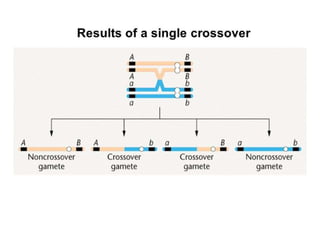
SINGLE CROSSING OVER:
 When the chiasma occurs only at one point of
the chromosome pair then the crossing over is
known as single crossing over.
 The single crossing over produces two cross
over chromatids and two non-cross over
chromatids.
DOUBLE CROSSING OVER:
 When the chiasmata occur at two points in the
same chromosome, the phenomena is known as
double crossing over.
 In the double crossing over, the formation of
each chiasma is independent of the other and in
it four possible classes of recombination occur.
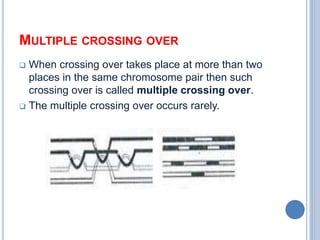
MULTIPLE CROSSING OVER
 When crossing over takes place at more than two
places in the same chromosome pair then such
crossing over is called multiple crossing over.
 The multiple crossing over occurs rarely.

Linking and-crossing-over

  • 4.
    DISCOVERY: • T.H Morganput forth the theory of linkage and conclude that coupling and repulsion were two phases of single phenomena, linkage. • Any organism has many more genes than chromosome it follows that each chromosome has many loci. • Genes are located in a linear fashion on chromosome, like beads on string. This was demonstrated by Sturtevant in 1913.
  • 5.
    LINKAGE:  Coexistence oftwo or more genes in the same chromosome and their inheritance in group.  Tendency of genes to remain to gather in their original combination during inheritance.  Existence of genes on the same chromosome by the failure of independent assortment.
  • 7.
    EXAMPLE: Genes on differentchromosome assort independently giving a 1:1:1:1 test cross ratio which is as follows: P1: AABB × aabb P1: (AB) | (ab) F1: AaB b Test cross: AaBb × aabb Gametes: (AB)(Ab)(aB)(ab) (ab) F2: 14 Aa Bb: 14 Aa bb : 14 aa Bb : 14aa bb or 1: 1: 1: 1.
  • 8.
     T.H.Morgan andhis co workers by their investigation on the drosophila and other organisms have found two types of linkages.i.e. 1. Complete linkage 2. Incomplete linkage
  • 9.
     1. Completelinkages:  The complete linkage is a phenomenon in which parental combinations of characters appear together for two or more generations in a continuous and regular fashion.  In this type of linkage genes are closely associated and tend to transmit together.  Example:  The genes of bent wings (bt) and shaven bristles (svn) of the fourth chromosome mutant of drosophila melanogaster exhibit complete linkage.
  • 10.
     In 1919,T.H.Morgan mated gray bodied and vestigial winged fruit flies with flies having black bogy and normal wings.  F1 progeny had gray bodies and normal long wings, indicating thereby that these characters are dominant.  When F1 males were backcrossed to double recessive females only two types of progeny (one with gray body and vestigial wings and other with black body and normal wings) instead of four types of phenotype obtained.
  • 11.
     Use oftest cross is very important  Because one parent contributes gametes carrying only recessive alleles, the phenotypes of the offspring represent the gametic contribution of the other heterozygote parent.
  • 12.
     The geneticalanalysts concentrate on the one meiosis and forget other.  This is in contrast to the situation in an F1 selfing where there are two sets of meiotic divisions to consider one for the F1 male parental gametes and one for the F1 female.
  • 13.
    INCOMPLETE LINKAGE  Thelinked gene do not always stay together homologous non-sister chromatids may exchange segments of varying length with one another during meiotic prophase.  This exchange of choromosomal segments in between homologous chromosome is known crossing over.  Linked genes which are widely located in chromosome have chance of separation by crossing over are called incompletely linked genes.
  • 14.
     Phenomena oftheir inheritance is called incomplete linkage or partial linkage.  Incomplete linkagehas been reported in female drosophila and various organisms such as tomato,maize,pea,mice,poultry and human being,etc.  Incomplete Linkage In Maize. When a maize piant with seeds having coloured and full endosperm(CS/CS) crossed with another plant having recessive alleles for colourless,shrunken seeds (cs/cs) the F1 hybrid is test crossed with double recessive parent (cs/cs) four classes of descendents are obtained instead of two as shown in following
  • 15.
     Parents: colouredfull x colourless shrunken CS/CS cs/cs F1: Coloured full (CS/cs)  Test Cross : F1 coloured full x colourless shrunken CS/CS cs/cs  Test cross results: coloured coloured shrunken: coloureless full: coloureless full: full shrunken  CS/cs Cs/cs cS/cs cs/cs
  • 17.
     Crossing overis a process that produces new combinations of genes by interchanging of cross ponding segments between non-sister’s chromatids of homologous chromosomes”. The chromatins resulting from such interchanges of chromosomal parts are known as cross overs.  The term crossing over was coined by Morgan.  No crossing over occur in male drosophila and female silk worm .
  • 19.
  • 20.
     Crossing overor recombination occurs at two levels  At gross chromosomal level called chromosomal crossing over and  At DNA level called genetic recombination.  A reciprocal exchange of material between homologous chromosomes in heterozygotes is reflected in crossing over.
  • 21.
     The crossingover results basically from an exchange of genetic material between non -sisters chromatids by break and exchange following replication.  The frequency of crossing over appears to be closely related to physical distance between genes on chromosomes and serves as a tool in constructing genetic map of chromosomes.
  • 22.
    TYPES OF CROSSINGOVER:  According to its occurrence in the Somatic or germ Cells following two type of crossing over have been recognize:  Somatic Or Mitotic Crossing Over  Germinal Or Meiotic Crossing Over
  • 23.
    SOMATIC CROSSING OVER: “Whenthe process of crossing over occur in the chromosomes of the body or somatic cells of an organism during the mitotic cell division is called somatic crossing over”.
  • 24.
    Somatic crossing overis rare in its occurrence. No genetical significance Somatic crossing over has been reported in the body or somatic cells of Drosophila by Cut stern and in fungus Aspergillus nidulans by G.Pontecorvo.
  • 25.
    GERMINAL OR MEIOTICCROSSING OVER:  Crossing over occurs in germinal cells during the gametogenesis in which the meiotic cell division take place.  This type of crossing over is known as germinal or meiotic crossing over.  The meiotic crossing over is universal in its occurrence is of great genetic significance.
  • 26.
    KINDS OF CROSSINGOVER  Single crossing over  Double crossing over  Multiple crossing over
  • 27.
    SINGLE CROSSING OVER: When the chiasma occurs only at one point of the chromosome pair then the crossing over is known as single crossing over.  The single crossing over produces two cross over chromatids and two non-cross over chromatids.
  • 29.
    DOUBLE CROSSING OVER: When the chiasmata occur at two points in the same chromosome, the phenomena is known as double crossing over.  In the double crossing over, the formation of each chiasma is independent of the other and in it four possible classes of recombination occur.
  • 31.
    MULTIPLE CROSSING OVER When crossing over takes place at more than two places in the same chromosome pair then such crossing over is called multiple crossing over.  The multiple crossing over occurs rarely.