The document discusses competency-based education and outcome-based education, defining key terms like competency, performance, and competence. It outlines the levels of competencies, purposes, principles, and processes of competency-based education and outcome-based education. The document also compares the two approaches and discusses their advantages and disadvantages.
Introduction to Competency-Based Education (CBE) and Outcome-Based Education (OBE) focusing on proficiency in real-life situations.
Detailed definitions of terms: Competency, Competence, and Performance in CBE; the necessity for CBE in education institutions and its impact on employers.
Description of four levels of competencies as proposed in 2005, addressing behavior and integrated skills necessary for performance.
Examples of CBE aimed at improving nursing services as outlined by WHO, with key intervention areas specified.
Outlines the purposes of CBE, major procedures involved in design, development, and implementation of competency-based curriculum.
Key characteristics of CBE such as self-paced learning and flexible methods, along with different interaction modes for learning.
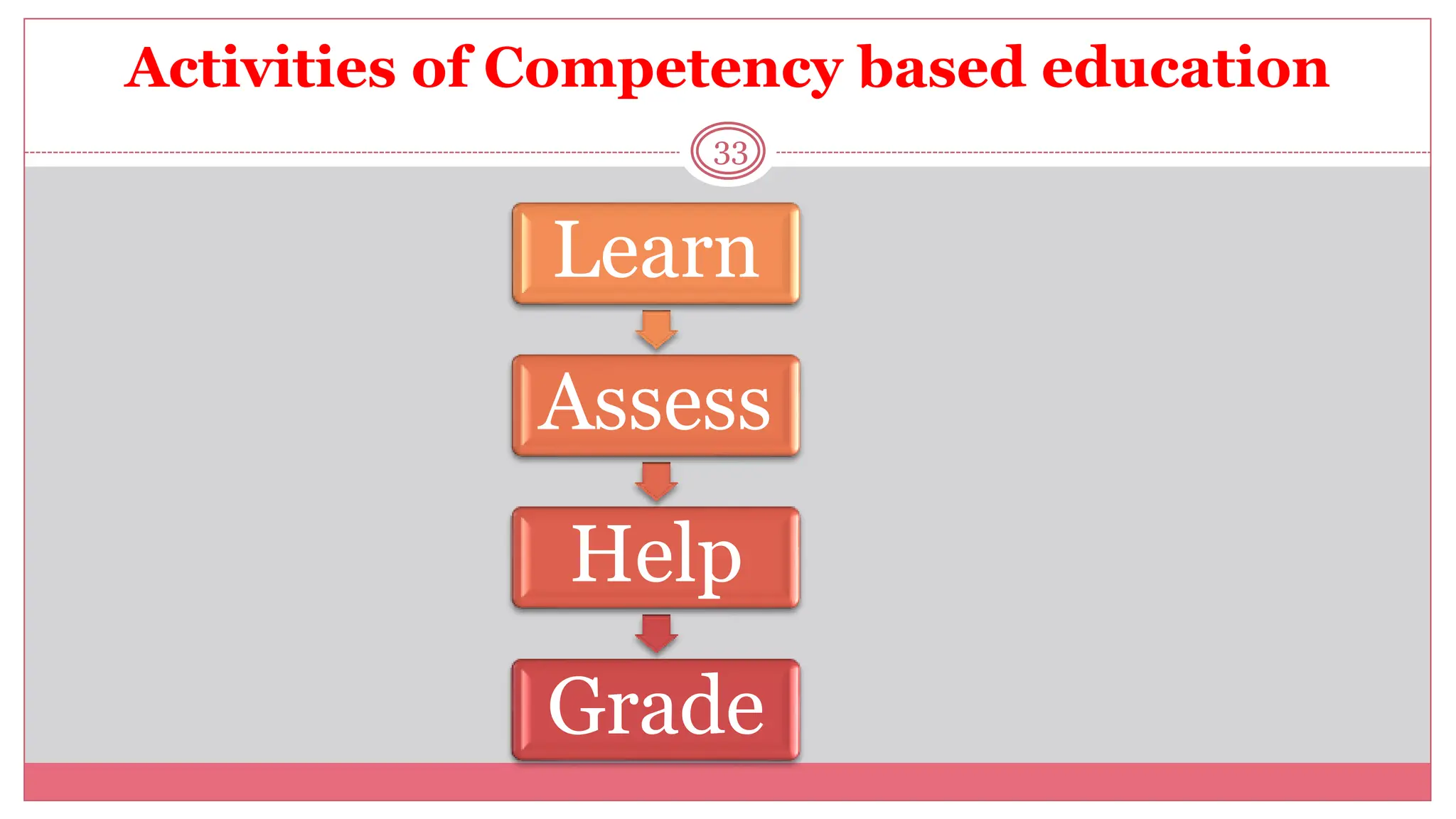
Step-by-step process for implementing CBE, including learning objectives, assessment, and continuous improvement activities.
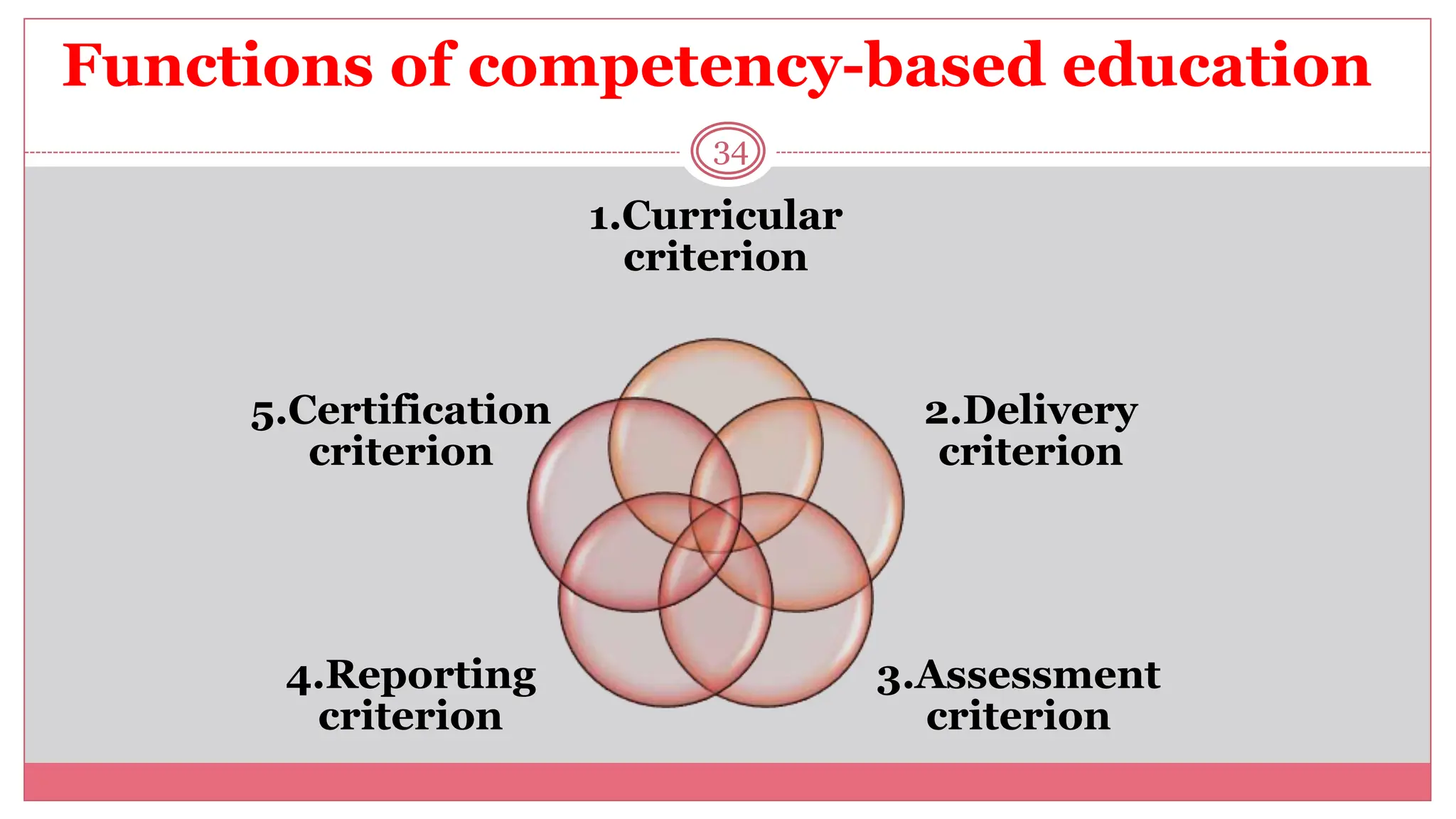
Various evaluation criteria in CBE, ensuring clarity in learning expectations, flexibility of delivery, and impactful reporting.
Identified potential disadvantages of CBE including reliance on traditional teaching modes and competency identification difficulties.
Overview of Outcome-Based Education focusing on defined goals and how educational structures can reflect mastery of learning.
Comprehensive definitions and purposes of OBE, emphasizing the necessity for clear outcomes in the educational process.
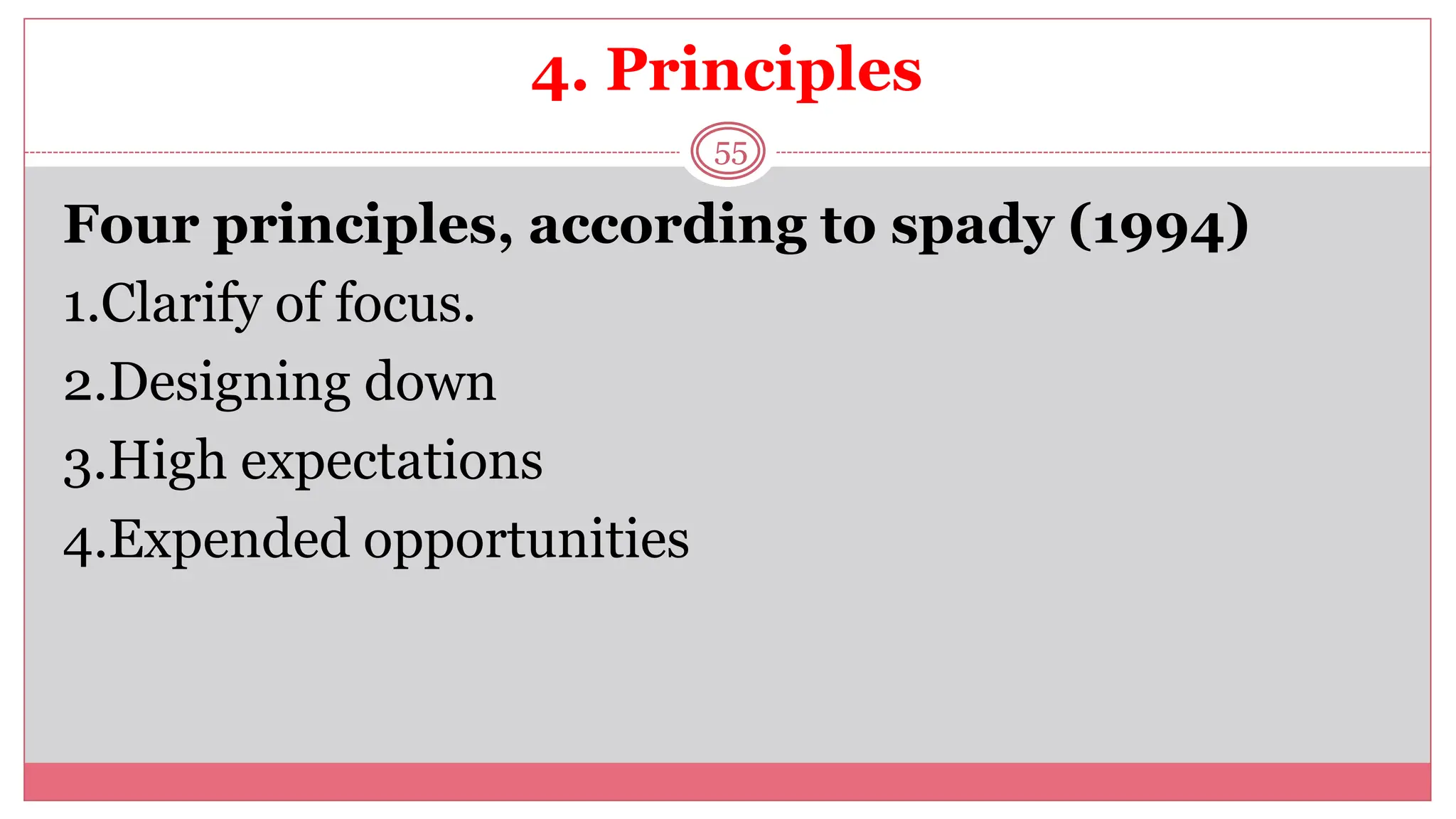
Four essential principles characterizing OBE: Clarity of focus, designing down, high expectations, and expanded opportunities.
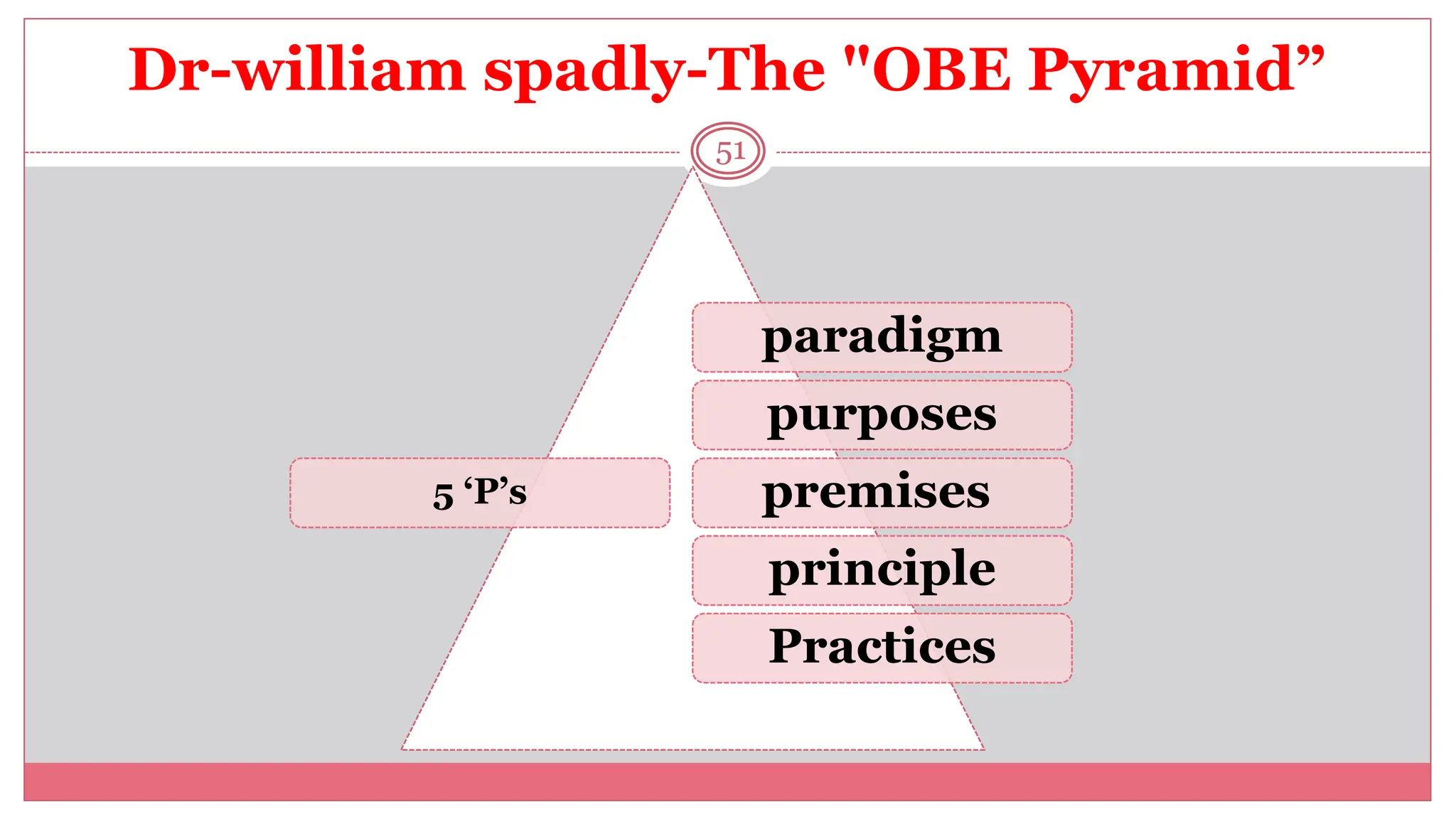
Dr. Spady’s pyramid of OBE emphasizing important educational practices and principles necessary for effective OBE implementation.
Key characteristics of OBE within nursing education that prepare students for professional accountability and improved care.
Outlined steps for implementing OBE effectively, from establishing goals to analyzing data for curriculum improvement.
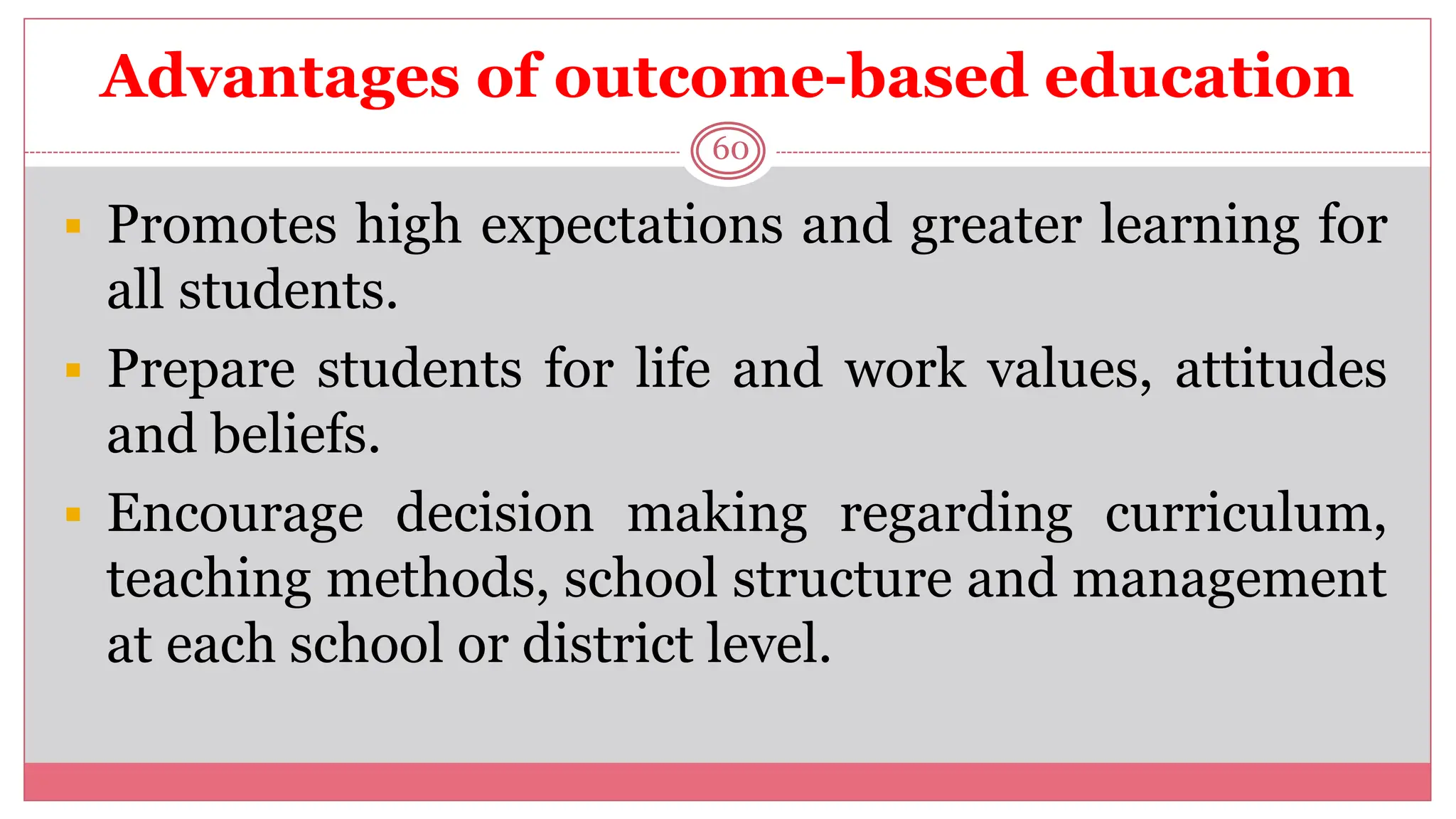
Activities related to setting outcomes in OBE and advantages highlighting its educational effectiveness.
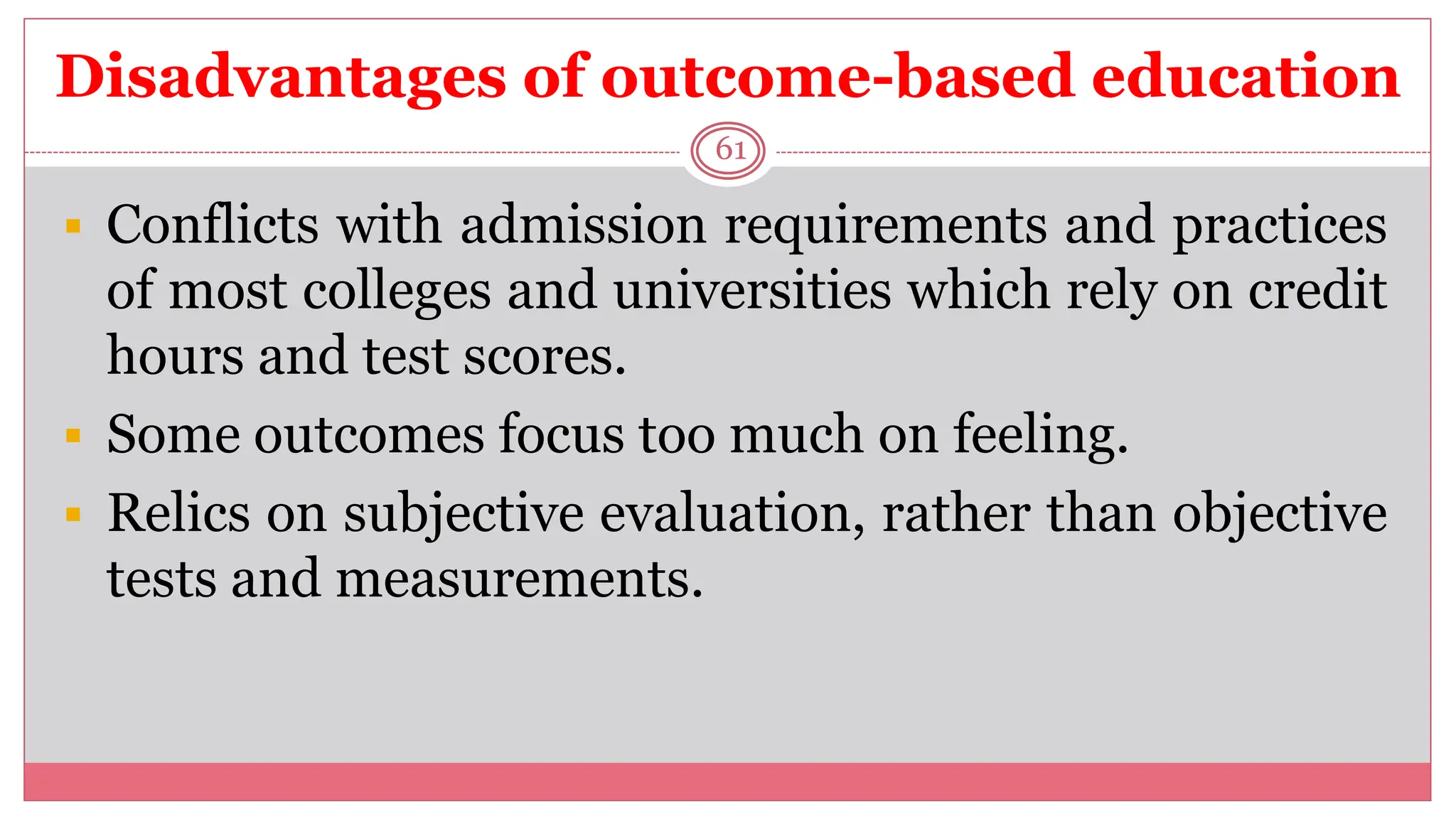
Examines weaknesses in OBE, such as potential conflicts with traditional educational metrics and reliance on subjective assessments.
Recap of key discussions regarding CBE and OBE, focusing on definitions, processes, and relative advantages.
Final thoughts on CBE as competence-centered and OBE as a student-focused approach, emphasizing educational outcomes.
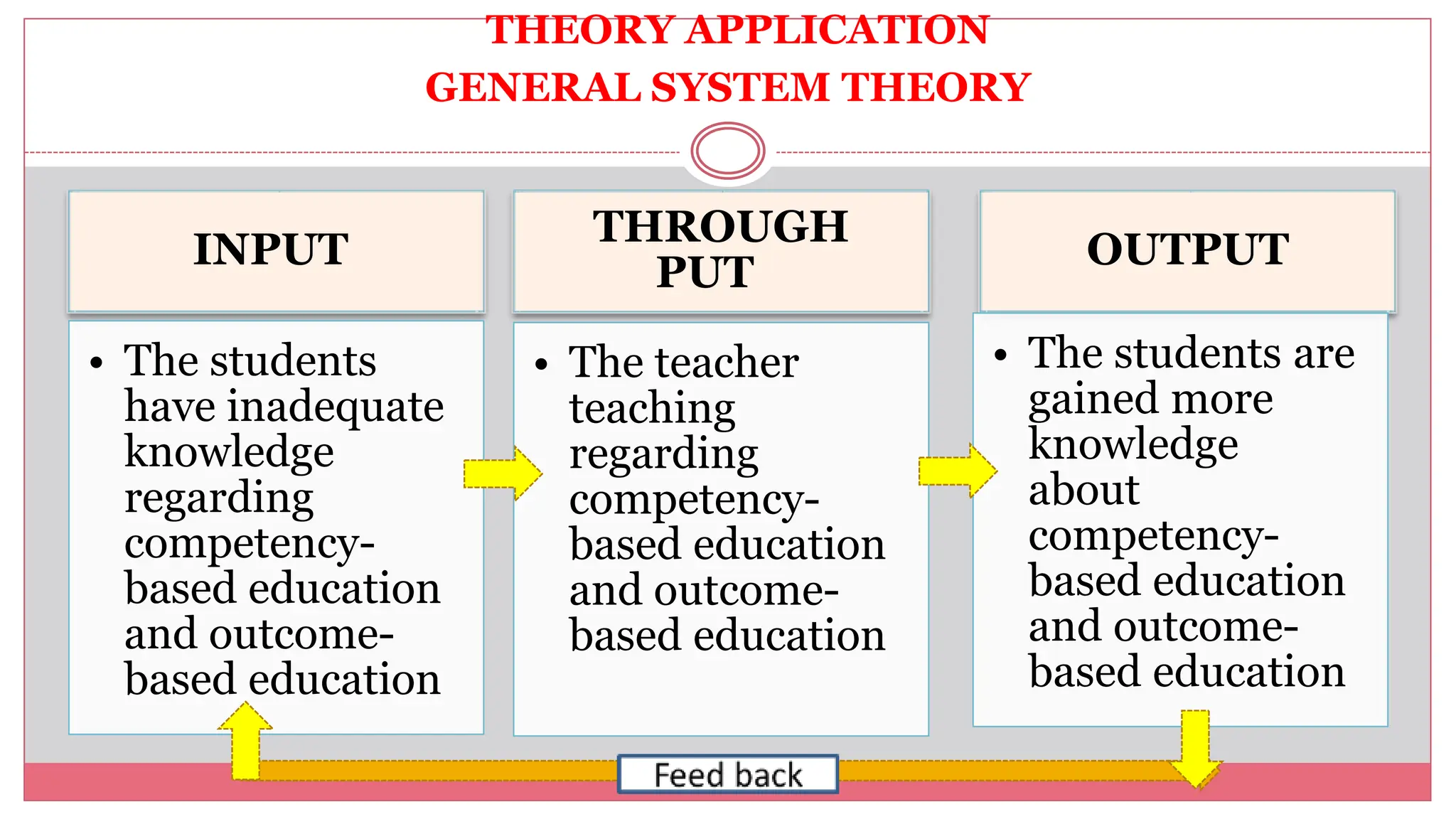
Illustrates the educational process using General System Theory, detailing inputs, throughput, and outputs related to CBE and OBE.
Assignment prompt asking students to write notes on CBE, indicating its educational relevance.
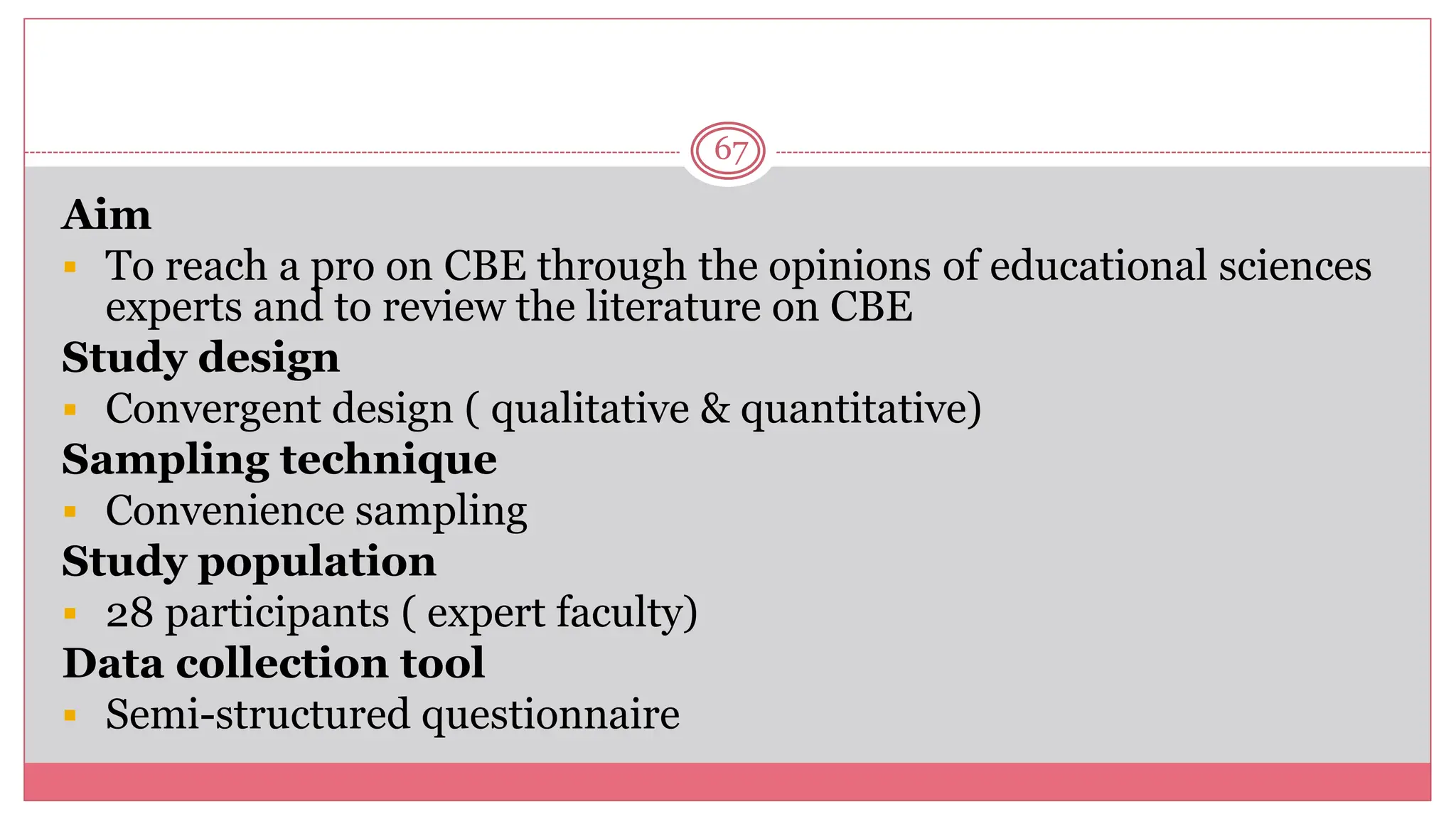
Summary of a study exploring expert opinions on CBE, revealing insights on competency definitions and student assessment methods.
COMPETENCY-BASED EDUCATION AND
OUTCOME-BASEDEDUCATION
3
Introduction
Competency-based education is an outcome -based
approach to education to ensure proficiency in learning by
students through demonstration of the knowledge, skills, values.
and attitudes required for dealing with real life situations at the
age and grade appropriate level.
Terms used inCompetency-based Education
5
Competency
It focuses on an individual's ability to perform
activities related to work, life skills or learning.
6.
Terms used inCompetency-based Education
6
Competence
It describes actions or skills the person should be
able to demonstrate competence is concerned with
perceived skills and cannot be directly measured.
7.
Terms used inCompetency-based Education
7
Performance
It relates to specific behaviors that are measurable
and can reflect what workers actually do.
8.
COMPETENCY-BASED EDUCATION
8
Meaning ofcompetency-based education
The competency- based education approach
allows students to advance based on their ability to
master a skill or competency at their own space of
regard less environment.
9.
Needs for competencybased education
9
Educational institution and providers need evidence that
anyone who completes a degree or course has achieved a
required level it competency .
Accrediting, regulatory, and professional group want
assurance that completion of an educational endeavor
indicates competency.
There is greater accountability for the coasts and time. It
takes to complete educational endeavors and determine if
they achieve the expected outcomes.
Employers hire new workers who do not have basic
competencies required for entry level positions.
10.
Needs for competencybased education……
10
Employers invest in extensive training programmes to address
the initial needs to new employees and the continuing training
needs of all employee, especially those in complex, changing
work environments.
Regulatory; legal, external standards and quality measures
require demonstration of Competence.
Workers need to continue their own personal and professional
development to advance their carriers and make positive
contribution to organizations.
11.
11
Levels of competencies
Juceivienceand lepaite [2005) proposed a multidisciplinary
approach to the Conceptualization of competence.
Level 1:
Behavior competencies relate to operational work
performance and have to meet the demands of the work place.
They have clearly stated constituent parts, consisting of
competencies.
Level 2:
Added competencies based on behavior and additional
knowledge needed to improve work.
12.
12
Levels of competencies…..
Level 3:
Integrated competencies that support changes of
Internal and external conditions knowledge, skills and
understanding are integrated into internal and external
work conditions.
Level 4:
It compromise of holistic competencies.
13.
COMPETENCY-BASED EDUCATION
13
Examples ofCBE based on WHO (2007) five key
interventions areas to improve nursing and midwifery
services.
The world health organization (WHO) 2007 is recognized
for its efforts on many fronts to improve the health of all
people.
Strategic Directions were developed for 2002-2008 and
included five key intervention areas to improve nursing and
midwifery services.
14.
Five key areasare..
14
Health and Human resources planning
Management of Health personnel
Practice and Health System improvement
Education of nurses and midwives
Leadership and Governance
15.
Purposes of CBE:
15
Measure
students
learningrather
than time.
Harness the
power of
technology for
teaching and
learning.
Fundamentally
change the
faculty role.
Define
competencies
and develop
valid reliable
assessments.
1.Design
17
To settraining approach.
To develop learning purposes
To determine operation scale
To design education
18.
2. Development
18
Toprepare learning guide
To verify a task
To prepare course plans
To prepare auxiliary medium
Guide tests / to review materials and procedures
19.
3. Implement
19
Toimplement a course plan
To train
To do derived assessment
To train a document
20.
Characteristics of CBE
20
Competenciesare carefully selected.
Supporting theory is integrated with skill, practice,
essential knowledge is learned to support the
performance of skills.
Participants knowledge and skills are assisted as they
enter the program.
Learning should be self-paced.
21.
Characteristics of CBE
21
Flexibletraining approaches including large group
methods, small group activities and individual study
are essential components.
Satisfactory completion of training is based on
achievement of all specified Components.
Competencies are carefully selected.
22.
Characteristics of CBE
22
Varietyof support materials including, print, audio-
visual aids and simulations (models) key to the skills
being mastered is used.
Method of instruction involves mastery learning, that
premise that all participants can master the required
knowledge or skills, provided sufficient time and
appropriate training methods are used.
23.
Competency-based education andnursing
education
23
Revised BSc (N) syllabus is based on Competency based
curriculum. According to new guidelines:
students are expected to perform the listed skills /
competencies many times until they reach Level 3
competency, after which the preceptor signs against each
competency.
preceptor/faculty:
Must ensure that the signature given for each
competency only after they reach Level 3
24.
Competency-based education andnursing education
24
Level-1
Competency denotes that the nursing student is not able
to perform that competency / skill even with supervision.
Level-2
Competency denotes that the nursing student is able to
perform each competency with supervision.
Level-3
Competency denotes that the nursing student is able to
perform that Competency without supervision.
1-Downloadable Mode
26
Downloadablemode empowers to offer education in a
dynamic from to students. student can assess lesson,
assignments and submit their script online.
They can download their lesson notes and archived
lessons, tutorial sessions, lectures etc.
27.
2. Read onlymode
27
Students will be able to only read the course
concepts.
Downloading or interacting is unavailable
28.
3.Class room interaction
28
Theinteractive learning provides an environment for
students to talk and discuss freely about any related
topics online.
There are two ways of classroom interaction,
a) ‘X’ chart
b) Mailing group
29.
a)’X’ chart
29
Clientserver models that works interact relay that
server protocol, it allows servers to connect to each
other effectively forming a network. protocol is used
by servers to talk to each others.
Instructor and participants can talk with each other
and discuss on related topic for stipulated time given
by the instructor.
30.
b) Mailing Group
30
Participant can become member of the mailing group
by registering their names in the group.
Once the approved by the instructor-participants can
post their questions to this group ID.
This way course instructor or any other participant
can reply to questions that will be read by all the
members in that group including the instructor.
31.
Process of CBE
31
Step-1
Understandthe
benefits and
challenges of
competency-based
education
Step-2:
Evaluate and
catalogue the
objective of
academic
program.
Step-3:
Review the
curriculum
structure of
programme and
the list of Care
competencies if
available
32.
Process of CBE…..
32
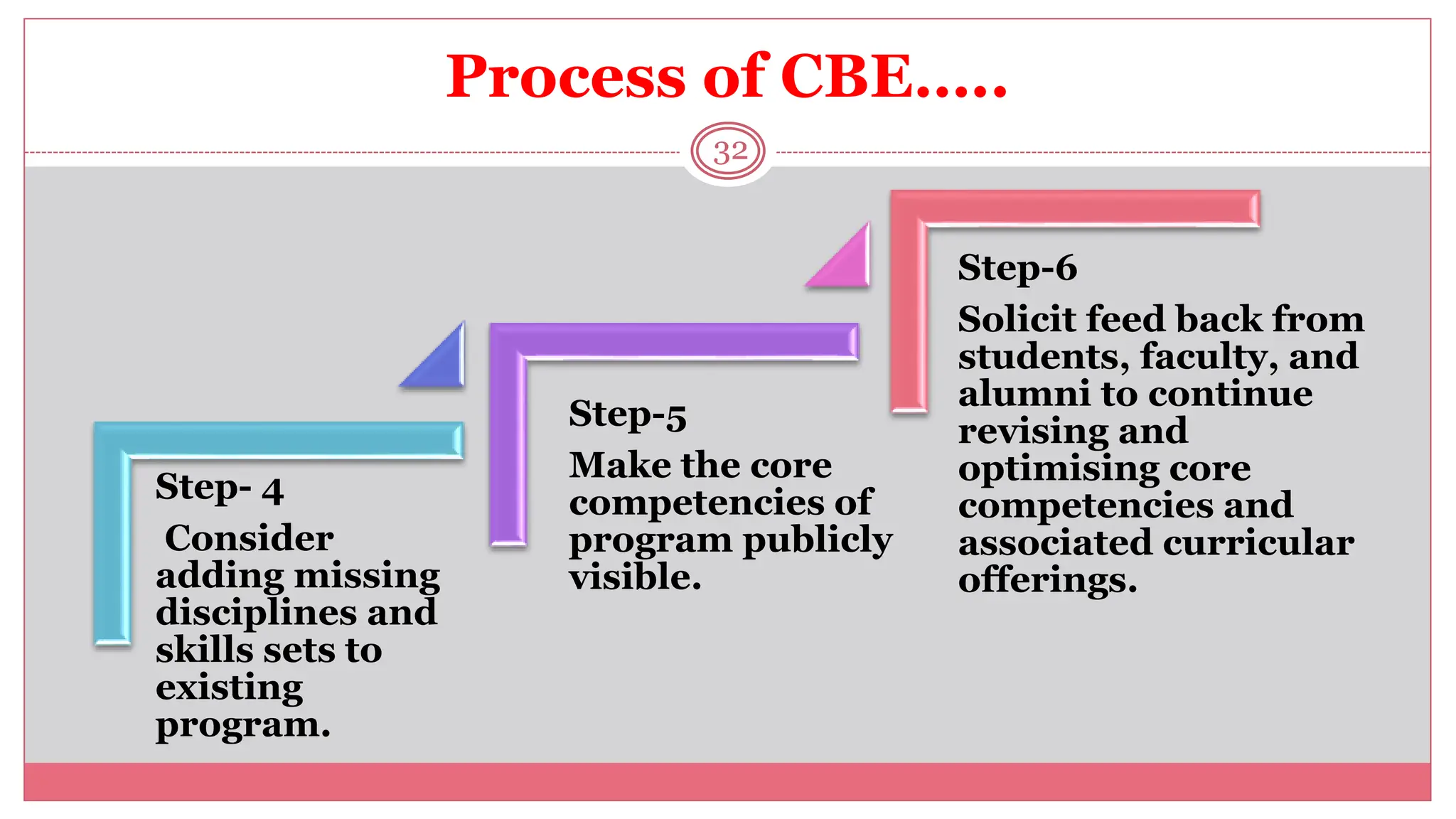
Step-4
Consider
adding missing
disciplines and
skills sets to
existing
program.
Step-5
Make the core
competencies of
program publicly
visible.
Step-6
Solicit feed back from
students, faculty, and
alumni to continue
revising and
optimising core
competencies and
associated curricular
offerings.
1. Curricular Criterion
35
The curriculum gives learners as clear indication of
what is expected of them in terms of performance,
conditions and standard.
Also, if appropriate, workplace and off the job training
and assessment responsibilities should be identified.
36.
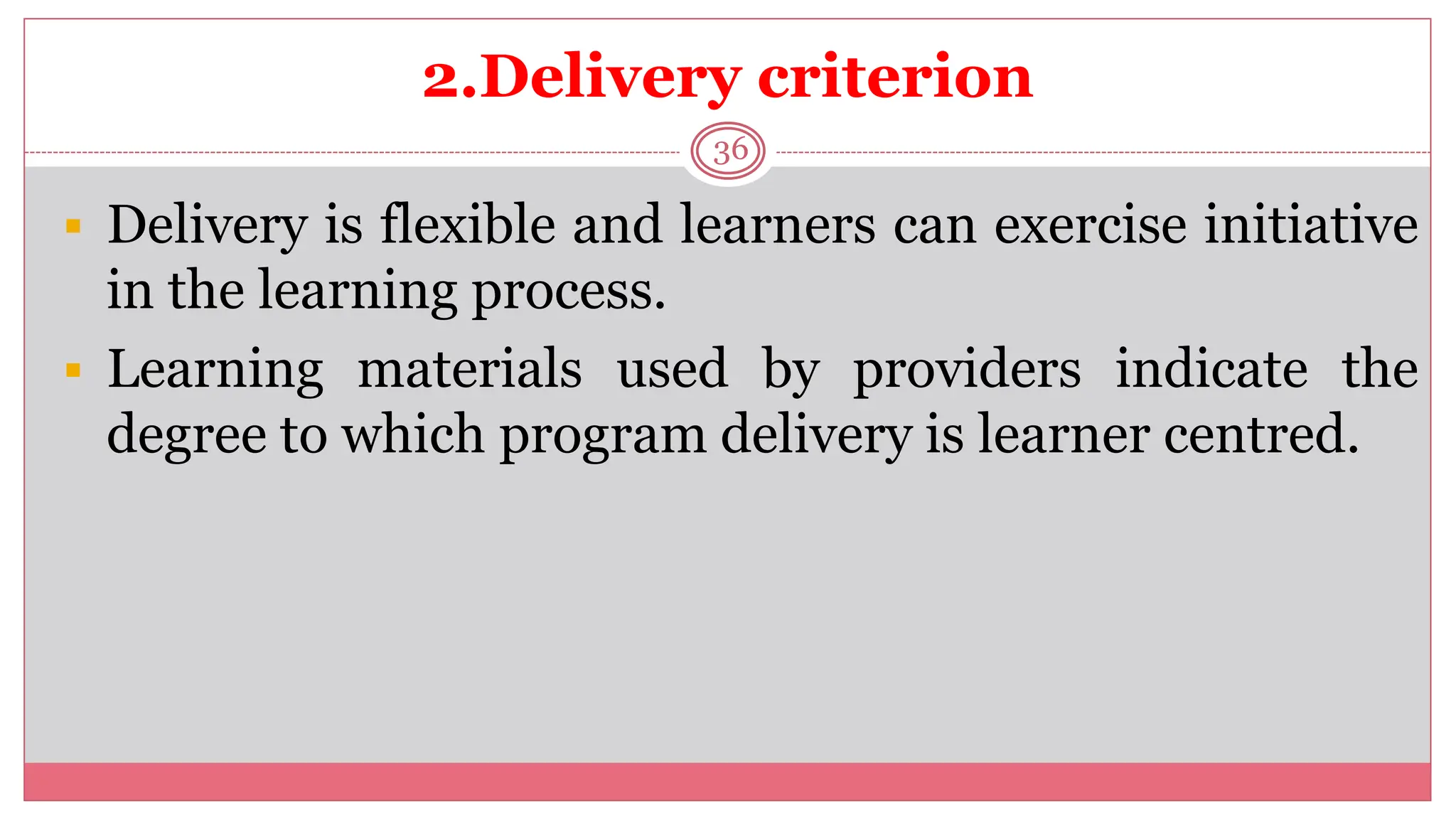
2.Delivery criterion
36
Deliveryis flexible and learners can exercise initiative
in the learning process.
Learning materials used by providers indicate the
degree to which program delivery is learner centred.
37.
3. Assessment Criterion
37
Assessmentshould,
Measure performance demonstrated against a
specified competence standard be available for
competencies gained outside the course.
Include workspace or off the job components it
appropriate.
38.
4. Reporting and/Recordingcriterion
38
Reports of competencies gained should be provided to
learners.
Reporting may be in terms of completed modules
provided that the relationship between competencies
and modules is understood.
39.
5. Certification Criterion
39
Person demonstrating all prescribed competencies in
an accredited course or training programme should
obtain a credential or statement of attainment which is
recognized with the national frame work.
40.
Disadvantages of CBE
40
Unless initial training and follow-up assistance is provided for
the trainers, there is tendency to "teach as were taught” we
and trainers quickly slip back into the role of the traditional
teacher.
CBE Courses is only as effective it process used to identify the
competencies.
When little or no attention is give to identification of the
essential job skills, then the resulting training course is likely
to be ineffective.
OUTCOME BASED EDUCATION
42
Introduction
Outcomebased education is an theory that bases
educational around pre-defined goals (out come).
By the end of the education experience each student is
expected to have achieved that goal.
It is also called standard based education reforms,
mastery education and performance based education.
43.
OUTCOME BASED EDUCATION
43
Meaningof OBE
Outcome-based education means clearly focusing
and organizing everything in an education system
around what is essential for all students to be able to do
successfully at the end of their learning experience.
44.
OUTCOME BASED EDUCATION
44
Definitionof outcome-based education
Outcome-based education (OBE) is a process that
involves the restructuring of curriculum, assessment and
reporting practices in education to reflect the
achievement of high order learning and mastery rather
than the accumulation of course credits.
Dr. William spady
45.
Purposes of outcome-basededucation
45
1. Equip all students with knowledge, Competencies,
and orientations needed for future success.
2.Implement programmes and conditions that
maximize learning success for all students.
46.
Four essential principlesin outcomes Based
education
46
1. Clarity of focus
2. Designing down
3. High expectation
4. Expanded opportunities
47.
1. Clarity offocus
47
Teachers should focus on helping students to
develop the knowledge, skills. and personalities that
will enable them to achieve the indented outcome
that have been clearly articulated.
48.
2.Designing down
48
Thecurriculum design must starts with a clear
definition of the indented outcomes that students are
to achieve by the end of the program.
Once this has been done all instructional decision are
then made to ensure achieve this desired end result.
49.
3. High Expectations
49
The teachers should establish high, challenging
standards of performance in order to encourage
students to engage deeply in what they are leaning.
50.
4.Expended opportunities
50
Teachersmust strive to provide expanded
opportunities for all students.
This principle is based on the idea that not all
learners can learn the same thing in the same way
and in the same time.
1. Paradigm:
52
whatand whether students learn well is more
important than when and How they learn it.
Clearly define framework of exit outcomes time is an
alterable resources “criterion-based’’ increasing
students learning and ultimate performance abilities.
53.
2. Purposes
53
Equipall students with knowledge, competencies
and orientation needed for future success.
Implement programs and conditions that maximize
learning success for all students.
54.
3. Premises
54
Allstudents can learn and succeed, but not on the
same day in the same way, Schools control the
conditions of success.
55.
4. Principles
55
Four principles,according to spady (1994)
1.Clarify of focus.
2.Designing down
3.High expectations
4.Expended opportunities
Characteristics of OBEin nursing education
57
Ability to exercise professional accountability and responsibility.
Ability to use research to plan, implement and evaluation concepts and
strategies leading to improvement in care.
Ability to evaluate quality of care delivered as an ongoing and
cumulative process
Ability to facilitate, initiates, manage and evaluate manage in practice
to improve quality of care
Understanding and use of health promotion and preventative policies
Ability to facilitate and assess the professional and other development
Act as a role model of professional practice
Specialist skills, knowledge and expertise in the practice area
58.
Process of outcome-basededucation
58
Step-1
Establish student learning goals as miserable learning objective
Step-2
Develop specific assessment
Step-3
Develop comprehensive assessment- tools to assess and measure each criteria
Step-4
Collect data from assessed student learning goal using
Step-5
Analyse assessment data
Step-6
Use data to improve student learning and report for accreditation
Advantages of outcome-basededucation
60
Promotes high expectations and greater learning for
all students.
Prepare students for life and work values, attitudes
and beliefs.
Encourage decision making regarding curriculum,
teaching methods, school structure and management
at each school or district level.
61.
Disadvantages of outcome-basededucation
61
Conflicts with admission requirements and practices
of most colleges and universities which rely on credit
hours and test scores.
Some outcomes focus too much on feeling.
Relics on subjective evaluation, rather than objective
tests and measurements.
62.
summary
62
So far wediscussed about the competency-
based education and outcome based education
meaning, definitions ,levels of competencies, process,
advantages and disadvantages.
63.
conclusion
63
Competency based educationemphasizing how
competent each student is in a specific subject. It does
focus on students grades.
Outcome-based education is a student centred
approach that has gained popularity in higher education
institutions due to its abilities to improve students
outcomes and institutional effectiveness.
64.
THEORY APPLICATION
GENERAL SYSTEMTHEORY
INPUT
• The students
have inadequate
knowledge
regarding
competency-
based education
and outcome-
based education
THROUGH
PUT
• The teacher
teaching
regarding
competency-
based education
and outcome-
based education
OUTPUT
• The students are
gained more
knowledge
about
competency-
based education
and outcome-
based education
67
Aim
To reacha pro on CBE through the opinions of educational sciences
experts and to review the literature on CBE
Study design
Convergent design ( qualitative & quantitative)
Sampling technique
Convenience sampling
Study population
28 participants ( expert faculty)
Data collection tool
Semi-structured questionnaire
68.
68
Results
The study showsthat the experts adopt the most—up-to-
date definitions of CBE, but it is often confuse with
proficiencies-based education
The study revealed that CBE focused on the demonstration
of competence when considering students progress and
measures it by formative assessments and that, in CBE
students learning gaps are eliminated by supporting them
at each studies.




























![competency based education [Autosaved]1.ppt](https://cdn.slidesharecdn.com/ss_thumbnails/competencybasededucationautosaved1-230723164405-7499f07f-thumbnail.jpg?width=640&height=640&fit=bounds)


