








SUBJECT : NURSING EDUCATION
TOPIC : COMPETENY BASED EDUCATION AND OUTCOME BASED
EDUCATION
Jyotsana Gurung
M.Sc (Nsg) 1st year
AIIMS,JODHPUR
CONTENT
• INTRODUCTION
• COMPETENCY BASED EDUCATION
• OUTCOME BASED EDUCATION
• RESEARCH ARTICLE
• SUMMARY
• CONCLUSION
• REFERENCES
INTRODUCTION
• COMPETENCE: is the capacity to realize (up to standard) the key occupational task
that characterize a profession (specific).
• COMPETENCY: is the capability to choose and apply integrated combination of
knowledge, skills and attitude with the intention to realize a task in a certain
context.
COMPETENCY BASED EDUCATION
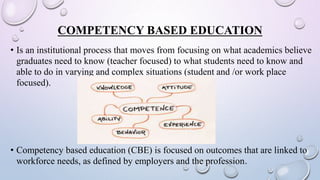
• Is an institutional process that moves from focusing on what academics believe
graduates need to know (teacher focused) to what students need to know and
able to do in varying and complex situations (student and /or work place
focused).
• Competency based education (CBE) is focused on outcomes that are linked to
workforce needs, as defined by employers and the profession.
NEED FOR CBE
1. Educational institutions and providers need evidence that anyone who completes a degree or
course has achieved a required level of competency.
2. Employers invest in extensive training programs to address the initial needs of new
employees and the continuing training needs of all employees, especially those in complex
changing work environments.
3. Regulatory legal, external standards and quality measures require demonstration of
competence.
4. Workers need to continue their own personal and professional development to advance their
careers and make positive contributions to organizations.
5. Measure student learning rather than time.
CHARATERISTICS OF CBE
• Competencies are carefully selected.
• Essential knowledge is learned to support the performance of skills.
• Participants’ knowledge and skills are assessed as they enter the program.
• Learning should be self-paced.
• Flexible training approaches including large group methods, small group
activities and individual study are essential components.
• Satisfactory completion of training is based on achievement of all specified
components.
LEVELS OF COMPETENCY
• Level 1: behavior competencies relate to operational work performance and have
to meet the demands of the workplace. they have clearly stated consistent parts,
consisting of competencies.
• Level 2: added competencies based on behavior and additional knowledge needed
to improve work.
• Level 3: integrated competencies that support change of internal and external
working conditions. Knowledge, skills and understanding are integrated into
internal and external work conditions.
• Level 4: it compromises of holistic competencies
 Flexible
Personalized
Skill-based
Affordable
Participants will achieve competencies required in the performance of their jobs.
Participants build confidence as they succeed in mastering specific competencies.
Self-pacing
ROLE OF CBE IN NURSING
• Allows students to advance based on their ability to master a skill or competency at their own pace
regardless of environment.
• It helps to meet different learning abilities and can lead to more efficient student outcomes.
• Students advance upon achieving mastery.
• Empower students.
• Assessment is meaningful and a positive learning experience for students.
• Learn about application and creation of knowledge, along with the development of important skills
and dispositions.
• Leads to an improved quality of patient care and an increased patient satisfaction with the nurses
and helps promote nursing as a profession .
• Improve nursing education and clinical nursing .
• It is necessary for professionals to demonstrate that they are clinically competent to perform certain
roles .
OUTCOME BASED EDUCATION/PERFORMANCE
BASED EDUCATION
• Outcomes are clear learning results that learners have to demonstrate at the
end of significant learning experiences.
• OBE is an educational theory that bases each part of an educational system
around goals (outcomes).
• It is a student-centered approach to education that focuses on the intended learning
outcomes resulting from instruction . (NICHOLSON, 2011)
• Outcome-based education(obe) means focusing and organising a school's entire programs
and instructional efforts around the clearly defined outcomes we want all students to
demonstrate when they leave school." (Spady, 1993)
OBE AS AN APPROACH
1.Identifying desired outcomes
2.Deciding on strategies and methodologies to achieve those outcomes
3.Determining assessment measures for the achievement of outcomes
PRINCIPLES
EXPANDED
OPPORTUNITY
CLARITY
OF FOCUS
HIGH
EXPECTATIONS
DESIGN
DOWN
OBE PROCESS
• ‘Constructive alignment’ is the process that we usually follow when we build
up an OBE syllabus. It is a term coined by professor John Biggs in 1999,
which refers to the process to create a learning environment that supports the
learning activities appropriate to achieving the desired learning outcomes.
• The word ‘constructive’ refers to what the learner does to construct meaning
through relevant learning activities.
• The ‘alignment’ aspect refers to what the teacher does.
THE "ESSENCE" OF OBE
1. In OBE what matters ultimately is not what is taught, but what is learned.
2. Teachers must set appropriate course intended learning outcomes, instead of teaching
objectives.
3. Constructive alignment: what we teach, how we teach and how we assess ought to be
aligned with the intended learning outcomes, such that they are fully consistent with
each other.
4. The quality of teaching is to be judged by the quality of learning that takes place.
5. All OBE approaches take a criterion-based view of assessment and focus on what
students can do with knowledge after a period of learning.
Set learning
outcomes
Motivate the
students
Improve the
teaching
strategies
Assessment/Evaluate
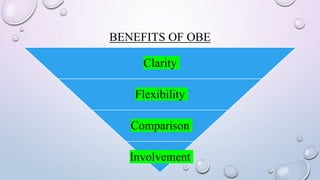
BENEFITS OF OBE
Clarity
Flexibility
Comparison
Involvement
ROLE OF OBE IN NURSING
• OBE empowers students to take more responsibility .
• Apply leadership concepts, skills, and decision making in the provision of high-quality nursing care, healthcare team
coordination, and the oversight and accountability for care delivery in a variety of settings.
• Integrate evidence, clinical judgment and patient preferences in planning, implementing, and evaluating outcomes of
care.
• Demonstrate skills in using patient care technologies, information systems, and communication devices that support
safe, effective nursing practice.
• Incorporate effective communication skills to contribute the nursing perspective to interprofessional teams to optimize
patient outcomes.
• Collaborate with members of the interprofessional team to develop an assessment and intervention plan that takes into
account determinants of health and available resources that contribute clinical prevention and population health.
• Assume accountability for personal and professional behaviors that demonstrate the nursing standards of moral, ethical,
and legal conduct.
• Implement holistic, evidenced-based, safe patient-centered care across the health illness continuum, across the lifespan,
and in all healthcare settings.
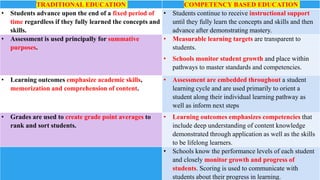
TRADITIONAL EDUCATION COMPETENCY BASED EDUCATION
• Students advance upon the end of a fixed period of
time regardless if they fully learned the concepts and
skills.
• Students continue to receive instructional support
until they fully learn the concepts and skills and then
advance after demonstrating mastery.
• Assessment is used principally for summative
purposes.
• Measurable learning targets are transparent to
students.
• Schools monitor student growth and place within
pathways to master standards and competencies.
• Learning outcomes emphasize academic skills,
memorization and comprehension of content.
• Assessment are embedded throughout a student
learning cycle and are used primarily to orient a
student along their individual learning pathway as
well as inform next steps
• Grades are used to create grade point averages to
rank and sort students.
• Learning outcomes emphasizes competencies that
include deep understanding of content knowledge
demonstrated through application as well as the skills
to be lifelong learners.
• Schools know the performance levels of each student
and closely monitor growth and progress of
students. Scoring is used to communicate with
students about their progress in learning.
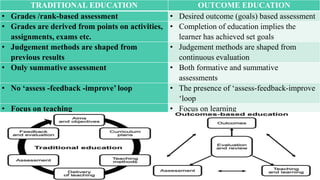
TRADITIONAL EDUCATION OUTCOME EDUCATION
• Grades /rank-based assessment • Desired outcome (goals) based assessment
• Grades are derived from points on activities,
assignments, exams etc.
• Completion of education implies the
learner has achieved set goals
• Judgement methods are shaped from
previous results
• Judgement methods are shaped from
continuous evaluation
• Only summative assessment • Both formative and summative
assessments
• No ‘assess -feedback -improve’ loop • The presence of ‘assess-feedback-improve
‘loop
• Focus on teaching • Focus on learning
• Teacher as guardian of curriculum
•
• Teacher as facilitator and guide
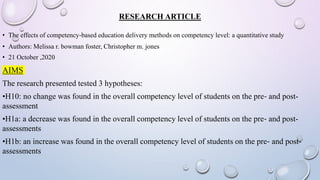
RESEARCH ARTICLE
• The effects of competency‐based education delivery methods on competency level: a quantitative study
• Authors: Melissa r. bowman foster, Christopher m. jones
• 21 October ,2020
AIMS
The research presented tested 3 hypotheses:
•H10: no change was found in the overall competency level of students on the pre‐ and post-
assessment
•H1a: a decrease was found in the overall competency level of students on the pre‐ and post-
assessments
•H1b: an increase was found in the overall competency level of students on the pre‐ and post-
assessments
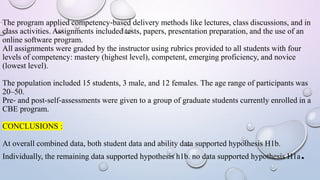
The program applied competency‐based delivery methods like lectures, class discussions, and in
class activities. Assignments included tests, papers, presentation preparation, and the use of an
online software program.
All assignments were graded by the instructor using rubrics provided to all students with four
levels of competency: mastery (highest level), competent, emerging proficiency, and novice
(lowest level).
The population included 15 students, 3 male, and 12 females. The age range of participants was
20–50.
Pre‐ and post-self‐assessments were given to a group of graduate students currently enrolled in a
CBE program.
CONCLUSIONS :
At overall combined data, both student data and ability data supported hypothesis H1b.
Individually, the remaining data supported hypothesis h1b. no data supported hypothesis H1a.
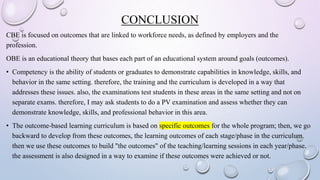
CONCLUSION
CBE is focused on outcomes that are linked to workforce needs, as defined by employers and the
profession.
OBE is an educational theory that bases each part of an educational system around goals (outcomes).
• Competency is the ability of students or graduates to demonstrate capabilities in knowledge, skills, and
behavior in the same setting. therefore, the training and the curriculum is developed in a way that
addresses these issues. also, the examinations test students in these areas in the same setting and not on
separate exams. therefore, I may ask students to do a PV examination and assess whether they can
demonstrate knowledge, skills, and professional behavior in this area.
• The outcome-based learning curriculum is based on specific outcomes for the whole program; then, we go
backward to develop from these outcomes, the learning outcomes of each stage/phase in the curriculum.
then we use these outcomes to build "the outcomes" of the teaching/learning sessions in each year/phase.
the assessment is also designed in a way to examine if these outcomes were achieved or not.
REFERENCES
• Castleberry, Thomas. 2006. "student learning outcomes assessment within the Texas state university map
program." applied research project. Texas state university.
• Sunseri, Ron. 1994. o.b.e. [i.e.] outcome based education: understanding the truth about education reform.
sisters, ore.: multnomah books. 235 p. isbn 0-88070-710-
• Neerja k p. textbook of nursing education. fifth edition: Jaypee publishers. pg. no. 267- 269.
• Sodhi Kaur Jaspreet. comprehensive textbook of nursing education. Jaypee publishers; 2017 pg. no. 233-234
• https://www.researchgate.net/post/competency_based_vs_outcome_based_curriculum
• Sturgis Chris. how competency-based education differs from the traditional system of education. education
domain blog. https://aurora-institute.org/blog/how-competency-based-education-differs-from-the-traditional-
system-of-education/
• Foster Bowman R. Melissa, Jones M. Christopher .21 October 2020.the effects of competency-based
education delivery methods on competency level: a quantitative study. Wiley online library.
https://onlinelibrary.wiley.com./doi/full/10.1002/cbe2.1226

COMPETENCY BASED EDUCATION AND OUTCOME BASED EDUCATION.pptx

  • 1.
    SUBJECT : NURSINGEDUCATION TOPIC : COMPETENY BASED EDUCATION AND OUTCOME BASED EDUCATION Jyotsana Gurung M.Sc (Nsg) 1st year AIIMS,JODHPUR
  • 2.
    CONTENT • INTRODUCTION • COMPETENCYBASED EDUCATION • OUTCOME BASED EDUCATION • RESEARCH ARTICLE • SUMMARY • CONCLUSION • REFERENCES
  • 3.
    INTRODUCTION • COMPETENCE: isthe capacity to realize (up to standard) the key occupational task that characterize a profession (specific). • COMPETENCY: is the capability to choose and apply integrated combination of knowledge, skills and attitude with the intention to realize a task in a certain context.
  • 5.
    COMPETENCY BASED EDUCATION •Is an institutional process that moves from focusing on what academics believe graduates need to know (teacher focused) to what students need to know and able to do in varying and complex situations (student and /or work place focused). • Competency based education (CBE) is focused on outcomes that are linked to workforce needs, as defined by employers and the profession.
  • 6.
    NEED FOR CBE 1.Educational institutions and providers need evidence that anyone who completes a degree or course has achieved a required level of competency. 2. Employers invest in extensive training programs to address the initial needs of new employees and the continuing training needs of all employees, especially those in complex changing work environments. 3. Regulatory legal, external standards and quality measures require demonstration of competence. 4. Workers need to continue their own personal and professional development to advance their careers and make positive contributions to organizations. 5. Measure student learning rather than time.
  • 7.
    CHARATERISTICS OF CBE •Competencies are carefully selected. • Essential knowledge is learned to support the performance of skills. • Participants’ knowledge and skills are assessed as they enter the program. • Learning should be self-paced. • Flexible training approaches including large group methods, small group activities and individual study are essential components. • Satisfactory completion of training is based on achievement of all specified components.
  • 8.
    LEVELS OF COMPETENCY •Level 1: behavior competencies relate to operational work performance and have to meet the demands of the workplace. they have clearly stated consistent parts, consisting of competencies. • Level 2: added competencies based on behavior and additional knowledge needed to improve work. • Level 3: integrated competencies that support change of internal and external working conditions. Knowledge, skills and understanding are integrated into internal and external work conditions. • Level 4: it compromises of holistic competencies
  • 9.
     Flexible Personalized Skill-based Affordable Participants willachieve competencies required in the performance of their jobs. Participants build confidence as they succeed in mastering specific competencies. Self-pacing
  • 10.
    ROLE OF CBEIN NURSING • Allows students to advance based on their ability to master a skill or competency at their own pace regardless of environment. • It helps to meet different learning abilities and can lead to more efficient student outcomes. • Students advance upon achieving mastery. • Empower students. • Assessment is meaningful and a positive learning experience for students. • Learn about application and creation of knowledge, along with the development of important skills and dispositions. • Leads to an improved quality of patient care and an increased patient satisfaction with the nurses and helps promote nursing as a profession . • Improve nursing education and clinical nursing . • It is necessary for professionals to demonstrate that they are clinically competent to perform certain roles .
  • 11.
    OUTCOME BASED EDUCATION/PERFORMANCE BASEDEDUCATION • Outcomes are clear learning results that learners have to demonstrate at the end of significant learning experiences. • OBE is an educational theory that bases each part of an educational system around goals (outcomes).
  • 12.
    • It isa student-centered approach to education that focuses on the intended learning outcomes resulting from instruction . (NICHOLSON, 2011) • Outcome-based education(obe) means focusing and organising a school's entire programs and instructional efforts around the clearly defined outcomes we want all students to demonstrate when they leave school." (Spady, 1993)
  • 13.
    OBE AS ANAPPROACH 1.Identifying desired outcomes 2.Deciding on strategies and methodologies to achieve those outcomes 3.Determining assessment measures for the achievement of outcomes
  • 14.
  • 15.
    OBE PROCESS • ‘Constructivealignment’ is the process that we usually follow when we build up an OBE syllabus. It is a term coined by professor John Biggs in 1999, which refers to the process to create a learning environment that supports the learning activities appropriate to achieving the desired learning outcomes. • The word ‘constructive’ refers to what the learner does to construct meaning through relevant learning activities. • The ‘alignment’ aspect refers to what the teacher does.
  • 16.
    THE "ESSENCE" OFOBE 1. In OBE what matters ultimately is not what is taught, but what is learned. 2. Teachers must set appropriate course intended learning outcomes, instead of teaching objectives. 3. Constructive alignment: what we teach, how we teach and how we assess ought to be aligned with the intended learning outcomes, such that they are fully consistent with each other. 4. The quality of teaching is to be judged by the quality of learning that takes place. 5. All OBE approaches take a criterion-based view of assessment and focus on what students can do with knowledge after a period of learning.
  • 17.
    Set learning outcomes Motivate the students Improvethe teaching strategies Assessment/Evaluate
  • 18.
  • 19.
    ROLE OF OBEIN NURSING • OBE empowers students to take more responsibility . • Apply leadership concepts, skills, and decision making in the provision of high-quality nursing care, healthcare team coordination, and the oversight and accountability for care delivery in a variety of settings. • Integrate evidence, clinical judgment and patient preferences in planning, implementing, and evaluating outcomes of care. • Demonstrate skills in using patient care technologies, information systems, and communication devices that support safe, effective nursing practice. • Incorporate effective communication skills to contribute the nursing perspective to interprofessional teams to optimize patient outcomes. • Collaborate with members of the interprofessional team to develop an assessment and intervention plan that takes into account determinants of health and available resources that contribute clinical prevention and population health. • Assume accountability for personal and professional behaviors that demonstrate the nursing standards of moral, ethical, and legal conduct. • Implement holistic, evidenced-based, safe patient-centered care across the health illness continuum, across the lifespan, and in all healthcare settings.
  • 20.
    TRADITIONAL EDUCATION COMPETENCYBASED EDUCATION • Students advance upon the end of a fixed period of time regardless if they fully learned the concepts and skills. • Students continue to receive instructional support until they fully learn the concepts and skills and then advance after demonstrating mastery. • Assessment is used principally for summative purposes. • Measurable learning targets are transparent to students. • Schools monitor student growth and place within pathways to master standards and competencies. • Learning outcomes emphasize academic skills, memorization and comprehension of content. • Assessment are embedded throughout a student learning cycle and are used primarily to orient a student along their individual learning pathway as well as inform next steps • Grades are used to create grade point averages to rank and sort students. • Learning outcomes emphasizes competencies that include deep understanding of content knowledge demonstrated through application as well as the skills to be lifelong learners. • Schools know the performance levels of each student and closely monitor growth and progress of students. Scoring is used to communicate with students about their progress in learning.
  • 21.
    TRADITIONAL EDUCATION OUTCOMEEDUCATION • Grades /rank-based assessment • Desired outcome (goals) based assessment • Grades are derived from points on activities, assignments, exams etc. • Completion of education implies the learner has achieved set goals • Judgement methods are shaped from previous results • Judgement methods are shaped from continuous evaluation • Only summative assessment • Both formative and summative assessments • No ‘assess -feedback -improve’ loop • The presence of ‘assess-feedback-improve ‘loop • Focus on teaching • Focus on learning • Teacher as guardian of curriculum • • Teacher as facilitator and guide
  • 22.
    RESEARCH ARTICLE • Theeffects of competency‐based education delivery methods on competency level: a quantitative study • Authors: Melissa r. bowman foster, Christopher m. jones • 21 October ,2020 AIMS The research presented tested 3 hypotheses: •H10: no change was found in the overall competency level of students on the pre‐ and post- assessment •H1a: a decrease was found in the overall competency level of students on the pre‐ and post- assessments •H1b: an increase was found in the overall competency level of students on the pre‐ and post- assessments
  • 23.
    The program appliedcompetency‐based delivery methods like lectures, class discussions, and in class activities. Assignments included tests, papers, presentation preparation, and the use of an online software program. All assignments were graded by the instructor using rubrics provided to all students with four levels of competency: mastery (highest level), competent, emerging proficiency, and novice (lowest level). The population included 15 students, 3 male, and 12 females. The age range of participants was 20–50. Pre‐ and post-self‐assessments were given to a group of graduate students currently enrolled in a CBE program. CONCLUSIONS : At overall combined data, both student data and ability data supported hypothesis H1b. Individually, the remaining data supported hypothesis h1b. no data supported hypothesis H1a.
  • 25.
    CONCLUSION CBE is focusedon outcomes that are linked to workforce needs, as defined by employers and the profession. OBE is an educational theory that bases each part of an educational system around goals (outcomes). • Competency is the ability of students or graduates to demonstrate capabilities in knowledge, skills, and behavior in the same setting. therefore, the training and the curriculum is developed in a way that addresses these issues. also, the examinations test students in these areas in the same setting and not on separate exams. therefore, I may ask students to do a PV examination and assess whether they can demonstrate knowledge, skills, and professional behavior in this area. • The outcome-based learning curriculum is based on specific outcomes for the whole program; then, we go backward to develop from these outcomes, the learning outcomes of each stage/phase in the curriculum. then we use these outcomes to build "the outcomes" of the teaching/learning sessions in each year/phase. the assessment is also designed in a way to examine if these outcomes were achieved or not.
  • 26.
    REFERENCES • Castleberry, Thomas.2006. "student learning outcomes assessment within the Texas state university map program." applied research project. Texas state university. • Sunseri, Ron. 1994. o.b.e. [i.e.] outcome based education: understanding the truth about education reform. sisters, ore.: multnomah books. 235 p. isbn 0-88070-710- • Neerja k p. textbook of nursing education. fifth edition: Jaypee publishers. pg. no. 267- 269. • Sodhi Kaur Jaspreet. comprehensive textbook of nursing education. Jaypee publishers; 2017 pg. no. 233-234 • https://www.researchgate.net/post/competency_based_vs_outcome_based_curriculum • Sturgis Chris. how competency-based education differs from the traditional system of education. education domain blog. https://aurora-institute.org/blog/how-competency-based-education-differs-from-the-traditional- system-of-education/ • Foster Bowman R. Melissa, Jones M. Christopher .21 October 2020.the effects of competency-based education delivery methods on competency level: a quantitative study. Wiley online library. https://onlinelibrary.wiley.com./doi/full/10.1002/cbe2.1226