The US Department of Education offers a clear definition of CBE: “Transitioning
away from seat time, in favor of a structure that creates flexibility, allows students
to progress as they demonstrate mastery of academic content, regardless of time,
place, or pace of learning. Competency-based strategies provide flexibility in the
way that credit can be earned or awarded, and provide students with personalized
learning opportunities.1
”
Competency-Based
Education (CBE):
Higher Education’s answer
to the call for change
1
http://www.ed.gov/oii-news/competency-based-learning-or-personalized-learning
Unpacking this simple statement sets free a mind-boggling
array of implied changes in higher education core practices
and even the underlying assumptions that guide practice.
CBE disrupts our traditional thoughts about teaching and
learning and helps us re-examine epistemology, pedagogy,
and technology, all with a focus on the student. It’s a
powerful engine to help higher education focus on bringing
value to the lives of its learners.
This short paper by
Blackboard’s Enterprise
Consulting team provides
institutions with a perspective
on CBE as well as basic
considerations when
developing CBE programs.
2
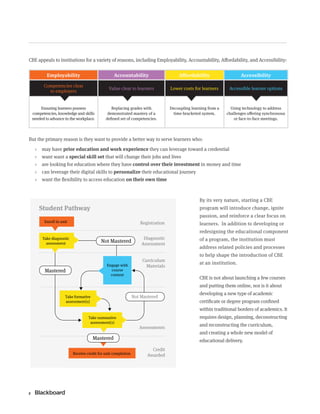
CBE appeals to institutions for a variety of reasons, including Employability, Accountability, Affordability, and Accessibility:
But the primary reason is they want to provide a better way to serve learners who:
›› may have prior education and work experience they can leverage toward a credential
›› want want a special skill set that will change their jobs and lives
›› are looking for education where they have control over their investment in money and time
›› can leverage their digital skills to personalize their educational journey
›› want the flexibility to access education on their own time
Not Mastered
Enroll in unit
Take diagnostic
assessment
Take formative
assessment(s)
Take summative
assessment(s)
Receive credit for unit completion
Engage with
course
content
Mastered
Registration
Diagnostic
Assessment
Curriculum
Materials
Assessments
Credit
Awarded
Not Mastered
Mastered
Student Pathway
Employability Accountability Affordability Accessibility
Competencies clear
to employers
Value clear to learners Lower costs for learners Accessible learner options
Ensuring learners possess
competencies, knowledge and skills
needed to advance in the workplace.
Replacing grades with
demonstrated mastery of a
defined set of competencies.
Decoupling learning from a
time-bracketed system.
Using technology to address
challenges offering synchronous
or face-to-face meetings.
By its very nature, starting a CBE
program will introduce change, ignite
passion, and reinforce a clear focus on
learners. In addition to developing or
redesigning the educational component
of a program, the institution must
address related policies and processes
to help shape the introduction of CBE
at an institution.
CBE is not about launching a few courses
and putting them online, nor is it about
developing a new type of academic
certificate or degree program confined
within traditional borders of academics. It
requires design, planning, deconstructing
and reconstructing the curriculum,
and creating a whole new model of
educational delivery.
Blackboard.com 3
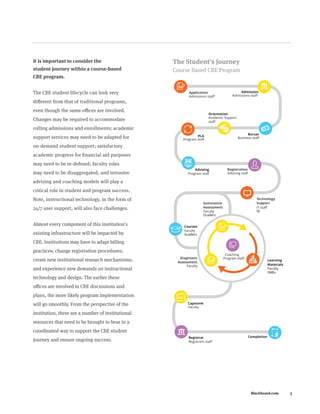
It is important to consider the
student journey within a course-based
CBE program.
The CBE student lifecycle can look very
different from that of traditional programs,
even though the same offices are involved.
Changes may be required to accommodate
rolling admissions and enrollments; academic
support services may need to be adapted for
on-demand student support; satisfactory
academic progress for financial aid purposes
may need to be re-defined; faculty roles
may need to be disaggregated; and intrusive
advising and coaching models will play a
critical role in student and program success.
Note, instructional technology, in the form of
24/7 user support, will also face challenges.
Almost every component of this institution’s
existing infrastructure will be impacted by
CBE. Institutions may have to adapt billing
practices; change registration procedures;
create new institutional research mechanisms;
and experience new demands on instructional
technology and design. The earlier these
offices are involved in CBE discussions and
plans, the more likely program implementation
will go smoothly. From the perspective of the
institution, there are a number of institutional
resources that need to be brought to bear in a
coordinated way to support the CBE student
journey and ensure ongoing success.
The Student’s Journey
Course Based CBE Program
Admissions staff
Admission
Program staff
PLA
Program staff
Advising
Advising staff
Registration
Faculty
Courses
Faculty
Capstone
Completion
Admissions staff
Application
Faculty
Diagnostic
Assessment
Faculty
Summative
Assessment
Learning
Materials
Program staff
Coaching
Academic Support
staff
Orientation
Business staff
Bursar
Registrar’s staff
Registrar
IT staff
Technology
Support
ID
Graders
Faculty
SMEs
Graders
Copyright © 2015. Blackboard Inc. All rights reserved. Blackboard, the Blackboard logo, BbWorld, Blackboard Learn, Blackboard Transact, Blackboard Connect, Blackboard Mobile, Blackboard Collaborate,
BlackboardAnalytics, Blackboard Engage, Edline, the Edline logo, the Blackboard Outcomes System, Behind the Blackboard, and Connect-ED are trademarks or registered trademarks of Blackboard Inc. or its
subsidiaries in the United States and/or other countries. Blackboard products and services may be covered by one or more of the following U.S. Patents: 8,265,968, 7,493,396; 7,558,853; 6,816,878; 8,150,925
650 Massachusetts Avenue, NW 6th Floor Washington, DC 20001 | 1.800.424.9299
Blackboard.com
Learn more about how Blackboard can help. Visit blackboard.com or reach out to your
Blackboard Sales Professional.
Key considerations Implications
A foundational guide defining CBE at the
institution, it’s purposes, goals, strategies,
governance, and key metrics
•	 Is governance process for CBE clearly defined and assigned?
•	 Are strategies, goals, and metrics clearly defined and articulated? Where?
•	 Who owns the initiative and do they have the positional authority to effectively
engage the functional units across the institution?
A rigorous CBE program identification, market
research and selection process
•	 Are we building the right CBE program for our students?
•	 Which market trends are driving growth in our CBE programs?
•	 What population segments should we be targeting?
An operational plan to guide the successful launch of
a CBE initiative including technology readiness, roles,
responsibilities, milestones and risk mitigation across
functions within the institution.
•	 Has technology been assessed and determined ready?
•	 Have (faculty, designer, leadership, IT) roles and responsibilities been clearly
defined and articulated?
•	 Does everyone know the milestones and dates?
An effective marketing and recruitment plan to attract
and enroll the target populations for the CBE program
•	 How will we create effective marketing campaigns for our new CBE programs?
•	 How can we drive brand awareness to reduce student acquisition cost
•	 How can we optimize our media and marketing strategy?
A comprehensive and detailed statement of
program competencies and subcompetencies,
measurement rubrics, and alignment between
competencies and assessments
•	 How can we develop a curricular model that is useful for initial and future
CBE programs?
•	 Who is responsible for researching, defining, organizing, and stating the
program and course level competencies?
•	 Who is responsible for aligning each subcompetency with each formative and
summative assessment?
•	 Who is responsible for creating assessment rubrics?
•	 What skills do they need to succeed?
A comprehensive plan for student success including
academic, technological, advisement, coaching/
mentoring, and CBE-specific support
•	 Are the student support tasks and associated roles clearly defined and
articulated and assigned?
•	 Which roles will be part of the program: coaches/mentor, advisors, graders, etc.
•	 Are the task responsibilities and impacts well understood by the providers?
Course design requirements-and-definitions plan for
CBE courses to maintain consistent high quality and
high impact courses
•	 Are course design requirements clearly understood?
•	 Are design and implementation responsibilities clearly assigned?
•	 What is the process for evaluating and improving the course over time?
Course development services to produce the courses
needed for CBE delivery
•	 Who provides course development services, and to what extent?
•	 Who will provide initial uploads of competencies within platform; physically
map goals and goal sets to courses; keep historical data of reporting on goals;
provide technical assistance on goals edits ongoing.
•	 Who is responsible for mapping goals and competencies to courses and
providing assistance moving forward?
A dedicated program manager to coordinate complex
tasks and projects needed in order to ensure readiness
of the entire system on the date desired
•	 Are course design services in place and known to all stakeholders?
•	 Is a program manager assigned to the project and known to all stakeholders?
Manage process, provide content, editing, and briefing
for substantive change process with regional accreditor
•	 If necessary, who will lead the process toward approval by
accreditation agencies?
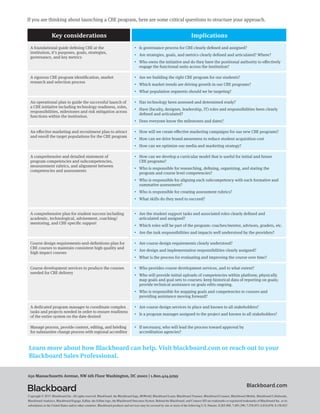
If you are thinking about launching a CBE program, here are some critical questions to structure your approach.

Higher Education's Answer to the Call for Change

  • 1.
    The US Departmentof Education offers a clear definition of CBE: “Transitioning away from seat time, in favor of a structure that creates flexibility, allows students to progress as they demonstrate mastery of academic content, regardless of time, place, or pace of learning. Competency-based strategies provide flexibility in the way that credit can be earned or awarded, and provide students with personalized learning opportunities.1 ” Competency-Based Education (CBE): Higher Education’s answer to the call for change 1 http://www.ed.gov/oii-news/competency-based-learning-or-personalized-learning Unpacking this simple statement sets free a mind-boggling array of implied changes in higher education core practices and even the underlying assumptions that guide practice. CBE disrupts our traditional thoughts about teaching and learning and helps us re-examine epistemology, pedagogy, and technology, all with a focus on the student. It’s a powerful engine to help higher education focus on bringing value to the lives of its learners. This short paper by Blackboard’s Enterprise Consulting team provides institutions with a perspective on CBE as well as basic considerations when developing CBE programs.
  • 2.
    2 CBE appeals toinstitutions for a variety of reasons, including Employability, Accountability, Affordability, and Accessibility: But the primary reason is they want to provide a better way to serve learners who: ›› may have prior education and work experience they can leverage toward a credential ›› want want a special skill set that will change their jobs and lives ›› are looking for education where they have control over their investment in money and time ›› can leverage their digital skills to personalize their educational journey ›› want the flexibility to access education on their own time Not Mastered Enroll in unit Take diagnostic assessment Take formative assessment(s) Take summative assessment(s) Receive credit for unit completion Engage with course content Mastered Registration Diagnostic Assessment Curriculum Materials Assessments Credit Awarded Not Mastered Mastered Student Pathway Employability Accountability Affordability Accessibility Competencies clear to employers Value clear to learners Lower costs for learners Accessible learner options Ensuring learners possess competencies, knowledge and skills needed to advance in the workplace. Replacing grades with demonstrated mastery of a defined set of competencies. Decoupling learning from a time-bracketed system. Using technology to address challenges offering synchronous or face-to-face meetings. By its very nature, starting a CBE program will introduce change, ignite passion, and reinforce a clear focus on learners. In addition to developing or redesigning the educational component of a program, the institution must address related policies and processes to help shape the introduction of CBE at an institution. CBE is not about launching a few courses and putting them online, nor is it about developing a new type of academic certificate or degree program confined within traditional borders of academics. It requires design, planning, deconstructing and reconstructing the curriculum, and creating a whole new model of educational delivery.
  • 3.
    Blackboard.com 3 It isimportant to consider the student journey within a course-based CBE program. The CBE student lifecycle can look very different from that of traditional programs, even though the same offices are involved. Changes may be required to accommodate rolling admissions and enrollments; academic support services may need to be adapted for on-demand student support; satisfactory academic progress for financial aid purposes may need to be re-defined; faculty roles may need to be disaggregated; and intrusive advising and coaching models will play a critical role in student and program success. Note, instructional technology, in the form of 24/7 user support, will also face challenges. Almost every component of this institution’s existing infrastructure will be impacted by CBE. Institutions may have to adapt billing practices; change registration procedures; create new institutional research mechanisms; and experience new demands on instructional technology and design. The earlier these offices are involved in CBE discussions and plans, the more likely program implementation will go smoothly. From the perspective of the institution, there are a number of institutional resources that need to be brought to bear in a coordinated way to support the CBE student journey and ensure ongoing success. The Student’s Journey Course Based CBE Program Admissions staff Admission Program staff PLA Program staff Advising Advising staff Registration Faculty Courses Faculty Capstone Completion Admissions staff Application Faculty Diagnostic Assessment Faculty Summative Assessment Learning Materials Program staff Coaching Academic Support staff Orientation Business staff Bursar Registrar’s staff Registrar IT staff Technology Support ID Graders Faculty SMEs Graders
  • 4.
    Copyright © 2015.Blackboard Inc. All rights reserved. Blackboard, the Blackboard logo, BbWorld, Blackboard Learn, Blackboard Transact, Blackboard Connect, Blackboard Mobile, Blackboard Collaborate, BlackboardAnalytics, Blackboard Engage, Edline, the Edline logo, the Blackboard Outcomes System, Behind the Blackboard, and Connect-ED are trademarks or registered trademarks of Blackboard Inc. or its subsidiaries in the United States and/or other countries. Blackboard products and services may be covered by one or more of the following U.S. Patents: 8,265,968, 7,493,396; 7,558,853; 6,816,878; 8,150,925 650 Massachusetts Avenue, NW 6th Floor Washington, DC 20001 | 1.800.424.9299 Blackboard.com Learn more about how Blackboard can help. Visit blackboard.com or reach out to your Blackboard Sales Professional. Key considerations Implications A foundational guide defining CBE at the institution, it’s purposes, goals, strategies, governance, and key metrics • Is governance process for CBE clearly defined and assigned? • Are strategies, goals, and metrics clearly defined and articulated? Where? • Who owns the initiative and do they have the positional authority to effectively engage the functional units across the institution? A rigorous CBE program identification, market research and selection process • Are we building the right CBE program for our students? • Which market trends are driving growth in our CBE programs? • What population segments should we be targeting? An operational plan to guide the successful launch of a CBE initiative including technology readiness, roles, responsibilities, milestones and risk mitigation across functions within the institution. • Has technology been assessed and determined ready? • Have (faculty, designer, leadership, IT) roles and responsibilities been clearly defined and articulated? • Does everyone know the milestones and dates? An effective marketing and recruitment plan to attract and enroll the target populations for the CBE program • How will we create effective marketing campaigns for our new CBE programs? • How can we drive brand awareness to reduce student acquisition cost • How can we optimize our media and marketing strategy? A comprehensive and detailed statement of program competencies and subcompetencies, measurement rubrics, and alignment between competencies and assessments • How can we develop a curricular model that is useful for initial and future CBE programs? • Who is responsible for researching, defining, organizing, and stating the program and course level competencies? • Who is responsible for aligning each subcompetency with each formative and summative assessment? • Who is responsible for creating assessment rubrics? • What skills do they need to succeed? A comprehensive plan for student success including academic, technological, advisement, coaching/ mentoring, and CBE-specific support • Are the student support tasks and associated roles clearly defined and articulated and assigned? • Which roles will be part of the program: coaches/mentor, advisors, graders, etc. • Are the task responsibilities and impacts well understood by the providers? Course design requirements-and-definitions plan for CBE courses to maintain consistent high quality and high impact courses • Are course design requirements clearly understood? • Are design and implementation responsibilities clearly assigned? • What is the process for evaluating and improving the course over time? Course development services to produce the courses needed for CBE delivery • Who provides course development services, and to what extent? • Who will provide initial uploads of competencies within platform; physically map goals and goal sets to courses; keep historical data of reporting on goals; provide technical assistance on goals edits ongoing. • Who is responsible for mapping goals and competencies to courses and providing assistance moving forward? A dedicated program manager to coordinate complex tasks and projects needed in order to ensure readiness of the entire system on the date desired • Are course design services in place and known to all stakeholders? • Is a program manager assigned to the project and known to all stakeholders? Manage process, provide content, editing, and briefing for substantive change process with regional accreditor • If necessary, who will lead the process toward approval by accreditation agencies? If you are thinking about launching a CBE program, here are some critical questions to structure your approach.