PRESENTED BY-
ANITA KUMARI(06)
ANJALI RAI(07)
ANKITA BUCHASIA(08)
ANKITA KRISHNA(09)
COMPENSATION
STRATEGIES IN
INDIA
COMPENSATION STRATEGY
The compensation strategy is derived from the HR
Strategy and it defines the position of the organization on
the job market, the level of the total cash, the main bonus
principles in the organization and rules for the base
salary setting.
ASPECTS OF
COMPENSATION
STRATEGY
I. Following tasks are performed-
•Model the changes from a proposed salary or compensation
reorganization, based on market values, to evaluate the cost of
moving the workforce up to market levels.
•Create new types of variable compensation to help motivate the
workforce, and evaluate the cost impact.
•Target special compensation plans for specific groups of employees,
such as executives, salespeople, or workers with mission-critical job
skills.
II. Following tasks are performed:
•Model compensation cost changes
based on forecasted workforce growth
and reduction.
•Establish a merit matrix or other rules for pay out of annual base
pay increases.
•Determine what types of performance goals or related pay out
rules we need for any base compensation or variable compensation
types in the compensation plan.
•Examine the compensation cost effects based on organizational
performance indicators, for periodic bonuses and so on.
•Set proposed compensation budgets for
departments or business units.
•Allocate compensation pools across
organizations, special classifications, groups, and individuals.
 Compensation Strategy Importance
•Manage the personnel expenses of the
organization
•Gives the certainty to the HR employees
and HR managers
•Acts as the basic document
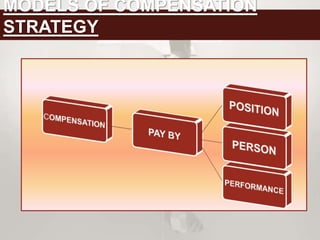
MODELS OF COMPENSATION
STRATEGY
 POSITION BASED MODEL
Fixed pay model
Compensation based on attributes and
challenges of position
Based on grade structure and
designation
Motivation through high compensation
PITFALLS
Encourage a bureaucratic orientation.
Entails top-down decision making and
information flow
Costly and time consuming
May not reward desired behaviour
PERSON BASED MODEL
 Personal and professional attributes
necessary for for effective performance
 Based on individual’s skills, knowledge and
experience
 Pay for what employee is capable of
doing and not what he actually
performs
 Retain competent employees
 Self-efficacy
PITFALLS
 Very costly
 Topping-out
 Difficult to determine market
rates
PERFORMANCE BASED MODEL
 Objective:-
 To develop a Productive, Efficient, and Effective organization
to increase employee Motivation and Performance.
 To keep Employee engaged throughout their work as they
are rewarded based on the outcome of their work.
ESSENTIALS FOR EFFECTIVE PAY
 VISION- Organization must have a clear purpose for
establishing pay for performance programme.
 ALIGNMENT- Organization should consider that compensation level
should match with the level of performance desired or achieved.
 HOLISTIC APPROACH- Human Resource create competitive
advantage for their organization, as a result integrated compensation
strategy should be formulated.
 TOP MANAGEMENT COMMITMENT- The words and action of top
management is essential for success of pay for performance ,so that
people may not lose confidence and belief while at work.
PITFALLS
 Its difficult to successfully implement in
government organization.
 It induces the employees to manipulate the
compensation system, as only those aspects of the
job will be seen which can directly be rewarded,
instead of seeing the other equally valuable tasks.
 Inculcate a habit of looking at short- term goals for
making more money.
 Often they doubt against the fairness and sensitivity
of pay as they feel personal biasness.
CONT....
 Highly dependent upon having enough money to
fund incentives.
 The use of extrinsic motivation may
erode intrinsic motivation which
affects productivity.
 Undermines teamwork.
COMPENSATION STRATEGIES IN
INDIA
India maintains its Labour
cost advantage
India continues to maintain its labour cost
advantage relative to the US, with fixed
compensation levels for entry-level and
mid-career professionals ranging between
15% and 25% of US base salaries.
INDIA IS DIVERSE, SO ARE ITS
COMPENSATION PRACTICES
Just as India is a highly diverse nation-made up of
multiple languages, religions, ethnic groups, and
custom spread across a tremendous geographic
range- so too are its compensation practices
Double digit fixed compensation increases
continue
 As overall economic growth moderates in India, fixed
compensation(salary) increase budgets are slowing down
as well.
 Increasingly, compensation professionals will need to
reconcile between specific cases where practices might
differ widely from macro trends.
 For ex-offering 25%annual increase to a group of key
employees in India, while others in the same location
receive 5% to 10% increases.
CONCLUSION
Tackle work avoidance(position based model)
Inducing greater effort(performance based
model)
Performance based model best because it
controls not only the type but also rate at which
activities are performed.
THANKYO
U

Compensation strategies

  • 1.
    PRESENTED BY- ANITA KUMARI(06) ANJALIRAI(07) ANKITA BUCHASIA(08) ANKITA KRISHNA(09) COMPENSATION STRATEGIES IN INDIA
  • 2.
    COMPENSATION STRATEGY The compensationstrategy is derived from the HR Strategy and it defines the position of the organization on the job market, the level of the total cash, the main bonus principles in the organization and rules for the base salary setting.
  • 3.
    ASPECTS OF COMPENSATION STRATEGY I. Followingtasks are performed- •Model the changes from a proposed salary or compensation reorganization, based on market values, to evaluate the cost of moving the workforce up to market levels. •Create new types of variable compensation to help motivate the workforce, and evaluate the cost impact. •Target special compensation plans for specific groups of employees, such as executives, salespeople, or workers with mission-critical job skills.
  • 4.
    II. Following tasksare performed: •Model compensation cost changes based on forecasted workforce growth and reduction. •Establish a merit matrix or other rules for pay out of annual base pay increases. •Determine what types of performance goals or related pay out rules we need for any base compensation or variable compensation types in the compensation plan. •Examine the compensation cost effects based on organizational performance indicators, for periodic bonuses and so on.
  • 5.
    •Set proposed compensationbudgets for departments or business units. •Allocate compensation pools across organizations, special classifications, groups, and individuals.  Compensation Strategy Importance •Manage the personnel expenses of the organization •Gives the certainty to the HR employees and HR managers •Acts as the basic document
  • 6.
  • 7.
     POSITION BASEDMODEL Fixed pay model Compensation based on attributes and challenges of position Based on grade structure and designation Motivation through high compensation
  • 8.
    PITFALLS Encourage a bureaucraticorientation. Entails top-down decision making and information flow Costly and time consuming May not reward desired behaviour
  • 9.
    PERSON BASED MODEL Personal and professional attributes necessary for for effective performance  Based on individual’s skills, knowledge and experience  Pay for what employee is capable of doing and not what he actually performs  Retain competent employees  Self-efficacy
  • 10.
    PITFALLS  Very costly Topping-out  Difficult to determine market rates
  • 11.
    PERFORMANCE BASED MODEL Objective:-  To develop a Productive, Efficient, and Effective organization to increase employee Motivation and Performance.  To keep Employee engaged throughout their work as they are rewarded based on the outcome of their work.
  • 12.
    ESSENTIALS FOR EFFECTIVEPAY  VISION- Organization must have a clear purpose for establishing pay for performance programme.  ALIGNMENT- Organization should consider that compensation level should match with the level of performance desired or achieved.  HOLISTIC APPROACH- Human Resource create competitive advantage for their organization, as a result integrated compensation strategy should be formulated.  TOP MANAGEMENT COMMITMENT- The words and action of top management is essential for success of pay for performance ,so that people may not lose confidence and belief while at work.
  • 13.
    PITFALLS  Its difficultto successfully implement in government organization.  It induces the employees to manipulate the compensation system, as only those aspects of the job will be seen which can directly be rewarded, instead of seeing the other equally valuable tasks.  Inculcate a habit of looking at short- term goals for making more money.  Often they doubt against the fairness and sensitivity of pay as they feel personal biasness.
  • 14.
    CONT....  Highly dependentupon having enough money to fund incentives.  The use of extrinsic motivation may erode intrinsic motivation which affects productivity.  Undermines teamwork.
  • 15.
    COMPENSATION STRATEGIES IN INDIA Indiamaintains its Labour cost advantage India continues to maintain its labour cost advantage relative to the US, with fixed compensation levels for entry-level and mid-career professionals ranging between 15% and 25% of US base salaries.
  • 16.
    INDIA IS DIVERSE,SO ARE ITS COMPENSATION PRACTICES Just as India is a highly diverse nation-made up of multiple languages, religions, ethnic groups, and custom spread across a tremendous geographic range- so too are its compensation practices
  • 17.
    Double digit fixedcompensation increases continue  As overall economic growth moderates in India, fixed compensation(salary) increase budgets are slowing down as well.  Increasingly, compensation professionals will need to reconcile between specific cases where practices might differ widely from macro trends.  For ex-offering 25%annual increase to a group of key employees in India, while others in the same location receive 5% to 10% increases.
  • 18.
    CONCLUSION Tackle work avoidance(positionbased model) Inducing greater effort(performance based model) Performance based model best because it controls not only the type but also rate at which activities are performed.
  • 19.