COMPENSATION PRACTICES
VARIOUS DEFINATIONS OF COMPENSATIONThe sum total of all forms of payments or rewards provided to employees for    performing tasks to achieve organizational objectivesCompensation is the process of providing adequate, equitable and fair remuneration to the employees. It is what employees receive in exchange for their contribution to the organization. It is a comprehensive term which includes pay, incentives and benefits offered to the employees.
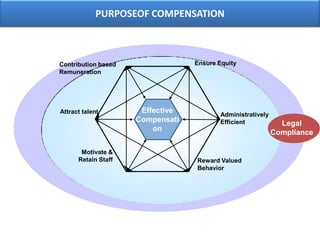
Compensation is a systematic approach to providing monetary value to employees in exchange for work performed. compensation may achieve several purposes assisting in recruitment, job performed and job satisfaction.PURPOSEOF COMPENSATIONEffective CompensationContribution based RemunerationEnsure EquityLegal Compliance Reward Valued BehaviorAttract talentAdministratively EfficientMotivate & Retain Staff
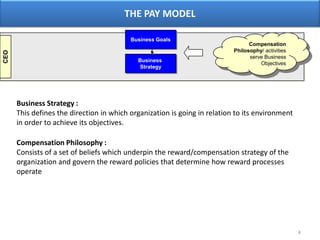
THE PAY MODELBusiness GoalsCompensation Philosophy/ activities serve Business ObjectivesCEOBusiness StrategyBusiness Strategy :This defines the direction in which organization is going in relation to its environment in order to achieve its objectives.Compensation Philosophy :Consists of a set of beliefs which underpin the reward/compensation strategy of the organization and govern the reward policies that determine how reward processes operate4
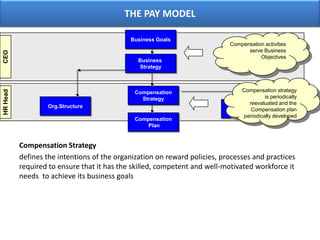
THE PAY MODELBusiness GoalsCompensation activities serve Business ObjectivesCEOBusiness StrategyCompensation strategy is periodically reevaluated and the Compensation plan periodically developedCompensationStrategyHR HeadOrg.StructureNon-FinancialRewardsCompensation PlanCompensation Strategy defines the intentions of the organization on reward policies, processes and practices required to ensure that it has the skilled, competent and well-motivated workforce it needs  to achieve its business goals
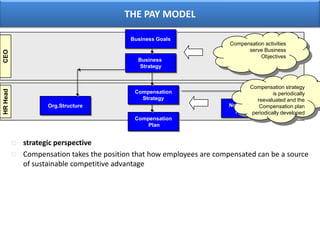
THE PAY MODELBusiness GoalsCompensation activities serve Business ObjectivesCEOBusiness StrategyCompensation strategy is periodically reevaluated and the Compensation plan periodically developedCompensationStrategyHR HeadOrg.StructureNon-FinancialRewardsCompensation Planstrategic perspective
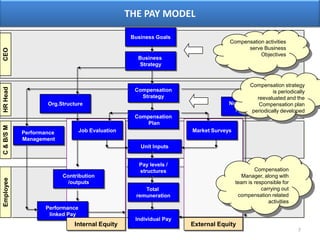
Compensation takes the position that how employees are compensated can be a source of sustainable competitive advantageTHE PAY MODELBusiness GoalsCompensation activities serve Business ObjectivesCEOBusiness StrategyCompensation strategy is periodically reevaluated and the Compensation plan periodically developedCompensationStrategyHR HeadOrg.StructureNon-FinancialRewardsCompensation PlanMarket SurveysJob EvaluationPerformance ManagementC & B/S MUnit InputsCompensation Manager, along with team is responsible for carrying out compensation related activitiesPay levels /structuresContribution/outputsTotal remunerationEmployeePerformance linked PayIndividual PayInternal EquityExternal Equity7
STRATEGIC COMPENSATION PLANNINGStrategic Compensation Planning
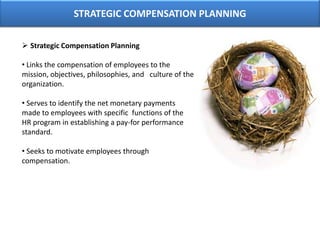
 Links the compensation of employees to the mission, objectives, philosophies, and   culture of the organization.
 Serves to identify the net monetary payments made to employees with specific  functions of the HR program in establishing a pay-for performance standard.
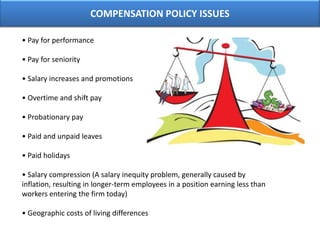
 Seeks to motivate employees through compensation.COMPENSATION POLICY ISSUES• Pay for performance• Pay for seniority• Salary increases and promotions• Overtime and shift pay• Probationary pay• Paid and unpaid leaves• Paid holidays• Salary compression (A salary inequity problem, generally caused byinflation, resulting in longer-term employees in a position earning less thanworkers entering the firm today)• Geographic costs of living differences
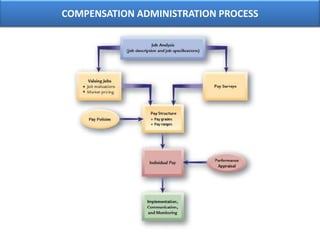
COMPENSATION ADMINISTRATION PROCESS
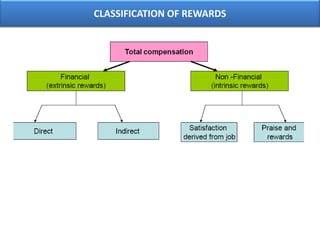
CLASSIFICATION OF REWARDS
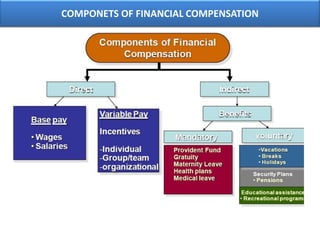
COMPONETS OF FINANCIAL COMPENSATION
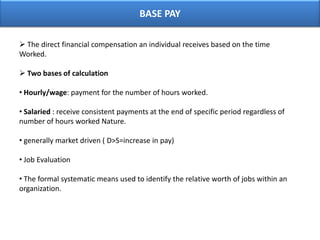
BASE PAY The direct financial compensation an individual receives based on the timeWorked.Two bases of calculation
Hourly/wage: payment for the number of hours worked.
Salaried : receive consistent payments at the end of specific period regardless of number of hours worked Nature.
 generally market driven ( D>S=increase in pay)
 Job Evaluation
 The formal systematic means used to identify the relative worth of jobs within anorganization.
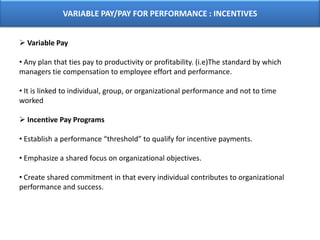
VARIABLE PAY/PAY FOR PERFORMANCE : INCENTIVES Variable Pay
 Any plan that ties pay to productivity or profitability. (i.e)The standard by which managers tie compensation to employee effort and performance.
 It is linked to individual, group, or organizational performance and not to time worked
 Incentive Pay Programs
 Establish a performance “threshold” to qualify for incentive payments.
 Emphasize a shared focus on organizational objectives.
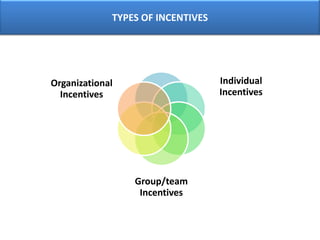
 Create shared commitment in that every individual contributes to organizational performance and success.TYPES OF INCENTIVES
INDIVIDUAL INCENTIVE PLANPiecework Plans
The worker is paid a sum (called a piece rate) for each unit he orshe produces.Straight piecework:
A fixed sum is paid for each unit the worker produces under an established piecerate standard. An incentive may be paid for exceeding the piece rate standard.Standard hour plan:
An incentive plan that sets pay rates based on the completion of a job in a predetermined “standard time.”
 If employees finish the work in less than the expected time, their pay is still based on the standard time for the job multiplied by their hourly rate.INDIVIDUAL INCENTIVE PLAN(CONT’D)Pro and cons of piecework
 Easily understandable, equitable, and powerful incentives
 Employee resistance to changes in standards or work processes affecting output
 Quality problems caused by an overriding output focus
 Possibility of violating minimum wage standards
 Employee dissatisfaction when incentives either cannot be earned due to external factors or are withdrawn due to a lack of need for output Merit pay
 A permanent cumulative salary increase the firm awards to an individual employee based on his or her individual performance.BONUS Incentive payment that is supplemental to the base wage for cost reduction, quality improvement, or other performance criteria.Spot bonus Unplanned bonus given for employee effort unrelated to an establishedperformance measure.
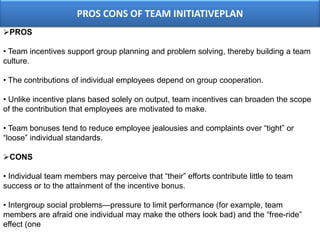
GROUP INCENTIVE PLANTeam Incentive Plans
 Compensation plans where all team members receive an incentive bonus payment when production or service standards are met or exceeded.
Establishing Team Incentive Payments
 Set performance measures upon which incentive payments are based
 Determine the size of the incentive bonus.
 Create a payout formula and fully explain to employees how payouts will be distributed.
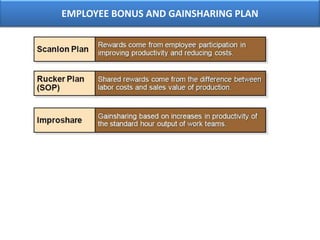
Gainsharing Plans
 Programs under which both employees and the organization share the financial gains according to a predetermined formula that reflects improved productivity and profitability.EMPLOYEE BONUS AND GAINSHARING PLAN

Compensation practices

  • 1.
  • 2.
    VARIOUS DEFINATIONS OFCOMPENSATIONThe sum total of all forms of payments or rewards provided to employees for performing tasks to achieve organizational objectivesCompensation is the process of providing adequate, equitable and fair remuneration to the employees. It is what employees receive in exchange for their contribution to the organization. It is a comprehensive term which includes pay, incentives and benefits offered to the employees.
  • 3.
    Compensation is asystematic approach to providing monetary value to employees in exchange for work performed. compensation may achieve several purposes assisting in recruitment, job performed and job satisfaction.PURPOSEOF COMPENSATIONEffective CompensationContribution based RemunerationEnsure EquityLegal Compliance Reward Valued BehaviorAttract talentAdministratively EfficientMotivate & Retain Staff
  • 4.
    THE PAY MODELBusinessGoalsCompensation Philosophy/ activities serve Business ObjectivesCEOBusiness StrategyBusiness Strategy :This defines the direction in which organization is going in relation to its environment in order to achieve its objectives.Compensation Philosophy :Consists of a set of beliefs which underpin the reward/compensation strategy of the organization and govern the reward policies that determine how reward processes operate4
  • 5.
    THE PAY MODELBusinessGoalsCompensation activities serve Business ObjectivesCEOBusiness StrategyCompensation strategy is periodically reevaluated and the Compensation plan periodically developedCompensationStrategyHR HeadOrg.StructureNon-FinancialRewardsCompensation PlanCompensation Strategy defines the intentions of the organization on reward policies, processes and practices required to ensure that it has the skilled, competent and well-motivated workforce it needs to achieve its business goals
  • 6.
    THE PAY MODELBusinessGoalsCompensation activities serve Business ObjectivesCEOBusiness StrategyCompensation strategy is periodically reevaluated and the Compensation plan periodically developedCompensationStrategyHR HeadOrg.StructureNon-FinancialRewardsCompensation Planstrategic perspective
  • 7.
    Compensation takes theposition that how employees are compensated can be a source of sustainable competitive advantageTHE PAY MODELBusiness GoalsCompensation activities serve Business ObjectivesCEOBusiness StrategyCompensation strategy is periodically reevaluated and the Compensation plan periodically developedCompensationStrategyHR HeadOrg.StructureNon-FinancialRewardsCompensation PlanMarket SurveysJob EvaluationPerformance ManagementC & B/S MUnit InputsCompensation Manager, along with team is responsible for carrying out compensation related activitiesPay levels /structuresContribution/outputsTotal remunerationEmployeePerformance linked PayIndividual PayInternal EquityExternal Equity7
  • 8.
  • 9.
    Links thecompensation of employees to the mission, objectives, philosophies, and culture of the organization.
  • 10.
    Serves toidentify the net monetary payments made to employees with specific functions of the HR program in establishing a pay-for performance standard.
  • 11.
    Seeks tomotivate employees through compensation.COMPENSATION POLICY ISSUES• Pay for performance• Pay for seniority• Salary increases and promotions• Overtime and shift pay• Probationary pay• Paid and unpaid leaves• Paid holidays• Salary compression (A salary inequity problem, generally caused byinflation, resulting in longer-term employees in a position earning less thanworkers entering the firm today)• Geographic costs of living differences
  • 12.
  • 13.
  • 14.
  • 15.
    BASE PAY Thedirect financial compensation an individual receives based on the timeWorked.Two bases of calculation
  • 16.
    Hourly/wage: payment forthe number of hours worked.
  • 17.
    Salaried : receiveconsistent payments at the end of specific period regardless of number of hours worked Nature.
  • 18.
    generally marketdriven ( D>S=increase in pay)
  • 19.
  • 20.
    The formalsystematic means used to identify the relative worth of jobs within anorganization.
  • 21.
    VARIABLE PAY/PAY FORPERFORMANCE : INCENTIVES Variable Pay
  • 22.
    Any planthat ties pay to productivity or profitability. (i.e)The standard by which managers tie compensation to employee effort and performance.
  • 23.
    It islinked to individual, group, or organizational performance and not to time worked
  • 24.
  • 25.
    Establish aperformance “threshold” to qualify for incentive payments.
  • 26.
    Emphasize ashared focus on organizational objectives.
  • 27.
    Create sharedcommitment in that every individual contributes to organizational performance and success.TYPES OF INCENTIVES
  • 28.
  • 29.
    The worker ispaid a sum (called a piece rate) for each unit he orshe produces.Straight piecework:
  • 30.
    A fixed sumis paid for each unit the worker produces under an established piecerate standard. An incentive may be paid for exceeding the piece rate standard.Standard hour plan:
  • 31.
    An incentive planthat sets pay rates based on the completion of a job in a predetermined “standard time.”
  • 32.
    If employeesfinish the work in less than the expected time, their pay is still based on the standard time for the job multiplied by their hourly rate.INDIVIDUAL INCENTIVE PLAN(CONT’D)Pro and cons of piecework
  • 33.
    Easily understandable,equitable, and powerful incentives
  • 34.
    Employee resistanceto changes in standards or work processes affecting output
  • 35.
    Quality problemscaused by an overriding output focus
  • 36.
    Possibility ofviolating minimum wage standards
  • 37.
    Employee dissatisfactionwhen incentives either cannot be earned due to external factors or are withdrawn due to a lack of need for output Merit pay
  • 38.
    A permanentcumulative salary increase the firm awards to an individual employee based on his or her individual performance.BONUS Incentive payment that is supplemental to the base wage for cost reduction, quality improvement, or other performance criteria.Spot bonus Unplanned bonus given for employee effort unrelated to an establishedperformance measure.
  • 39.
  • 40.
    Compensation planswhere all team members receive an incentive bonus payment when production or service standards are met or exceeded.
  • 41.
  • 42.
    Set performancemeasures upon which incentive payments are based
  • 43.
    Determine thesize of the incentive bonus.
  • 44.
    Create apayout formula and fully explain to employees how payouts will be distributed.
  • 45.
  • 46.
    Programs underwhich both employees and the organization share the financial gains according to a predetermined formula that reflects improved productivity and profitability.EMPLOYEE BONUS AND GAINSHARING PLAN