
Redundancy
An overview of the law
What is Redundancy?
A situation in which your job does not exist anymore
A situation in which your job is now being undertaken
by changes in technology
Your job still exists, but another employee’s job does
not and the other person has been given your old job
A situation in which your place of work does not exist
any more
In some cases, redundancy can also include
situations where your job has moved location
If you have been dismissed for a reason other than those listed
then it is likely that you have not been dismissed for genuine
redundancy reasons.
Redundancy Process
– what should I do as
an employer?
Employers must give as much warning as possible about
the possibility of redundancy
The employers should consult with unions and/or
employees directly, in particular to agree any alternatives
to redundancy or any alternatives to redundancy
Criteria for selection needs to be objective and not simply
a subjective opinion. LIFO & discriminatory tactics are not
acceptable
Selection must be made according to the criteria agreed
If there is any alternative employment, this must be
offered to the redundant employee.
In companies where large scale redundancies are taking place,
the consultation rules are much stricter
Redundancy Selection;
how does it work?
Does the employer have a genuine need for the redundancy?
Is there more than 1 position made redundant?
Is there more than 1 person at risk of the redundancy
Consult with all the people likely to be affected or their Trade
Union or Employee representative as soon as you can
Select the correct redundancy pool
Decide on fair selection criteria
Apply the selection criteria that you have decided on fairly
Where possible, make offers of suitable alternative employment
Where not possible, make sure the correct amount of
redundancy money is paid.
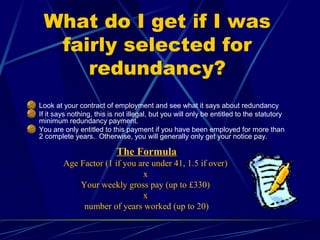
What do I get if I was
fairly selected for
redundancy?
Look at your contract of employment and see what it says about redundancy
If it says nothing, this is not illegal, but you will only be entitled to the statutory
minimum redundancy payment.
You are only entitled to this payment if you have been employed for more than
2 complete years. Otherwise, you will generally only get your notice pay.
The Formula
Age Factor (1 if you are under 41, 1.5 if over)
x
Your weekly gross pay (up to £330)
x
number of years worked (up to 20)
What makes a
redundancy unfair?
There are many reasons why a
redundancy can be unfair
Look at the redundancy process; if any of
these steps have not been completed
properly, you may have an unfair dismissal
case.
Discriminatory reasons or non-genuine
redundancy cases are the most common
unfair redundancy scenarios
What if my employer
has made a mistake?
Speak to your immediate manager and try to sort out the mistake
informally
If this doesn’t work, check whether your company operates a
grievance procedure. Under current law, it is illegal not to have a
grievance procedure, but this is set to change shortly
Write a letter to whoever the appropriate person is to submit a
grievance to
Your employer must invite you to a meeting. If you have left your job
already you can agree to sort the problem out in writing
At any meeting, you have the right to be accompanied by a colleague
or Trade Union representative
You have the right to appeal the decision made
Do not leave it longer than 3 months between your date of dismissal
and writing the letter of grievance.
What if I want to take
this to a Tribunal?
You have 3 months from your dismissal date to bring a
Tribunal claim
The time limits are strictly enforced but may be
extended to 6 months if you are waiting for a grievance
decision
You do not need a lawyer to complete the claim form
There are no costs implications in terms of paying for
the other side’s costs if you lose unless your case was
completely vexatious
The easiest way to submit a claim is online at
http://www.employmenttribunals.gov.uk/claim_form_et1.asp
The easiest way to respond to a claim is online at
http://www.employmenttribunals.gov.uk/claim_form_et3.asp
You may have to wait up to 8 months for your case to
be listed depending on the complexity of the case and
your local Tribunal
How would I be
financially
compensated for an
unfair Redundancy?Basic Award (age factor x weekly gross wage up to
£330 x number of years worked up to 20)
Compensatory Award (weekly net wage for the number
of weeks you are out of work)
Benefits that you have had to give up
Loss of Statutory rights (usually about £200-£350)
Minus anything you have earned from a new job or
received in benefits
It is always worth considering an early settlement
The Tribunal maximum is currently £60,000. This is
revised annually and does not apply to discrimination
claims
Injury to feelings award if this is a discrimination claim,
usually up to £25,000
Where to go for further
assistance
Legal Committee
Free Representation Unit
Citizen’s Advice Bureau
Pro Bono Clinics
Any Questions?

Redundancy

  • 1.
  • 2.
    What is Redundancy? Asituation in which your job does not exist anymore A situation in which your job is now being undertaken by changes in technology Your job still exists, but another employee’s job does not and the other person has been given your old job A situation in which your place of work does not exist any more In some cases, redundancy can also include situations where your job has moved location If you have been dismissed for a reason other than those listed then it is likely that you have not been dismissed for genuine redundancy reasons.
  • 3.
    Redundancy Process – whatshould I do as an employer? Employers must give as much warning as possible about the possibility of redundancy The employers should consult with unions and/or employees directly, in particular to agree any alternatives to redundancy or any alternatives to redundancy Criteria for selection needs to be objective and not simply a subjective opinion. LIFO & discriminatory tactics are not acceptable Selection must be made according to the criteria agreed If there is any alternative employment, this must be offered to the redundant employee. In companies where large scale redundancies are taking place, the consultation rules are much stricter
  • 4.
    Redundancy Selection; how doesit work? Does the employer have a genuine need for the redundancy? Is there more than 1 position made redundant? Is there more than 1 person at risk of the redundancy Consult with all the people likely to be affected or their Trade Union or Employee representative as soon as you can Select the correct redundancy pool Decide on fair selection criteria Apply the selection criteria that you have decided on fairly Where possible, make offers of suitable alternative employment Where not possible, make sure the correct amount of redundancy money is paid.
  • 5.
    What do Iget if I was fairly selected for redundancy? Look at your contract of employment and see what it says about redundancy If it says nothing, this is not illegal, but you will only be entitled to the statutory minimum redundancy payment. You are only entitled to this payment if you have been employed for more than 2 complete years. Otherwise, you will generally only get your notice pay. The Formula Age Factor (1 if you are under 41, 1.5 if over) x Your weekly gross pay (up to £330) x number of years worked (up to 20)
  • 6.
    What makes a redundancyunfair? There are many reasons why a redundancy can be unfair Look at the redundancy process; if any of these steps have not been completed properly, you may have an unfair dismissal case. Discriminatory reasons or non-genuine redundancy cases are the most common unfair redundancy scenarios
  • 7.
    What if myemployer has made a mistake? Speak to your immediate manager and try to sort out the mistake informally If this doesn’t work, check whether your company operates a grievance procedure. Under current law, it is illegal not to have a grievance procedure, but this is set to change shortly Write a letter to whoever the appropriate person is to submit a grievance to Your employer must invite you to a meeting. If you have left your job already you can agree to sort the problem out in writing At any meeting, you have the right to be accompanied by a colleague or Trade Union representative You have the right to appeal the decision made Do not leave it longer than 3 months between your date of dismissal and writing the letter of grievance.
  • 8.
    What if Iwant to take this to a Tribunal? You have 3 months from your dismissal date to bring a Tribunal claim The time limits are strictly enforced but may be extended to 6 months if you are waiting for a grievance decision You do not need a lawyer to complete the claim form There are no costs implications in terms of paying for the other side’s costs if you lose unless your case was completely vexatious The easiest way to submit a claim is online at http://www.employmenttribunals.gov.uk/claim_form_et1.asp The easiest way to respond to a claim is online at http://www.employmenttribunals.gov.uk/claim_form_et3.asp You may have to wait up to 8 months for your case to be listed depending on the complexity of the case and your local Tribunal
  • 9.
    How would Ibe financially compensated for an unfair Redundancy?Basic Award (age factor x weekly gross wage up to £330 x number of years worked up to 20) Compensatory Award (weekly net wage for the number of weeks you are out of work) Benefits that you have had to give up Loss of Statutory rights (usually about £200-£350) Minus anything you have earned from a new job or received in benefits It is always worth considering an early settlement The Tribunal maximum is currently £60,000. This is revised annually and does not apply to discrimination claims Injury to feelings award if this is a discrimination claim, usually up to £25,000
  • 10.
    Where to gofor further assistance Legal Committee Free Representation Unit Citizen’s Advice Bureau Pro Bono Clinics
  • 11.