SWOT-
INTERNAL
ANALYSIS
PRESENTED BY-
ANJALI RAI
ROLL NO -07
MPMIR 3rd SEMESTER
INTERNAL
ANALYSIS
A review of organization’s strength and weakness
Provides means of identifying the strengths to build on and
the weaknesses to overcome in formulating strategies.
A firm’s overall strengths and weaknesses and its ability to
execute may be even more important than its environment in
determining its performance.
FRAMEWORK FOR IDENTIFYING
WHAT TO ASSESS
CRITICAL
SUCCESS
FACTORS
INDUSTRY
CHARACTERSTICS
COMPETETIVE
POSITION
GENERAL
ENVIRONMENT
ORGANIZATIONAL
DEVELOPMENT
THE VALUE
CHAIN
PRIMARY
ACTIVITIES
SUPPORT
ACTIVITIES
CORE
PROCCESSES
AND SYSTEMS
PRIMARY
PROCESS
SUPPORT
SYSTEM
CONTROL
SYSTEM
THE VALUE CHAIN
FIRM’S INFRASTRUCTURE
HRM
TECHNOLOGY DEVELOPMENT
PROCUREMENT
INBOUND OPERATIONS OUTBOUND MARKETNG
LOGISTICS LOGISTICS & SALES SERVICE
PRIMARY ACTIVITIES
SUPPORT
ACTIVITIES
CORE PROCESSES AND SYSTEMS
 PRIMARY PROCESSES
• Product development
• Demand Management
• Order Fulfilment
 SUPPORT SYSTEMS
 Capital resourcing
 Human resourcing
 Information resourcing
 CONTROL SYSTEMS
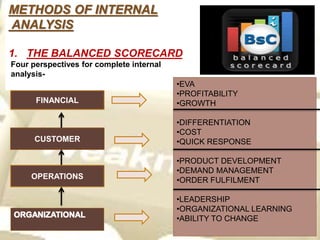
METHODS OF INTERNAL
ANALYSIS
1. THE BALANCED SCORECARD
Four perspectives for complete internal
analysis-
FINANCIAL
CUSTOMER
OPERATIONS
•EVA
•PROFITABILITY
•GROWTH
•DIFFERENTIATION
•COST
•QUICK RESPONSE
•PRODUCT DEVELOPMENT
•DEMAND MANAGEMENT
•ORDER FULFILMENT
•LEADERSHIP
•ORGANIZATIONAL LEARNING
•ABILITY TO CHANGE
2. QUANTITATIVE ANALYSIS
FINANCIAL QUANTITATIVE ANALYSIS
There are four types of financial ratios-
•PROFITABILITY RATIOS
•LIQUIDITY RATIOS
•LEVERAGE RATIOS
•ACTIVITY RATIOS
ECONOMIC VALUE ADDED ANALYSIS
Three options for raising anticipated EVA-
•Acquire capital from less expensive sources
•Earn better return on invested capital
•Use less capital
ACTIVITY -BASED COST ACCOUNTING
•Investigating the activities that drive a
firm’s cost and its strategy
•Presents a clearer picture of where costs are
incurred than that available from traditional
accounting methods.
NON-FINANCIAL QUANTITATIVE ANALYSIS
•“The numbers” entail much more than
financial accounting.
• Examples-no. Of patents, employees turnover,
customer complaints, absenteeism rate, no. Of
new products etc.
3. QUALITATIVE ANALYSIS
• 80% of information a firm needs to
make decisions is qualitative, and
rest 20% is quantitative .
•Example-employees morale and
commitment, ability to learn from
past mistakes, creativity and
motivation, extent to which different
parts of the organization share a
common vision and work together as
a team.
CONCLUSION
Internal analysis along with external analysis plays an
important role in formulating strategies. The different
frameworks helps in determining the key attributes for
internal analysis. And the different methods of internal
analysis helps us in providing an overview of firm’s
strength and weaknesses.
THANK
YOU...

Internal analysis

  • 1.
  • 2.
    INTERNAL ANALYSIS A review oforganization’s strength and weakness Provides means of identifying the strengths to build on and the weaknesses to overcome in formulating strategies. A firm’s overall strengths and weaknesses and its ability to execute may be even more important than its environment in determining its performance.
  • 3.
    FRAMEWORK FOR IDENTIFYING WHATTO ASSESS CRITICAL SUCCESS FACTORS INDUSTRY CHARACTERSTICS COMPETETIVE POSITION GENERAL ENVIRONMENT ORGANIZATIONAL DEVELOPMENT THE VALUE CHAIN PRIMARY ACTIVITIES SUPPORT ACTIVITIES CORE PROCCESSES AND SYSTEMS PRIMARY PROCESS SUPPORT SYSTEM CONTROL SYSTEM
  • 4.
    THE VALUE CHAIN FIRM’SINFRASTRUCTURE HRM TECHNOLOGY DEVELOPMENT PROCUREMENT INBOUND OPERATIONS OUTBOUND MARKETNG LOGISTICS LOGISTICS & SALES SERVICE PRIMARY ACTIVITIES SUPPORT ACTIVITIES
  • 5.
    CORE PROCESSES ANDSYSTEMS  PRIMARY PROCESSES • Product development • Demand Management • Order Fulfilment  SUPPORT SYSTEMS  Capital resourcing  Human resourcing  Information resourcing  CONTROL SYSTEMS
  • 6.
    METHODS OF INTERNAL ANALYSIS 1.THE BALANCED SCORECARD Four perspectives for complete internal analysis- FINANCIAL CUSTOMER OPERATIONS •EVA •PROFITABILITY •GROWTH •DIFFERENTIATION •COST •QUICK RESPONSE •PRODUCT DEVELOPMENT •DEMAND MANAGEMENT •ORDER FULFILMENT •LEADERSHIP •ORGANIZATIONAL LEARNING •ABILITY TO CHANGE
  • 7.
    2. QUANTITATIVE ANALYSIS FINANCIALQUANTITATIVE ANALYSIS There are four types of financial ratios- •PROFITABILITY RATIOS •LIQUIDITY RATIOS •LEVERAGE RATIOS •ACTIVITY RATIOS ECONOMIC VALUE ADDED ANALYSIS Three options for raising anticipated EVA- •Acquire capital from less expensive sources •Earn better return on invested capital •Use less capital
  • 8.
    ACTIVITY -BASED COSTACCOUNTING •Investigating the activities that drive a firm’s cost and its strategy •Presents a clearer picture of where costs are incurred than that available from traditional accounting methods. NON-FINANCIAL QUANTITATIVE ANALYSIS •“The numbers” entail much more than financial accounting. • Examples-no. Of patents, employees turnover, customer complaints, absenteeism rate, no. Of new products etc.
  • 9.
    3. QUALITATIVE ANALYSIS •80% of information a firm needs to make decisions is qualitative, and rest 20% is quantitative . •Example-employees morale and commitment, ability to learn from past mistakes, creativity and motivation, extent to which different parts of the organization share a common vision and work together as a team.
  • 10.
    CONCLUSION Internal analysis alongwith external analysis plays an important role in formulating strategies. The different frameworks helps in determining the key attributes for internal analysis. And the different methods of internal analysis helps us in providing an overview of firm’s strength and weaknesses.
  • 11.