

Recruitment & Selection
Subject Code : 14MBA HR302
Objectives
1. To enable students to understand and apply
the principles of recruitment and Selection
trends in the industry.
2. To provide a conceptual and Application of
Selection Procedure in the Industry.
3. To give an understanding of the components
and meaning of Latest Selection Tools in the
corporate sector.
Job Analysis
Module 1
Module Overview
• Meaning, definition and purpose.
• Methods of job analysis:
– Job analysis interviews
– Job analysis questionnaire
• Task analysis inventory
• Position analysis questionnaire
– Subject expert workshops
– Critical incident technique
– Fleishman job analysis survey
– Functional job analysis
– Job element method, repertory grid, critical incident
technique
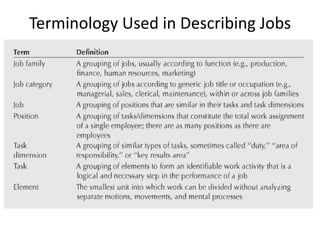
Terminology Used in Describing Jobs
Job Analysis
• A purposeful, systematic process for collecting
information on the important work related aspects of
a job.
• The procedure for determining the duties and skill
requirements of a job and the kind of person who
should be hired for it.
• The process of studying jobs to gather, analyze,
synthesize and report information about job
responsibilities and requirements and the conditions
under which work is performed.
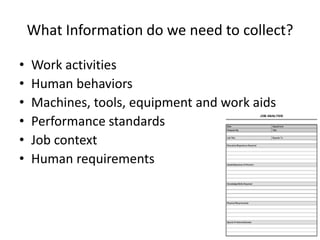
What Information do we need to collect?
• Work activities
• Human behaviors
• Machines, tools, equipment and work aids
• Performance standards
• Job context
• Human requirements
Work activities
• Collects information about the job’s actual
work activities, such as
– Cleaning
– Selling
– Teaching
– Painting
• Also include how, why and when the activities
are performed
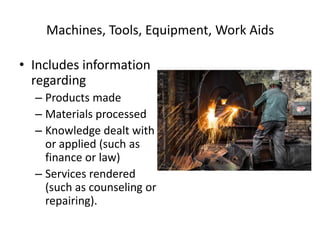
Machines, Tools, Equipment, Work Aids
• Includes information
regarding
– Products made
– Materials processed
– Knowledge dealt with
or applied (such as
finance or law)
– Services rendered
(such as counseling or
repairing).
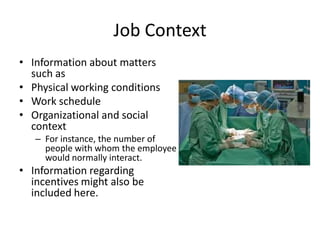
Job Context
• Information about matters
such as
• Physical working conditions
• Work schedule
• Organizational and social
context
– For instance, the number of
people with whom the employee
would normally interact.
• Information regarding
incentives might also be
included here.
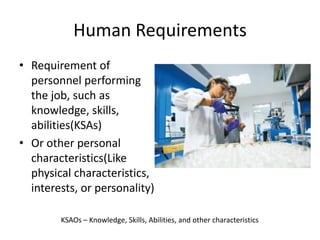
Human Requirements
• Requirement of
personnel performing
the job, such as
knowledge, skills,
abilities(KSAs)
• Or other personal
characteristics(Like
physical characteristics,
interests, or personality)
KSAOs – Knowledge, Skills, Abilities, and other characteristics
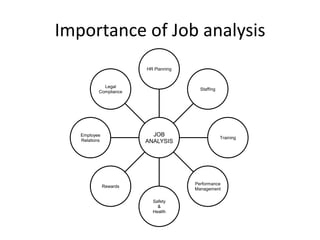
Importance of Job analysis
JOB
ANALYSIS
HR Planning
Staffing
Training
Performance
Management
Safety
&
Health
Rewards
Employee
Relations
Legal
Compliance
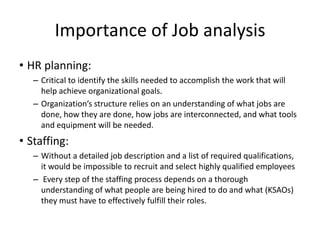
Importance of Job analysis
• HR planning:
– Critical to identify the skills needed to accomplish the work that will
help achieve organizational goals.
– Organization’s structure relies on an understanding of what jobs are
done, how they are done, how jobs are interconnected, and what tools
and equipment will be needed.
• Staffing:
– Without a detailed job description and a list of required qualifications,
it would be impossible to recruit and select highly qualified employees
– Every step of the staffing process depends on a thorough
understanding of what people are being hired to do and what (KSAOs)
they must have to effectively fulfill their roles.
Importance of Job analysis
• Training:
– Pinpoint the knowledge, skills and abilities required to perform the
duties.
• Performance management:
– Identification of performance standards
• Safety and health:
– Identify work hazards inherent in the job, any required personal
protective equipment and training needs.
• Rewards:
– Proper evaluation of a job’s value or worth relies on codifying tasks,
duties and qualifications for successful job performance.
– Pay rates should not be established without a sound job evaluation
process.
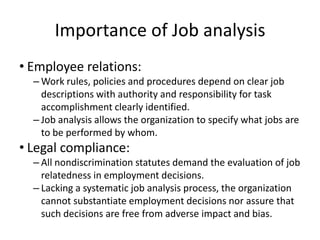
Importance of Job analysis
• Employee relations:
– Work rules, policies and procedures depend on clear job
descriptions with authority and responsibility for task
accomplishment clearly identified.
– Job analysis allows the organization to specify what jobs are
to be performed by whom.
• Legal compliance:
– All nondiscrimination statutes demand the evaluation of job
relatedness in employment decisions.
– Lacking a systematic job analysis process, the organization
cannot substantiate employment decisions nor assure that
such decisions are free from adverse impact and bias.
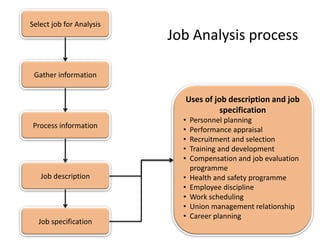
Select job for Analysis
Gather information
Process information
Job description
Uses of job description and job
specification
• Personnel planning
• Performance appraisal
• Recruitment and selection
• Training and development
• Compensation and job evaluation
programme
• Health and safety programme
• Employee discipline
• Work scheduling
• Union management relationship
• Career planning
Job specification
Job Analysis process
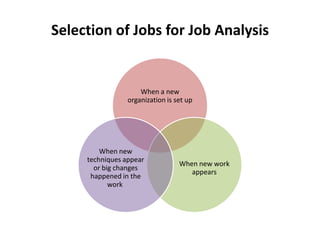
Selection of Jobs for Job Analysis
When a new
organization is set up
When new work
appears
When new
techniques appear
or big changes
happened in the
work
Gather Information (Data Collection)
1) Type of job analysis information
– Major types of job analysis information are
• Work Activities
– Description of work activities (tasks)
– Interface with other jobs and equipment
– Procedures used
– Behaviors required on the job
– Physical movements and demands of the job
• Machine, Tools, Equipment, and Work Aids Used
Type of job analysis information (cont`d)
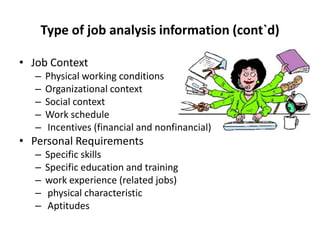
• Job Context
– Physical working conditions
– Organizational context
– Social context
– Work schedule
– Incentives (financial and nonfinancial)
• Personal Requirements
– Specific skills
– Specific education and training
– work experience (related jobs)
– physical characteristic
– Aptitudes
Gather Information (cont`d)
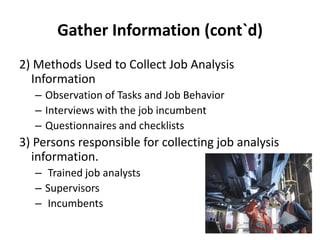
2) Methods Used to Collect Job Analysis
Information
– Observation of Tasks and Job Behavior
– Interviews with the job incumbent
– Questionnaires and checklists
3) Persons responsible for collecting job analysis
information.
– Trained job analysts
– Supervisors
– Incumbents
Processing
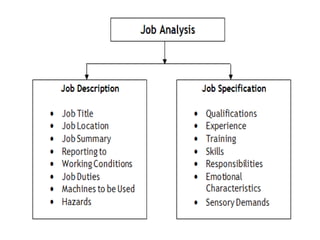
• The job analysis process results in two
essential documents:
– Job description : summarizes the duties,
responsibilities, working conditions, and activities
of a particular job.
– Job specification: outlines employee qualifications
such as education level, job-related experience,
knowledge, skills, or abilities that are required to
perform a given job.
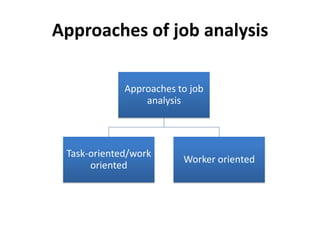
Approaches of job analysis
Approaches to job
analysis
Task-oriented/work
oriented
Worker oriented
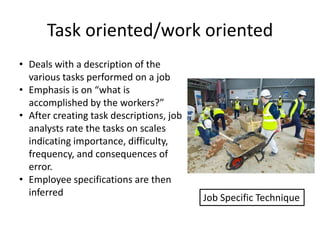
Task oriented/work oriented
• Deals with a description of the
various tasks performed on a job
• Emphasis is on “what is
accomplished by the workers?”
• After creating task descriptions, job
analysts rate the tasks on scales
indicating importance, difficulty,
frequency, and consequences of
error.
• Employee specifications are then
inferred Job Specific Technique
Worker oriented
• Aim to examine the human attributes needed to perform
the job successfully.
• These human attributes have been commonly classified
into four categories: knowledge, skills, abilities, and other
characteristics (KSAO).
– Knowledge - Information needed in order to perform the job.
– Skills - Proficiencies needed to perform each task.
– Abilities - Attributes that are relatively stable over time.
– Other characteristics - All other attributes, usually personality
factors.
• Focus is on general aspects of the job that describe the
perceptual, interpersonal, sensory, mental and physical
activities
FIGURE 7.10 Examples of Knowledge, Skills, and Abilities (KSAs)
Statements Developed in Previous Job Analyses
Knowledge:
“Knowledge of building materials including the uses, storage, and preparation of materials such as
aluminum siding, Masonite®, concrete block, and gypsum board” (building materials company supervisor)
“Knowledge of the development, scoring, and application of employee performance appraisal techniques
such as behaviorally anchored rating scales, 360-feedback, and graphic rating scales.” (human resources
consultant)
“Knowledge of basic and advanced first aid procedures to include CPR techniques” (state police corporal)
“Knowledge of aircraft nomenclature (type, number of engines, manufacturer, jet/non-jet engine) and
performance characteristics such as speed, climb/descent rates, turning radius, and weather and radio
capabilities” (air traffic controller)
Skills:
“Skill in using a bank proof machine to process 50 checks per minute without error” (bank proof machine
operator)
“Skill in typing business correspondence at 50 words per minute without error” (secretary)
“Skill in the use of handguns as needed to pass annual departmental qualifying standards” (state police
corporal)
Abilities:
“Ability to give oral testimony in court as an expert witness in an employment discrimination suit regarding
test validation issues” (human resources consultant)
“Ability to use basic arithmetic to calculate flow of current through an electrical circuit” (lighting company
technician)
“Ability to obtain facts and information by using interviewing skills and techniques” (state police corporal)
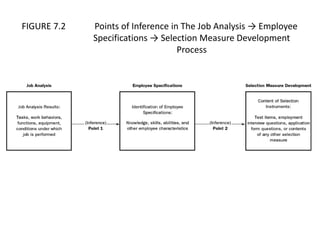
FIGURE 7.2 Points of Inference in The Job Analysis → Employee
Specifications → Selection Measure Development
Process
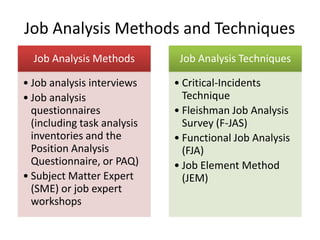
Job Analysis Methods and Techniques
Job Analysis Methods
• Job analysis interviews
• Job analysis
questionnaires
(including task analysis
inventories and the
Position Analysis
Questionnaire, or PAQ)
• Subject Matter Expert
(SME) or job expert
workshops
Job Analysis Techniques
• Critical-Incidents
Technique
• Fleishman Job Analysis
Survey (F-JAS)
• Functional Job Analysis
(FJA)
• Job Element Method
(JEM)
Job Analysis Interviews
• Description
– Job analysis data is
collected from incumbents
or supervisors by a trained
analyst asking questions
about the duties and
responsibilities, KSAs
required, and equipment
and/or conditions of
employment for a job or
class of jobs.
Job Analysis Interviews
• Purposes
– To collect job information on job tasks that will
serve as a basis for developing other job analysis
measures, such as a job analysis questionnaire
– To serve as a means for clarifying or verifying
information collected previously through other
job analysis methods
– To serve as a method, perhaps as one of several
used, for collecting relevant job data for
developing a selection system
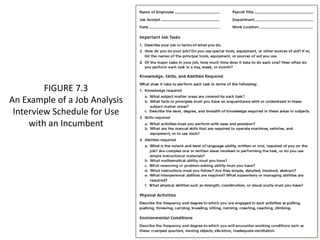
FIGURE 7.3
An Example of a Job Analysis
Interview Schedule for Use
with an Incumbent
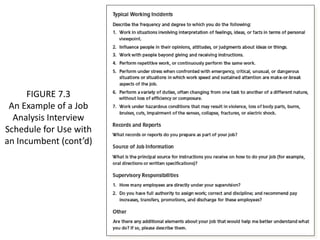
FIGURE 7.3
An Example of a Job
Analysis Interview
Schedule for Use with
an Incumbent (cont’d)
FIGURE 7.5 Guidelines for Conducting a Job Analysis Interview
Opening the Interview
1. Put the worker at ease by learning his or her name in advance, introducing yourself, and discussing general
and pleasant topics long enough to establish rapport. Be at ease.
2. Make the purpose of the interview clear by explaining why the interview was scheduled, what is expected
to be accomplished, and how the worker’s cooperation will help in the production of tools for use in
personnel selection.
3. Encourage the worker to talk by always being courteous and showing a sincere interest in what he or she
says.
Steering the Interview
1. Help the worker to think and talk according to the logical sequence of the duties performed. If duties are
not performed in a regular order, ask the worker to describe the functional aspects of the duties by taking
the most important activity first, the second-most important next, and so forth. Request the worker to
describe the infrequent duties of his or her job—duties that are not part of the worker’s regular activities,
such as the occasional setup of a machine, occasional repairs, or infrequent reports.
2. Allow the worker sufficient time to answer each question and to formulate an answer.
3. Phrase questions carefully, so that the answers will be more than “yes” or “no.”
4. Avoid the use of leading questions.
5. Conduct the interview in plain, easily understood language.
6. Control the interview with respect to the economic use of time and adherence to subject matter. For
example, when the interviewee strays from the subject, a good technique for bringing him or her back to
the point is to summarize the data collected up to that point.
FIGURE 7.5 Guidelines for Conducting a Job Analysis Interview
(cont’d)
Closing the Interview
1. Summarize the information obtained from the worker, indicating the major duties
performed and the details concerning each of the duties.
2. Close the interview on a friendly note.
Miscellaneous Dos and Don’ts for Interviews
1. Do not take issue with the worker’s statements.
2. Do not show any partiality to grievances or conflicts concerning the employer-
employee relations.
3. Do not show any interest in the wage classification of the job.
4. Do not talk down to the worker.
5. Do not permit yourself to be influenced by your personal likes and dislikes.
6. Be impersonal. Do not be critical or attempt to suggest any changes or
improvements in the organization or methods of work.
7. Talk to the worker only with permission of her or his supervisor.
8. Verify completed job analysis interview with an appropriate individual—such as a
supervisor.
Limitations of the Job Analysis Interview
• Lack of standardization in collection process
• Limited possibilities for covering large numbers of
respondents
• Documentation for each individual interview
• Time requirements to conduct individual interviews
• Costs of individually interviewing respondents
• Variations in interviewer skills
• Distortions in the information collected from
interviewees
Job Analysis Questionnaires
• Description
– Respondents are asked to make judgments (e.g.,
via rating scales) to indicate the degree to which
various aspects of job information listed on the
questionnaire apply to their jobs
• Activities or tasks
• Tools and equipment used to perform the job
• Working conditions in which the job is performed
• KSAs or other characteristics incumbents need to
perform the job successfully
Types of Job Analysis Questionnaires
• Tailored Questionnaires
– Are measures developed by an organization (or
its consultants) for a specific purpose or for
application to a specific job
• Prefabricated or Existing Questionnaires
– Are generic measures developed for use with a
variety of jobs that usually consist of a
preestablished set of items describing aspects of
a job that respondents judge using a rating scale
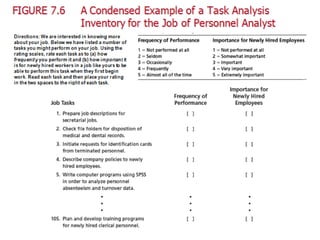
The Task Analysis Inventory
• Description
– A questionnaire composed of a listing of tasks for
which respondents make judgments using a task
rating scale, such as frequency of task
performance.
• Use/Purpose
– Many employers have adopted a content
validation strategy for selection measures, for
which the inventories are particularly helpful.
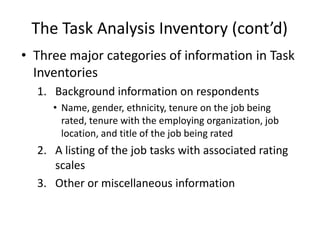
The Task Analysis Inventory (cont’d)
• Three major categories of information in Task
Inventories
1. Background information on respondents
• Name, gender, ethnicity, tenure on the job being
rated, tenure with the employing organization, job
location, and title of the job being rated
2. A listing of the job tasks with associated rating
scales
3. Other or miscellaneous information
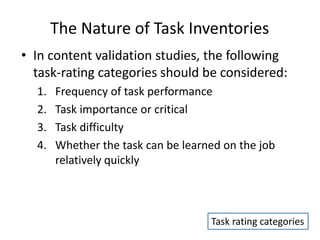
The Nature of Task Inventories
• In content validation studies, the following
task-rating categories should be considered:
1. Frequency of task performance
2. Task importance or critical
3. Task difficulty
4. Whether the task can be learned on the job
relatively quickly
Task rating categories
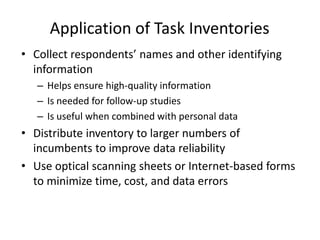
Application of Task Inventories
• Collect respondents’ names and other identifying
information
– Helps ensure high-quality information
– Is needed for follow-up studies
– Is useful when combined with personal data
• Distribute inventory to larger numbers of
incumbents to improve data reliability
• Use optical scanning sheets or Internet-based forms
to minimize time, cost, and data errors
Task Analysis Inventories
• Advantages
– Offer an efficient means for collecting data from large
numbers of incumbents in geographically dispersed
locations.
– Provide data that is readily quantifiable.
• Disadvantages
– Development can be expensive and time-consuming
– Length and complexity can create respondent motivation
problems
– Ambiguities and respondent questions are not readily
addressable during administration
Position Analysis Questionnaire(PAQ-Form C)
• One of the broadest and best researched
instrument for analysing the job
• Questionnaire is worker oriented
• Used primarily for wide spectrum of jobs
• Standardized, structured job analysis
questionnaire
• Contains 195 items or elements out of which
– 187 items concern work activities and work situations
– Seven relate to compensation issues
– Final items deals with exempt or non-exempt status of
the position being analysed
Position Analysis Questionnaire(PAQ-Form C)
• Items on the PAQ organised into 6 basic division or
sections
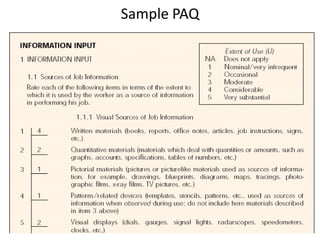
1. Information input
• Where and how a worker gets information needed to perform
the job
2. Mental processes
• Reasoning, decision making, planning and information
processing involved in the job
3. Work output
• Physical activities, tools and devices used by the worker to
perform the job
4. Relationship with other persons
• Relationship required to perform the job
5. Job context
• Physical and social context in which the work is performed
6. Other job characteristics
• Activities, conditions and characteristics another than already
described that are relevant to the job
Position Analysis Questionnaire(PAQ-Form C)
• Scales used in PAQ
1. Extent of use
• Degree to which an item is used by the worker
2. Amount of time
• Proportion of time spent doing something
3. Importance to this job
• Importance of an activity specified by the item in performing the
job
4. Possibility of occurrence
• Degree to which there is a possibility of physical hazards on the
job
5. Applicability
• Whether an item applies to the job
– Special code
• Special rating scales that are used with a particular item on the
PAQ
Position Analysis Questionnaire(PAQ-Form C)
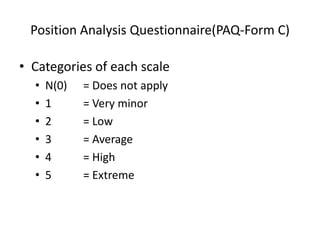
• Categories of each scale
• N(0) = Does not apply
• 1 = Very minor
• 2 = Low
• 3 = Average
• 4 = High
• 5 = Extreme
Sample PAQ
Position Analysis Questionnaire(PAQ-Form C)
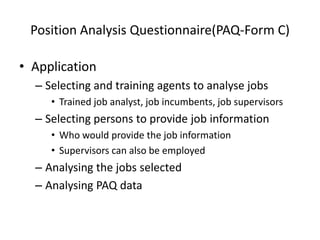
• Application
– Selecting and training agents to analyse jobs
• Trained job analyst, job incumbents, job supervisors
– Selecting persons to provide job information
• Who would provide the job information
• Supervisors can also be employed
– Analysing the jobs selected
– Analysing PAQ data
PAQ
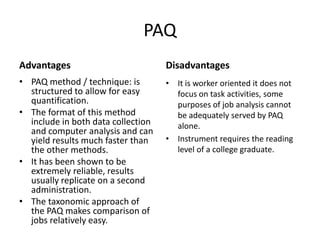
Advantages
• PAQ method / technique: is
structured to allow for easy
quantification.
• The format of this method
include in both data collection
and computer analysis and can
yield results much faster than
the other methods.
• It has been shown to be
extremely reliable, results
usually replicate on a second
administration.
• The taxonomic approach of
the PAQ makes comparison of
jobs relatively easy.
Disadvantages
• It is worker oriented it does not
focus on task activities, some
purposes of job analysis cannot
be adequately served by PAQ
alone.
• Instrument requires the reading
level of a college graduate.
Subject Matter Expert Workshops(SME)
• Consist of groups of panels of 10 to 20 job
incumbents who work with a group leader to
produce a job analysis
• Participants are selected for their knowledge
of the job- referred as subject experts
• No one particular format for conducting the
workshop
Subject Matter Expert Workshops(SME)
• General steps:
1. Selecting and preparing SMEs
2. Identifying and rating job tasks
3. Identifying and rating KSAs
4. Judging selection measure-Job content relevance
Supplementary Methods for collecting
Job information
• Technical conferences
– Group interview sessions designed to identify the
characteristics of a specific job
– Conducted between job analyst and
knowledgeable supervisors or incumbents
• Worker diaries
– Job incumbents record their diary job activities
using some form of log or diary
Supplementary Methods for collecting
Job information
• Critical-Incidents Technique
– Purpose
• To generate a work-oriented list of observed good and poor
(critical) job performance behaviors (incidents) of job
incumbents to be grouped into job dimensions
– Critical Incident Characteristics
• Focuses on a specific (single) observable behavior that has
been, or could be, exhibited on the job
• Briefly describes the context in which the behavior occurred
• Involves observation and recording of particularly effective
or ineffective behaviours.
CIT
• Consists of :
1. Description of a situation
2. The effective or ineffective behaviour performed
by a job incumbent
3. Consequences of that behaviour
• Result of CIT is a list of events where employees
performed tasks poorly or exceptionally well
Critical-Incidents Technique (cont’d)
• Application
– To generate a list of job-related behaviors from which
inferences are based regarding worker specifications
– To determine how to measure worker specifications that
are consistent with what actually occurs on the job.
• Implementation
1. Selecting the method for critical-incidents collection
2. Selecting a panel of job experts
3. Gathering critical incidents
4. Rating and classifying critical incidents into job
dimensions
Critical-Incidents Technique (cont’d)
• Implementation
1. Selecting the method for critical-incidents
collection
• Gathered from job experts
1. In a group setting (most efficient)
2. Individual interview (when info is confidential)
3. Administering a questionnaire (when no common time is
available)
2. Selecting a panel of job experts
• Supervisors, subordinates and incumbents
Critical-Incidents Technique (cont’d)
• Implementation
3. Gathering critical incidents
• Using structured format
4. Rating and classifying critical incidents into job
dimensions
• Are determined by analyzing the content of the
critical incidents and identifying common themes
among the incidents
CIT
• Advantage
– It results in a great deal of interesting, specific,
job related information. Information is
behavioural in nature, not trait based.
• Disadvantage
– It is not clear that the incidents reported
represent the full scope of the job.
– Dimensions based on these critical incidents may
not be representative of the entire job.
– Dimensions may not be stable.
Fleishman Job Analysis Survey (F-JAS)
• Developed by Edwin Fleishman.
• Worker oriented approach to be applied once job
duties have been identified
• Consists of behaviourally anchored rating scales
from 52 abilities.
• Each of the abilities is classified into one of 4
general ability categories including cognitive,
psychomotor, physical and sensory/perceptual.
• F-JAS method provides a direct link between job
tasks and the characteristics of individuals
required to perform these tasks effectively.
Fleishman Job Analysis Survey (F-JAS)
• Information is collected on
– Interactive/social scales
– Knowledge/skill scales
• Application
1. Determining level of analysis
2. Selecting job agents
3. Rating ability levels for each task
4. Analysing results
5. Selecting tests
Fleishman Job Analysis Survey (F-JAS)
• Application
1. Determining level of analysis
• Decision must be made as to whether abilities are to
be inferred for the job as a whole or for
• Specific job dimension
• Or for specific job tasks (most appropriate)
2. Selecting job agents
– Job incumbents
– Supervisors
– Job analyst
Fleishman Job Analysis Survey (F-JAS)
• Application
3. Rating ability levels for each task
• Need not use all the rating scales
• Each of the abilities has a 7 point rating scale ,with
behavioural anchors defined from variety of jobs
• Job expert compares the level of ability required to
perform the task with the level described by the
anchors
• Rating is time consuming and produce large amount
of data
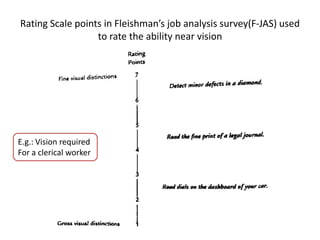
Rating Scale points in Fleishman’s job analysis survey(F-JAS) used
to rate the ability near vision
E.g.: Vision required
For a clerical worker
Fleishman Job Analysis Survey (F-JAS)
• Application
4. Analysing results
• For each task the mean ratings across all raters for
each ability is computed
• Result is profile of abilities required for each task
performance
5. Selecting tests
• Beyond scope of determining worker requirements
and ability specifications
• For criterion validation strategy’
F-JAS
• Advantage is list of abilities and behavioural
anchors represent in the scales.
• The method is straight forward and easy to
adopt.
• Disadvantage is the method may not be as
appropriate when using a content validation
strategy
Functional job analysis (FJA)
• Sidney fine and his associates designed FJA.
• Two types of task information are obtained from
FJA.
1. What a worker does, i.e., the procedures and
processes engaged in by a worker as a task is
performed
2. How a task is performed in context of the physical,
mental and interpersonal involvement of the worker
with the task
• Information obtained is used to clarify both what
a worker does and the result of those job
behaviours
Functional job analysis (FJA)
• When using FJA, judgments about jobs are based on at
least two premises:
1. All job require workers to deal, in some degree, with
people ( clients, customers, co workers etc.), Data (
Information or Ideas) and Things ( machines or
equipment)
2. The tasks a worker performs in relation to People, Data
and Things can be measured by rating scales.
• Functional Job Analysis is frequently applied by an
analyst working with job incumbents, either
individually or in groups.
• The objective is to describe what a worker does in
performing the job-not what gets done.
Functional job analysis (FJA)
• Application
1. Organising job incumbents to analyse the job
• Incumbents knowledgeable of the job being studied
2. Specifying job outputs
• SMEs are asked to specify the outputs they produce on their job
3. Identifying job tasks
• Who performs the task?
• What action is performed?
• What immediate result is accomplished?
• What tools, equipment, or work aids are used?
• What instructions(prescribed or discretionary) are followed?
Functional job analysis (FJA)
4. Measuring worker functions
– Worker functions scales consists of separate
ratings of people, data and things
– Information is used to assess task requirements
1. Task level- shows relative complexity of a task
compared to other task
2. Task orientation – indicate relative involvement of a
worker with data, people, and things as a task is
performed
Functional job analysis (FJA)
5. Measuring worker instructions
– Measuring degree of prescription and discretion in task
performance
– Prescribed aspects of task
• Represent those areas in which worker has no control over what
is done
– Discretionary components
• Involve those aspects of tasks in which the worker must decide
on the execution of tasks
6. Measuring worker qualifications
– Reasoning development scale (problem solving)
– Mathematical development scale
– Language development scale (oral and written)
Functional job analysis (FJA)
7. Identifying employee specifications
– Analyst attempt to identify the KSAs or other
employee characteristics needed to perform the
job tasks
8. Administering a job task questionnaire
– If needed, the tasks that have been identified
with SMEs either through observation and/or
interview can be included in a questionnaire
FJA
• Advantage :
– FJA represents a comprehensive, quantitative
procedure for analyzing jobs.
– Rating scales appear to provide reliable task
analysis data.
• Disadvantage :
– Cost and the method is laborious and time
consuming.
– Special training is mandatory in order to apply FJA
effectively –training can be expensive.
Job element method (JEM)
• Originally developed by Earnest prim off.
• Focuses on the human attributes necessary
for superior performance on the job.
• Used to identify the superior workers on a job
• Supervisors develop a list of characteristics
and then rate them in such a way that the
characteristics are essential to superior
performance.
• These qualities are called job element.
Job element method (JEM)
• Application
1. Selecting a panel of raters
• Success depends on panel of experts
2. Developing the job elements and sub
elements(specific employee characteristics)
• E.g.: “If you had to pick out one person to get a special
bonus for outstanding work, what might you look for?”
3. Rating job elements and sub elements
• Independently rating
4. Analysing JEM data
5. Amplifying sub element definitions
• Goal is to be specific as possible in defining KSAOs that
reflect the nature of the sub element
JEM
• Advantage:
– Offers a unique alternative for identifying
important employee specifications and
constructing measures for them.
• Disadvantage:
– JEM has been criticized for ignoring the
specifications of job tasks.
– It may not be best method for content validation
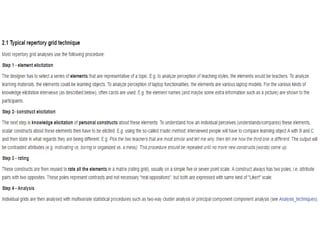
Repertory Grid
• The repertory grid technique (RGT or RepGrid) is a method
for eliciting personal constructs, i.e. what people think
about a given topic.
• Methodology of repertory grid is used for identification of
competencies.
• It was devised by George Kelly in around 1955 and is based
on his Personal Constructs theory of personality.
• The repertory grid is a technique for identifying the ways
that a person construes (interprets/ gives meaning to) his
or her experience.
• It provides information from which inferences about
personality can be made, but it is not a personality test in
the conventional sense
Personal construct theory suggests that people develop personal constructs
about how the world works. People then use these constructs to make sense of
their observations and experiences.
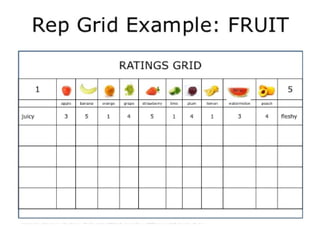
Repertory Grid -Four parts
1. Topic: it is about some part of the person's experience
2. A Set of Elements, which are examples or instances of the
Topic.
– E.g.: To see how I construe the purchase of a car, a list of
vehicles within my price range could make an excellent set
of elements.
3. A set of Constructs.
– Are the basic terms that the client uses to make sense of
the elements, and are always expressed as a contrast.
– E.g.: The meaning of 'Good' depends on whether you
intend to say 'Good versus Poor‘
4. A set of ratings of Elements on Constructs.
– Each element is positioned between the two extremes of
the construct using a 5- or 7-point rating scale system
Job Description
• Job description includes basic job-related data
that is useful to advertise a specific job and
attract a pool of talent.
• It includes information such as
– job title, job location,
– reporting to and of employees,
– job summary, nature and objectives of a job,
– tasks and duties to be performed, working conditions,
– machines, tools and equipments to be used by a
prospective worker and hazards involved in it.
Purpose
• Is to collect job-related data in order to advertise for a
particular job.
• It helps in attracting, targeting, recruiting and selecting
the right candidate for the right job.
• It is done to determine what needs to be delivered in a
particular job.
• It clarifies what employees are supposed to do if
selected for that particular job opening.
• It gives recruiting staff a clear view what kind of
candidate is required by a particular department or
division to perform a specific task or job.
• It also clarifies who will report to whom.
Job Specification
• Also known as employee specifications.
• A job specification is a written statement of
– educational qualifications, specific qualities,
– level of experience, physical, emotional, technical and
– communication skills required to perform a job,
– responsibilities involved in a job and other unusual sensory
demands.
• It also includes general
– health, mental health, intelligence, aptitude,
– memory, judgment, leadership skills, emotional ability,
– adaptability, flexibility, values and ethics, manners and
creativity, etc.
Purpose
• Described on the basis, job specification helps
candidates analyze whether they are eligible to apply
for a particular job vacancy or not.
• It helps recruiting team of an organization understand
what level of qualifications, qualities and set of
characteristics should be present in a candidate to
make him or her eligible for the job opening.
• Job Specification gives detailed information about any
job including job responsibilities, desired technical and
physical skills, conversational ability and much more.
• It helps in selecting the most appropriate candidate for
a particular job.
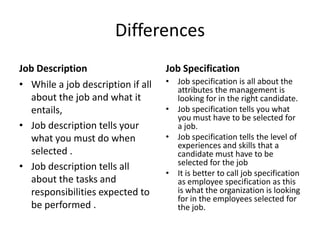
Differences
Job Description
• While a job description if all
about the job and what it
entails,
• Job description tells your
what you must do when
selected .
• Job description tells all
about the tasks and
responsibilities expected to
be performed .
Job Specification
• Job specification is all about the
attributes the management is
looking for in the right candidate.
• Job specification tells you what
you must have to be selected for
a job.
• Job specification tells the level of
experiences and skills that a
candidate must have to be
selected for the job
• It is better to call job specification
as employee specification as this
is what the organization is looking
for in the employees selected for
the job.
End of Module 1

Module 1 rs

  • 1.
  • 2.
    Objectives 1. To enablestudents to understand and apply the principles of recruitment and Selection trends in the industry. 2. To provide a conceptual and Application of Selection Procedure in the Industry. 3. To give an understanding of the components and meaning of Latest Selection Tools in the corporate sector.
  • 3.
  • 4.
    Module Overview • Meaning,definition and purpose. • Methods of job analysis: – Job analysis interviews – Job analysis questionnaire • Task analysis inventory • Position analysis questionnaire – Subject expert workshops – Critical incident technique – Fleishman job analysis survey – Functional job analysis – Job element method, repertory grid, critical incident technique
  • 5.
    Terminology Used inDescribing Jobs
  • 6.
    Job Analysis • Apurposeful, systematic process for collecting information on the important work related aspects of a job. • The procedure for determining the duties and skill requirements of a job and the kind of person who should be hired for it. • The process of studying jobs to gather, analyze, synthesize and report information about job responsibilities and requirements and the conditions under which work is performed.
  • 7.
    What Information dowe need to collect? • Work activities • Human behaviors • Machines, tools, equipment and work aids • Performance standards • Job context • Human requirements
  • 8.
    Work activities • Collectsinformation about the job’s actual work activities, such as – Cleaning – Selling – Teaching – Painting • Also include how, why and when the activities are performed
  • 9.
    Machines, Tools, Equipment,Work Aids • Includes information regarding – Products made – Materials processed – Knowledge dealt with or applied (such as finance or law) – Services rendered (such as counseling or repairing).
  • 10.
    Job Context • Informationabout matters such as • Physical working conditions • Work schedule • Organizational and social context – For instance, the number of people with whom the employee would normally interact. • Information regarding incentives might also be included here.
  • 11.
    Human Requirements • Requirementof personnel performing the job, such as knowledge, skills, abilities(KSAs) • Or other personal characteristics(Like physical characteristics, interests, or personality) KSAOs – Knowledge, Skills, Abilities, and other characteristics
  • 12.
    Importance of Jobanalysis JOB ANALYSIS HR Planning Staffing Training Performance Management Safety & Health Rewards Employee Relations Legal Compliance
  • 13.
    Importance of Jobanalysis • HR planning: – Critical to identify the skills needed to accomplish the work that will help achieve organizational goals. – Organization’s structure relies on an understanding of what jobs are done, how they are done, how jobs are interconnected, and what tools and equipment will be needed. • Staffing: – Without a detailed job description and a list of required qualifications, it would be impossible to recruit and select highly qualified employees – Every step of the staffing process depends on a thorough understanding of what people are being hired to do and what (KSAOs) they must have to effectively fulfill their roles.
  • 14.
    Importance of Jobanalysis • Training: – Pinpoint the knowledge, skills and abilities required to perform the duties. • Performance management: – Identification of performance standards • Safety and health: – Identify work hazards inherent in the job, any required personal protective equipment and training needs. • Rewards: – Proper evaluation of a job’s value or worth relies on codifying tasks, duties and qualifications for successful job performance. – Pay rates should not be established without a sound job evaluation process.
  • 15.
    Importance of Jobanalysis • Employee relations: – Work rules, policies and procedures depend on clear job descriptions with authority and responsibility for task accomplishment clearly identified. – Job analysis allows the organization to specify what jobs are to be performed by whom. • Legal compliance: – All nondiscrimination statutes demand the evaluation of job relatedness in employment decisions. – Lacking a systematic job analysis process, the organization cannot substantiate employment decisions nor assure that such decisions are free from adverse impact and bias.
  • 16.
    Select job forAnalysis Gather information Process information Job description Uses of job description and job specification • Personnel planning • Performance appraisal • Recruitment and selection • Training and development • Compensation and job evaluation programme • Health and safety programme • Employee discipline • Work scheduling • Union management relationship • Career planning Job specification Job Analysis process
  • 17.
    Selection of Jobsfor Job Analysis When a new organization is set up When new work appears When new techniques appear or big changes happened in the work
  • 18.
    Gather Information (DataCollection) 1) Type of job analysis information – Major types of job analysis information are • Work Activities – Description of work activities (tasks) – Interface with other jobs and equipment – Procedures used – Behaviors required on the job – Physical movements and demands of the job • Machine, Tools, Equipment, and Work Aids Used
  • 19.
    Type of jobanalysis information (cont`d) • Job Context – Physical working conditions – Organizational context – Social context – Work schedule – Incentives (financial and nonfinancial) • Personal Requirements – Specific skills – Specific education and training – work experience (related jobs) – physical characteristic – Aptitudes
  • 20.
    Gather Information (cont`d) 2)Methods Used to Collect Job Analysis Information – Observation of Tasks and Job Behavior – Interviews with the job incumbent – Questionnaires and checklists 3) Persons responsible for collecting job analysis information. – Trained job analysts – Supervisors – Incumbents
  • 21.
    Processing • The jobanalysis process results in two essential documents: – Job description : summarizes the duties, responsibilities, working conditions, and activities of a particular job. – Job specification: outlines employee qualifications such as education level, job-related experience, knowledge, skills, or abilities that are required to perform a given job.
  • 22.
    Approaches of jobanalysis Approaches to job analysis Task-oriented/work oriented Worker oriented
  • 23.
    Task oriented/work oriented •Deals with a description of the various tasks performed on a job • Emphasis is on “what is accomplished by the workers?” • After creating task descriptions, job analysts rate the tasks on scales indicating importance, difficulty, frequency, and consequences of error. • Employee specifications are then inferred Job Specific Technique
  • 24.
    Worker oriented • Aimto examine the human attributes needed to perform the job successfully. • These human attributes have been commonly classified into four categories: knowledge, skills, abilities, and other characteristics (KSAO). – Knowledge - Information needed in order to perform the job. – Skills - Proficiencies needed to perform each task. – Abilities - Attributes that are relatively stable over time. – Other characteristics - All other attributes, usually personality factors. • Focus is on general aspects of the job that describe the perceptual, interpersonal, sensory, mental and physical activities
  • 25.
    FIGURE 7.10 Examplesof Knowledge, Skills, and Abilities (KSAs) Statements Developed in Previous Job Analyses Knowledge: “Knowledge of building materials including the uses, storage, and preparation of materials such as aluminum siding, Masonite®, concrete block, and gypsum board” (building materials company supervisor) “Knowledge of the development, scoring, and application of employee performance appraisal techniques such as behaviorally anchored rating scales, 360-feedback, and graphic rating scales.” (human resources consultant) “Knowledge of basic and advanced first aid procedures to include CPR techniques” (state police corporal) “Knowledge of aircraft nomenclature (type, number of engines, manufacturer, jet/non-jet engine) and performance characteristics such as speed, climb/descent rates, turning radius, and weather and radio capabilities” (air traffic controller) Skills: “Skill in using a bank proof machine to process 50 checks per minute without error” (bank proof machine operator) “Skill in typing business correspondence at 50 words per minute without error” (secretary) “Skill in the use of handguns as needed to pass annual departmental qualifying standards” (state police corporal) Abilities: “Ability to give oral testimony in court as an expert witness in an employment discrimination suit regarding test validation issues” (human resources consultant) “Ability to use basic arithmetic to calculate flow of current through an electrical circuit” (lighting company technician) “Ability to obtain facts and information by using interviewing skills and techniques” (state police corporal)
  • 26.
    FIGURE 7.2 Pointsof Inference in The Job Analysis → Employee Specifications → Selection Measure Development Process
  • 27.
    Job Analysis Methodsand Techniques Job Analysis Methods • Job analysis interviews • Job analysis questionnaires (including task analysis inventories and the Position Analysis Questionnaire, or PAQ) • Subject Matter Expert (SME) or job expert workshops Job Analysis Techniques • Critical-Incidents Technique • Fleishman Job Analysis Survey (F-JAS) • Functional Job Analysis (FJA) • Job Element Method (JEM)
  • 28.
    Job Analysis Interviews •Description – Job analysis data is collected from incumbents or supervisors by a trained analyst asking questions about the duties and responsibilities, KSAs required, and equipment and/or conditions of employment for a job or class of jobs.
  • 29.
    Job Analysis Interviews •Purposes – To collect job information on job tasks that will serve as a basis for developing other job analysis measures, such as a job analysis questionnaire – To serve as a means for clarifying or verifying information collected previously through other job analysis methods – To serve as a method, perhaps as one of several used, for collecting relevant job data for developing a selection system
  • 30.
    FIGURE 7.3 An Exampleof a Job Analysis Interview Schedule for Use with an Incumbent
  • 31.
    FIGURE 7.3 An Exampleof a Job Analysis Interview Schedule for Use with an Incumbent (cont’d)
  • 32.
    FIGURE 7.5 Guidelinesfor Conducting a Job Analysis Interview Opening the Interview 1. Put the worker at ease by learning his or her name in advance, introducing yourself, and discussing general and pleasant topics long enough to establish rapport. Be at ease. 2. Make the purpose of the interview clear by explaining why the interview was scheduled, what is expected to be accomplished, and how the worker’s cooperation will help in the production of tools for use in personnel selection. 3. Encourage the worker to talk by always being courteous and showing a sincere interest in what he or she says. Steering the Interview 1. Help the worker to think and talk according to the logical sequence of the duties performed. If duties are not performed in a regular order, ask the worker to describe the functional aspects of the duties by taking the most important activity first, the second-most important next, and so forth. Request the worker to describe the infrequent duties of his or her job—duties that are not part of the worker’s regular activities, such as the occasional setup of a machine, occasional repairs, or infrequent reports. 2. Allow the worker sufficient time to answer each question and to formulate an answer. 3. Phrase questions carefully, so that the answers will be more than “yes” or “no.” 4. Avoid the use of leading questions. 5. Conduct the interview in plain, easily understood language. 6. Control the interview with respect to the economic use of time and adherence to subject matter. For example, when the interviewee strays from the subject, a good technique for bringing him or her back to the point is to summarize the data collected up to that point.
  • 33.
    FIGURE 7.5 Guidelinesfor Conducting a Job Analysis Interview (cont’d) Closing the Interview 1. Summarize the information obtained from the worker, indicating the major duties performed and the details concerning each of the duties. 2. Close the interview on a friendly note. Miscellaneous Dos and Don’ts for Interviews 1. Do not take issue with the worker’s statements. 2. Do not show any partiality to grievances or conflicts concerning the employer- employee relations. 3. Do not show any interest in the wage classification of the job. 4. Do not talk down to the worker. 5. Do not permit yourself to be influenced by your personal likes and dislikes. 6. Be impersonal. Do not be critical or attempt to suggest any changes or improvements in the organization or methods of work. 7. Talk to the worker only with permission of her or his supervisor. 8. Verify completed job analysis interview with an appropriate individual—such as a supervisor.
  • 34.
    Limitations of theJob Analysis Interview • Lack of standardization in collection process • Limited possibilities for covering large numbers of respondents • Documentation for each individual interview • Time requirements to conduct individual interviews • Costs of individually interviewing respondents • Variations in interviewer skills • Distortions in the information collected from interviewees
  • 35.
    Job Analysis Questionnaires •Description – Respondents are asked to make judgments (e.g., via rating scales) to indicate the degree to which various aspects of job information listed on the questionnaire apply to their jobs • Activities or tasks • Tools and equipment used to perform the job • Working conditions in which the job is performed • KSAs or other characteristics incumbents need to perform the job successfully
  • 36.
    Types of JobAnalysis Questionnaires • Tailored Questionnaires – Are measures developed by an organization (or its consultants) for a specific purpose or for application to a specific job • Prefabricated or Existing Questionnaires – Are generic measures developed for use with a variety of jobs that usually consist of a preestablished set of items describing aspects of a job that respondents judge using a rating scale
  • 37.
    The Task AnalysisInventory • Description – A questionnaire composed of a listing of tasks for which respondents make judgments using a task rating scale, such as frequency of task performance. • Use/Purpose – Many employers have adopted a content validation strategy for selection measures, for which the inventories are particularly helpful.
  • 38.
    The Task AnalysisInventory (cont’d) • Three major categories of information in Task Inventories 1. Background information on respondents • Name, gender, ethnicity, tenure on the job being rated, tenure with the employing organization, job location, and title of the job being rated 2. A listing of the job tasks with associated rating scales 3. Other or miscellaneous information
  • 40.
    The Nature ofTask Inventories • In content validation studies, the following task-rating categories should be considered: 1. Frequency of task performance 2. Task importance or critical 3. Task difficulty 4. Whether the task can be learned on the job relatively quickly Task rating categories
  • 41.
    Application of TaskInventories • Collect respondents’ names and other identifying information – Helps ensure high-quality information – Is needed for follow-up studies – Is useful when combined with personal data • Distribute inventory to larger numbers of incumbents to improve data reliability • Use optical scanning sheets or Internet-based forms to minimize time, cost, and data errors
  • 42.
    Task Analysis Inventories •Advantages – Offer an efficient means for collecting data from large numbers of incumbents in geographically dispersed locations. – Provide data that is readily quantifiable. • Disadvantages – Development can be expensive and time-consuming – Length and complexity can create respondent motivation problems – Ambiguities and respondent questions are not readily addressable during administration
  • 43.
    Position Analysis Questionnaire(PAQ-FormC) • One of the broadest and best researched instrument for analysing the job • Questionnaire is worker oriented • Used primarily for wide spectrum of jobs • Standardized, structured job analysis questionnaire • Contains 195 items or elements out of which – 187 items concern work activities and work situations – Seven relate to compensation issues – Final items deals with exempt or non-exempt status of the position being analysed
  • 44.
    Position Analysis Questionnaire(PAQ-FormC) • Items on the PAQ organised into 6 basic division or sections 1. Information input • Where and how a worker gets information needed to perform the job 2. Mental processes • Reasoning, decision making, planning and information processing involved in the job 3. Work output • Physical activities, tools and devices used by the worker to perform the job 4. Relationship with other persons • Relationship required to perform the job 5. Job context • Physical and social context in which the work is performed 6. Other job characteristics • Activities, conditions and characteristics another than already described that are relevant to the job
  • 45.
    Position Analysis Questionnaire(PAQ-FormC) • Scales used in PAQ 1. Extent of use • Degree to which an item is used by the worker 2. Amount of time • Proportion of time spent doing something 3. Importance to this job • Importance of an activity specified by the item in performing the job 4. Possibility of occurrence • Degree to which there is a possibility of physical hazards on the job 5. Applicability • Whether an item applies to the job – Special code • Special rating scales that are used with a particular item on the PAQ
  • 46.
    Position Analysis Questionnaire(PAQ-FormC) • Categories of each scale • N(0) = Does not apply • 1 = Very minor • 2 = Low • 3 = Average • 4 = High • 5 = Extreme
  • 47.
  • 48.
    Position Analysis Questionnaire(PAQ-FormC) • Application – Selecting and training agents to analyse jobs • Trained job analyst, job incumbents, job supervisors – Selecting persons to provide job information • Who would provide the job information • Supervisors can also be employed – Analysing the jobs selected – Analysing PAQ data
  • 49.
    PAQ Advantages • PAQ method/ technique: is structured to allow for easy quantification. • The format of this method include in both data collection and computer analysis and can yield results much faster than the other methods. • It has been shown to be extremely reliable, results usually replicate on a second administration. • The taxonomic approach of the PAQ makes comparison of jobs relatively easy. Disadvantages • It is worker oriented it does not focus on task activities, some purposes of job analysis cannot be adequately served by PAQ alone. • Instrument requires the reading level of a college graduate.
  • 50.
    Subject Matter ExpertWorkshops(SME) • Consist of groups of panels of 10 to 20 job incumbents who work with a group leader to produce a job analysis • Participants are selected for their knowledge of the job- referred as subject experts • No one particular format for conducting the workshop
  • 51.
    Subject Matter ExpertWorkshops(SME) • General steps: 1. Selecting and preparing SMEs 2. Identifying and rating job tasks 3. Identifying and rating KSAs 4. Judging selection measure-Job content relevance
  • 52.
    Supplementary Methods forcollecting Job information • Technical conferences – Group interview sessions designed to identify the characteristics of a specific job – Conducted between job analyst and knowledgeable supervisors or incumbents • Worker diaries – Job incumbents record their diary job activities using some form of log or diary
  • 53.
    Supplementary Methods forcollecting Job information • Critical-Incidents Technique – Purpose • To generate a work-oriented list of observed good and poor (critical) job performance behaviors (incidents) of job incumbents to be grouped into job dimensions – Critical Incident Characteristics • Focuses on a specific (single) observable behavior that has been, or could be, exhibited on the job • Briefly describes the context in which the behavior occurred • Involves observation and recording of particularly effective or ineffective behaviours.
  • 54.
    CIT • Consists of: 1. Description of a situation 2. The effective or ineffective behaviour performed by a job incumbent 3. Consequences of that behaviour • Result of CIT is a list of events where employees performed tasks poorly or exceptionally well
  • 55.
    Critical-Incidents Technique (cont’d) •Application – To generate a list of job-related behaviors from which inferences are based regarding worker specifications – To determine how to measure worker specifications that are consistent with what actually occurs on the job. • Implementation 1. Selecting the method for critical-incidents collection 2. Selecting a panel of job experts 3. Gathering critical incidents 4. Rating and classifying critical incidents into job dimensions
  • 56.
    Critical-Incidents Technique (cont’d) •Implementation 1. Selecting the method for critical-incidents collection • Gathered from job experts 1. In a group setting (most efficient) 2. Individual interview (when info is confidential) 3. Administering a questionnaire (when no common time is available) 2. Selecting a panel of job experts • Supervisors, subordinates and incumbents
  • 57.
    Critical-Incidents Technique (cont’d) •Implementation 3. Gathering critical incidents • Using structured format 4. Rating and classifying critical incidents into job dimensions • Are determined by analyzing the content of the critical incidents and identifying common themes among the incidents
  • 58.
    CIT • Advantage – Itresults in a great deal of interesting, specific, job related information. Information is behavioural in nature, not trait based. • Disadvantage – It is not clear that the incidents reported represent the full scope of the job. – Dimensions based on these critical incidents may not be representative of the entire job. – Dimensions may not be stable.
  • 59.
    Fleishman Job AnalysisSurvey (F-JAS) • Developed by Edwin Fleishman. • Worker oriented approach to be applied once job duties have been identified • Consists of behaviourally anchored rating scales from 52 abilities. • Each of the abilities is classified into one of 4 general ability categories including cognitive, psychomotor, physical and sensory/perceptual. • F-JAS method provides a direct link between job tasks and the characteristics of individuals required to perform these tasks effectively.
  • 60.
    Fleishman Job AnalysisSurvey (F-JAS) • Information is collected on – Interactive/social scales – Knowledge/skill scales • Application 1. Determining level of analysis 2. Selecting job agents 3. Rating ability levels for each task 4. Analysing results 5. Selecting tests
  • 61.
    Fleishman Job AnalysisSurvey (F-JAS) • Application 1. Determining level of analysis • Decision must be made as to whether abilities are to be inferred for the job as a whole or for • Specific job dimension • Or for specific job tasks (most appropriate) 2. Selecting job agents – Job incumbents – Supervisors – Job analyst
  • 62.
    Fleishman Job AnalysisSurvey (F-JAS) • Application 3. Rating ability levels for each task • Need not use all the rating scales • Each of the abilities has a 7 point rating scale ,with behavioural anchors defined from variety of jobs • Job expert compares the level of ability required to perform the task with the level described by the anchors • Rating is time consuming and produce large amount of data
  • 63.
    Rating Scale pointsin Fleishman’s job analysis survey(F-JAS) used to rate the ability near vision E.g.: Vision required For a clerical worker
  • 64.
    Fleishman Job AnalysisSurvey (F-JAS) • Application 4. Analysing results • For each task the mean ratings across all raters for each ability is computed • Result is profile of abilities required for each task performance 5. Selecting tests • Beyond scope of determining worker requirements and ability specifications • For criterion validation strategy’
  • 65.
    F-JAS • Advantage islist of abilities and behavioural anchors represent in the scales. • The method is straight forward and easy to adopt. • Disadvantage is the method may not be as appropriate when using a content validation strategy
  • 66.
    Functional job analysis(FJA) • Sidney fine and his associates designed FJA. • Two types of task information are obtained from FJA. 1. What a worker does, i.e., the procedures and processes engaged in by a worker as a task is performed 2. How a task is performed in context of the physical, mental and interpersonal involvement of the worker with the task • Information obtained is used to clarify both what a worker does and the result of those job behaviours
  • 67.
    Functional job analysis(FJA) • When using FJA, judgments about jobs are based on at least two premises: 1. All job require workers to deal, in some degree, with people ( clients, customers, co workers etc.), Data ( Information or Ideas) and Things ( machines or equipment) 2. The tasks a worker performs in relation to People, Data and Things can be measured by rating scales. • Functional Job Analysis is frequently applied by an analyst working with job incumbents, either individually or in groups. • The objective is to describe what a worker does in performing the job-not what gets done.
  • 68.
    Functional job analysis(FJA) • Application 1. Organising job incumbents to analyse the job • Incumbents knowledgeable of the job being studied 2. Specifying job outputs • SMEs are asked to specify the outputs they produce on their job 3. Identifying job tasks • Who performs the task? • What action is performed? • What immediate result is accomplished? • What tools, equipment, or work aids are used? • What instructions(prescribed or discretionary) are followed?
  • 69.
    Functional job analysis(FJA) 4. Measuring worker functions – Worker functions scales consists of separate ratings of people, data and things – Information is used to assess task requirements 1. Task level- shows relative complexity of a task compared to other task 2. Task orientation – indicate relative involvement of a worker with data, people, and things as a task is performed
  • 70.
    Functional job analysis(FJA) 5. Measuring worker instructions – Measuring degree of prescription and discretion in task performance – Prescribed aspects of task • Represent those areas in which worker has no control over what is done – Discretionary components • Involve those aspects of tasks in which the worker must decide on the execution of tasks 6. Measuring worker qualifications – Reasoning development scale (problem solving) – Mathematical development scale – Language development scale (oral and written)
  • 71.
    Functional job analysis(FJA) 7. Identifying employee specifications – Analyst attempt to identify the KSAs or other employee characteristics needed to perform the job tasks 8. Administering a job task questionnaire – If needed, the tasks that have been identified with SMEs either through observation and/or interview can be included in a questionnaire
  • 72.
    FJA • Advantage : –FJA represents a comprehensive, quantitative procedure for analyzing jobs. – Rating scales appear to provide reliable task analysis data. • Disadvantage : – Cost and the method is laborious and time consuming. – Special training is mandatory in order to apply FJA effectively –training can be expensive.
  • 73.
    Job element method(JEM) • Originally developed by Earnest prim off. • Focuses on the human attributes necessary for superior performance on the job. • Used to identify the superior workers on a job • Supervisors develop a list of characteristics and then rate them in such a way that the characteristics are essential to superior performance. • These qualities are called job element.
  • 74.
    Job element method(JEM) • Application 1. Selecting a panel of raters • Success depends on panel of experts 2. Developing the job elements and sub elements(specific employee characteristics) • E.g.: “If you had to pick out one person to get a special bonus for outstanding work, what might you look for?” 3. Rating job elements and sub elements • Independently rating 4. Analysing JEM data 5. Amplifying sub element definitions • Goal is to be specific as possible in defining KSAOs that reflect the nature of the sub element
  • 75.
    JEM • Advantage: – Offersa unique alternative for identifying important employee specifications and constructing measures for them. • Disadvantage: – JEM has been criticized for ignoring the specifications of job tasks. – It may not be best method for content validation
  • 76.
    Repertory Grid • Therepertory grid technique (RGT or RepGrid) is a method for eliciting personal constructs, i.e. what people think about a given topic. • Methodology of repertory grid is used for identification of competencies. • It was devised by George Kelly in around 1955 and is based on his Personal Constructs theory of personality. • The repertory grid is a technique for identifying the ways that a person construes (interprets/ gives meaning to) his or her experience. • It provides information from which inferences about personality can be made, but it is not a personality test in the conventional sense Personal construct theory suggests that people develop personal constructs about how the world works. People then use these constructs to make sense of their observations and experiences.
  • 77.
    Repertory Grid -Fourparts 1. Topic: it is about some part of the person's experience 2. A Set of Elements, which are examples or instances of the Topic. – E.g.: To see how I construe the purchase of a car, a list of vehicles within my price range could make an excellent set of elements. 3. A set of Constructs. – Are the basic terms that the client uses to make sense of the elements, and are always expressed as a contrast. – E.g.: The meaning of 'Good' depends on whether you intend to say 'Good versus Poor‘ 4. A set of ratings of Elements on Constructs. – Each element is positioned between the two extremes of the construct using a 5- or 7-point rating scale system
  • 80.
    Job Description • Jobdescription includes basic job-related data that is useful to advertise a specific job and attract a pool of talent. • It includes information such as – job title, job location, – reporting to and of employees, – job summary, nature and objectives of a job, – tasks and duties to be performed, working conditions, – machines, tools and equipments to be used by a prospective worker and hazards involved in it.
  • 81.
    Purpose • Is tocollect job-related data in order to advertise for a particular job. • It helps in attracting, targeting, recruiting and selecting the right candidate for the right job. • It is done to determine what needs to be delivered in a particular job. • It clarifies what employees are supposed to do if selected for that particular job opening. • It gives recruiting staff a clear view what kind of candidate is required by a particular department or division to perform a specific task or job. • It also clarifies who will report to whom.
  • 82.
    Job Specification • Alsoknown as employee specifications. • A job specification is a written statement of – educational qualifications, specific qualities, – level of experience, physical, emotional, technical and – communication skills required to perform a job, – responsibilities involved in a job and other unusual sensory demands. • It also includes general – health, mental health, intelligence, aptitude, – memory, judgment, leadership skills, emotional ability, – adaptability, flexibility, values and ethics, manners and creativity, etc.
  • 83.
    Purpose • Described onthe basis, job specification helps candidates analyze whether they are eligible to apply for a particular job vacancy or not. • It helps recruiting team of an organization understand what level of qualifications, qualities and set of characteristics should be present in a candidate to make him or her eligible for the job opening. • Job Specification gives detailed information about any job including job responsibilities, desired technical and physical skills, conversational ability and much more. • It helps in selecting the most appropriate candidate for a particular job.
  • 85.
    Differences Job Description • Whilea job description if all about the job and what it entails, • Job description tells your what you must do when selected . • Job description tells all about the tasks and responsibilities expected to be performed . Job Specification • Job specification is all about the attributes the management is looking for in the right candidate. • Job specification tells you what you must have to be selected for a job. • Job specification tells the level of experiences and skills that a candidate must have to be selected for the job • It is better to call job specification as employee specification as this is what the organization is looking for in the employees selected for the job.
  • 86.