Introductionto Compensation
Learning Outcomes
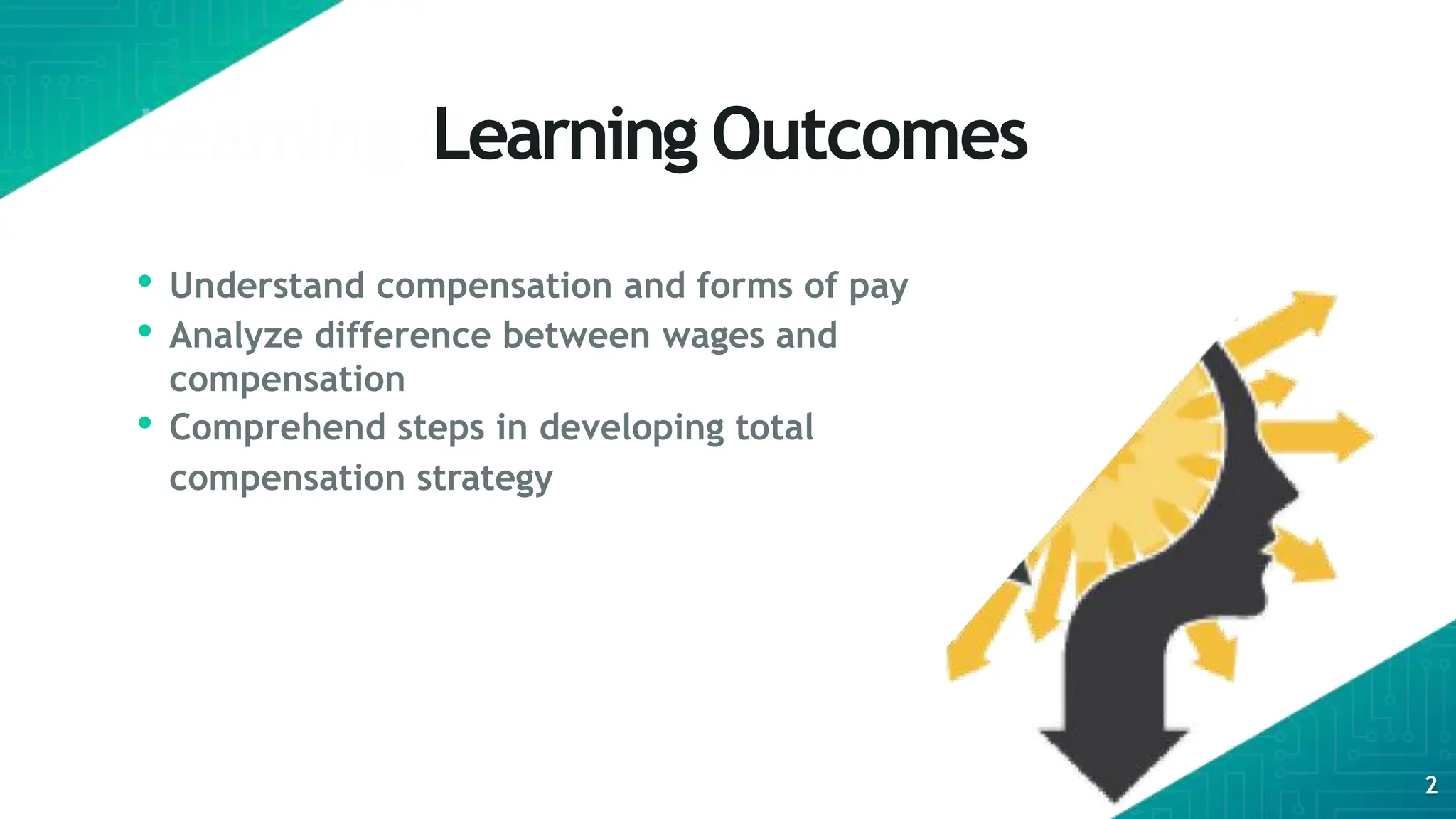
• Understand compensation and forms of pay
• Analyze difference between wages and
compensation
• Comprehend steps in developing total
compensation strategy
2
Meaning
Compensation is a systematic approach to providing
monetary and non monetary value to employees in exchange
for work performed
Money received in performance of work and many kinds of
benefits that an organization provides to employees
3
Compensation Systems
Objectives of an Effective Compensation System:
 Legal compliance with all appropriate laws and regulations
 Cost effectiveness for the organization
 Internal, external, and individual equity for employees
 Performance enhancement for the organization
4
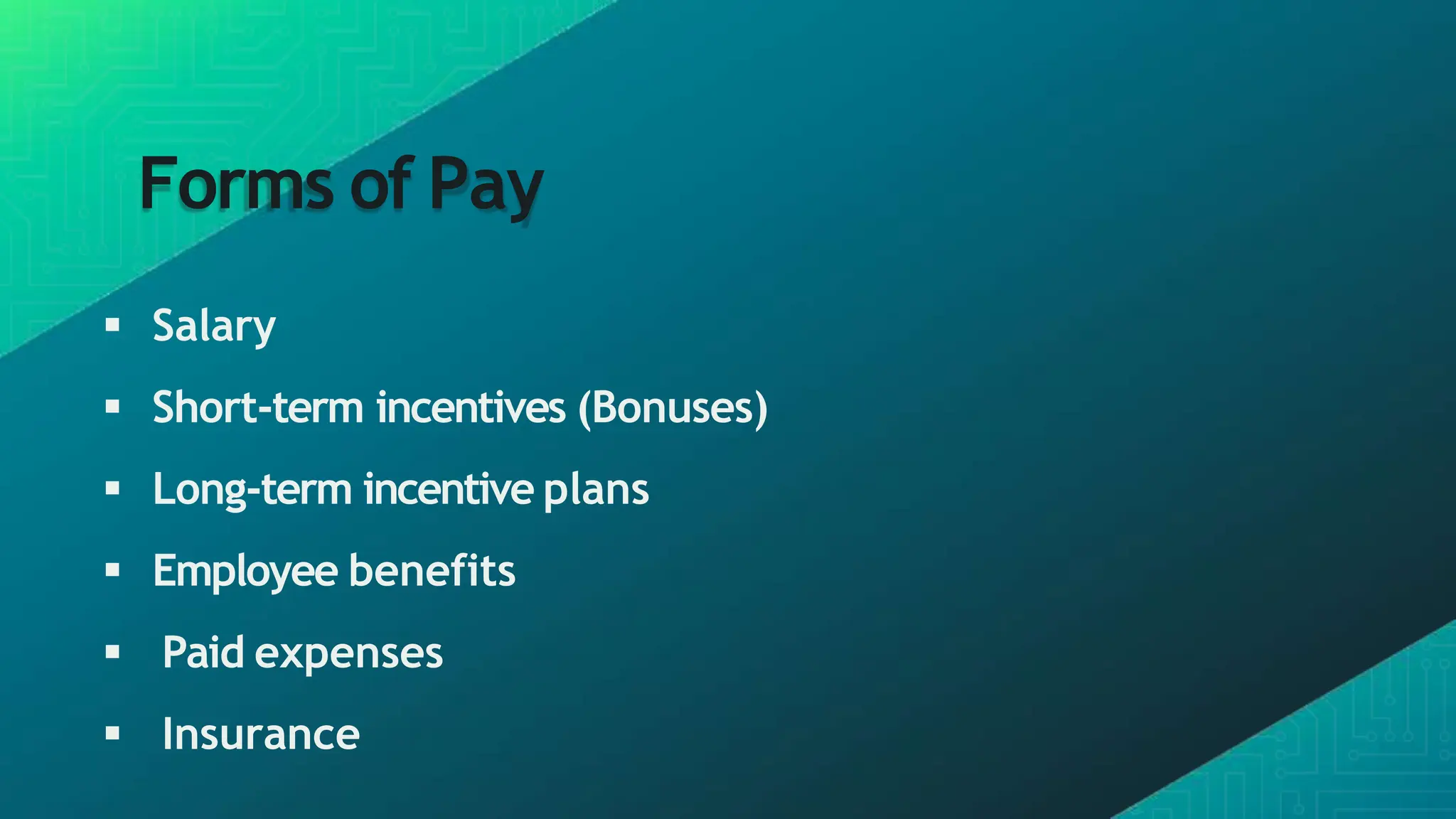
Forms of Pay
 Salary
 Short-term incentives (Bonuses)
 Long-term incentive plans
 Employee benefits
 Paid expenses
 Insurance
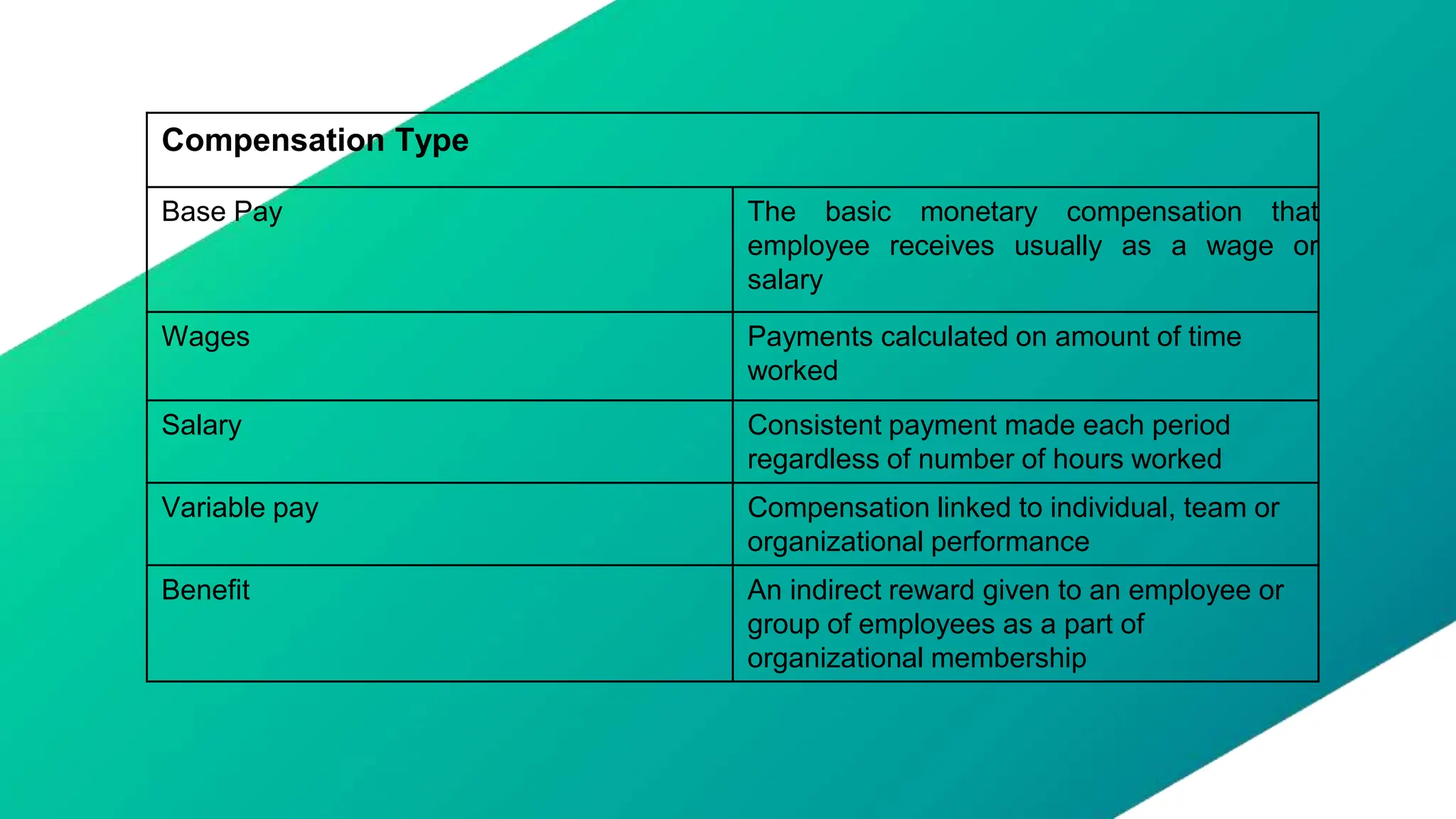
Compensation Type
Base Pay The basic monetary compensation that
employee receives usually as a wage or
salary
Wages Payments calculated on amount of time
worked
Salary Consistent payment made each period
regardless of number of hours worked
Variable pay Compensation linked to individual, team or
organizational performance
Benefit An indirect reward given to an employee or
group of employees as a part of
organizational membership
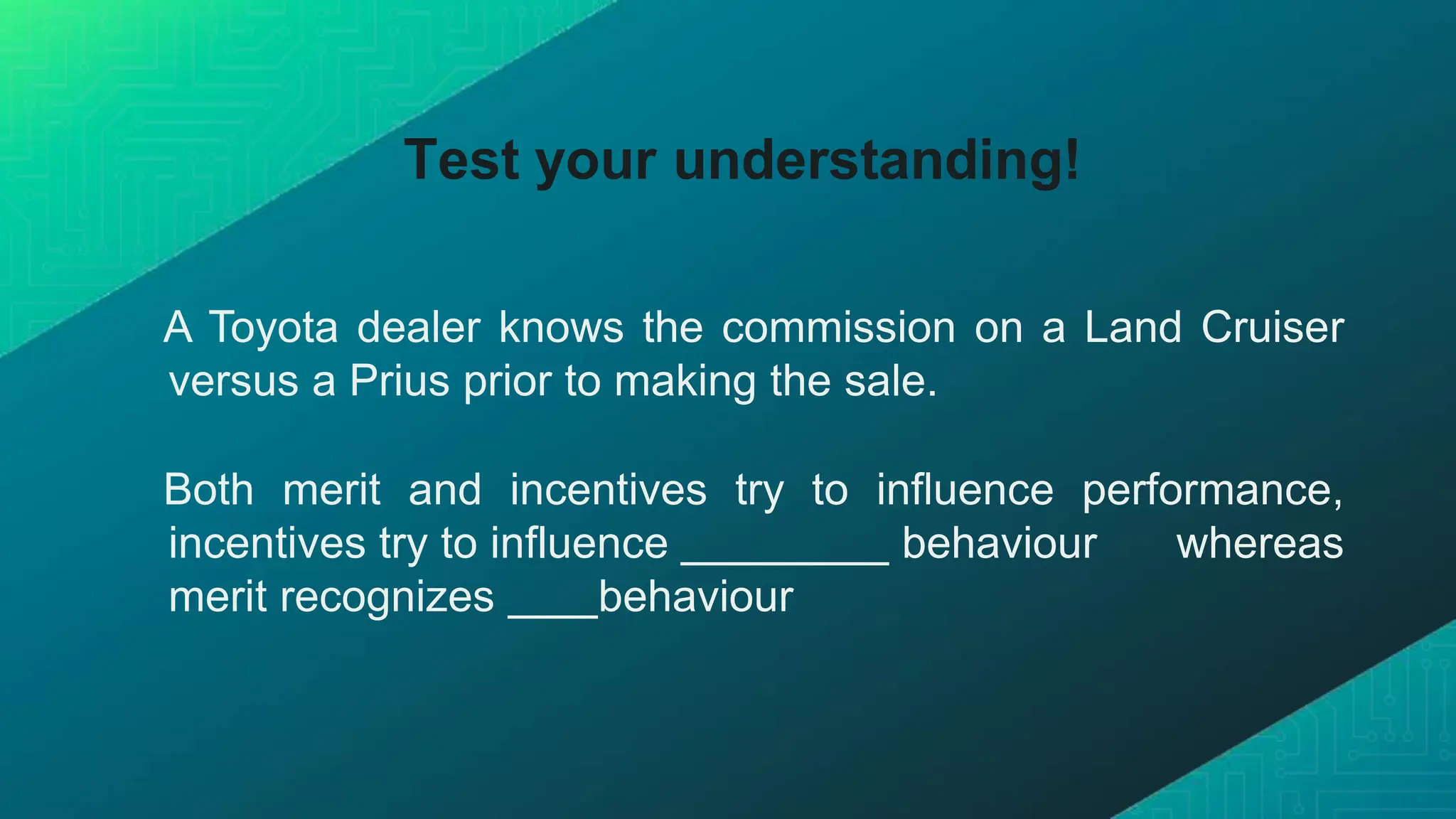
Test your understanding!
A Toyota dealer knows the commission on a Land Cruiser
versus a Prius prior to making the sale.
Both merit and incentives try to influence performance,
incentives try to influence behaviour whereas
merit recognizes behaviour
Factors affecting Compensation
Worker Productivity & Value To The Organization
Employer's Ability To Pay
Labor Union Requirements
Prevailing Wage Rates
Cost of Living (COL)
Labor Supply And Labor Demand
Government Controls
Globalization
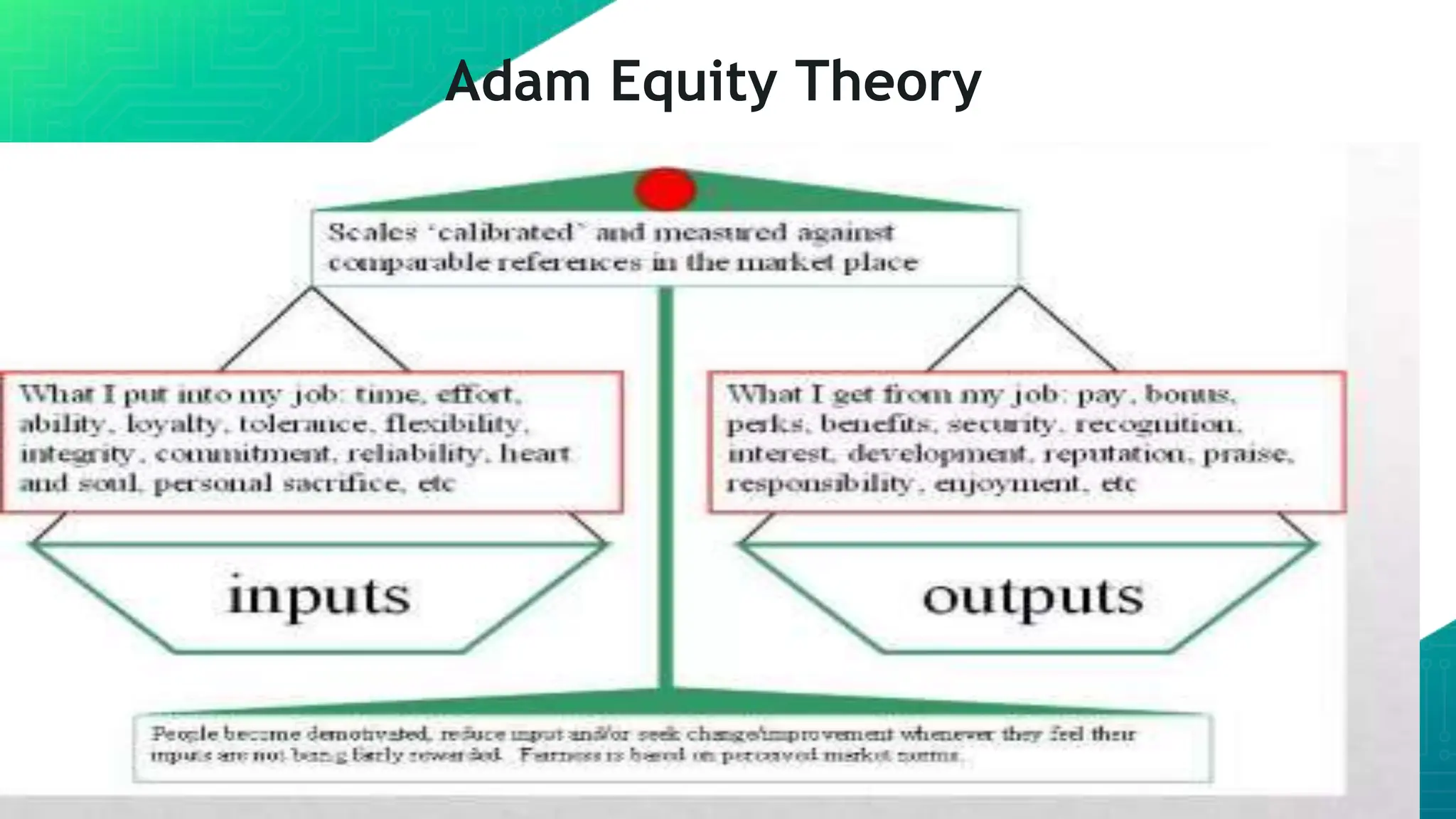
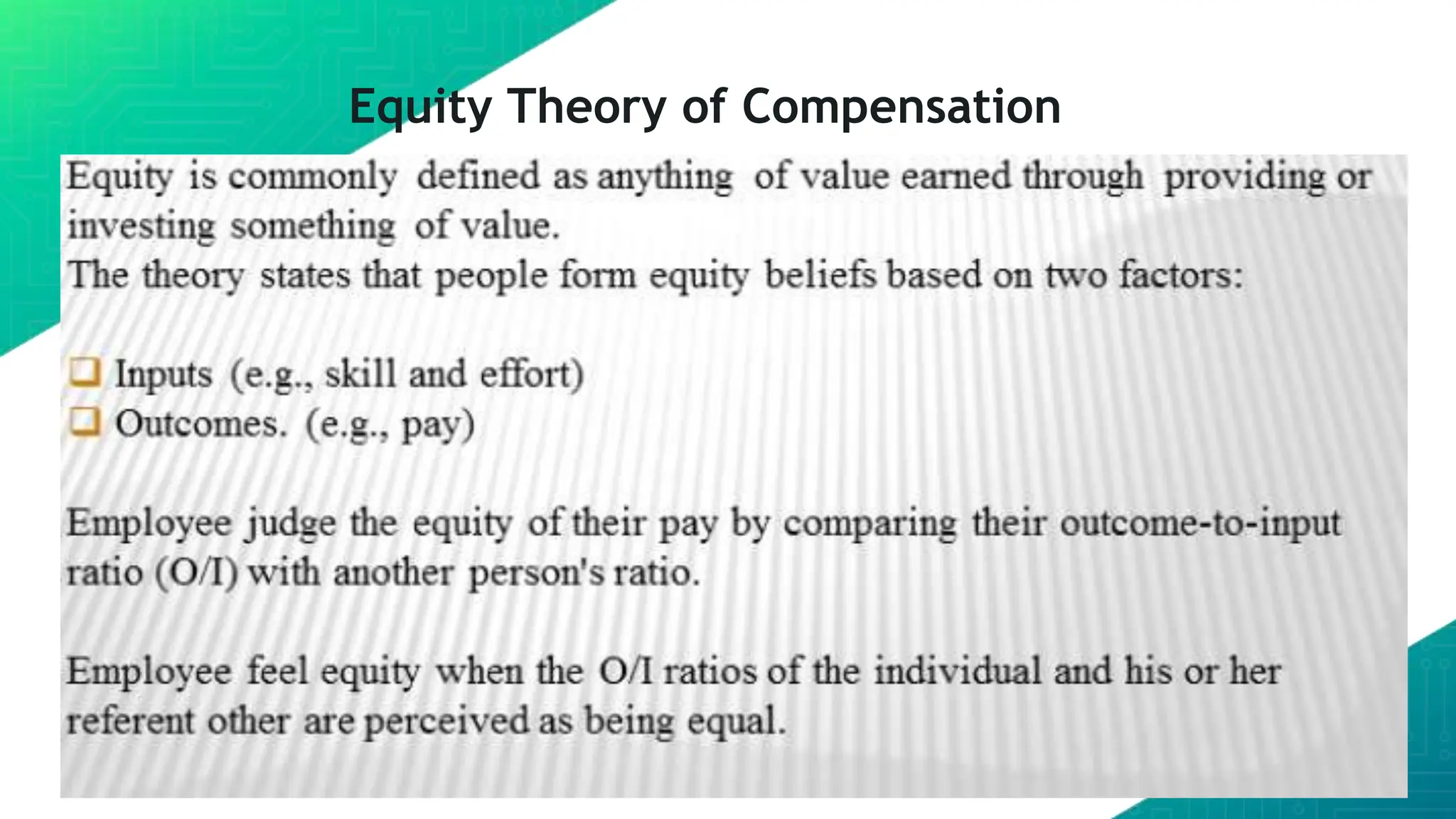
Adam Equity Theory
Equity Theory of Compensation
Expectancy Theory
The expectancy theory asserts that employees will put in as much
work as they expect to receive.
If the employee perceives they are going to be paid favorably, they
will work to achieve the outcomes.
If employees believe the rewards do not equal the amount of effort,
they may not work as hard.
Reinforcement Theory
If high performance is followed by some reward, that desired behavior
will likely occur in the future.
If high performance isn't followed by a reward, it is less likely the high
performance will occur in the future.
Test your Understanding!
Q1: Compensation is reward to employees for their:
A. Performance
B. Work
C. Contribution to organization
Test your Understanding!
Q2: First step of compensation process (management) is:
A. Developing pay structure
B. Evaluation of Job
C. Pricing of job
D. Analysis of Job
14
Unmerited Pay
⦿ Bureau of Labour statistics (2013) revealed that the largest gaps
in
wages between men and women are in sales.
⦿ In insurance, saleswomen make only 62.5%
of what their male colleagues earn, in retail
estate only 66%
⦿ Sales pay has been considered to be less political and more
merit
based.
15
Pay Commission
Administrative system that the Government of India set up in 1956 to
determine
the salaries of government employees
First pay commission was established in 1956 Second pay commission
was set up in 1957 Third pay commission was set up in 1970
Fourth pay commission covered the period between 1986 and 1996
Sixth pay commission revised pay scales of Central government
employees in July 2006.
16
7th Pay Commission: Centre announces new
reforms for government employees
Date: 7th January 2021
The central government has decided to extend 'disability compensation' to
all its serving employees. It will be applicable if they get disabled in the line
of duty and are still retained in service despite their disability. This is in line
with the efforts of the government to simplify the rules and rectify
discriminatory clauses.
Link- https://www.zeebiz.com/personal-finance/photo-gallery-7th-pay-
commission- 7th-cpc-latest-news-today-centre-announces-new-reforms-for-
government- employees-check-key-points-who-will-benefit-here-145301
17
Incentives and Fringe Benefits
Employee incentives and benefits are a vital tool for companies.
If companies want to attract talent, improve workforce motivation,
reduce staff turnover, etc., then incentives and fringe benefits should
be included into the salary packages which company offers.
Incentives are linked to an employee's performance, so they work
in the same way as a prize.
Standard Benefits
 Relocation assistance
 Medical, prescription, vision and dental plans
 Dependent care
 Retirement benefit plans
 Group term-life and long-term care insurance plans
 Legal assistance plans
 Child care benefits
 Transportation benefits
 Paid-time off (PTO)
Differences between incentives and benefits
Incentives are awarded after the work has been done, as long as
the employee has hit specific targets. Benefits, are delivered from
the moment they join the company's workforce.
Only employees that stand out for their efficiency and productivity
gain these incentives. Conversely, benefits are offered to everyone
equally, and even to those with below-average performance.
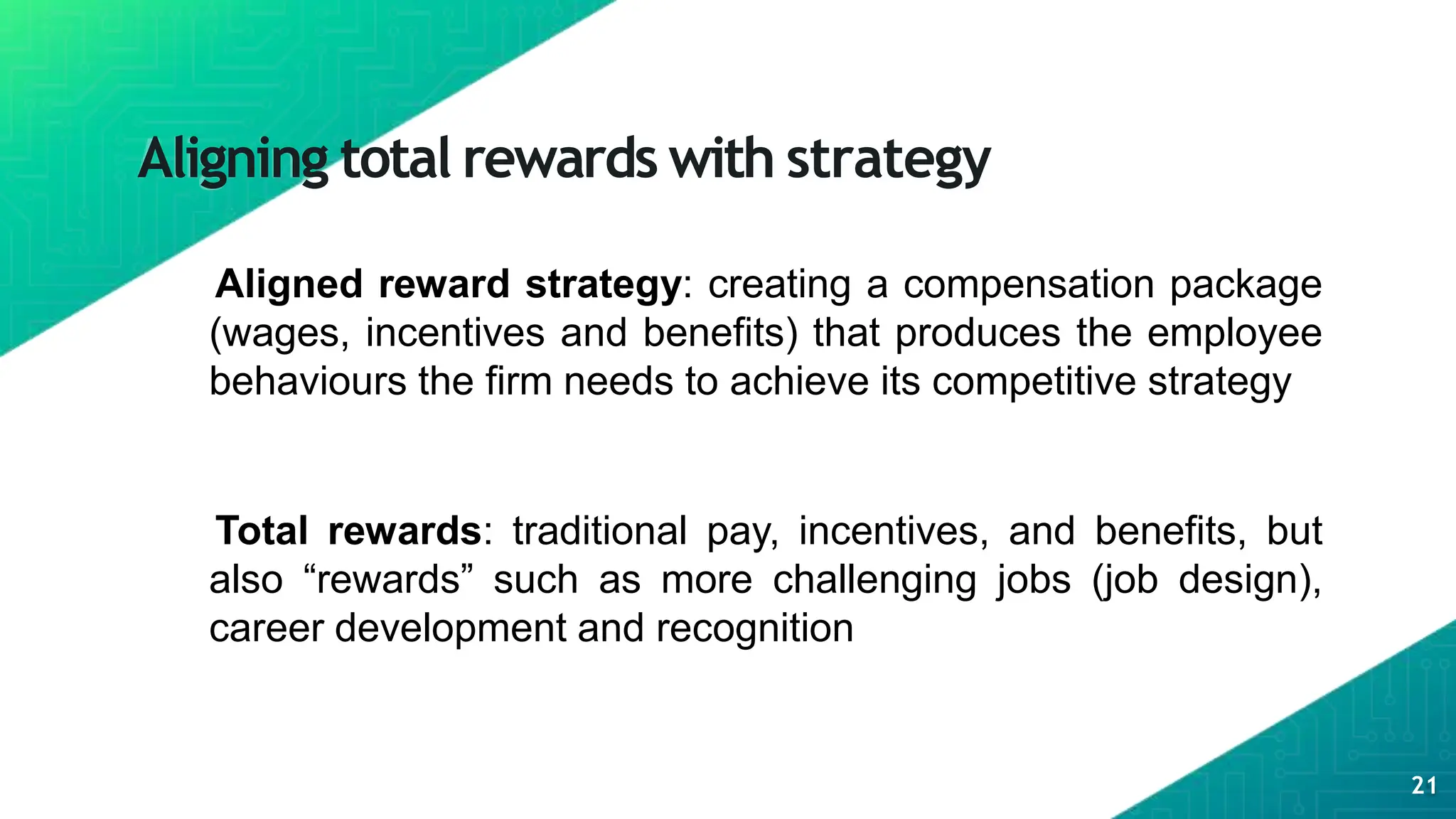
Aligning total rewards with strategy
Aligned reward strategy: creating a compensation package
(wages, incentives and benefits) that produces the employee
behaviours the firm needs to achieve its competitive strategy
Total rewards: traditional pay, incentives, and benefits, but
also “rewards” such as more challenging jobs (job design),
career development and recognition
21
Building a Compelling Compensation Strategy
Total Compensation= Cash compensation and Benefits + Relational Returns
Characteristics of Total Reward Strategy:
 Best fit
 Integrative
 Strategic
 People-centred
 Customised
 Distinctive
 Evolutionary
22
Designing total compensation for Business
Development Trainee
Working hours: 9 hours a day
Job type: Full time
Location: Bangaluru (India)
Revenue Target: 2,20,000 INR
23
Thankyou!

Compensation Management full details management

  • 1.
  • 2.
    Learning Outcomes • Understandcompensation and forms of pay • Analyze difference between wages and compensation • Comprehend steps in developing total compensation strategy 2
  • 3.
    Meaning Compensation is asystematic approach to providing monetary and non monetary value to employees in exchange for work performed Money received in performance of work and many kinds of benefits that an organization provides to employees 3
  • 4.
    Compensation Systems Objectives ofan Effective Compensation System:  Legal compliance with all appropriate laws and regulations  Cost effectiveness for the organization  Internal, external, and individual equity for employees  Performance enhancement for the organization 4
  • 5.
    Forms of Pay Salary  Short-term incentives (Bonuses)  Long-term incentive plans  Employee benefits  Paid expenses  Insurance
  • 6.
    Compensation Type Base PayThe basic monetary compensation that employee receives usually as a wage or salary Wages Payments calculated on amount of time worked Salary Consistent payment made each period regardless of number of hours worked Variable pay Compensation linked to individual, team or organizational performance Benefit An indirect reward given to an employee or group of employees as a part of organizational membership
  • 7.
    Test your understanding! AToyota dealer knows the commission on a Land Cruiser versus a Prius prior to making the sale. Both merit and incentives try to influence performance, incentives try to influence behaviour whereas merit recognizes behaviour
  • 8.
    Factors affecting Compensation WorkerProductivity & Value To The Organization Employer's Ability To Pay Labor Union Requirements Prevailing Wage Rates Cost of Living (COL) Labor Supply And Labor Demand Government Controls Globalization
  • 9.
  • 10.
    Equity Theory ofCompensation
  • 11.
    Expectancy Theory The expectancytheory asserts that employees will put in as much work as they expect to receive. If the employee perceives they are going to be paid favorably, they will work to achieve the outcomes. If employees believe the rewards do not equal the amount of effort, they may not work as hard.
  • 12.
    Reinforcement Theory If highperformance is followed by some reward, that desired behavior will likely occur in the future. If high performance isn't followed by a reward, it is less likely the high performance will occur in the future.
  • 13.
    Test your Understanding! Q1:Compensation is reward to employees for their: A. Performance B. Work C. Contribution to organization
  • 14.
    Test your Understanding! Q2:First step of compensation process (management) is: A. Developing pay structure B. Evaluation of Job C. Pricing of job D. Analysis of Job 14
  • 15.
    Unmerited Pay ⦿ Bureauof Labour statistics (2013) revealed that the largest gaps in wages between men and women are in sales. ⦿ In insurance, saleswomen make only 62.5% of what their male colleagues earn, in retail estate only 66% ⦿ Sales pay has been considered to be less political and more merit based. 15
  • 16.
    Pay Commission Administrative systemthat the Government of India set up in 1956 to determine the salaries of government employees First pay commission was established in 1956 Second pay commission was set up in 1957 Third pay commission was set up in 1970 Fourth pay commission covered the period between 1986 and 1996 Sixth pay commission revised pay scales of Central government employees in July 2006. 16
  • 17.
    7th Pay Commission:Centre announces new reforms for government employees Date: 7th January 2021 The central government has decided to extend 'disability compensation' to all its serving employees. It will be applicable if they get disabled in the line of duty and are still retained in service despite their disability. This is in line with the efforts of the government to simplify the rules and rectify discriminatory clauses. Link- https://www.zeebiz.com/personal-finance/photo-gallery-7th-pay- commission- 7th-cpc-latest-news-today-centre-announces-new-reforms-for- government- employees-check-key-points-who-will-benefit-here-145301 17
  • 18.
    Incentives and FringeBenefits Employee incentives and benefits are a vital tool for companies. If companies want to attract talent, improve workforce motivation, reduce staff turnover, etc., then incentives and fringe benefits should be included into the salary packages which company offers. Incentives are linked to an employee's performance, so they work in the same way as a prize.
  • 19.
    Standard Benefits  Relocationassistance  Medical, prescription, vision and dental plans  Dependent care  Retirement benefit plans  Group term-life and long-term care insurance plans  Legal assistance plans  Child care benefits  Transportation benefits  Paid-time off (PTO)
  • 20.
    Differences between incentivesand benefits Incentives are awarded after the work has been done, as long as the employee has hit specific targets. Benefits, are delivered from the moment they join the company's workforce. Only employees that stand out for their efficiency and productivity gain these incentives. Conversely, benefits are offered to everyone equally, and even to those with below-average performance.
  • 21.
    Aligning total rewardswith strategy Aligned reward strategy: creating a compensation package (wages, incentives and benefits) that produces the employee behaviours the firm needs to achieve its competitive strategy Total rewards: traditional pay, incentives, and benefits, but also “rewards” such as more challenging jobs (job design), career development and recognition 21
  • 22.
    Building a CompellingCompensation Strategy Total Compensation= Cash compensation and Benefits + Relational Returns Characteristics of Total Reward Strategy:  Best fit  Integrative  Strategic  People-centred  Customised  Distinctive  Evolutionary 22
  • 23.
    Designing total compensationfor Business Development Trainee Working hours: 9 hours a day Job type: Full time Location: Bangaluru (India) Revenue Target: 2,20,000 INR 23
  • 24.

Editor's Notes

  • #9 https://hrcertification.com/factors-affecting-compensation