PRESENTED BY-
ANJALI RAI
ROLL NO -07
MPMIR-3rd SEMESTER
 BHEL a MAHARATNA COMPANY completed 50 GOLDEN years
 Integrated power plant equipment manufacturer
 Offers over 180 products for Power, Transmission, Industry,
Transportation (Railway), Oil
& Gas and Defence sector
 BHEL's 57% share in India's total installed capacity of
power and 65% share in the country's total generation
from thermal utility sets (coal based) as on
March 31, 2014
 Greatest strength -highly skilled and committed
workforce of 47,525 employees setting new
benchmarks in terms of productivity,
quality and responsiveness.
PRODUCTS
RANGE
GAS TURBINES
e-MAP
 Introduced in 2002-03 covers Frontline Executives
(E1-E4) and Middle level Executives(E5-E7) of BHEL
Divided in 2 parts-
performance (KRA and routine responsibilities)
skill assessment(functional &behavioral)
Key people involved-appraiser, Appraisee, reviewer,
accepting authority
Appraisee
does Self
Assessment
of KRAs
Appraiser
gives his
assessment
of KRAs &
Part B
Appraisee
gets to see
Appraiser’s
Assessment
of KRAs
Reviewer
Gives Final
Assessment on
KRAs & Part-B
Accepting Authority
(PG/Function Head or
Unit Head, as the case
may be) does Final
Assessment of Part - B
Composite Score gets calculated in the
system after allotting weightage to
Part-A and Part B, also taking into
account Deduction of Marks for Late
Submission of Part-A, if any
To analyze the Performance Management System
(e-MAP) of BHEL in detail and its
effectiveness.
To analyze the problems faced by the
Appraisee and appraiser in this system.
To analyze the steps taken by the
appraisers for the improvement of the
performances of the appraisees.
Types of Data collected
Primary: First hand information was received
from the employees through questionnaire
Secondary: The data from internet was collected
to get a better insight and the company’ manual.
SIMPLE RANDOM SAMPLING:
Each and every item of the population is given
equal chance of being included in the sample, sample
is chosen at random and if the sample is sufficiently
large, it will represent all groups in the population
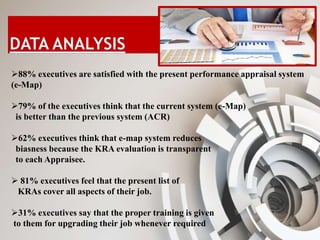
88% executives are satisfied with the present performance appraisal system
(e-Map)
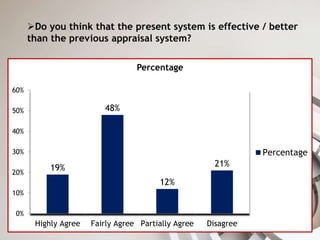
79% of the executives think that the current system (e-Map)
is better than the previous system (ACR)
62% executives think that e-map system reduces
biasness because the KRA evaluation is transparent
to each Appraisee.
 81% executives feel that the present list of
KRAs cover all aspects of their job.
31% executives say that the proper training is given
to them for upgrading their job whenever required
Do you think that the present system is effective / better
than the previous appraisal system?
19%
48%
12%
21%
0%
10%
20%
30%
40%
50%
60%
Highly Agree Fairly Agree Partially Agree Disagree
Percentage
Percentage
 As an Appraisee do you face any problem while
selecting the KRAs?
19%
25%
38%
18%
0%
5%
10%
15%
20%
25%
30%
35%
40%
Highly Agree Fairly Agree Partially
Agree
Disagree
Percentage
Percentage
 Communication gap should be minimized
between managers or supervisor and
employees.
 Time constraint
 Respondents error
Proper training program should be conducted about the E-Map
system for the new employees.
Whenever there are any changes in the KRA’s
the executives should be informed about it
in advance.
Employees should be made known that on
what basis their performance is being
measured in Part-B as this plays an important
role at the time of their promotion.
Personality development trainings
should also be provided apart from just
job oriented training.
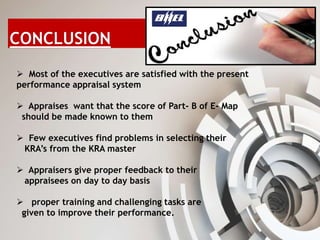
 Most of the executives are satisfied with the present
performance appraisal system
 Appraises want that the score of Part- B of E- Map
should be made known to them
 Few executives find problems in selecting their
KRA’s from the KRA master
 Appraisers give proper feedback to their
appraisees on day to day basis
 proper training and challenging tasks are
given to improve their performance.
BIBLIOGRAPHY
BOOKS
Research methodology, R. Panneerselvam (2008),
Research Design, sixth edition 2008, Prentice Hall of India
Pvt. Ltd. Publishers.pg.285-298
Annual Report of BHEL of 2012-2013 pg 4-22
E-MAP manual
General Articles of BHEL(HERP), Varanasi
of 2013-2014
WEBSITE
www.bhel.com as on 10th July 2014
www.indianinfoline.com as on10th July 2014
BHEL performance management system

BHEL performance management system

  • 1.
    PRESENTED BY- ANJALI RAI ROLLNO -07 MPMIR-3rd SEMESTER
  • 2.
     BHEL aMAHARATNA COMPANY completed 50 GOLDEN years  Integrated power plant equipment manufacturer  Offers over 180 products for Power, Transmission, Industry, Transportation (Railway), Oil & Gas and Defence sector  BHEL's 57% share in India's total installed capacity of power and 65% share in the country's total generation from thermal utility sets (coal based) as on March 31, 2014  Greatest strength -highly skilled and committed workforce of 47,525 employees setting new benchmarks in terms of productivity, quality and responsiveness.
  • 3.
  • 4.
    e-MAP  Introduced in2002-03 covers Frontline Executives (E1-E4) and Middle level Executives(E5-E7) of BHEL Divided in 2 parts- performance (KRA and routine responsibilities) skill assessment(functional &behavioral) Key people involved-appraiser, Appraisee, reviewer, accepting authority
  • 6.
    Appraisee does Self Assessment of KRAs Appraiser giveshis assessment of KRAs & Part B Appraisee gets to see Appraiser’s Assessment of KRAs Reviewer Gives Final Assessment on KRAs & Part-B Accepting Authority (PG/Function Head or Unit Head, as the case may be) does Final Assessment of Part - B Composite Score gets calculated in the system after allotting weightage to Part-A and Part B, also taking into account Deduction of Marks for Late Submission of Part-A, if any
  • 7.
    To analyze thePerformance Management System (e-MAP) of BHEL in detail and its effectiveness. To analyze the problems faced by the Appraisee and appraiser in this system. To analyze the steps taken by the appraisers for the improvement of the performances of the appraisees.
  • 8.
    Types of Datacollected Primary: First hand information was received from the employees through questionnaire Secondary: The data from internet was collected to get a better insight and the company’ manual. SIMPLE RANDOM SAMPLING: Each and every item of the population is given equal chance of being included in the sample, sample is chosen at random and if the sample is sufficiently large, it will represent all groups in the population
  • 9.
    88% executives aresatisfied with the present performance appraisal system (e-Map) 79% of the executives think that the current system (e-Map) is better than the previous system (ACR) 62% executives think that e-map system reduces biasness because the KRA evaluation is transparent to each Appraisee.  81% executives feel that the present list of KRAs cover all aspects of their job. 31% executives say that the proper training is given to them for upgrading their job whenever required
  • 10.
    Do you thinkthat the present system is effective / better than the previous appraisal system? 19% 48% 12% 21% 0% 10% 20% 30% 40% 50% 60% Highly Agree Fairly Agree Partially Agree Disagree Percentage Percentage
  • 11.
     As anAppraisee do you face any problem while selecting the KRAs? 19% 25% 38% 18% 0% 5% 10% 15% 20% 25% 30% 35% 40% Highly Agree Fairly Agree Partially Agree Disagree Percentage Percentage
  • 12.
     Communication gapshould be minimized between managers or supervisor and employees.  Time constraint  Respondents error
  • 13.
    Proper training programshould be conducted about the E-Map system for the new employees. Whenever there are any changes in the KRA’s the executives should be informed about it in advance. Employees should be made known that on what basis their performance is being measured in Part-B as this plays an important role at the time of their promotion. Personality development trainings should also be provided apart from just job oriented training.
  • 14.
     Most ofthe executives are satisfied with the present performance appraisal system  Appraises want that the score of Part- B of E- Map should be made known to them  Few executives find problems in selecting their KRA’s from the KRA master  Appraisers give proper feedback to their appraisees on day to day basis  proper training and challenging tasks are given to improve their performance.
  • 15.
    BIBLIOGRAPHY BOOKS Research methodology, R.Panneerselvam (2008), Research Design, sixth edition 2008, Prentice Hall of India Pvt. Ltd. Publishers.pg.285-298 Annual Report of BHEL of 2012-2013 pg 4-22 E-MAP manual General Articles of BHEL(HERP), Varanasi of 2013-2014 WEBSITE www.bhel.com as on 10th July 2014 www.indianinfoline.com as on10th July 2014