Creating Writers: all students
   writing and writing well
                  Comox	
  Valley	
  
       Nov.	
  21,	
  Feb.	
  6.,	
  Apr.	
  17,	
  2013	
  
                  Faye	
  Brownlie	
  
               www.slideshare.net	
  
Learning Intentions
•  I will uncover ways to remember the joy of
   writing
•  I will add new strategies to my repertoire that
   include all students in writing
•  I better understand how to embed AFL in our
   writing classroom
•  I acknowledge the power of oral language,
   modeling, building criteria, practice,
   engagement and sharing in building writers
Managing the Workshop
•  Work with large chunks of time
•  Build criteria with students
•  Teach one/t wo specific criteria at a time, over
   time
•  Model, model, model
•  Practice, practice, practice
•  Focus on pre-writing and oral language
•  Establish clear expectations for writing
•  Coach students as they are writing (DF)
•  Goal-set with students
Model
                                          Guided practice
                                          Independent practice
                                          Independent application	
  
Pearson	
  &	
  Gallagher	
  (1983)	
  
The Traits of
  Writing

                               … a start                                      … coming along                                 … that’s it                                         … Wow!

                • a series of loosely connected events that do   • a series of loosely connected events that     • a logical sequence of events              • a creative and logical sequence of events
    Ideas
                  not make sense                                     make sense
                • main idea and problem are unclear              • basic main idea and problem are not too       • main idea, problem and solution are       • an interesting twist that is part of the main
                                                                     original, not too clear                       clear and parts are original                  idea, problem or solution
                • very few details                               •    a few details                              • details and descriptions develop char-    • vivid details show rather than tell about
                                                                                                                   acters and plot                               characters and plot

                • simple word choices; some words have mis-      • some interesting word choices; mostly risk- • interesting word choices sprinkled          • precise word choices that allow the reader
Word Choice
                  takes                                            free                                            throughout                                    to visualize
                • no poetic words                                • an attempt at poetry                          • poetry that adds interest                 • clever use of poetry

                • short, simple sentences with run-ons and/or    • mostly short, simple sentences and a few      • a mixture of short, medium and long       • smooth flow because sentences are of dif-
  Sentence
                  fragments                                          longer ones                                   sentences that create flow                    ferent lengths and types
   Fluency      • many sentences that begin the same way         • many sentences that begin in different        • sentence beginnings that are different    • a variety of clever sentence beginnings that
                                                                     ways                                          and interesting                               fit perfectly


                • no personality                                 • a glimmer of personality                      • clear personality                         •
    Voice                                                                                                                                                      personality that shines
                • no evidence of care for topic                  • some evidence of care for topic               • evidence that show care for topic         • evidence that shows passion for topic
                                                                                                                                                             • a clear understanding of what readers crave
                • no thought for the reader                      • thought for the reader at times               • carefully chosen words and events to      • characters have individuality and are vividly
                                                                                                                   engage the reader                           described
                • characters are named, but not described       • characters are named and described a lit-      • characters are well developed on the      • dialogue reveals character personality and
                • dialogue (if used) is boring and/or confusing   tle                                              inside and outside                          moves plot along
                                                                • unnatural or basic dialogue                    • dialogue moves plot along or reveals
                                                                                                                   the personality of characters

                • no lead; reader wonders what this is about     • has a basic lead that hints at the story to   • has an interesting lead that estab-       • a lead that readers love and will lure them
Organization
                • a series of loosely related events               follow                                          lishes the plot                               into the plot
                                                                 • related events that wander in parts           • events that develop logically             • events that weave together beautifully
                • no ending                                      • a weak ending that may not make sense                                                     • an ending that satisfies; it may have a sur-
                                                                 • a small variety of connections; some are      • a believable ending that attempts to          prise twist
                • basic sentence connections       (e.g. and,      over used                                       tie up the story                          • artful connecting words
                  then, so)                                                                                      • Smooth connecting words
                • frequent errors in spelling, grammar and       • some errors in spelling, grammar and punc-    • errors in spelling, grammar and punc-     • the occasional error in spelling and punctua-
 Conventions
                  punctuation make story hard to understand          tuation; reader can figure out meaning        tuation, but only in the complex parts;       tion, but only in the complex parts; meaning
                • minimal use of paragraphs                      • evidence that show understanding of para-       meaning is clear                              is clear
                                                                     graphs                                      • clear use of paragraphs                   • paragraphs in all the right places
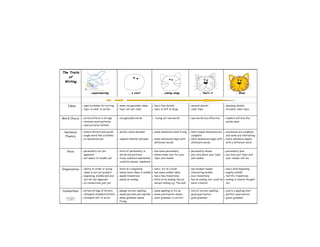
The Traits
    of
 Writing


                           …experimenting                     … a start                       … coming along                    … that’s it                         … Wow!


    Ideas         •   uses scribbles for writing   •   some recognizable ideas      •   has a few details            •   several details               •   dazzling details
                  •   topic is clear to writer     •   topic not yet clear          •   topic is still to large      •   clear topic                   •   focused, clear topic


Word Choice       •   writes letters in strings    •   recognizable words           •   trying out new words         •   new words are effective       •   readers will love the
                  •   imitates word patterns                                                                                                               words used
                  •   uses pictures instead

 Sentence         •   mimics letters and words     •   words create phrases         •   some sentences need fixing   •   most simple sentences are     •   sentences are complete
  Fluency         •   single word-like scribbles                                                                         complete                          and some are interesting
                  •   no sentences yet             •   repeats familiar phrases     •   some sentences begin with    •   most sentences begin with     •   every sentence begins
                                                                                        different words                  different words                   with a different word


   Voice          •   personality not yet          •   hints of personality in      •   has some personality         •   personality shows             •   personality plus
                      apparent                         words and pictures           •   shows some care for your     •   you care about your topic     •   you love your topic and
                  •   not aware of reader yet      •   fuzzy audience awareness;        topic and reader                 and reader                        your reader will too
                                                       could be anyone, anywhere


Organization      •   ability to order or group    •   hints at a beginning         •   has a bit of a hook          •   has hooked reader             •   has a bold beginning
                      ideas is not yet present     •   needs more ideas in middle   •   has some middle ideas        •   interesting middle            •   mighty middle
                  •   beginning, middle and end    •   needs transitions            •   has a few transitions        •   nice transitions              •   terrific transitions
                      are not yet apparent         •   needs an ending              •   hints of an ending; has an   •   has an ending, but could be   •   ending is clearly thought
                  •   no connections just yet                                           abrupt ending e.g. The end       more creative                     out


Conventions       •   writes strings of letters    •   please correct spelling      •   some spelling to fix up      •   lots of correct spelling      •   you’re a spelling star!
                  •   attempts standard letters    •   needs periods and capitals   •   some punctuation issues      •   good punctuation              •   perfect punctuation
  Carol Walters   •   attempts left to write       •   some grammar needs           •   most grammar is correct      •   good grammar                  •   great grammar
    S.D. #71
                                                       fixing
Key Qualities of the Traits
           IDEAS                      ORGANIZATION

        Clear messages                A brilliant beginning

       Narrowed focus                   A mighty middle

         Vivid details                An excellent ending

        Stays on Topic            Transitions that create flow


           VOICE                       WORD CHOICE


     Passion for the topic            Fresh and original
                                      word combinations
 Contains writer’s personality
                                     Trying out new words
    There’s a reader/writer
          connection                     poetic devices


    SENTENCE FLUENCY                   CONVENTIONS
      Complete sentences                    Spelling

Sentences begin with different             Grammar
           words
                                          Punctuation
Sentences are different lengths
                                      Use of paragraphs
Descriptive Feedback
   -to scaffold & extend the learning
•  What’s working?
  –  Give a specific compliment


•  What’s not?
  –  Set a goal


•  What’s next?
  –  Have an action plan
Quick Writes
•  Give a word to students
•  Give 15 seconds to think about the word, then 3
   minutes to free write, using the word
•  Students reread (mumble) their writing
•  Students choose a phrase, sentence, powerful
   word to share – if they choose
•  Share the ‘treasures’
•  Describe ‘what works’
•  Repeat the process
Building Criteria
•    Whip around
•    What struck you? What worked?
•    Categorize
•    Choose a focus criteria
•    Model
•    Practice
•    Highlight and seek advice
Its All in the Bag
•  Have students fold a paper in 4 boxes.
•  Pull an artifact from a bag and discuss, what is
   this, how could it be used in a story?
•  Students return to their desks and draw their
   thinking in the first box.
•  Repeat with each artifact, drawing in each box,
   including all previous artifacts in each drawing.
•  Discuss how the story changes as new information
   (artifacts) are added.
•  Start writing!
Kindergarten Writing
  Ishaan & Roopjit
      2011-2012
  Commons & Jakovac
    Tait Elementary	
  
What’s Next for This Beginning Writer,
 2nd edition (Reid, Schultz, Peterson)
K- Writing:
                                            1
                                          Model - pictures & print
                                          Refer to criteria
                                          Kids draw & write
                                          Refer to criteria	
  
Pearson	
  &	
  Gallagher	
  (1983)	
  
Criteria
•  Big

•  Bold

•  Beautiful

•  A picture that tells a story
Comox writing.Nov.2012

Comox writing.Nov.2012

  • 1.
    Creating Writers: allstudents writing and writing well Comox  Valley   Nov.  21,  Feb.  6.,  Apr.  17,  2013   Faye  Brownlie   www.slideshare.net  
  • 2.
    Learning Intentions •  Iwill uncover ways to remember the joy of writing •  I will add new strategies to my repertoire that include all students in writing •  I better understand how to embed AFL in our writing classroom •  I acknowledge the power of oral language, modeling, building criteria, practice, engagement and sharing in building writers
  • 3.
    Managing the Workshop • Work with large chunks of time •  Build criteria with students •  Teach one/t wo specific criteria at a time, over time •  Model, model, model •  Practice, practice, practice •  Focus on pre-writing and oral language •  Establish clear expectations for writing •  Coach students as they are writing (DF) •  Goal-set with students
  • 4.
    Model Guided practice Independent practice Independent application   Pearson  &  Gallagher  (1983)  
  • 6.
    The Traits of Writing … a start … coming along … that’s it … Wow! • a series of loosely connected events that do • a series of loosely connected events that • a logical sequence of events • a creative and logical sequence of events Ideas not make sense make sense • main idea and problem are unclear • basic main idea and problem are not too • main idea, problem and solution are • an interesting twist that is part of the main original, not too clear clear and parts are original idea, problem or solution • very few details • a few details • details and descriptions develop char- • vivid details show rather than tell about acters and plot characters and plot • simple word choices; some words have mis- • some interesting word choices; mostly risk- • interesting word choices sprinkled • precise word choices that allow the reader Word Choice takes free throughout to visualize • no poetic words • an attempt at poetry • poetry that adds interest • clever use of poetry • short, simple sentences with run-ons and/or • mostly short, simple sentences and a few • a mixture of short, medium and long • smooth flow because sentences are of dif- Sentence fragments longer ones sentences that create flow ferent lengths and types Fluency • many sentences that begin the same way • many sentences that begin in different • sentence beginnings that are different • a variety of clever sentence beginnings that ways and interesting fit perfectly • no personality • a glimmer of personality • clear personality • Voice personality that shines • no evidence of care for topic • some evidence of care for topic • evidence that show care for topic • evidence that shows passion for topic • a clear understanding of what readers crave • no thought for the reader • thought for the reader at times • carefully chosen words and events to • characters have individuality and are vividly engage the reader described • characters are named, but not described • characters are named and described a lit- • characters are well developed on the • dialogue reveals character personality and • dialogue (if used) is boring and/or confusing tle inside and outside moves plot along • unnatural or basic dialogue • dialogue moves plot along or reveals the personality of characters • no lead; reader wonders what this is about • has a basic lead that hints at the story to • has an interesting lead that estab- • a lead that readers love and will lure them Organization • a series of loosely related events follow lishes the plot into the plot • related events that wander in parts • events that develop logically • events that weave together beautifully • no ending • a weak ending that may not make sense • an ending that satisfies; it may have a sur- • a small variety of connections; some are • a believable ending that attempts to prise twist • basic sentence connections (e.g. and, over used tie up the story • artful connecting words then, so) • Smooth connecting words • frequent errors in spelling, grammar and • some errors in spelling, grammar and punc- • errors in spelling, grammar and punc- • the occasional error in spelling and punctua- Conventions punctuation make story hard to understand tuation; reader can figure out meaning tuation, but only in the complex parts; tion, but only in the complex parts; meaning • minimal use of paragraphs • evidence that show understanding of para- meaning is clear is clear graphs • clear use of paragraphs • paragraphs in all the right places
  • 7.
    The Traits of Writing …experimenting … a start … coming along … that’s it … Wow! Ideas • uses scribbles for writing • some recognizable ideas • has a few details • several details • dazzling details • topic is clear to writer • topic not yet clear • topic is still to large • clear topic • focused, clear topic Word Choice • writes letters in strings • recognizable words • trying out new words • new words are effective • readers will love the • imitates word patterns words used • uses pictures instead Sentence • mimics letters and words • words create phrases • some sentences need fixing • most simple sentences are • sentences are complete Fluency • single word-like scribbles complete and some are interesting • no sentences yet • repeats familiar phrases • some sentences begin with • most sentences begin with • every sentence begins different words different words with a different word Voice • personality not yet • hints of personality in • has some personality • personality shows • personality plus apparent words and pictures • shows some care for your • you care about your topic • you love your topic and • not aware of reader yet • fuzzy audience awareness; topic and reader and reader your reader will too could be anyone, anywhere Organization • ability to order or group • hints at a beginning • has a bit of a hook • has hooked reader • has a bold beginning ideas is not yet present • needs more ideas in middle • has some middle ideas • interesting middle • mighty middle • beginning, middle and end • needs transitions • has a few transitions • nice transitions • terrific transitions are not yet apparent • needs an ending • hints of an ending; has an • has an ending, but could be • ending is clearly thought • no connections just yet abrupt ending e.g. The end more creative out Conventions • writes strings of letters • please correct spelling • some spelling to fix up • lots of correct spelling • you’re a spelling star! • attempts standard letters • needs periods and capitals • some punctuation issues • good punctuation • perfect punctuation Carol Walters • attempts left to write • some grammar needs • most grammar is correct • good grammar • great grammar S.D. #71 fixing
  • 8.
    Key Qualities ofthe Traits IDEAS ORGANIZATION Clear messages A brilliant beginning Narrowed focus A mighty middle Vivid details An excellent ending Stays on Topic Transitions that create flow VOICE WORD CHOICE Passion for the topic Fresh and original word combinations Contains writer’s personality Trying out new words There’s a reader/writer connection poetic devices SENTENCE FLUENCY CONVENTIONS Complete sentences Spelling Sentences begin with different Grammar words Punctuation Sentences are different lengths Use of paragraphs
  • 9.
    Descriptive Feedback -to scaffold & extend the learning •  What’s working? –  Give a specific compliment •  What’s not? –  Set a goal •  What’s next? –  Have an action plan
  • 10.
    Quick Writes •  Givea word to students •  Give 15 seconds to think about the word, then 3 minutes to free write, using the word •  Students reread (mumble) their writing •  Students choose a phrase, sentence, powerful word to share – if they choose •  Share the ‘treasures’ •  Describe ‘what works’ •  Repeat the process
  • 11.
    Building Criteria •  Whip around •  What struck you? What worked? •  Categorize •  Choose a focus criteria •  Model •  Practice •  Highlight and seek advice
  • 12.
    Its All inthe Bag •  Have students fold a paper in 4 boxes. •  Pull an artifact from a bag and discuss, what is this, how could it be used in a story? •  Students return to their desks and draw their thinking in the first box. •  Repeat with each artifact, drawing in each box, including all previous artifacts in each drawing. •  Discuss how the story changes as new information (artifacts) are added. •  Start writing!
  • 13.
    Kindergarten Writing Ishaan & Roopjit 2011-2012 Commons & Jakovac Tait Elementary  
  • 14.
    What’s Next forThis Beginning Writer, 2nd edition (Reid, Schultz, Peterson)
  • 15.
    K- Writing: 1 Model - pictures & print Refer to criteria Kids draw & write Refer to criteria   Pearson  &  Gallagher  (1983)  
  • 16.
    Criteria •  Big •  Bold • Beautiful •  A picture that tells a story