BUS 370
• Course Information
  • http://homepages.wmich.edu/~bowman/bus370.html
  • http://homepages.wmich.edu/~bowman/syl370.html
• Course Materials
  • http://homepages.wmich.edu/~bowman/mir.html
  • http://homepages.wmich.edu/~bowman/bus370.ppt
• Class Conference
  • http://vms.cc.wmich.edu/www/confer/
  • BUS370-DISC and BUS370-CASES
Overview

• Communication Skills
  • Nonverbal communication
  • Oral communication
  • Written communication
• Interpersonal Applications
• Business Applications
Why Study Communication?
• The Only Completely Portable Skill
  • You will use it in every relationship
  • You will need it regardless of your career path
• The “Information Age”
  • The history of civilization is the history of information
  • Language and written documents facilitate the transfer
    of information and knowledge through time and space
Why Study Communication?

• Your Quality of Life Depends Primarily on
  Your Communication Skills
• You Cannot Be Too Good at Communication
• People Overestimate Their Own
  Communication Skills
We Want Others to Change
What Is Communication?
• Transfer of Meaning—No
• Influence of Mental Maps—Yes
• Redundant
   • Visual
   • Auditory
   • Kinesthestic
   • Energetic
What Is Communication?
• Conscious and Intentional
  • Nonverbal
  • Verbal
• Unconscious and Unintentional
  • Nonverbal
  • Verbal
Unconscious Processing
•   Conscious Processing = 7±2/Second
•   Unconscious Processing = 200,000,000/Sec.
•   Short-term Memory
•   Long-term Memory
•   Habits
     • Physical
     • Mental
Habits
• Learned Behavior
• Established Over Time
  • Practice
  • Self-talk
• Change
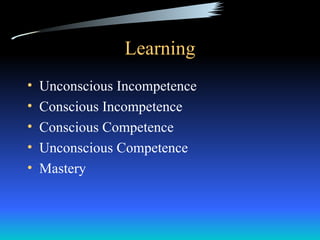
Learning
•   Unconscious Incompetence
•   Conscious Incompetence
•   Conscious Competence
•   Unconscious Competence
•   Mastery
External Reality
• The Map is Not the Territory
  •   We delete information
  •   We distort information
  •   We generalize
  •   We assign meaning
• Models of the World
Sensory Data

• The Building Blocks of Subjective Experience
  • What we see
  • What we hear
  • What we touch, taste, and smell
• The Four-tuple
• Meanings and Memories
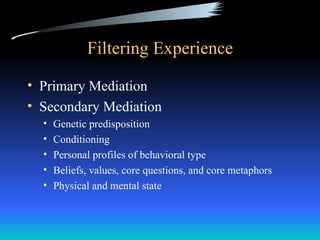
Filtering Experience

• Primary Mediation
• Secondary Mediation
  •   Genetic predisposition
  •   Conditioning
  •   Personal profiles of behavioral type
  •   Beliefs, values, core questions, and core metaphors
  •   Physical and mental state
Perception Can Be Tricky
The Communication Process
                                         Message

                             Decision-                                                    Decision-
                Filters      Making                                         Filters       Making
Sensory Data


                                                   Sensory Data
                 Beliefs                                                    Beliefs
                 Values                                                     Values
               Questions &                                                Questions &
               Metaphors                                                  Metaphors
                Beh. Type                                                  Beh. Type
                  State      Encoding                                        State        Encoding

                      Sender             Channel                                   Receiver


                                                                  The Bowman Communication Model, 1992-2003
Metaphor: The Language of Perception
• Metaphors and Similes
  • My love is a flower.
  • My love is like a flower.
• Core Metaphors
  •   Argument is war
  •   Business is war
  •   Business is a sport or a game
  •   Business is a building
Core Metaphors

• Metaphors, Similes, and Analogies
• Perceptual Filters
• Common Operational Metaphors
  •   Time is…
  •   Learning is…
  •   Men/Women are…
  •   Success is...
  •   Life is…
Experience, Language, and Meaning

     Language            Meaning


            Mental Maps

            Sensory Data

                Experience
Symbol Systems

• Language
  • Words and sentences
  • Meaning and labels
• Mathematics
• Money
History of Communication

• Nonverbal:                      150,000 years
• Oral:                            55,000 years
• Written:                          6,000 years
  •   Early writing: 4000 BC
  •   Egyptian hieroglyphics: 3000 BC
  •   Phoenician alphabet: 1500 to 2000 BC
  •   Book printing in China: 600 BC
  •   Book printing in Europe: 1400 AD
Communicating Meaning

• Physiology and Appearance:   55 percent
• Paralanguage:                38 percent
• Language:                     7 percent
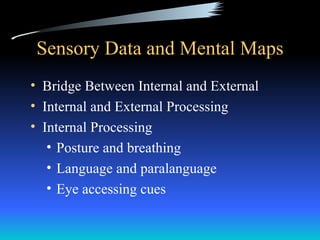
Sensory Data and Mental Maps
• Bridge Between Internal and External
• Internal and External Processing
• Internal Processing
   • Posture and breathing
   • Language and paralanguage
   • Eye accessing cues
Sensory Modalities

• Visual
• Auditory
• Kinesthetic
  •   Touch
  •   Taste
  •   Smell
  •   Emotional responses (feelings)
Preferred Sensory Modalities

•   People Use All Their Available Senses
•   Some Prefer Visual
•   Some Prefer Auditory
•   Some Prefer the Kinesthetic Cluster
    • Senses of touch, taste, and smell
    • Associated emotional responses
• Some Prefer “Digital” Processing
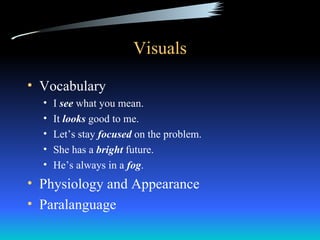
Visuals

• Vocabulary
  •   I see what you mean.
  •   It looks good to me.
  •   Let’s stay focused on the problem.
  •   She has a bright future.
  •   He’s always in a fog.
• Physiology and Appearance
• Paralanguage
Auditories

• Vocabulary
  •   I hear what you are saying.
  •   It sounds good to me.
  •   Does the name Pavlov ring a bell?
  •   That’s music to my ears.
  •   He’s always blowing his own horn.
• Physiology and Appearance
• Paralanguage
Kinesthetics (Kinos)

• Vocabulary
  •   I can grasp the concept, and it feels right to me.
  •   It smells fishy to me.
  •   It left me with a bad taste in my mouth.
  •   She’s still rough around the edges.
  •   He’s a smooth operator.
• Physiology and Appearance
• Paralanguage
Eye Accessing Cues

Vc                        Vr

Ac                             Ar

K                         Ai
Exercise: Observing Eye
           Movements
• Ask questions that require internal processing.
  • Visual
  • Auditory
  • Kinesthetic
     • Taste or smell
     • Touch
     • Emotions
Exercise: Flexibility
• Determine your preferred system.
   • What are you doing when you “think”?
   • Speak for two minutes using predicates
     from one sensory modality, then do the
     the same for each of the other two.
• Work in groups and take turns speaking
  using sense-based predicates in a systematic
  way.
Rapport
 • Finding Commonalities
    • Values
    • Vocabulary and paralanguage
    • Physiology and appearance
 • Matching and Mirroring
 • Cross-over Matching

People who are like each other,
like each other.
Developing Rapport

• Nonverbal (what you see and do)
  • Physiology
  • Appearance
  • Congruence
• Verbal (what you hear and say)
  • Sense-based predicates
  • Values, beliefs, and criteria
  • Voice tone and rate of speech
Reading Nonverbal Messages

• Sensory Acuity
• Agree and Disagree
• Posture and Movement
  • Associated or dissociated
  • Bodily response
Exercises: Rapport
• Matching and Mirroring
  • Observing others
  • Practicing
• Calibration
  • Like/dislike
  • Yes/no
Congruence
• Physiology
  • Left/right body
  • Left/right brain
• Nonverbal and Verbal Messages
• “Parts”
• Groups
Strategies

• The Structure of Subjective Experience
  • Four-tuples
  • Syntax
• Learned Behavior
  • TOTE (Test, Operate, Test, Exit)
  • Habits
  • Skills
Common Strategies

• Spelling
  • Auditory (spell “phonics” phonetically)
  • Visual
• Making Decisions
• Communicating
  • Listening and speaking
  • Writing
Decision-making Strategies

• Purchasing
  • An inexpensive product
  • Dinner in a nice restaurant
  • An expensive product or service
• Relationships
• Career Choices
Communication Strategy, 1 & 2

• Pace
  • Match (nonverbally and verbally)
  • Meet expectations
• Lead
  • Set direction
  • Maintain interest
  • Maintain rapport
Communication Strategy, 3 & 4

• Blend Outcomes
  • Understand objectives and desires
  • Create win-win solutions
• Motivate
  • Clarify who does what next
  • Future-pace possibilities
  • Presuppose positive results
Exercise: Eliciting Strategies
• Ordering a Meal in a Restaurant
• Learning Something New
• Teaching Something for the First Time
Personal Profiles

•   Achiever
•   Communicator
•   Specialist
•   Perfectionist    A           C


                     P           S
Profile Characteristics
• Achiever
   • Likes to set goals, challenge the environment and win.
   • Sees life as a competition.
• Communicator
   • Likes to achieve results by working with and through people.
   • Finds more enjoyment in the process than in the results.
• Specialist
   • Likes to plan work and relationships.
   • Finds enjoyment in knowing what to expect.
• Perfectionist
   • Enjoys jobs requiring attention to detail.
   • Complies with authority and tries to provide the “right” answer.
Metaprograms

•   Action      —   Initiate or Respond
•   Direction   —   Toward or Away From
•   Source      —   Internal or External
•   Conduct     —   Rule Follower or Breaker
More Metaprograms

•   Response          —   Match or Mismatch
•   Scope             —   Global or Specific
•   Cognitive Style   —   Thinking or Feeling
•   Confirmation      —   VAK and Times
Exercise: Eliciting Metaprograms

• Metaprograms are revealed by
  • Nonverbal messages
  • Language
• Questions
  • What do you mean?
  • How do you know?
  • What’s important to you about that?
Changing Behavior

• Patterns and Pattern Interrupts
• Anchors and Anchoring
  • Stimulus-response conditioning
  • Visual, auditory, and kinesthetic anchors
• Advanced Language Patterns
  • The Metamodel
  • The Milton Model
Exercise: Anchoring
• Setting Anchors
   • Kinesthetic
   • Visual
   • Auditory
• Stacking Anchors
• Collapsing Anchors
• Using Sliding Anchors
The Structure of
          Subjective Experience
• Sorting for Time
  • Past, present, and future
  • Timelines
• Sorting for Like and Dislike
• Creating and Changing Meaning
Modalities and Submodalities
• Visual Submodalities
  • Location, size, distance, brightness, point of view
  • Color or black & white, moving or still
• Auditory Submodalities
  • Location, tone, rate, pitch, inflection, rhythm
  • Language, voice (your voice, the voice of a parent)
• Kinesthetic Submodalities
  • Location, strength, duration, movement
  • Quality (warm, cold, “tingly,” etc.)
Exercise: Changing Submodalities
• Select something, someone, or an activity
  you want to like better.
• Elicit submodalities for
   • Things you like.
   • Things you dislike.
• Change the submodalities with which you
  represent the thing, person, or activity.
Belief Systems

•   Cultural            • Global (Identity)
•   Parental            • Cause-effect
•   Group                 • If X, then Y
                          • If I study, then I will...
•   Individual
                        • Rules
                          • Can/can’t
                          • Must/must not
                          • Should/should not
Values

• A Type of Belief
• Hierarchical
• Either Positive or Negative
  • Something desired
  • Something to avoid
• Congruent or Incongruent
Core Questions

•   Remain Out of Conscious Awareness
•   Focus Attention
•   Influence Interpretation of Events
•   Influence Psychological State
•   Influence the Range of Possibilities
Exercise: Belief and Disbelief
• Elicit the submodalities of something you
  believe absolutely.
• Elicit the submodalities of something you
  doubt.
• Elicit the submodalities of something you
  disbelieve.
• Select a limiting belief and change its
  submodalities.
Frames and Reframes
• The Filters That Determine Meaning
• Influence State and Behavior
• Creating and Changing Frames
   • Anchoring
   • Reframing Context
   • Reframing Content
Reframing Context
• Key Questions
  • Where would the characteristic or behavior be useful?
  • When would the characteristic or behavior be useful?
  • What would have to be true for this to be useful?
• Common Context Reframes
  • Rudolph’s red nose
  • Oil
  • Procrastination
Reframing Content
• Key Questions
  •   What else could this mean (or be)?
  •   What am I missing here?
  •   How can he or she believe that?
  •   How could this mean the opposite of what I thought?
• Common Content Reframes
  • The ugly duckling
  • Plastic or sawdust
  • Failure
The Metamodel
•   Used to Understand Another’s Mental Maps
•   Used to Recover Lost Information
•   Used to Help Correct Distortions
•   Universal Metamodel Questions
    •   What, who, or how specifically?
    •   What do you mean?
    •   How do you know?
    •   What would happen if you did (or didn’t)?
Metamodel “Violations”

• Unspecified Nouns
  • Abstract nouns (a student, teachers)
  • Nominalizations (freedom, justice)
• Unspecified or Missing Pronouns
  • Someone you know. . . .
  • It’s wrong to think that.
Metamodel “Violations”

• Unspecified Verbs
  • You have to learn this.
  • You will solve your problems.
• Unwarranted Generalizations
  • You never want to do anything.
  • Politicians are crooks.
Metamodel “Violations”

• Unwarranted Comparisons
  • Brand X gives you more.
  • Sally is the best.
• Unwarranted Rules
  • You can’t do that on television.
  • Clean your plate.
  • No pain, no gain.
The Milton Model

• Used to Change Another’s Mental Maps
• Used to Create New Possibilities
• Used to Influence
Milton Model Techniques
• Metamodel “Violations”
  • Unspecified nouns, pronouns, and verbs.
  • Generalizations
  • Comparisons
  • Shifts in referential index
More Milton Model Techniques
•   Presuppositions
•   Embedded Questions
•   Embedded Commands
•   Negative Commands
•   Metaphors
•   Quotes
•   Ambiguities
Basic Language Skills
• My automobile prefers to warm up slowly.
• The organization is in excellent shape. For
  example, the record profits last year.
• The company has decided to purchase new
  furniture.
• While busy working at the computer all day
  was no doubt the cause of her eye strain and
  stiff neck.
More Basic Language Skills
• Not only will Alex need to justify his
  behavior to his boss, but also to the
  company president.
• The data is from “Service Is the Key”, by
  Eileen Johnson in the May issue of The
  Journal of Customer Relations.
Language Skills for Case 1
• As an employee of Con-U-Tel, it is my
  responsibility to set up our companies
  annual convention.
• I am writing this letter to inquire about your
  hotel’s accommodations.
• How many people can your hotel
  accommodate at one time?
More Language Skills for Case 1
• Does your hotel have banquet facilities?
• How many conference rooms does your
  hotel have with audio/visual equipment?
• I must have your answer by July 10th so
  that I can make a decision.
• Thank you in advance for sending this and
  other helpful information.
Block Format and
               Mixed Punctuation
• Date goes on left margin
  • 5 January 2004
  • January 5, 2004
  • NOT: 1/5/2004 or 5.1.2004
• Inside address includes the following:
  •   Name of the individual with courtesy title
  •   Professional title and/or office or department
  •   Organization plus “mail stop” information
  •   City, state, and ZIP code information
Block Format and
      Mixed Punctuation—Part 2
• Salutation
  • Dear Ms. Goldman:
  • Dear Director:
  • Ladies and Gentlemen:
• The signature block includes the following:
  • An appropriate complimentary close (Sincerely,
    Cordially, Best Wishes)
  • The signature of the person who wrote the letter
  • The typed/printed name of the writer
Message Structure for Case 1
• Ask the most important question.
   • What is the make-or-break question?
   • Why are convention facilities more important than guest rooms?
   • Why is it important to include the dates in the opening question?
• Explain your needs.
   • What does she need to know to help you?
   • What does she not need to know?
   • What is required for transition to the list of secondary questions?
More Structure for Case 1
• Ask your secondary questions.
  • What is implied by the numbered list?
  • How do you ensure that the information you receive
    will help you make a decision?
• Set and justify an end-date.
  • Is it possible that she can help you in ways you haven’t
    asked about?
  • Why do you need a time index to justify a specific end-
    date?

Busniess communication

  • 1.
    BUS 370 • CourseInformation • http://homepages.wmich.edu/~bowman/bus370.html • http://homepages.wmich.edu/~bowman/syl370.html • Course Materials • http://homepages.wmich.edu/~bowman/mir.html • http://homepages.wmich.edu/~bowman/bus370.ppt • Class Conference • http://vms.cc.wmich.edu/www/confer/ • BUS370-DISC and BUS370-CASES
  • 2.
    Overview • Communication Skills • Nonverbal communication • Oral communication • Written communication • Interpersonal Applications • Business Applications
  • 3.
    Why Study Communication? •The Only Completely Portable Skill • You will use it in every relationship • You will need it regardless of your career path • The “Information Age” • The history of civilization is the history of information • Language and written documents facilitate the transfer of information and knowledge through time and space
  • 4.
    Why Study Communication? •Your Quality of Life Depends Primarily on Your Communication Skills • You Cannot Be Too Good at Communication • People Overestimate Their Own Communication Skills
  • 5.
    We Want Othersto Change
  • 6.
    What Is Communication? •Transfer of Meaning—No • Influence of Mental Maps—Yes • Redundant • Visual • Auditory • Kinesthestic • Energetic
  • 7.
    What Is Communication? •Conscious and Intentional • Nonverbal • Verbal • Unconscious and Unintentional • Nonverbal • Verbal
  • 8.
    Unconscious Processing • Conscious Processing = 7±2/Second • Unconscious Processing = 200,000,000/Sec. • Short-term Memory • Long-term Memory • Habits • Physical • Mental
  • 9.
    Habits • Learned Behavior •Established Over Time • Practice • Self-talk • Change
  • 10.
    Learning • Unconscious Incompetence • Conscious Incompetence • Conscious Competence • Unconscious Competence • Mastery
  • 11.
    External Reality • TheMap is Not the Territory • We delete information • We distort information • We generalize • We assign meaning • Models of the World
  • 12.
    Sensory Data • TheBuilding Blocks of Subjective Experience • What we see • What we hear • What we touch, taste, and smell • The Four-tuple • Meanings and Memories
  • 13.
    Filtering Experience • PrimaryMediation • Secondary Mediation • Genetic predisposition • Conditioning • Personal profiles of behavioral type • Beliefs, values, core questions, and core metaphors • Physical and mental state
  • 14.
  • 15.
    The Communication Process Message Decision- Decision- Filters Making Filters Making Sensory Data Sensory Data Beliefs Beliefs Values Values Questions & Questions & Metaphors Metaphors Beh. Type Beh. Type State Encoding State Encoding Sender Channel Receiver The Bowman Communication Model, 1992-2003
  • 16.
    Metaphor: The Languageof Perception • Metaphors and Similes • My love is a flower. • My love is like a flower. • Core Metaphors • Argument is war • Business is war • Business is a sport or a game • Business is a building
  • 17.
    Core Metaphors • Metaphors,Similes, and Analogies • Perceptual Filters • Common Operational Metaphors • Time is… • Learning is… • Men/Women are… • Success is... • Life is…
  • 18.
    Experience, Language, andMeaning Language Meaning Mental Maps Sensory Data Experience
  • 19.
    Symbol Systems • Language • Words and sentences • Meaning and labels • Mathematics • Money
  • 20.
    History of Communication •Nonverbal: 150,000 years • Oral: 55,000 years • Written: 6,000 years • Early writing: 4000 BC • Egyptian hieroglyphics: 3000 BC • Phoenician alphabet: 1500 to 2000 BC • Book printing in China: 600 BC • Book printing in Europe: 1400 AD
  • 21.
    Communicating Meaning • Physiologyand Appearance: 55 percent • Paralanguage: 38 percent • Language: 7 percent
  • 22.
    Sensory Data andMental Maps • Bridge Between Internal and External • Internal and External Processing • Internal Processing • Posture and breathing • Language and paralanguage • Eye accessing cues
  • 23.
    Sensory Modalities • Visual •Auditory • Kinesthetic • Touch • Taste • Smell • Emotional responses (feelings)
  • 24.
    Preferred Sensory Modalities • People Use All Their Available Senses • Some Prefer Visual • Some Prefer Auditory • Some Prefer the Kinesthetic Cluster • Senses of touch, taste, and smell • Associated emotional responses • Some Prefer “Digital” Processing
  • 25.
    Visuals • Vocabulary • I see what you mean. • It looks good to me. • Let’s stay focused on the problem. • She has a bright future. • He’s always in a fog. • Physiology and Appearance • Paralanguage
  • 26.
    Auditories • Vocabulary • I hear what you are saying. • It sounds good to me. • Does the name Pavlov ring a bell? • That’s music to my ears. • He’s always blowing his own horn. • Physiology and Appearance • Paralanguage
  • 27.
    Kinesthetics (Kinos) • Vocabulary • I can grasp the concept, and it feels right to me. • It smells fishy to me. • It left me with a bad taste in my mouth. • She’s still rough around the edges. • He’s a smooth operator. • Physiology and Appearance • Paralanguage
  • 28.
    Eye Accessing Cues Vc Vr Ac Ar K Ai
  • 29.
    Exercise: Observing Eye Movements • Ask questions that require internal processing. • Visual • Auditory • Kinesthetic • Taste or smell • Touch • Emotions
  • 30.
    Exercise: Flexibility • Determineyour preferred system. • What are you doing when you “think”? • Speak for two minutes using predicates from one sensory modality, then do the the same for each of the other two. • Work in groups and take turns speaking using sense-based predicates in a systematic way.
  • 31.
    Rapport • FindingCommonalities • Values • Vocabulary and paralanguage • Physiology and appearance • Matching and Mirroring • Cross-over Matching People who are like each other, like each other.
  • 32.
    Developing Rapport • Nonverbal(what you see and do) • Physiology • Appearance • Congruence • Verbal (what you hear and say) • Sense-based predicates • Values, beliefs, and criteria • Voice tone and rate of speech
  • 33.
    Reading Nonverbal Messages •Sensory Acuity • Agree and Disagree • Posture and Movement • Associated or dissociated • Bodily response
  • 34.
    Exercises: Rapport • Matchingand Mirroring • Observing others • Practicing • Calibration • Like/dislike • Yes/no
  • 36.
    Congruence • Physiology • Left/right body • Left/right brain • Nonverbal and Verbal Messages • “Parts” • Groups
  • 37.
    Strategies • The Structureof Subjective Experience • Four-tuples • Syntax • Learned Behavior • TOTE (Test, Operate, Test, Exit) • Habits • Skills
  • 38.
    Common Strategies • Spelling • Auditory (spell “phonics” phonetically) • Visual • Making Decisions • Communicating • Listening and speaking • Writing
  • 39.
    Decision-making Strategies • Purchasing • An inexpensive product • Dinner in a nice restaurant • An expensive product or service • Relationships • Career Choices
  • 40.
    Communication Strategy, 1& 2 • Pace • Match (nonverbally and verbally) • Meet expectations • Lead • Set direction • Maintain interest • Maintain rapport
  • 41.
    Communication Strategy, 3& 4 • Blend Outcomes • Understand objectives and desires • Create win-win solutions • Motivate • Clarify who does what next • Future-pace possibilities • Presuppose positive results
  • 42.
    Exercise: Eliciting Strategies •Ordering a Meal in a Restaurant • Learning Something New • Teaching Something for the First Time
  • 43.
    Personal Profiles • Achiever • Communicator • Specialist • Perfectionist A C P S
  • 44.
    Profile Characteristics • Achiever • Likes to set goals, challenge the environment and win. • Sees life as a competition. • Communicator • Likes to achieve results by working with and through people. • Finds more enjoyment in the process than in the results. • Specialist • Likes to plan work and relationships. • Finds enjoyment in knowing what to expect. • Perfectionist • Enjoys jobs requiring attention to detail. • Complies with authority and tries to provide the “right” answer.
  • 45.
    Metaprograms • Action — Initiate or Respond • Direction — Toward or Away From • Source — Internal or External • Conduct — Rule Follower or Breaker
  • 46.
    More Metaprograms • Response — Match or Mismatch • Scope — Global or Specific • Cognitive Style — Thinking or Feeling • Confirmation — VAK and Times
  • 47.
    Exercise: Eliciting Metaprograms •Metaprograms are revealed by • Nonverbal messages • Language • Questions • What do you mean? • How do you know? • What’s important to you about that?
  • 48.
    Changing Behavior • Patternsand Pattern Interrupts • Anchors and Anchoring • Stimulus-response conditioning • Visual, auditory, and kinesthetic anchors • Advanced Language Patterns • The Metamodel • The Milton Model
  • 49.
    Exercise: Anchoring • SettingAnchors • Kinesthetic • Visual • Auditory • Stacking Anchors • Collapsing Anchors • Using Sliding Anchors
  • 50.
    The Structure of Subjective Experience • Sorting for Time • Past, present, and future • Timelines • Sorting for Like and Dislike • Creating and Changing Meaning
  • 51.
    Modalities and Submodalities •Visual Submodalities • Location, size, distance, brightness, point of view • Color or black & white, moving or still • Auditory Submodalities • Location, tone, rate, pitch, inflection, rhythm • Language, voice (your voice, the voice of a parent) • Kinesthetic Submodalities • Location, strength, duration, movement • Quality (warm, cold, “tingly,” etc.)
  • 52.
    Exercise: Changing Submodalities •Select something, someone, or an activity you want to like better. • Elicit submodalities for • Things you like. • Things you dislike. • Change the submodalities with which you represent the thing, person, or activity.
  • 53.
    Belief Systems • Cultural • Global (Identity) • Parental • Cause-effect • Group • If X, then Y • If I study, then I will... • Individual • Rules • Can/can’t • Must/must not • Should/should not
  • 54.
    Values • A Typeof Belief • Hierarchical • Either Positive or Negative • Something desired • Something to avoid • Congruent or Incongruent
  • 55.
    Core Questions • Remain Out of Conscious Awareness • Focus Attention • Influence Interpretation of Events • Influence Psychological State • Influence the Range of Possibilities
  • 56.
    Exercise: Belief andDisbelief • Elicit the submodalities of something you believe absolutely. • Elicit the submodalities of something you doubt. • Elicit the submodalities of something you disbelieve. • Select a limiting belief and change its submodalities.
  • 57.
    Frames and Reframes •The Filters That Determine Meaning • Influence State and Behavior • Creating and Changing Frames • Anchoring • Reframing Context • Reframing Content
  • 58.
    Reframing Context • KeyQuestions • Where would the characteristic or behavior be useful? • When would the characteristic or behavior be useful? • What would have to be true for this to be useful? • Common Context Reframes • Rudolph’s red nose • Oil • Procrastination
  • 59.
    Reframing Content • KeyQuestions • What else could this mean (or be)? • What am I missing here? • How can he or she believe that? • How could this mean the opposite of what I thought? • Common Content Reframes • The ugly duckling • Plastic or sawdust • Failure
  • 60.
    The Metamodel • Used to Understand Another’s Mental Maps • Used to Recover Lost Information • Used to Help Correct Distortions • Universal Metamodel Questions • What, who, or how specifically? • What do you mean? • How do you know? • What would happen if you did (or didn’t)?
  • 61.
    Metamodel “Violations” • UnspecifiedNouns • Abstract nouns (a student, teachers) • Nominalizations (freedom, justice) • Unspecified or Missing Pronouns • Someone you know. . . . • It’s wrong to think that.
  • 62.
    Metamodel “Violations” • UnspecifiedVerbs • You have to learn this. • You will solve your problems. • Unwarranted Generalizations • You never want to do anything. • Politicians are crooks.
  • 63.
    Metamodel “Violations” • UnwarrantedComparisons • Brand X gives you more. • Sally is the best. • Unwarranted Rules • You can’t do that on television. • Clean your plate. • No pain, no gain.
  • 64.
    The Milton Model •Used to Change Another’s Mental Maps • Used to Create New Possibilities • Used to Influence
  • 65.
    Milton Model Techniques •Metamodel “Violations” • Unspecified nouns, pronouns, and verbs. • Generalizations • Comparisons • Shifts in referential index
  • 66.
    More Milton ModelTechniques • Presuppositions • Embedded Questions • Embedded Commands • Negative Commands • Metaphors • Quotes • Ambiguities
  • 67.
    Basic Language Skills •My automobile prefers to warm up slowly. • The organization is in excellent shape. For example, the record profits last year. • The company has decided to purchase new furniture. • While busy working at the computer all day was no doubt the cause of her eye strain and stiff neck.
  • 68.
    More Basic LanguageSkills • Not only will Alex need to justify his behavior to his boss, but also to the company president. • The data is from “Service Is the Key”, by Eileen Johnson in the May issue of The Journal of Customer Relations.
  • 69.
    Language Skills forCase 1 • As an employee of Con-U-Tel, it is my responsibility to set up our companies annual convention. • I am writing this letter to inquire about your hotel’s accommodations. • How many people can your hotel accommodate at one time?
  • 70.
    More Language Skillsfor Case 1 • Does your hotel have banquet facilities? • How many conference rooms does your hotel have with audio/visual equipment? • I must have your answer by July 10th so that I can make a decision. • Thank you in advance for sending this and other helpful information.
  • 71.
    Block Format and Mixed Punctuation • Date goes on left margin • 5 January 2004 • January 5, 2004 • NOT: 1/5/2004 or 5.1.2004 • Inside address includes the following: • Name of the individual with courtesy title • Professional title and/or office or department • Organization plus “mail stop” information • City, state, and ZIP code information
  • 72.
    Block Format and Mixed Punctuation—Part 2 • Salutation • Dear Ms. Goldman: • Dear Director: • Ladies and Gentlemen: • The signature block includes the following: • An appropriate complimentary close (Sincerely, Cordially, Best Wishes) • The signature of the person who wrote the letter • The typed/printed name of the writer
  • 73.
    Message Structure forCase 1 • Ask the most important question. • What is the make-or-break question? • Why are convention facilities more important than guest rooms? • Why is it important to include the dates in the opening question? • Explain your needs. • What does she need to know to help you? • What does she not need to know? • What is required for transition to the list of secondary questions?
  • 74.
    More Structure forCase 1 • Ask your secondary questions. • What is implied by the numbered list? • How do you ensure that the information you receive will help you make a decision? • Set and justify an end-date. • Is it possible that she can help you in ways you haven’t asked about? • Why do you need a time index to justify a specific end- date?