Characters in a Novel
What is a Character?


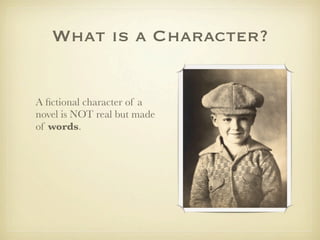
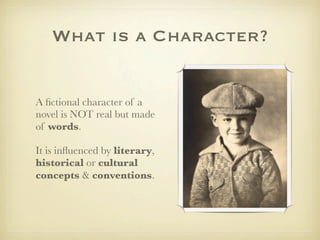
A fictional character of a
novel is NOT real but made
of words.
What is a Character?


A fictional character of a
novel is NOT real but made
of words.

It is influenced by literary,
historical or cultural
concepts & conventions.
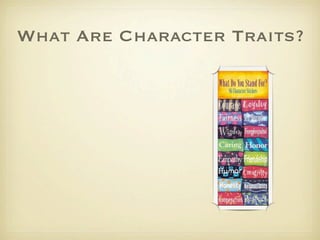
What Are Character Traits?
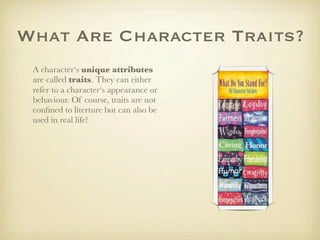
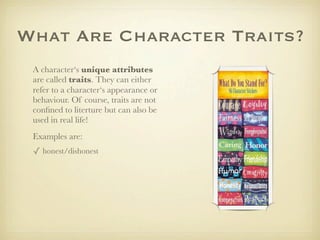
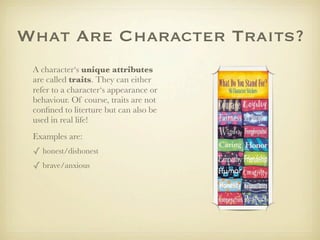
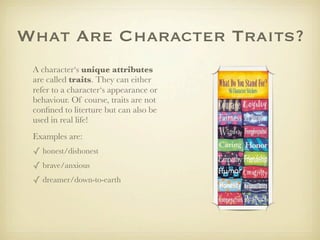
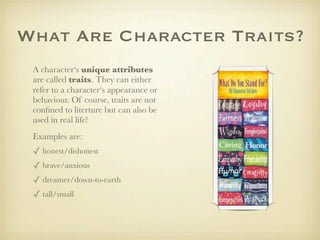
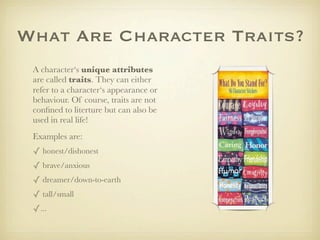
 A character‘s unique attributes
 are called traits. They can either
 refer to a character‘s appearance or
 behaviour. Of course, traits are not
 confined to literture but can also be
 used in real life!
What Are Character Traits?
 A character‘s unique attributes
 are called traits. They can either
 refer to a character‘s appearance or
 behaviour. Of course, traits are not
 confined to literture but can also be
 used in real life!
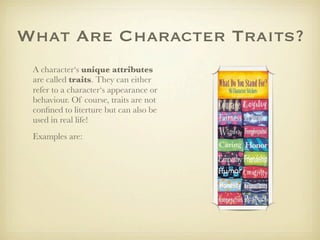
 Examples are:
What Are Character Traits?
 A character‘s unique attributes
 are called traits. They can either
 refer to a character‘s appearance or
 behaviour. Of course, traits are not
 confined to literture but can also be
 used in real life!
 Examples are:
 ✓ honest/dishonest
What Are Character Traits?
 A character‘s unique attributes
 are called traits. They can either
 refer to a character‘s appearance or
 behaviour. Of course, traits are not
 confined to literture but can also be
 used in real life!
 Examples are:
 ✓ honest/dishonest
 ✓ brave/anxious
What Are Character Traits?
 A character‘s unique attributes
 are called traits. They can either
 refer to a character‘s appearance or
 behaviour. Of course, traits are not
 confined to literture but can also be
 used in real life!
 Examples are:
 ✓ honest/dishonest
 ✓ brave/anxious
 ✓ dreamer/down-to-earth
What Are Character Traits?
 A character‘s unique attributes
 are called traits. They can either
 refer to a character‘s appearance or
 behaviour. Of course, traits are not
 confined to literture but can also be
 used in real life!
 Examples are:
 ✓ honest/dishonest
 ✓ brave/anxious
 ✓ dreamer/down-to-earth
 ✓ tall/small
What Are Character Traits?
 A character‘s unique attributes
 are called traits. They can either
 refer to a character‘s appearance or
 behaviour. Of course, traits are not
 confined to literture but can also be
 used in real life!
 Examples are:
 ✓ honest/dishonest
 ✓ brave/anxious
 ✓ dreamer/down-to-earth
 ✓ tall/small
 ✓...
Character?
                                                                                 How Can You Analyse a


http://www.northcanton.sparcc.org/~elem/kidspiration/tornero/horribleharry.htm
How Can You Analyse a
         Character?


                                     http://www.northcanton.sparcc.org/~elem/kidspiration/tornero/horribleharry.htm
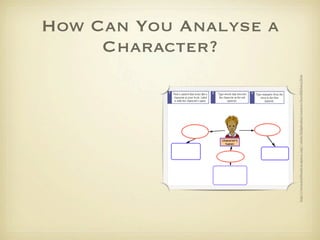
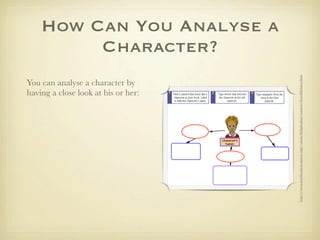
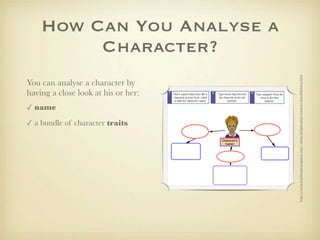
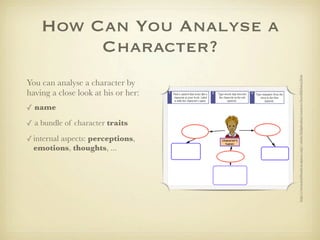
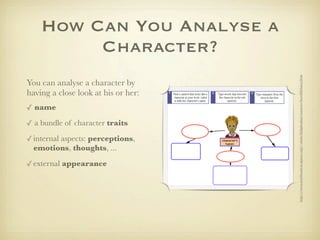
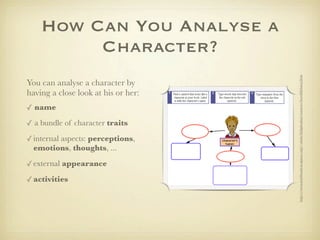
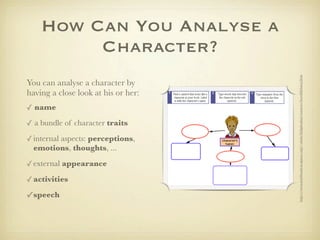
You can analyse a character by
having a close look at his or her:
How Can You Analyse a
         Character?


                                     http://www.northcanton.sparcc.org/~elem/kidspiration/tornero/horribleharry.htm
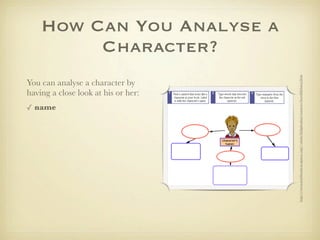
You can analyse a character by
having a close look at his or her:
✓ name
How Can You Analyse a
         Character?


                                     http://www.northcanton.sparcc.org/~elem/kidspiration/tornero/horribleharry.htm
You can analyse a character by
having a close look at his or her:
✓ name
✓ a bundle of character traits
How Can You Analyse a
         Character?


                                     http://www.northcanton.sparcc.org/~elem/kidspiration/tornero/horribleharry.htm
You can analyse a character by
having a close look at his or her:
✓ name
✓ a bundle of character traits
✓ internal aspects: perceptions,
  emotions, thoughts, ...
How Can You Analyse a
         Character?


                                     http://www.northcanton.sparcc.org/~elem/kidspiration/tornero/horribleharry.htm
You can analyse a character by
having a close look at his or her:
✓ name
✓ a bundle of character traits
✓ internal aspects: perceptions,
  emotions, thoughts, ...

✓ external appearance
How Can You Analyse a
         Character?


                                     http://www.northcanton.sparcc.org/~elem/kidspiration/tornero/horribleharry.htm
You can analyse a character by
having a close look at his or her:
✓ name
✓ a bundle of character traits
✓ internal aspects: perceptions,
  emotions, thoughts, ...

✓ external appearance
✓ activities
How Can You Analyse a
         Character?


                                     http://www.northcanton.sparcc.org/~elem/kidspiration/tornero/horribleharry.htm
You can analyse a character by
having a close look at his or her:
✓ name
✓ a bundle of character traits
✓ internal aspects: perceptions,
  emotions, thoughts, ...

✓ external appearance
✓ activities
✓ speech
What is a
Characterisation?
What is a
              Characterisation?
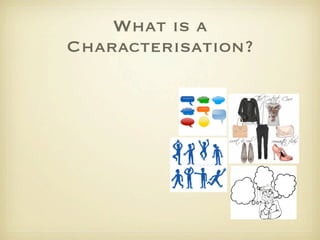
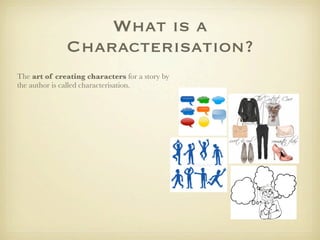
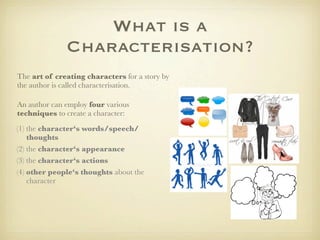
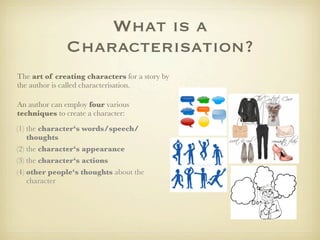
The art of creating characters for a story by
the author is called characterisation.
What is a
              Characterisation?
The art of creating characters for a story by
the author is called characterisation.

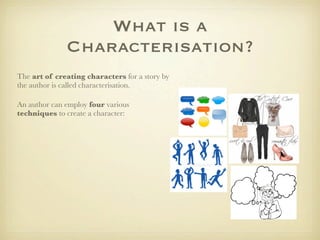
An author can employ four various
techniques to create a character:
What is a
              Characterisation?
The art of creating characters for a story by
the author is called characterisation.

An author can employ four various
techniques to create a character:
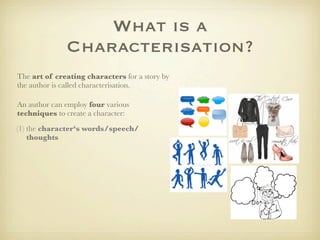
(1) the character‘s words/speech/
    thoughts
What is a
              Characterisation?
The art of creating characters for a story by
the author is called characterisation.

An author can employ four various
techniques to create a character:
(1) the character‘s words/speech/
    thoughts
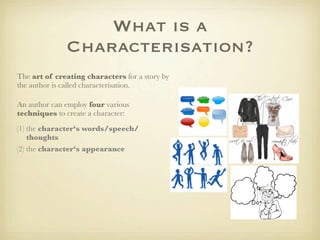
(2) the character‘s appearance
What is a
              Characterisation?
The art of creating characters for a story by
the author is called characterisation.

An author can employ four various
techniques to create a character:
(1) the character‘s words/speech/
    thoughts
(2) the character‘s appearance
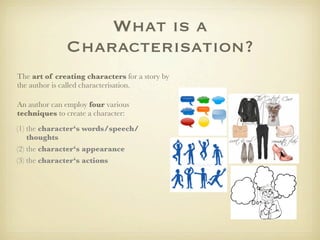
(3) the character‘s actions
What is a
              Characterisation?
The art of creating characters for a story by
the author is called characterisation.

An author can employ four various
techniques to create a character:
(1) the character‘s words/speech/
    thoughts
(2) the character‘s appearance
(3) the character‘s actions
(4) other people‘s thoughts about the
    character
What is a
              Characterisation?
The art of creating characters for a story by
the author is called characterisation.

An author can employ four various
techniques to create a character:
(1) the character‘s words/speech/
    thoughts
(2) the character‘s appearance
(3) the character‘s actions
(4) other people‘s thoughts about the
    character
Characters and
            Their Foils


                                   http://www.filmreference.com/Actors-and-Actresses-Ke-Le/Laurel-Stan-and-Oliver-Hardy.html
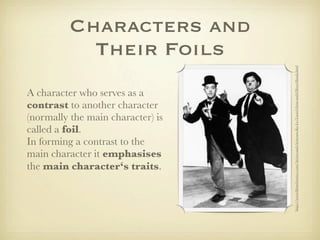
A character who serves as a
contrast to another character
(normally the main character) is
called a foil.
In forming a contrast to the
main character it emphasises
the main character‘s traits.
Major Character Types
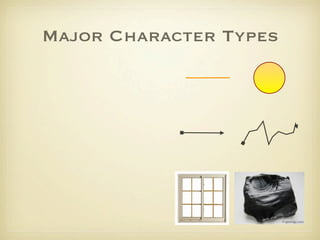
A flat character is a simple one
whereas a round character represents
a complex individual with many
different facettes in appearance, emotion
and action.
Major Character Types
A flat character is a simple one
whereas a round character represents
a complex individual with many
different facettes in appearance, emotion
and action.

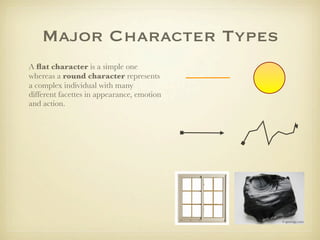
A static character does not change
throughout the novel, whereas a
dynamic character changes and
develops during the progress of the
story.
Major Character Types
A flat character is a simple one
whereas a round character represents
a complex individual with many
different facettes in appearance, emotion
and action.

A static character does not change
throughout the novel, whereas a
dynamic character changes and
develops during the progress of the
story.

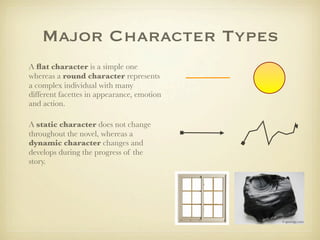
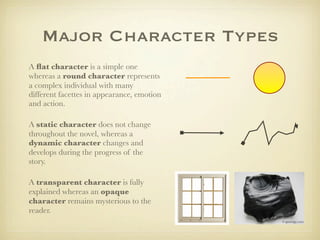
A transparent character is fully
explained whereas an opaque
character remains mysterious to the
reader.
a Character?
                                                                               Can the Setting Be


https://sjsibsenglish12.wikispaces.com/Graveyard+and+Gravestones+by+Young+Ji
Can the Setting Be
            a Character?


                                       https://sjsibsenglish12.wikispaces.com/Graveyard+and+Gravestones+by+Young+Ji
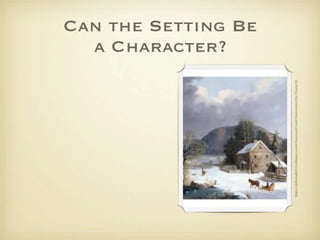
The setting of a story is often more
than simply the time and place when
and where the story happens!
Can the Setting Be
             a Character?


                                        https://sjsibsenglish12.wikispaces.com/Graveyard+and+Gravestones+by+Young+Ji
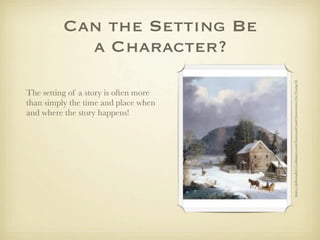
The setting of a story is often more
than simply the time and place when
and where the story happens!

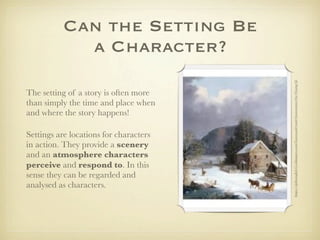
Settings are locations for characters
in action. They provide a scenery
and an atmosphere characters
perceive and respond to. In this
sense they can be regarded and
analysed as characters.
What Are


http://poshttp://www.cliffsnotes.com/study_guide/literature/ethan-frome/
                           character-map.html
                                                                           Character Constellations?

Input characters

  • 1.
  • 2.
    What is aCharacter?
  • 3.
    What is aCharacter? A fictional character of a novel is NOT real but made of words.
  • 4.
    What is aCharacter? A fictional character of a novel is NOT real but made of words. It is influenced by literary, historical or cultural concepts & conventions.
  • 5.
  • 6.
    What Are CharacterTraits? A character‘s unique attributes are called traits. They can either refer to a character‘s appearance or behaviour. Of course, traits are not confined to literture but can also be used in real life!
  • 7.
    What Are CharacterTraits? A character‘s unique attributes are called traits. They can either refer to a character‘s appearance or behaviour. Of course, traits are not confined to literture but can also be used in real life! Examples are:
  • 8.
    What Are CharacterTraits? A character‘s unique attributes are called traits. They can either refer to a character‘s appearance or behaviour. Of course, traits are not confined to literture but can also be used in real life! Examples are: ✓ honest/dishonest
  • 9.
    What Are CharacterTraits? A character‘s unique attributes are called traits. They can either refer to a character‘s appearance or behaviour. Of course, traits are not confined to literture but can also be used in real life! Examples are: ✓ honest/dishonest ✓ brave/anxious
  • 10.
    What Are CharacterTraits? A character‘s unique attributes are called traits. They can either refer to a character‘s appearance or behaviour. Of course, traits are not confined to literture but can also be used in real life! Examples are: ✓ honest/dishonest ✓ brave/anxious ✓ dreamer/down-to-earth
  • 11.
    What Are CharacterTraits? A character‘s unique attributes are called traits. They can either refer to a character‘s appearance or behaviour. Of course, traits are not confined to literture but can also be used in real life! Examples are: ✓ honest/dishonest ✓ brave/anxious ✓ dreamer/down-to-earth ✓ tall/small
  • 12.
    What Are CharacterTraits? A character‘s unique attributes are called traits. They can either refer to a character‘s appearance or behaviour. Of course, traits are not confined to literture but can also be used in real life! Examples are: ✓ honest/dishonest ✓ brave/anxious ✓ dreamer/down-to-earth ✓ tall/small ✓...
  • 13.
    Character? How Can You Analyse a http://www.northcanton.sparcc.org/~elem/kidspiration/tornero/horribleharry.htm
  • 14.
    How Can YouAnalyse a Character? http://www.northcanton.sparcc.org/~elem/kidspiration/tornero/horribleharry.htm You can analyse a character by having a close look at his or her:
  • 15.
    How Can YouAnalyse a Character? http://www.northcanton.sparcc.org/~elem/kidspiration/tornero/horribleharry.htm You can analyse a character by having a close look at his or her: ✓ name
  • 16.
    How Can YouAnalyse a Character? http://www.northcanton.sparcc.org/~elem/kidspiration/tornero/horribleharry.htm You can analyse a character by having a close look at his or her: ✓ name ✓ a bundle of character traits
  • 17.
    How Can YouAnalyse a Character? http://www.northcanton.sparcc.org/~elem/kidspiration/tornero/horribleharry.htm You can analyse a character by having a close look at his or her: ✓ name ✓ a bundle of character traits ✓ internal aspects: perceptions, emotions, thoughts, ...
  • 18.
    How Can YouAnalyse a Character? http://www.northcanton.sparcc.org/~elem/kidspiration/tornero/horribleharry.htm You can analyse a character by having a close look at his or her: ✓ name ✓ a bundle of character traits ✓ internal aspects: perceptions, emotions, thoughts, ... ✓ external appearance
  • 19.
    How Can YouAnalyse a Character? http://www.northcanton.sparcc.org/~elem/kidspiration/tornero/horribleharry.htm You can analyse a character by having a close look at his or her: ✓ name ✓ a bundle of character traits ✓ internal aspects: perceptions, emotions, thoughts, ... ✓ external appearance ✓ activities
  • 20.
    How Can YouAnalyse a Character? http://www.northcanton.sparcc.org/~elem/kidspiration/tornero/horribleharry.htm You can analyse a character by having a close look at his or her: ✓ name ✓ a bundle of character traits ✓ internal aspects: perceptions, emotions, thoughts, ... ✓ external appearance ✓ activities ✓ speech
  • 21.
  • 22.
    What is a Characterisation? The art of creating characters for a story by the author is called characterisation.
  • 23.
    What is a Characterisation? The art of creating characters for a story by the author is called characterisation. An author can employ four various techniques to create a character:
  • 24.
    What is a Characterisation? The art of creating characters for a story by the author is called characterisation. An author can employ four various techniques to create a character: (1) the character‘s words/speech/ thoughts
  • 25.
    What is a Characterisation? The art of creating characters for a story by the author is called characterisation. An author can employ four various techniques to create a character: (1) the character‘s words/speech/ thoughts (2) the character‘s appearance
  • 26.
    What is a Characterisation? The art of creating characters for a story by the author is called characterisation. An author can employ four various techniques to create a character: (1) the character‘s words/speech/ thoughts (2) the character‘s appearance (3) the character‘s actions
  • 27.
    What is a Characterisation? The art of creating characters for a story by the author is called characterisation. An author can employ four various techniques to create a character: (1) the character‘s words/speech/ thoughts (2) the character‘s appearance (3) the character‘s actions (4) other people‘s thoughts about the character
  • 28.
    What is a Characterisation? The art of creating characters for a story by the author is called characterisation. An author can employ four various techniques to create a character: (1) the character‘s words/speech/ thoughts (2) the character‘s appearance (3) the character‘s actions (4) other people‘s thoughts about the character
  • 29.
    Characters and Their Foils http://www.filmreference.com/Actors-and-Actresses-Ke-Le/Laurel-Stan-and-Oliver-Hardy.html A character who serves as a contrast to another character (normally the main character) is called a foil. In forming a contrast to the main character it emphasises the main character‘s traits.
  • 30.
  • 31.
    Major Character Types Aflat character is a simple one whereas a round character represents a complex individual with many different facettes in appearance, emotion and action.
  • 32.
    Major Character Types Aflat character is a simple one whereas a round character represents a complex individual with many different facettes in appearance, emotion and action. A static character does not change throughout the novel, whereas a dynamic character changes and develops during the progress of the story.
  • 33.
    Major Character Types Aflat character is a simple one whereas a round character represents a complex individual with many different facettes in appearance, emotion and action. A static character does not change throughout the novel, whereas a dynamic character changes and develops during the progress of the story. A transparent character is fully explained whereas an opaque character remains mysterious to the reader.
  • 34.
    a Character? Can the Setting Be https://sjsibsenglish12.wikispaces.com/Graveyard+and+Gravestones+by+Young+Ji
  • 35.
    Can the SettingBe a Character? https://sjsibsenglish12.wikispaces.com/Graveyard+and+Gravestones+by+Young+Ji The setting of a story is often more than simply the time and place when and where the story happens!
  • 36.
    Can the SettingBe a Character? https://sjsibsenglish12.wikispaces.com/Graveyard+and+Gravestones+by+Young+Ji The setting of a story is often more than simply the time and place when and where the story happens! Settings are locations for characters in action. They provide a scenery and an atmosphere characters perceive and respond to. In this sense they can be regarded and analysed as characters.
  • 37.