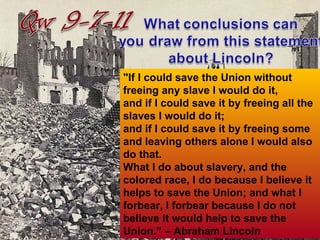
"If I could save the Union without freeing any slave I would do it,  and if I could save it by freeing all the slaves I would do it;  and if I could save it by freeing some and leaving others alone I would also do that.  What I do about slavery, and the colored race, I do because I believe it helps to save the Union; and what I forbear, I forbear because I do not believe it would help to save the Union.” – Abraham Lincoln
 
Changing  Laws  doesn’t change  attitudes “  Our Constitution is color-blind, and neither knows nor tolerates classes among citizens. In respect of civil rights, all citizens are equal before the law.” - Supreme Court Justice Harlan
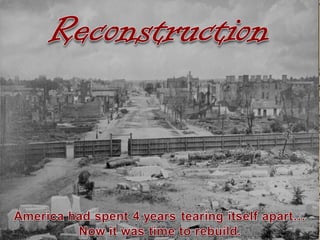
Rebuilding of the nation after the war Putting the United States back together would take time and many decisions  New agencies and amendments would be created to deal with the new issues the US was facing
Changing  Laws  doesn’t change  attitudes “ We want you to be free,  but don’t live next to me” -Northern Citizen
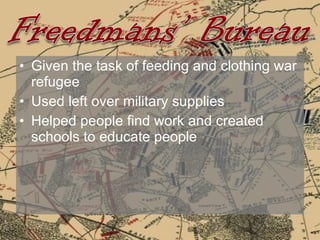
Given the task of feeding and clothing war refugee Used left over military supplies Helped people find work and created schools to educate people
Changing  Laws  doesn’t change  attitudes “ Separate but equal” -Plessy V. Ferguson
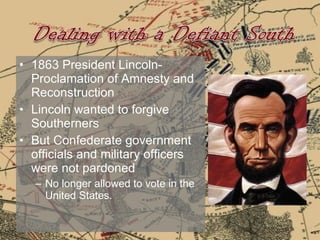
1863 President Lincoln- Proclamation of Amnesty and Reconstruction  Lincoln wanted to forgive Southerners  But Confederate government officials and military officers were not pardoned  No longer allowed to vote in the United States.
Changing  Laws  doesn’t change  attitudes “ A White man’s government!” -Ku Klux Klan
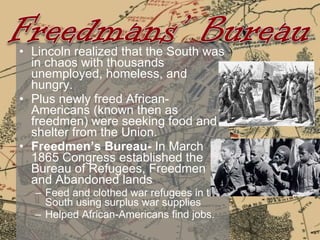
Lincoln realized that the South was in chaos with thousands unemployed, homeless, and hungry. Plus newly freed African-Americans (known then as freedmen) were seeking food and shelter from the Union.  Freedmen’s Bureau-  In March 1865 Congress established the Bureau of Refugees, Freedmen and Abandoned lands Feed and clothed war refugees in the South using surplus war supplies Helped African-Americans find jobs.
Changing  Laws  doesn’t change  attitudes “ I am for the immediate, unconditional, and universal enfrachisement of the black man, in every States of the Union.” -Fredrick Douglass
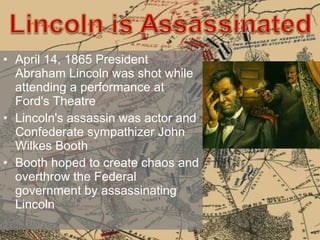
April 14, 1865 President Abraham Lincoln was shot while attending a performance at Ford's Theatre  Lincoln's assassin was actor and Confederate sympathizer John Wilkes Booth Booth hoped to create chaos and overthrow the Federal government by assassinating Lincoln
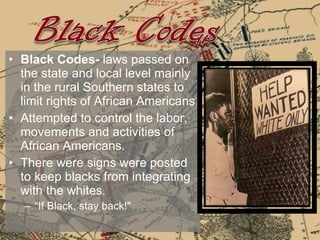
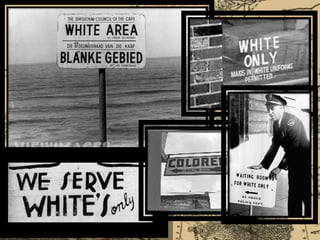
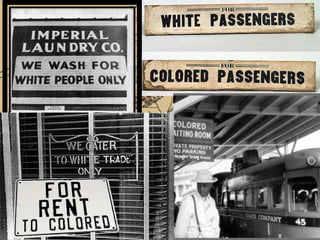
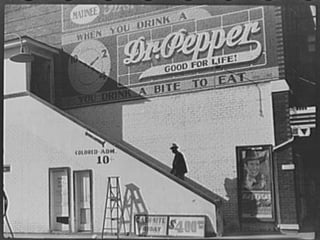
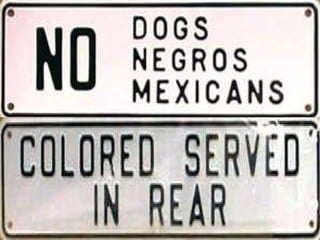
Black Codes-  laws passed on the state and local level mainly in the rural Southern states to limit rights of African Americans Attempted to control the labor, movements and activities of African Americans.  There were signs were posted to keep blacks from integrating with the whites.  “ If Black, stay back!"


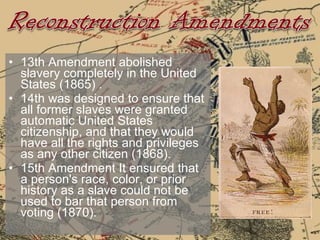
13th Amendment abolished slavery completely in the United States (1865) . 14th was designed to ensure that all former slaves were granted automatic United States citizenship, and that they would have all the rights and privileges as any other citizen (1868).  15th Amendment It ensured that a person's race, color, or prior history as a slave could not be used to bar that person from voting (1870).
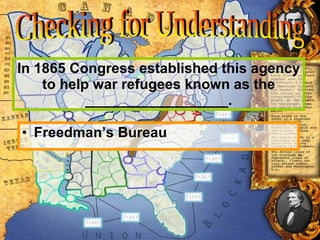
In 1865 Congress established this agency to help war refugees known as the __________________. Freedman’s Bureau Checking for Understanding
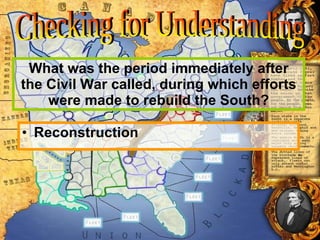
What was the period immediately after the Civil War called, during which efforts were made to rebuild the South? Reconstruction Checking for Understanding
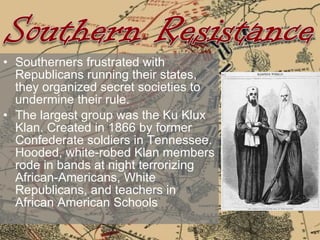
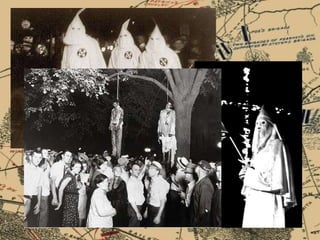
Southerners frustrated with Republicans running their states, they organized secret societies to undermine their rule.  The largest group was the Ku Klux Klan. Created in 1866 by former Confederate soldiers in Tennessee. Hooded, white-robed Klan members rode in bands at night terrorizing African-Americans, White Republicans, and teachers in African American Schools
 
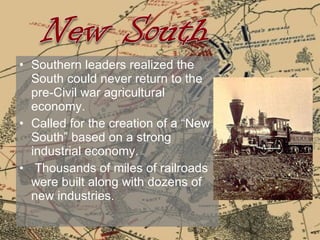
Southern leaders realized the South could never return to the pre-Civil war agricultural economy.  Called for the creation of a “New South” based on a strong industrial economy. Thousands of miles of railroads were built along with dozens of new industries.
The _______ amendment declared that the right to vote “Shall not be denied…on the account of race, color, or previous condition of servitude.” 15 th   Checking for Understanding
The _______ amendment outlawed slavery in the United States. 13th Checking for Understanding
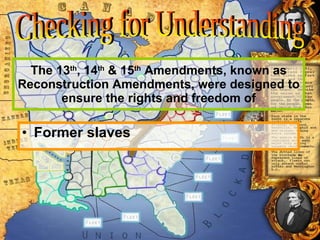
The 13 th , 14 th  & 15 th  Amendments, known as Reconstruction Amendments, were designed to ensure the rights and freedom of Former slaves Checking for Understanding
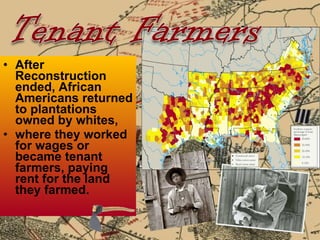
After Reconstruction ended, African Americans returned to plantations owned by whites,  where they worked for wages or became tenant farmers, paying rent for the land they farmed.
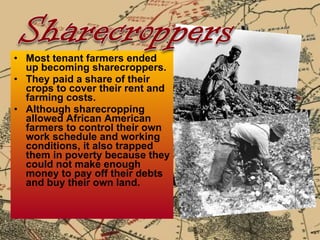
Most tenant farmers ended up becoming sharecroppers.  They paid a share of their crops to cover their rent and farming costs. Although sharecropping allowed African American farmers to control their own work schedule and working conditions, it also trapped them in poverty because they could not make enough money to pay off their debts and buy their own land.
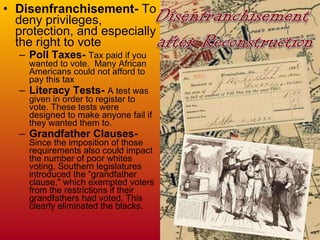
Disenfranchisement-  To deny privileges, protection, and especially the right to vote Poll Taxes-   Tax paid if you wanted to vote.  Many African Americans could not afford to pay this tax Literacy Tests-  A test was given in order to register to vote. These tests were designed to make anyone fail if they wanted them to. Grandfather Clauses-  Since the imposition of those requirements also could impact the number of poor whites voting, Southern legislatures introduced the “grandfather clause," which exempted voters from the restrictions if their grandfathers had voted. This clearly eliminated the blacks.
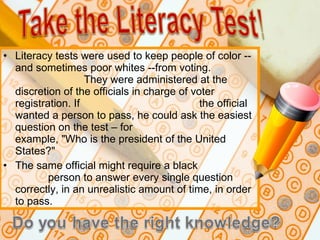
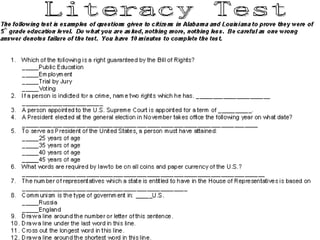
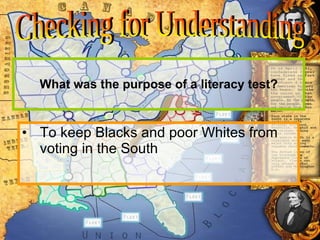
Literacy tests were used to keep people of color -- and sometimes poor whites --from voting.  They were administered at the discretion of the officials in charge of voter registration. If  the official wanted a person to pass, he could ask the easiest question on the test – for  example, "Who is the president of the United States?"  The same official might require a black  person to answer every single question correctly, in an unrealistic amount of time, in order to pass.
 
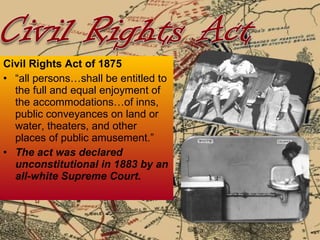
Civil Rights Act of 1875 “ all persons…shall be entitled to the full and equal enjoyment of the accommodations…of inns, public conveyances on land or water, theaters, and other places of public amusement.” The act was declared unconstitutional in 1883 by an all-white Supreme Court.
 
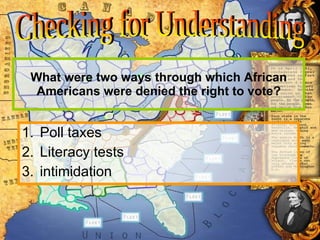
What were two ways through which African Americans were denied the right to vote? Poll taxes Literacy tests intimidation Checking for Understanding
What was the purpose of a literacy test? To keep Blacks and poor Whites from voting in the South Checking for Understanding
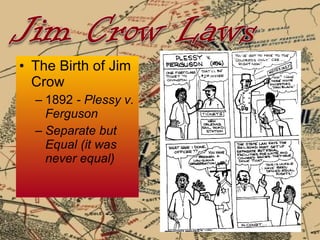
The Birth of Jim Crow 1892  - Plessy v. Ferguson Separate but Equal (it was never equal)
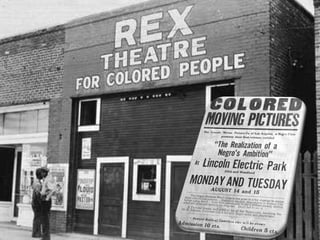
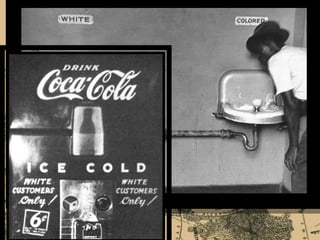
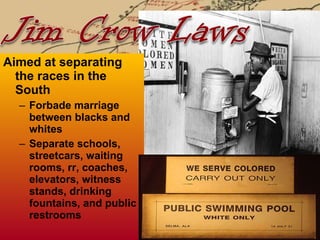
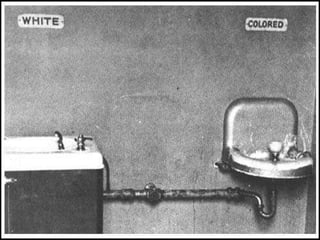
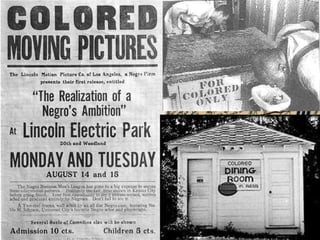
Aimed at separating the races in the South Forbade marriage between blacks and whites Separate schools, streetcars, waiting rooms, rr, coaches, elevators, witness stands, drinking fountains, and public restrooms
Slavery banned Free to work for wages Could move and live anywhere Many families reunited  Could serve in political office
Sharecropping put in place Ability to vote and hold office restricted White leadership regained control of southern governments Changing  Laws  doesn’t change  attitudes Black Codes Jim Crow Laws Plessy V. Ferguson Literacy Tests Poll Taxes Grandfather Clause Ku Klux Klan Forced Segration


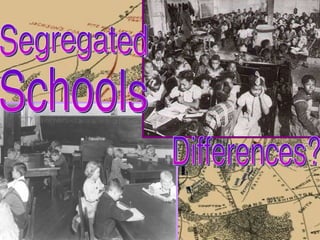
Segregated  Schools Differences?

Reconstruction and rights 2011

  • 1.
  • 2.
  • 3.
  • 4.
  • 5.
  • 6.
  • 7.
  • 8.
  • 9.
  • 10.
  • 11.
  • 12.
  • 13.
  • 14.
    "If I couldsave the Union without freeing any slave I would do it, and if I could save it by freeing all the slaves I would do it; and if I could save it by freeing some and leaving others alone I would also do that. What I do about slavery, and the colored race, I do because I believe it helps to save the Union; and what I forbear, I forbear because I do not believe it would help to save the Union.” – Abraham Lincoln
  • 15.
  • 16.
    Changing Laws doesn’t change attitudes “ Our Constitution is color-blind, and neither knows nor tolerates classes among citizens. In respect of civil rights, all citizens are equal before the law.” - Supreme Court Justice Harlan
  • 17.
    Rebuilding of thenation after the war Putting the United States back together would take time and many decisions New agencies and amendments would be created to deal with the new issues the US was facing
  • 18.
    Changing Laws doesn’t change attitudes “ We want you to be free, but don’t live next to me” -Northern Citizen
  • 19.
    Given the taskof feeding and clothing war refugee Used left over military supplies Helped people find work and created schools to educate people
  • 20.
    Changing Laws doesn’t change attitudes “ Separate but equal” -Plessy V. Ferguson
  • 21.
    1863 President Lincoln-Proclamation of Amnesty and Reconstruction Lincoln wanted to forgive Southerners But Confederate government officials and military officers were not pardoned No longer allowed to vote in the United States.
  • 22.
    Changing Laws doesn’t change attitudes “ A White man’s government!” -Ku Klux Klan
  • 23.
    Lincoln realized thatthe South was in chaos with thousands unemployed, homeless, and hungry. Plus newly freed African-Americans (known then as freedmen) were seeking food and shelter from the Union. Freedmen’s Bureau- In March 1865 Congress established the Bureau of Refugees, Freedmen and Abandoned lands Feed and clothed war refugees in the South using surplus war supplies Helped African-Americans find jobs.
  • 24.
    Changing Laws doesn’t change attitudes “ I am for the immediate, unconditional, and universal enfrachisement of the black man, in every States of the Union.” -Fredrick Douglass
  • 25.
    April 14, 1865President Abraham Lincoln was shot while attending a performance at Ford's Theatre Lincoln's assassin was actor and Confederate sympathizer John Wilkes Booth Booth hoped to create chaos and overthrow the Federal government by assassinating Lincoln
  • 26.
    Black Codes- laws passed on the state and local level mainly in the rural Southern states to limit rights of African Americans Attempted to control the labor, movements and activities of African Americans. There were signs were posted to keep blacks from integrating with the whites. “ If Black, stay back!"
  • 27.
  • 28.
  • 29.
  • 30.
    13th Amendment abolishedslavery completely in the United States (1865) . 14th was designed to ensure that all former slaves were granted automatic United States citizenship, and that they would have all the rights and privileges as any other citizen (1868). 15th Amendment It ensured that a person's race, color, or prior history as a slave could not be used to bar that person from voting (1870).
  • 31.
    In 1865 Congressestablished this agency to help war refugees known as the __________________. Freedman’s Bureau Checking for Understanding
  • 32.
    What was theperiod immediately after the Civil War called, during which efforts were made to rebuild the South? Reconstruction Checking for Understanding
  • 33.
    Southerners frustrated withRepublicans running their states, they organized secret societies to undermine their rule. The largest group was the Ku Klux Klan. Created in 1866 by former Confederate soldiers in Tennessee. Hooded, white-robed Klan members rode in bands at night terrorizing African-Americans, White Republicans, and teachers in African American Schools
  • 34.
  • 35.
    Southern leaders realizedthe South could never return to the pre-Civil war agricultural economy. Called for the creation of a “New South” based on a strong industrial economy. Thousands of miles of railroads were built along with dozens of new industries.
  • 36.
    The _______ amendmentdeclared that the right to vote “Shall not be denied…on the account of race, color, or previous condition of servitude.” 15 th Checking for Understanding
  • 37.
    The _______ amendmentoutlawed slavery in the United States. 13th Checking for Understanding
  • 38.
    The 13 th, 14 th & 15 th Amendments, known as Reconstruction Amendments, were designed to ensure the rights and freedom of Former slaves Checking for Understanding
  • 39.
    After Reconstruction ended,African Americans returned to plantations owned by whites, where they worked for wages or became tenant farmers, paying rent for the land they farmed.
  • 40.
    Most tenant farmersended up becoming sharecroppers. They paid a share of their crops to cover their rent and farming costs. Although sharecropping allowed African American farmers to control their own work schedule and working conditions, it also trapped them in poverty because they could not make enough money to pay off their debts and buy their own land.
  • 41.
    Disenfranchisement- Todeny privileges, protection, and especially the right to vote Poll Taxes- Tax paid if you wanted to vote. Many African Americans could not afford to pay this tax Literacy Tests- A test was given in order to register to vote. These tests were designed to make anyone fail if they wanted them to. Grandfather Clauses- Since the imposition of those requirements also could impact the number of poor whites voting, Southern legislatures introduced the “grandfather clause," which exempted voters from the restrictions if their grandfathers had voted. This clearly eliminated the blacks.
  • 42.
    Literacy tests wereused to keep people of color -- and sometimes poor whites --from voting. They were administered at the discretion of the officials in charge of voter registration. If the official wanted a person to pass, he could ask the easiest question on the test – for example, "Who is the president of the United States?" The same official might require a black person to answer every single question correctly, in an unrealistic amount of time, in order to pass.
  • 43.
  • 44.
    Civil Rights Actof 1875 “ all persons…shall be entitled to the full and equal enjoyment of the accommodations…of inns, public conveyances on land or water, theaters, and other places of public amusement.” The act was declared unconstitutional in 1883 by an all-white Supreme Court.
  • 45.
  • 46.
    What were twoways through which African Americans were denied the right to vote? Poll taxes Literacy tests intimidation Checking for Understanding
  • 47.
    What was thepurpose of a literacy test? To keep Blacks and poor Whites from voting in the South Checking for Understanding
  • 48.
    The Birth ofJim Crow 1892 - Plessy v. Ferguson Separate but Equal (it was never equal)
  • 49.
    Aimed at separatingthe races in the South Forbade marriage between blacks and whites Separate schools, streetcars, waiting rooms, rr, coaches, elevators, witness stands, drinking fountains, and public restrooms
  • 50.
    Slavery banned Freeto work for wages Could move and live anywhere Many families reunited Could serve in political office
  • 51.
    Sharecropping put inplace Ability to vote and hold office restricted White leadership regained control of southern governments Changing Laws doesn’t change attitudes Black Codes Jim Crow Laws Plessy V. Ferguson Literacy Tests Poll Taxes Grandfather Clause Ku Klux Klan Forced Segration
  • 52.
  • 53.
  • 54.
  • 55.
  • 56.
    Segregated SchoolsDifferences?