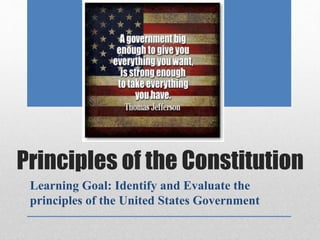
Principles of the Constitution 
Learning Goal: Identify and Evaluate the 
principles of the United States Government
• How is a principle different from a rule? 
• Can you name a rule and a principle behind it? 
• Can you name some principles you live by? 
Do-Now
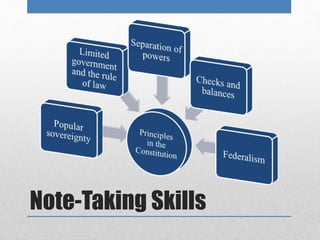
Note-Taking Skills
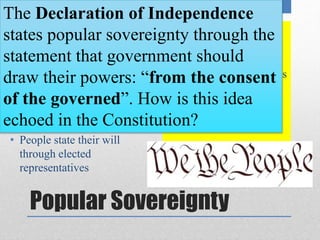
The Declaration of Independence 
states popular sovereignty through the 
statement that government should 
draw their powers: “from the consent 
of the governed”. How is this idea 
echoed in the Constitution? 
• Article IV guarantees 
citizens: “A Republican 
form of government” 
• Framers used republic to 
describe a representative 
democracy 
• Power belongs to the people 
• People state their will 
through elected 
representatives 
• Popular Sovereignty is 
the idea that power lies 
with the people. 
Popular Sovereignty
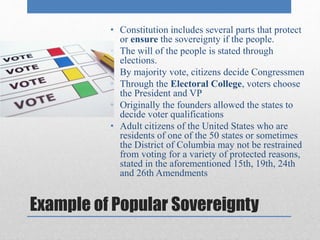
• Constitution includes several parts that protect 
or ensure the sovereignty if the people. 
• The will of the people is stated through 
elections. 
• By majority vote, citizens decide Congressmen 
• Through the Electoral College, voters choose 
the President and VP 
• Originally the founders allowed the states to 
decide voter qualifications 
• Adult citizens of the United States who are 
residents of one of the 50 states or sometimes 
the District of Columbia may not be restrained 
from voting for a variety of protected reasons, 
stated in the aforementioned 15th, 19th, 24th 
and 26th Amendments 
Example of Popular Sovereignty
• How does voting ensure the “consent of the governed”? 
• Voters can replace officials who do not serve them well by 
Review- Analyzing 
electing others 
• What do you think the United States would be like if 
leaders did not respect the idea of popular sovereignty?
Limited Government and 
the Rule of Law
• “In framing a government which 
is to be administered [run] by 
men over men, the great 
difficulty lies in this: you must 
first enable the government to 
control the governed and in the 
next place oblige [require] it to 
control itself” 
How would you 
rephrase this statement 
so that it explains in 
simple terms what 
Madison meant when 
he explained “the great 
difficulty lies in this”? 
A government needs to be given the 
power to control the people it governs, 
and it must be required to control itself, 
too. 
Primary Source- 
James Madison, The Federalist, No. 51
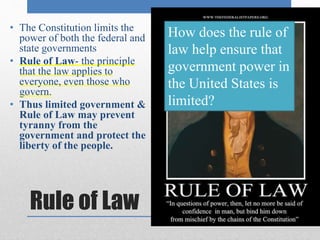
• The Constitution limits the 
power of both the federal and 
state governments 
• Rule of Law- the principle 
that the law applies to 
everyone, even those who 
govern. 
• Thus limited government & 
Rule of Law may prevent 
tyranny from the 
government and protect the 
liberty of the people. 
Rule of Law 
How does the rule of 
law help ensure that 
government power in 
the United States is 
limited?
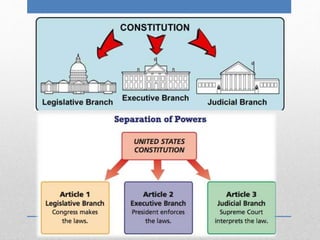
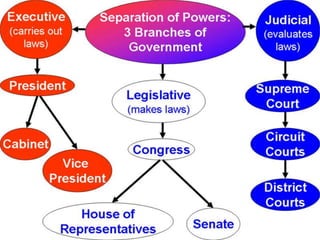
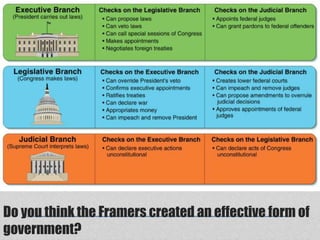
• The Framers divided the federal government into 3 
branches to protect Americans against the abuse, or 
misuse of power. 
• The idea was influenced by French thinker Baron de 
Montesquieu who believed that people’s liberty could be 
protected by assigning legislative, executive and judicial 
powers to a separate branch of government 
• Separation of Powers- the split of authority among the 
legislative, executive and judicial branches. 
Separation of Powers
• Separation of powers was set up to check unlimited 
authority 
• However, the Framers feared that one branch of 
government could still gain control of the other two 
• Checks & Balances- a system in which each branch of 
government is able to check, or restrain, the power of the 
others. 
Checks & Balances
Do you think the Framers created an effective form of 
government?
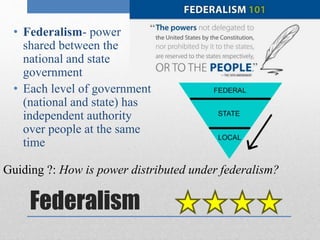
• Federalism- power 
shared between the 
national and state 
government 
• Each level of government 
(national and state) has 
independent authority 
over people at the same 
time 
Guiding ?: How is power distributed under federalism? 
Federalism
• How did the Framers of the Constitution attempt to protect Americans 
from the abuse of power by the government? 
• Do you think these precautions are working? 
Critical Thinking
• The writers of the Constitution divided the powers of 
government into three types. 
• Enumerated Powers 
• Reserved Powers 
• Concurrent Powers 
3 Types of Power
• Enumerated 
Powers: powers 
directly granted to the 
federal government 
by the Constitution 
• Enumerated = 
“listed” or “spelled 
out” 
• Strict constructionism 
and loose 
constructionism 
Enumerated Powers
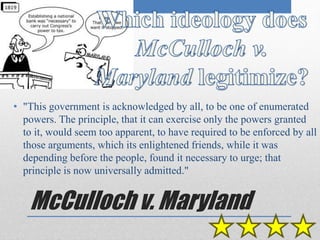
• "This government is acknowledged by all, to be one of enumerated 
powers. The principle, that it can exercise only the powers granted 
to it, would seem too apparent, to have required to be enforced by all 
those arguments, which its enlightened friends, while it was 
depending before the people, found it necessary to urge; that 
principle is now universally admitted." 
McCulloch v. Maryland
• "We admit, as all must admit, that the powers of the 
Government are limited, and that its limits are not to be 
transcended. But we think the sound construction of the 
Constitution must allow to the national legislature that 
discretion with respect to the means by which the powers 
it confers are to be carried into execution which will 
enable that body to perform the high duties assigned to it 
in the manner most beneficial to the people. Let the end 
be legitimate, let it be within the scope of the 
Constitution, and all means which are appropriate, which 
are plainly adapted to that end, which are not prohibited, 
but consistent with the letter and spirit of the 
Constitution, are constitutional,” –John Marshall 
Primary Source- John Marshall
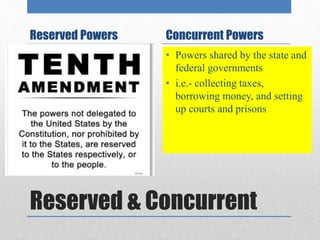
Reserved Powers 
• Powers the Constitution does 
not give to the federal 
government, powers set aside 
for the states. 
• i.e.- regulating trade with state 
borders, setting up schools, 
and making rules for marriage 
and divorce. 
Concurrent Powers 
• Powers shared by the state and 
federal governments 
• i.e.- collecting taxes, 
borrowing money, and setting 
up courts and prisons 
Reserved & Concurrent
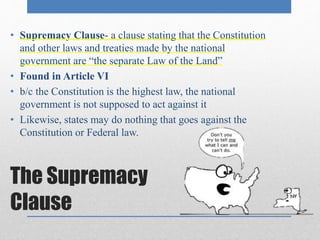
• Supremacy Clause- a clause stating that the Constitution 
and other laws and treaties made by the national 
government are “the separate Law of the Land” 
• Found in Article VI 
• b/c the Constitution is the highest law, the national 
government is not supposed to act against it 
• Likewise, states may do nothing that goes against the 
Constitution or Federal law. 
The Supremacy 
Clause
• Can you think of a situation in which the supremacy 
clause might take effect? 
Critical Thinking
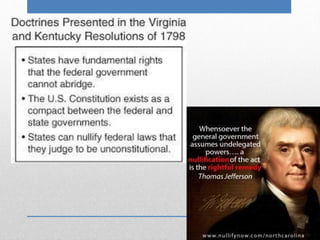
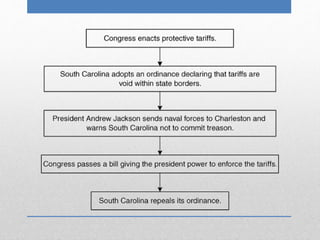
• Constitution did not firmly settle the issue of federal and 
state powers. 
• 1798- urged by Thomas Jefferson, Virginia and Kentucky 
resolved that certain laws passed by Congress were void 
in their states [invoking the 10th Amendment] 
• Congress repealed the laws in question 
• In 1830- Carolina passed a similar resolution 
• By Compromise the issue was resolved after Jackson 
threatened to send federal troops 
• Nullification of a federal law by a state was not finally 
put to rest until AFTER the Civil War 
Content Background
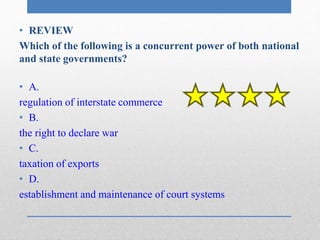
• REVIEW 
Which of the following is a concurrent power of both national 
and state governments? 
• A. 
regulation of interstate commerce 
• B. 
the right to declare war 
• C. 
taxation of exports 
• D. 
establishment and maintenance of court systems
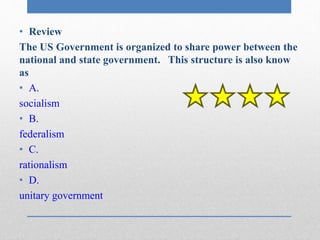
• Review 
The US Government is organized to share power between the 
national and state government. This structure is also know 
as 
• A. 
socialism 
• B. 
federalism 
• C. 
rationalism 
• D. 
unitary government
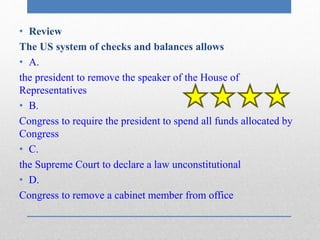
• Review 
The US system of checks and balances allows 
• A. 
the president to remove the speaker of the House of 
Representatives 
• B. 
Congress to require the president to spend all funds allocated by 
Congress 
• C. 
the Supreme Court to declare a law unconstitutional 
• D. 
Congress to remove a cabinet member from office
• Review 
The founders decided that voter qualifications should be 
• A. 
based on universal manhood suffrage 
• B. 
left for the individual states to decide 
• C. 
the same for national, state, and local elections 
• D. 
open to all regardless of race or gender
• Review 
The 19th century doctrine of nullification supported the belief 
that 
• A. 
states cannot declare acts of Congress unconstitutional 
• B. 
states have the right to decide whether or not federal laws will be 
followed within their borders 
• C. 
national supremacy is inevitable 
• D. 
the national government has power over interstate commerce, and 
states over intrastate commerce
• Review 
One reason that most of the founders were opposed to using 
direct democracy as a model for the Constitution was that 
• A. 
direct democracy had not worked well for the Ancient Greeks 
• B. 
direct democracy does not allow ordinary people much input into 
government decisions 
• C. 
they feared that direct democracy would lead to chaos and 
violence among opposing factions 
• D. 
they feared that representatives would be allowed too much 
power.
• Review 
Which principle of the Constitution is most directly reflected 
in the procedures for creating formal amendments? 
• A. 
popular sovereignty 
• B. 
separation of powers 
• C. 
checks and balances 
• D. 
Federalism
• Of the 5 Principles of the Constitution, which matters the 
most to you? 
• Write a paragraph identifying the principle that matters 
most to you and another paragraph explaining why. 
• What are some examples of enumerated, reserved, and 
concurrent powers held by your parents or guardians 
(who can be compared to a national government), and 
yourself (who can be considered a state government)? 
Homework

3.2.principles.of.us.government

  • 1.
    Principles of theConstitution Learning Goal: Identify and Evaluate the principles of the United States Government
  • 2.
    • How isa principle different from a rule? • Can you name a rule and a principle behind it? • Can you name some principles you live by? Do-Now
  • 3.
  • 4.
    The Declaration ofIndependence states popular sovereignty through the statement that government should draw their powers: “from the consent of the governed”. How is this idea echoed in the Constitution? • Article IV guarantees citizens: “A Republican form of government” • Framers used republic to describe a representative democracy • Power belongs to the people • People state their will through elected representatives • Popular Sovereignty is the idea that power lies with the people. Popular Sovereignty
  • 5.
    • Constitution includesseveral parts that protect or ensure the sovereignty if the people. • The will of the people is stated through elections. • By majority vote, citizens decide Congressmen • Through the Electoral College, voters choose the President and VP • Originally the founders allowed the states to decide voter qualifications • Adult citizens of the United States who are residents of one of the 50 states or sometimes the District of Columbia may not be restrained from voting for a variety of protected reasons, stated in the aforementioned 15th, 19th, 24th and 26th Amendments Example of Popular Sovereignty
  • 6.
    • How doesvoting ensure the “consent of the governed”? • Voters can replace officials who do not serve them well by Review- Analyzing electing others • What do you think the United States would be like if leaders did not respect the idea of popular sovereignty?
  • 7.
    Limited Government and the Rule of Law
  • 8.
    • “In framinga government which is to be administered [run] by men over men, the great difficulty lies in this: you must first enable the government to control the governed and in the next place oblige [require] it to control itself” How would you rephrase this statement so that it explains in simple terms what Madison meant when he explained “the great difficulty lies in this”? A government needs to be given the power to control the people it governs, and it must be required to control itself, too. Primary Source- James Madison, The Federalist, No. 51
  • 9.
    • The Constitutionlimits the power of both the federal and state governments • Rule of Law- the principle that the law applies to everyone, even those who govern. • Thus limited government & Rule of Law may prevent tyranny from the government and protect the liberty of the people. Rule of Law How does the rule of law help ensure that government power in the United States is limited?
  • 10.
    • The Framersdivided the federal government into 3 branches to protect Americans against the abuse, or misuse of power. • The idea was influenced by French thinker Baron de Montesquieu who believed that people’s liberty could be protected by assigning legislative, executive and judicial powers to a separate branch of government • Separation of Powers- the split of authority among the legislative, executive and judicial branches. Separation of Powers
  • 13.
    • Separation ofpowers was set up to check unlimited authority • However, the Framers feared that one branch of government could still gain control of the other two • Checks & Balances- a system in which each branch of government is able to check, or restrain, the power of the others. Checks & Balances
  • 14.
    Do you thinkthe Framers created an effective form of government?
  • 15.
    • Federalism- power shared between the national and state government • Each level of government (national and state) has independent authority over people at the same time Guiding ?: How is power distributed under federalism? Federalism
  • 16.
    • How didthe Framers of the Constitution attempt to protect Americans from the abuse of power by the government? • Do you think these precautions are working? Critical Thinking
  • 17.
    • The writersof the Constitution divided the powers of government into three types. • Enumerated Powers • Reserved Powers • Concurrent Powers 3 Types of Power
  • 18.
    • Enumerated Powers:powers directly granted to the federal government by the Constitution • Enumerated = “listed” or “spelled out” • Strict constructionism and loose constructionism Enumerated Powers
  • 19.
    • "This governmentis acknowledged by all, to be one of enumerated powers. The principle, that it can exercise only the powers granted to it, would seem too apparent, to have required to be enforced by all those arguments, which its enlightened friends, while it was depending before the people, found it necessary to urge; that principle is now universally admitted." McCulloch v. Maryland
  • 20.
    • "We admit,as all must admit, that the powers of the Government are limited, and that its limits are not to be transcended. But we think the sound construction of the Constitution must allow to the national legislature that discretion with respect to the means by which the powers it confers are to be carried into execution which will enable that body to perform the high duties assigned to it in the manner most beneficial to the people. Let the end be legitimate, let it be within the scope of the Constitution, and all means which are appropriate, which are plainly adapted to that end, which are not prohibited, but consistent with the letter and spirit of the Constitution, are constitutional,” –John Marshall Primary Source- John Marshall
  • 21.
    Reserved Powers •Powers the Constitution does not give to the federal government, powers set aside for the states. • i.e.- regulating trade with state borders, setting up schools, and making rules for marriage and divorce. Concurrent Powers • Powers shared by the state and federal governments • i.e.- collecting taxes, borrowing money, and setting up courts and prisons Reserved & Concurrent
  • 23.
    • Supremacy Clause-a clause stating that the Constitution and other laws and treaties made by the national government are “the separate Law of the Land” • Found in Article VI • b/c the Constitution is the highest law, the national government is not supposed to act against it • Likewise, states may do nothing that goes against the Constitution or Federal law. The Supremacy Clause
  • 24.
    • Can youthink of a situation in which the supremacy clause might take effect? Critical Thinking
  • 25.
    • Constitution didnot firmly settle the issue of federal and state powers. • 1798- urged by Thomas Jefferson, Virginia and Kentucky resolved that certain laws passed by Congress were void in their states [invoking the 10th Amendment] • Congress repealed the laws in question • In 1830- Carolina passed a similar resolution • By Compromise the issue was resolved after Jackson threatened to send federal troops • Nullification of a federal law by a state was not finally put to rest until AFTER the Civil War Content Background
  • 29.
    • REVIEW Whichof the following is a concurrent power of both national and state governments? • A. regulation of interstate commerce • B. the right to declare war • C. taxation of exports • D. establishment and maintenance of court systems
  • 30.
    • Review TheUS Government is organized to share power between the national and state government. This structure is also know as • A. socialism • B. federalism • C. rationalism • D. unitary government
  • 31.
    • Review TheUS system of checks and balances allows • A. the president to remove the speaker of the House of Representatives • B. Congress to require the president to spend all funds allocated by Congress • C. the Supreme Court to declare a law unconstitutional • D. Congress to remove a cabinet member from office
  • 32.
    • Review Thefounders decided that voter qualifications should be • A. based on universal manhood suffrage • B. left for the individual states to decide • C. the same for national, state, and local elections • D. open to all regardless of race or gender
  • 33.
    • Review The19th century doctrine of nullification supported the belief that • A. states cannot declare acts of Congress unconstitutional • B. states have the right to decide whether or not federal laws will be followed within their borders • C. national supremacy is inevitable • D. the national government has power over interstate commerce, and states over intrastate commerce
  • 34.
    • Review Onereason that most of the founders were opposed to using direct democracy as a model for the Constitution was that • A. direct democracy had not worked well for the Ancient Greeks • B. direct democracy does not allow ordinary people much input into government decisions • C. they feared that direct democracy would lead to chaos and violence among opposing factions • D. they feared that representatives would be allowed too much power.
  • 35.
    • Review Whichprinciple of the Constitution is most directly reflected in the procedures for creating formal amendments? • A. popular sovereignty • B. separation of powers • C. checks and balances • D. Federalism
  • 36.
    • Of the5 Principles of the Constitution, which matters the most to you? • Write a paragraph identifying the principle that matters most to you and another paragraph explaining why. • What are some examples of enumerated, reserved, and concurrent powers held by your parents or guardians (who can be compared to a national government), and yourself (who can be considered a state government)? Homework