Capitalism 101
The history of capitalism as it has operated in the last two
hundred years in the realm of Western civilization is the
record of a steady rise in the wage earners' standard of living.
The inherent mark of capitalism is that it is mass production
for mass consumption directed by the most energetic and far-
sighted individuals, unflaggingly aiming at improvement. Its
driving force is the profit motive, the instrumentality of which
forces the businessman constantly to provide the consumers
with more, better, and cheaper amenities. An excess of
profits over losses can appear only in a progressing economy
and only to the extent to which the masses' standard of living
improves. Thus capitalism is the system under which the
keenest and most agile minds are driven to promote to the
best of their abilities the welfare of the laggard many.
To Mobilize and Transform
• Critical-Utopian
• Understanding-Empathetic
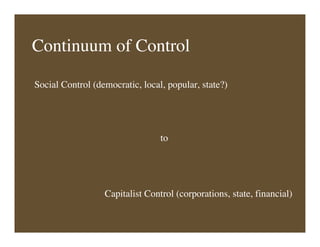
Continuum of Control
Social Control (democratic, local, popular, state?)
to
Capitalist Control (corporations, state, financial)
Iraq- Neoliberalism
• Privatize economy
• Allow foreign investment
• Free trade
• Allow repatriation of profits
• Flat tax
Neoliberalism
• No more “outside” to capitalism - no more
communism, or trade union movement
• Capitalism becomes the sovereign
• Neoliberal subjectivity - the competitive
commodified self
• Chile 1973 to Iraq 2003 - 30 years of
building this kind of state-person
combination - Where did it come from?
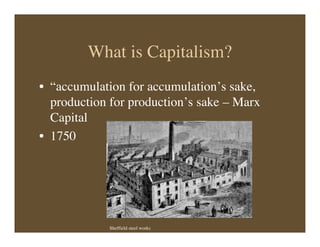
What is Capitalism?
• “accumulation for accumulation’s sake,
production for production’s sake – Marx
Capital
• 1750
Sheffield steel works
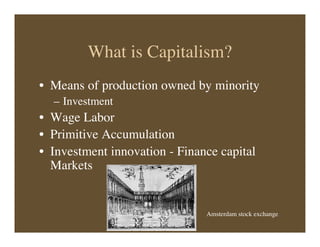
What is Capitalism?
• Means of production owned by minority
– Investment
• Wage Labor
• Primitive Accumulation
• Investment innovation - Finance capital
Markets
Amsterdam stock exchange
What is Capitalism?
• Is the US unique?
– Mobility, cultural egalitarianism, immigration,
popular sovereignty
• Ethos
– sensibility, social imaginary, spirit of capitalism
rationalization-differentiation, freedom,
individuality
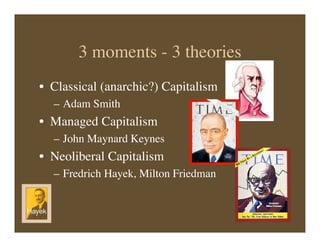
3 moments - 3 theories
• Classical (anarchic?) Capitalism
– Adam Smith
• Managed Capitalism
– John Maynard Keynes
• Neoliberal Capitalism
– Fredrich Hayek, Milton Friedman
Capitalism Growth and Crisis
• Why expanding system?
– Competition between capitalists
– Logic of investment
• Where to invest surplus? Barriers?
– Labor
– Markets
– Materials
– Financial mobility
• Crisis - 1848,1929, 1973, 2008
– System stops - surplus of labor and capital side by side
– Lack of wealth in motion
– So move it around find new investment opportunities
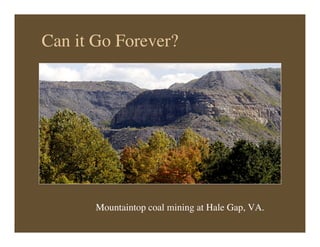
Mountaintop coal mining at Hale Gap, VA.
Can it Go Forever?
Keynesianism (popular control or
capitalist survival?)
• Depression
• Labor Movement
• Public expenditures
• WWII - nationalized economy
• Women in the labor force
• After War - how to absorb surplus?
– Armament race, imperialism, public spending, marshall
plan
– Urban crisis
1970s - Fall of Keynesianism
• 1950s 60s von Hayek - ignored
• But 1973 crash
• Extra petrol dollars, dollar off gold standard
• Seen as opportunity for class revitalization
and neoliberal practices
• New York
– Financial take over
Neoliberal State
• Human Welfare reliant on private property
and free trade
• Labor
• Markets - Loans, IMF
• Growth of Finance Capital
Class project?
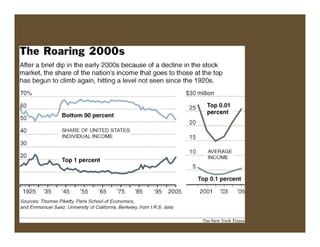
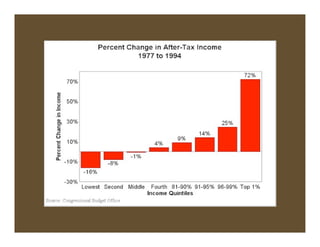
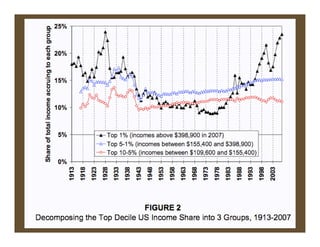
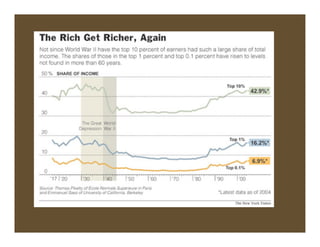
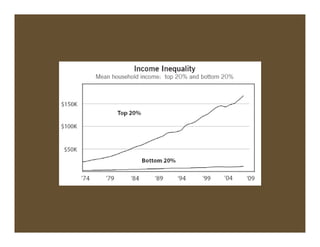
• Concentration of Wealth
– 1970s top 1% got 7-8% of income
– 2000 they got 16%
• Accident?
– Right wing NGOs - moral majority
– Take over of Republican party
• Money from Where?
– Dispossession
– Privatization
– Financial expansion
Do we like it?
• Logic - competition vs cooperation
• History
– Disparity of wealth
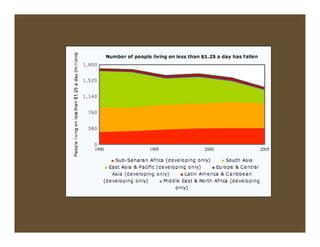
– Poverty/ life expectancy
• Subjectivity
Ethics/ Effects of Neoliberalism
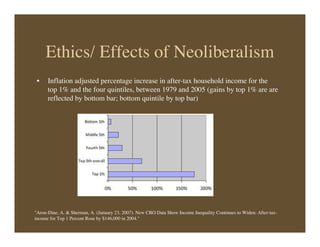
• Inflation adjusted percentage increase in after-tax household income for the
top 1% and the four quintiles, between 1979 and 2005 (gains by top 1% are are
reflected by bottom bar; bottom quintile by top bar)
"Aron-Dine, A. & Sherman, A. (January 23, 2007). New CBO Data Show Income Inequality Continues to Widen: After-tax-
income for Top 1 Percent Rose by $146,000 in 2004."
But…
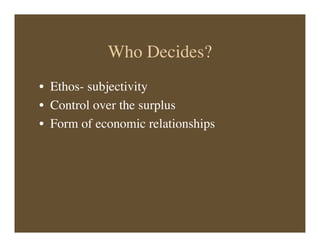
Who Decides?
• Ethos- subjectivity
• Control over the surplus
• Form of economic relationships

What is capitalism

  • 1.
  • 2.
    The history ofcapitalism as it has operated in the last two hundred years in the realm of Western civilization is the record of a steady rise in the wage earners' standard of living. The inherent mark of capitalism is that it is mass production for mass consumption directed by the most energetic and far- sighted individuals, unflaggingly aiming at improvement. Its driving force is the profit motive, the instrumentality of which forces the businessman constantly to provide the consumers with more, better, and cheaper amenities. An excess of profits over losses can appear only in a progressing economy and only to the extent to which the masses' standard of living improves. Thus capitalism is the system under which the keenest and most agile minds are driven to promote to the best of their abilities the welfare of the laggard many.
  • 3.
    To Mobilize andTransform • Critical-Utopian • Understanding-Empathetic
  • 4.
    Continuum of Control SocialControl (democratic, local, popular, state?) to Capitalist Control (corporations, state, financial)
  • 5.
    Iraq- Neoliberalism • Privatizeeconomy • Allow foreign investment • Free trade • Allow repatriation of profits • Flat tax
  • 6.
    Neoliberalism • No more“outside” to capitalism - no more communism, or trade union movement • Capitalism becomes the sovereign • Neoliberal subjectivity - the competitive commodified self • Chile 1973 to Iraq 2003 - 30 years of building this kind of state-person combination - Where did it come from?
  • 7.
    What is Capitalism? •“accumulation for accumulation’s sake, production for production’s sake – Marx Capital • 1750 Sheffield steel works
  • 8.
    What is Capitalism? •Means of production owned by minority – Investment • Wage Labor • Primitive Accumulation • Investment innovation - Finance capital Markets Amsterdam stock exchange
  • 9.
    What is Capitalism? •Is the US unique? – Mobility, cultural egalitarianism, immigration, popular sovereignty • Ethos – sensibility, social imaginary, spirit of capitalism rationalization-differentiation, freedom, individuality
  • 10.
    3 moments -3 theories • Classical (anarchic?) Capitalism – Adam Smith • Managed Capitalism – John Maynard Keynes • Neoliberal Capitalism – Fredrich Hayek, Milton Friedman
  • 11.
    Capitalism Growth andCrisis • Why expanding system? – Competition between capitalists – Logic of investment • Where to invest surplus? Barriers? – Labor – Markets – Materials – Financial mobility • Crisis - 1848,1929, 1973, 2008 – System stops - surplus of labor and capital side by side – Lack of wealth in motion – So move it around find new investment opportunities
  • 13.
    Mountaintop coal miningat Hale Gap, VA. Can it Go Forever?
  • 16.
    Keynesianism (popular controlor capitalist survival?) • Depression • Labor Movement • Public expenditures • WWII - nationalized economy • Women in the labor force • After War - how to absorb surplus? – Armament race, imperialism, public spending, marshall plan – Urban crisis
  • 17.
    1970s - Fallof Keynesianism • 1950s 60s von Hayek - ignored • But 1973 crash • Extra petrol dollars, dollar off gold standard • Seen as opportunity for class revitalization and neoliberal practices • New York – Financial take over
  • 18.
    Neoliberal State • HumanWelfare reliant on private property and free trade • Labor • Markets - Loans, IMF • Growth of Finance Capital
  • 19.
    Class project? • Concentrationof Wealth – 1970s top 1% got 7-8% of income – 2000 they got 16% • Accident? – Right wing NGOs - moral majority – Take over of Republican party • Money from Where? – Dispossession – Privatization – Financial expansion
  • 21.
    Do we likeit? • Logic - competition vs cooperation • History – Disparity of wealth – Poverty/ life expectancy • Subjectivity
  • 22.
    Ethics/ Effects ofNeoliberalism • Inflation adjusted percentage increase in after-tax household income for the top 1% and the four quintiles, between 1979 and 2005 (gains by top 1% are are reflected by bottom bar; bottom quintile by top bar) "Aron-Dine, A. & Sherman, A. (January 23, 2007). New CBO Data Show Income Inequality Continues to Widen: After-tax- income for Top 1 Percent Rose by $146,000 in 2004."
  • 27.
  • 31.
    Who Decides? • Ethos-subjectivity • Control over the surplus • Form of economic relationships