Mode of Production


           KARL MARX
Key Idea
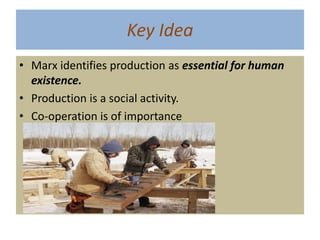
• Marx identifies production as essential for human
  existence.
• Production is a social activity.
• Co-operation is of importance
 Divisions of Labor : Different People have different
  jobs.
 Production has to be organized or ‘managed’.
 Different forms of production:
 “modes” of production=different type of society
 The system of class division is dependent on mode of
  production.
 Society moves from stages to stages when the
  dominant class is displaced by a new emerging class.
 Mode of production also determines all expressions of
  “civilization”:Law,Philosophy,art,
  Religion etc.
• There is a distinction between means of production
  and the relations of production.
   the means of production
      land
     Natural resources
     Technology
   Relations of production
     The social and technical relationships people enter into
     As they acquire and use the means of production.
     The comprised not only relations among individual, but
      between among groups of people or classes.
The Social Superstructure
• Ways of thinking ,values, ideas
  Forms of social consciousness
  Ideologies
• Social Institutions
  Religion
  Family
  Education
  Media
  Government /the state
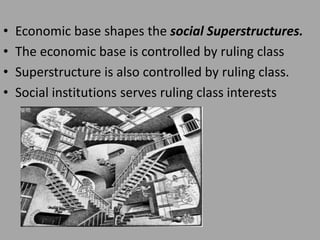
•   Economic base shapes the social Superstructures.
•   The economic base is controlled by ruling class
•   Superstructure is also controlled by ruling class.
•   Social institutions serves ruling class interests
Type of mode of production
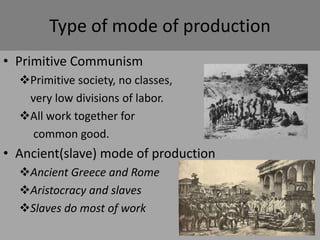
• Primitive Communism
  Primitive society, no classes,
   very low divisions of labor.
  All work together for
    common good.
• Ancient(slave) mode of production
  Ancient Greece and Rome
  Aristocracy and slaves
  Slaves do most of work
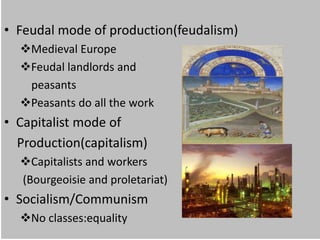
• Feudal mode of production(feudalism)
  Medieval Europe
  Feudal landlords and
   peasants
  Peasants do all the work
• Capitalist mode of
  Production(capitalism)
  Capitalists and workers
  (Bourgeoisie and proletariat)
• Socialism/Communism
  No classes:equality
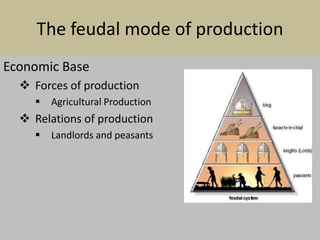
The feudal mode of production
Economic Base
   Forces of production
       Agricultural Production
   Relations of production
       Landlords and peasants
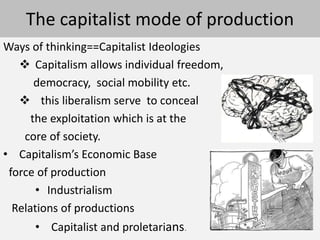
The capitalist mode of production
Ways of thinking==Capitalist Ideologies
    Capitalism allows individual freedom,
       democracy, social mobility etc.
    this liberalism serve to conceal
      the exploitation which is at the
    core of society.
• Capitalism’s Economic Base
 force of production
       • Industrialism
  Relations of productions
      • Capitalist and proletarians.
Capitalism Today
Capitalism Economic Base
  • Forces of production
      Post-Industrialism
     (service sector, computer &IT, stock markets)
  • Relation of production
      Capitalists
      Managerial class
      Proletarians(include ‘white collar’ office workers,Mcworkers)
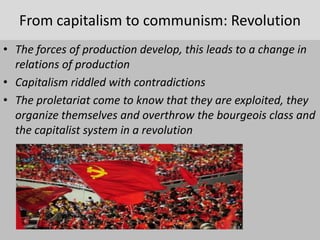
From capitalism to communism: Revolution
• The forces of production develop, this leads to a change in
  relations of production
• Capitalism riddled with contradictions
• The proletariat come to know that they are exploited, they
  organize themselves and overthrow the bourgeois class and
  the capitalist system in a revolution
A Communist Mode of Production
Economical Base
•   forces of production
     Highly developed
     Machine doing a lots of work
     Humane working freely and creatively together
• Relation of production
     Classes abolished
     All work together in cooperation
     All contribute to society, everyone gets what they need
Ways of thinking: the end of ideologies, truth emerges
Thank you
    ?

Mode of production

  • 1.
  • 2.
    Key Idea • Marxidentifies production as essential for human existence. • Production is a social activity. • Co-operation is of importance
  • 3.
     Divisions ofLabor : Different People have different jobs.  Production has to be organized or ‘managed’.  Different forms of production: “modes” of production=different type of society  The system of class division is dependent on mode of production.  Society moves from stages to stages when the dominant class is displaced by a new emerging class.  Mode of production also determines all expressions of “civilization”:Law,Philosophy,art, Religion etc.
  • 4.
    • There isa distinction between means of production and the relations of production.  the means of production  land Natural resources Technology  Relations of production The social and technical relationships people enter into As they acquire and use the means of production. The comprised not only relations among individual, but between among groups of people or classes.
  • 5.
    The Social Superstructure •Ways of thinking ,values, ideas Forms of social consciousness Ideologies • Social Institutions Religion Family Education Media Government /the state
  • 6.
    Economic base shapes the social Superstructures. • The economic base is controlled by ruling class • Superstructure is also controlled by ruling class. • Social institutions serves ruling class interests
  • 7.
    Type of modeof production • Primitive Communism Primitive society, no classes, very low divisions of labor. All work together for common good. • Ancient(slave) mode of production Ancient Greece and Rome Aristocracy and slaves Slaves do most of work
  • 8.
    • Feudal modeof production(feudalism) Medieval Europe Feudal landlords and peasants Peasants do all the work • Capitalist mode of Production(capitalism) Capitalists and workers (Bourgeoisie and proletariat) • Socialism/Communism No classes:equality
  • 9.
    The feudal modeof production Economic Base  Forces of production  Agricultural Production  Relations of production  Landlords and peasants
  • 10.
    The capitalist modeof production Ways of thinking==Capitalist Ideologies  Capitalism allows individual freedom, democracy, social mobility etc.  this liberalism serve to conceal the exploitation which is at the core of society. • Capitalism’s Economic Base force of production • Industrialism Relations of productions • Capitalist and proletarians.
  • 11.
    Capitalism Today Capitalism EconomicBase • Forces of production  Post-Industrialism (service sector, computer &IT, stock markets) • Relation of production  Capitalists  Managerial class  Proletarians(include ‘white collar’ office workers,Mcworkers)
  • 12.
    From capitalism tocommunism: Revolution • The forces of production develop, this leads to a change in relations of production • Capitalism riddled with contradictions • The proletariat come to know that they are exploited, they organize themselves and overthrow the bourgeois class and the capitalist system in a revolution
  • 13.
    A Communist Modeof Production Economical Base • forces of production  Highly developed  Machine doing a lots of work  Humane working freely and creatively together • Relation of production  Classes abolished  All work together in cooperation  All contribute to society, everyone gets what they need Ways of thinking: the end of ideologies, truth emerges
  • 14.