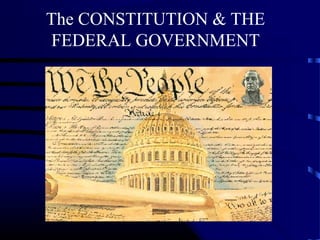
The CONSTITUTION & THE 
FEDERAL GOVERNMENT
Learning Goal 
• SWBAT Identify and Explain how the 
U.S. Constitution organizes the 
government. 
Major Part Purpose 
1. Preamble 
2. Articles 
3. Amendments
This is the Preamble (or introduction) of 
the Constitution.
THE THREE BRANCHES OF 
GOVERNMENT: The 7 Articles 
* Legislative 
* Executive 
* Judicial
THE LEGISLATIVE BRANCH 
House of Representatives 
and 
Senate
LEGISLATIVE BRANCH 
• Also called Congress. 
• Meet in the Capitol 
Building in 
Washington, DC.
LEGISLATIVE BRANCH 
• Bicameral - 2 Houses 
• House of Representatives 
• Senate 
• Responsibility is to make (create) laws. 
• Dual Role - constituents needs & wants and 
considering what is good for nation as a 
whole.
HOUSE OF 
REPRESENTATIVES 
• 435 Seats 
• Number of seats determined by state 
population. 
• 19 Committees - 84 sub-committees 
• Referred to as the “lower” house. 
• Leader is called Speaker of the House.
HOUSE OF 
REPRESENATIVES 
• Has sole power to Impeach President. 
• All bills to raise money must come from the 
House of Representatives. 
• All bills (laws) must pass in the House 
before going to the President.
SENATE 
• 100 seats -2 seats per state - separate vote 
• 16 Committees and 69 sub- committees 
• Referred to as the “upper” house 
• Vice President is President of Senate but 
NO vote unless a tie. 
• Leader = President pro tempore 
• Nicknamed “Millionaires Club”
SENATE 
• Power to try impeachment - 2/3rd vote 
• Senate approval needed on bills to raise 
money. 
• All laws must pass in the Senate before 
going to the President.
LEGISLATIVE BRANCH 
• Powers of Congress 
• Oversee elections 
• Set rules within the legislative branch 
• To tax, to borrow money, to coin money 
• Set rules of naturalization 
• regulate commerce 
• Establish Post Offices
LEGISLATIVE BRANCH 
• Powers continued…. 
• To declare war 
• To raise and support armies 
• To make all laws that are necessary and 
proper
LEGISLATIVE BRANCH 
• Powers that Congress DOES NOT have.. 
• Can not suspend Habeas Corpus 
• Can not tax inter-state commerce 
• Can not take money from treasury unless a 
law is passed to do so 
• Can not give a title of nobility
THE EXECUTIVE BRANCH
EXECUTIVE BRANCH 
• Responsible for enforcing the laws. 
• President is the head of the Executive 
Branch. 
• President provides leadership by setting 
goals and developing policy.
EXECUTIVE BRANCH 
• Must be a natural born citizen 
• Must be at least 35 years old 
• Must be 14 years a resident within the 
United States 
• Term is for 4 years - only 2 in a row 
• Must give state of the union to Congress
EXECUTIVE BRANCH 
• Must take an oath as follows, “I do 
solemnly swear that I will faithfully execute 
the Office of President of the United States, 
and will to the best of my ability, preserve, 
protect and defend the Constitution of the 
United States”
EXECUTIVE BRANCH 
• Powers of the President…. 
• Commander and Chief of the Army and 
Navy (expressly granted in Article II) 
• Can grant pardons and Can veto laws. 
• Can call Congress into session. 
• Make treaties, appoint Supreme Court 
Justices and Ambassadors - Senate approval
EXECUTIVE BRANCH 
• Can be impeached for the following 
reasons: 
• Treason 
• Bribery 
• Other high Crimes and Misdemeanors
EXECUTIVE BRANCH 
• President creates cabinet - advisors 
• Department of State, Treasury, Interior, 
Agriculture, Justice, Labor, Commerce, 
Veterans’ Affairs, Defense, Health and 
Human Services, Housing and Urban 
Development, Transportation, Energy, 
Education and NOW Homeland Security
THE JUDICIAL BRANCH
JUDICIAL BRANCH 
• Responsible for interpreting the law in 
regards to the Constitution 
• Final court of appeals for state and federal 
cases. 
• Supreme Court justices are appointed by the 
President, approved by the Senate, and they 
hold their office for life or retirement.
JUDICIAL BRANCH 
• Currently - 9 Justices - only can be changed 
by Constitutional Amendment 
• Justices hear 150 cases per year - over 5000 
requests 
• 4 Justices need to agree to hear a case 
• Session is October through June 
• Removed by impeachment or conviction
JUDICIAL BRANCH 
• Qualifications - nothing listed in the 
Constitution 
• Unofficial qualifications are: 
• Politically active 
• Lawyer or Lower Court Judge 
• Same political party as the President
JUDICIAL BRANCH 
• Article III is where we define treason, 
establishes the court systems, lists the 
powers of the federal courts and describes 
the kind of cases the court can hear. 
• Treason = committing an overt action - it 
must be seen 
• Talking about treason is not a crime 
• Can not punish family
JUDICIAL BRANCH 
• Judicial Act of 1789 
• Created three part court system 
• Established the Office of Attorney General 
• Job of Attorney General is to represent the 
USA in the Supreme Court and to be a legal 
advisor to the Executive Branch
JUDICIAL BRANCH 
S u p r e m e C o u r t 
9 J u s t i c e s 
C i r c u i t C o u r t s 
1 3 C o u r t o f A p p e a l s 
S t a t e v s . S t a t e 
D i s t r i c t C o u r t s 
T r i a l C o u r t s 
C i v i l C a s e s 
C r i m i n a l C a s e s 
C h i e f J u s t i c e 
H e a d o f S u p r e m e C o u r t
JUDICIAL BRANCH 
• Civil Cases - sue, divorce, contracts, any 
case that does not involve a crime 
• Criminal Cases - commit a crime 
• Defendant - the person on trial 
• Plaintiff - person who brought case to court 
• Prosecutor - represents city, state, people in 
a criminal case
JUDICIAL BRANCH 
• Influences on the Court 
• Precedents - past decisions 
• Personal legal views - strict interpretation 
means to look at intent of founding fathers – 
loose (broad) interpretation means you need 
to take into account changes in society 
• Justices interaction
JUDICIAL BRANCH 
• Influences continued…… 
• Public Opinion, Congress, and the President
Questions: Visual Skills 
• What are the ways an 
amendment can be 
proposed? Do you 
think it is easy or 
difficult to propose an 
amendment? Why? 
• What are the ways an 
amendment is ratified? 
• In what way is it more 
difficult to ratify an 
amendment than to 
propose one?
• Review 
Which of the following is a power expressly 
granted to the president in Article II of the 
Constitution? 
• A. 
executive privilege 
• B. 
the line item veto 
• C. 
impoundment of funds 
• D. 
commander in chief of the armed forces
• Review: 
The Constitution grants the House of 
Representatives the right to 
• A. 
confirm presidential appointments to executive 
positions 
• B. 
initiate all impeachment proceedings 
• C. 
approve treaties with other nations 
• D. 
override objections by the Senate to proposed 
legislation
• REVIEW: 
What power is granted to the vice president 
by the Constitution? 
• A. 
advice and consent to presidential treaties and 
appointments 
• B. 
tie-breaking power in votes by the Senate 
• C. 
floor leadership in the House of Representatives 
• D. 
power to veto legislative bills
• REVIEW: 
A presidential veto of a legislative bill may be 
overridden by 
• A. 
a 2/3 vote of either house of Congress 
• B. 
5 of 9 Supreme Court justices 
• C. 
a majority vote of both houses of Congress 
• D. 
a 2/3 vote of both houses of Congress

3 branches1

  • 1.
    The CONSTITUTION &THE FEDERAL GOVERNMENT
  • 2.
    Learning Goal •SWBAT Identify and Explain how the U.S. Constitution organizes the government. Major Part Purpose 1. Preamble 2. Articles 3. Amendments
  • 3.
    This is thePreamble (or introduction) of the Constitution.
  • 4.
    THE THREE BRANCHESOF GOVERNMENT: The 7 Articles * Legislative * Executive * Judicial
  • 6.
    THE LEGISLATIVE BRANCH House of Representatives and Senate
  • 7.
    LEGISLATIVE BRANCH •Also called Congress. • Meet in the Capitol Building in Washington, DC.
  • 8.
    LEGISLATIVE BRANCH •Bicameral - 2 Houses • House of Representatives • Senate • Responsibility is to make (create) laws. • Dual Role - constituents needs & wants and considering what is good for nation as a whole.
  • 9.
    HOUSE OF REPRESENTATIVES • 435 Seats • Number of seats determined by state population. • 19 Committees - 84 sub-committees • Referred to as the “lower” house. • Leader is called Speaker of the House.
  • 10.
    HOUSE OF REPRESENATIVES • Has sole power to Impeach President. • All bills to raise money must come from the House of Representatives. • All bills (laws) must pass in the House before going to the President.
  • 11.
    SENATE • 100seats -2 seats per state - separate vote • 16 Committees and 69 sub- committees • Referred to as the “upper” house • Vice President is President of Senate but NO vote unless a tie. • Leader = President pro tempore • Nicknamed “Millionaires Club”
  • 12.
    SENATE • Powerto try impeachment - 2/3rd vote • Senate approval needed on bills to raise money. • All laws must pass in the Senate before going to the President.
  • 13.
    LEGISLATIVE BRANCH •Powers of Congress • Oversee elections • Set rules within the legislative branch • To tax, to borrow money, to coin money • Set rules of naturalization • regulate commerce • Establish Post Offices
  • 14.
    LEGISLATIVE BRANCH •Powers continued…. • To declare war • To raise and support armies • To make all laws that are necessary and proper
  • 15.
    LEGISLATIVE BRANCH •Powers that Congress DOES NOT have.. • Can not suspend Habeas Corpus • Can not tax inter-state commerce • Can not take money from treasury unless a law is passed to do so • Can not give a title of nobility
  • 16.
  • 17.
    EXECUTIVE BRANCH •Responsible for enforcing the laws. • President is the head of the Executive Branch. • President provides leadership by setting goals and developing policy.
  • 18.
    EXECUTIVE BRANCH •Must be a natural born citizen • Must be at least 35 years old • Must be 14 years a resident within the United States • Term is for 4 years - only 2 in a row • Must give state of the union to Congress
  • 19.
    EXECUTIVE BRANCH •Must take an oath as follows, “I do solemnly swear that I will faithfully execute the Office of President of the United States, and will to the best of my ability, preserve, protect and defend the Constitution of the United States”
  • 20.
    EXECUTIVE BRANCH •Powers of the President…. • Commander and Chief of the Army and Navy (expressly granted in Article II) • Can grant pardons and Can veto laws. • Can call Congress into session. • Make treaties, appoint Supreme Court Justices and Ambassadors - Senate approval
  • 21.
    EXECUTIVE BRANCH •Can be impeached for the following reasons: • Treason • Bribery • Other high Crimes and Misdemeanors
  • 22.
    EXECUTIVE BRANCH •President creates cabinet - advisors • Department of State, Treasury, Interior, Agriculture, Justice, Labor, Commerce, Veterans’ Affairs, Defense, Health and Human Services, Housing and Urban Development, Transportation, Energy, Education and NOW Homeland Security
  • 24.
  • 25.
    JUDICIAL BRANCH •Responsible for interpreting the law in regards to the Constitution • Final court of appeals for state and federal cases. • Supreme Court justices are appointed by the President, approved by the Senate, and they hold their office for life or retirement.
  • 26.
    JUDICIAL BRANCH •Currently - 9 Justices - only can be changed by Constitutional Amendment • Justices hear 150 cases per year - over 5000 requests • 4 Justices need to agree to hear a case • Session is October through June • Removed by impeachment or conviction
  • 27.
    JUDICIAL BRANCH •Qualifications - nothing listed in the Constitution • Unofficial qualifications are: • Politically active • Lawyer or Lower Court Judge • Same political party as the President
  • 28.
    JUDICIAL BRANCH •Article III is where we define treason, establishes the court systems, lists the powers of the federal courts and describes the kind of cases the court can hear. • Treason = committing an overt action - it must be seen • Talking about treason is not a crime • Can not punish family
  • 29.
    JUDICIAL BRANCH •Judicial Act of 1789 • Created three part court system • Established the Office of Attorney General • Job of Attorney General is to represent the USA in the Supreme Court and to be a legal advisor to the Executive Branch
  • 30.
    JUDICIAL BRANCH Su p r e m e C o u r t 9 J u s t i c e s C i r c u i t C o u r t s 1 3 C o u r t o f A p p e a l s S t a t e v s . S t a t e D i s t r i c t C o u r t s T r i a l C o u r t s C i v i l C a s e s C r i m i n a l C a s e s C h i e f J u s t i c e H e a d o f S u p r e m e C o u r t
  • 31.
    JUDICIAL BRANCH •Civil Cases - sue, divorce, contracts, any case that does not involve a crime • Criminal Cases - commit a crime • Defendant - the person on trial • Plaintiff - person who brought case to court • Prosecutor - represents city, state, people in a criminal case
  • 32.
    JUDICIAL BRANCH •Influences on the Court • Precedents - past decisions • Personal legal views - strict interpretation means to look at intent of founding fathers – loose (broad) interpretation means you need to take into account changes in society • Justices interaction
  • 33.
    JUDICIAL BRANCH •Influences continued…… • Public Opinion, Congress, and the President
  • 37.
    Questions: Visual Skills • What are the ways an amendment can be proposed? Do you think it is easy or difficult to propose an amendment? Why? • What are the ways an amendment is ratified? • In what way is it more difficult to ratify an amendment than to propose one?
  • 39.
    • Review Whichof the following is a power expressly granted to the president in Article II of the Constitution? • A. executive privilege • B. the line item veto • C. impoundment of funds • D. commander in chief of the armed forces
  • 40.
    • Review: TheConstitution grants the House of Representatives the right to • A. confirm presidential appointments to executive positions • B. initiate all impeachment proceedings • C. approve treaties with other nations • D. override objections by the Senate to proposed legislation
  • 41.
    • REVIEW: Whatpower is granted to the vice president by the Constitution? • A. advice and consent to presidential treaties and appointments • B. tie-breaking power in votes by the Senate • C. floor leadership in the House of Representatives • D. power to veto legislative bills
  • 42.
    • REVIEW: Apresidential veto of a legislative bill may be overridden by • A. a 2/3 vote of either house of Congress • B. 5 of 9 Supreme Court justices • C. a majority vote of both houses of Congress • D. a 2/3 vote of both houses of Congress