COMMUNISM
BY KAMILSAYEDBALOCH
BPA2ND SEMESTER
BZUMULTAN
COMMUNISM
COMMUNISM
Communism, political and economic doctrine that aims to replace private
property and a profit-based economy with public ownership and communal
control of at least the major means of production (e.g., mines, mills, and
factories) and the natural resources of a society. Communism is thus a form of
socialism—a higher and more advanced form, according to its advocates.
Exactly how communism differs from socialism has long been a matter of
debate, but the distinction rests largely on the communists’adherence to the
revolutionary socialism of Karl Marx.
Like most writers of the 19th century, Marx tended to use the terms
communism and socialism interchangeably. In his Critique of the Gotha
Programme (1875), however, Marx identified two phases of communism that
would follow the predicted overthrow of capitalism: the first would be a
transitional system in which the working class would control the government
and economy yet still find it necessary to pay people according to how long,
hard, or well they worked
The second would be fully realized communism—a society without
class divisions or government, in which the production and
distribution of goods would be based upon the principle “From each
according to his ability, to each according to his needs.” Marx’s
followers, especially the Russian revolutionary Vladimir Ilich Lenin,
took up this distinction.
In State and Revolution (1917), Lenin asserted that socialism
corresponds to Marx’s first phase of communist society and
communism proper to the second. Lenin and the Bolshevik wing of
the Russian Social-Democratic Workers’ Party reinforced this
distinction in 1918, the year after they seized power in Russia, by
taking the name All-Russian Communist Party. Since then,
communism has been largely, if not exclusively, identified with the
form of political and economic organization developed in the Soviet
Union and adopted subsequently in the People’s Republic of China
and other countries ruled by communist parties.
HISTORICAL BACKGROUND
 Although the term communism did not come into use until the
1840s—it is derived from the Latin commune's, meaning
“shared” or “common”—visions of a society that may be
considered communist appeared as long ago as the 4th century
BCE. In the ideal state described in Plato’s Republic, the
governing class of guardians devotes itself to serving the
interests of the whole community. Because private ownership of
goods would corrupt their owners by encouraging selfishness,
Plato argued, the guardians must live as a large family that
shares common ownership not only of material goods but also of
spouses and children.
 Other early visions of communism drew their inspiration from
religion. The first Christians practiced a simple kind of
communism—as described in Acts 4:32–37, for example—both as
a form of solidarity and as a way of renouncing worldly
possessions. Similar motives later inspired the formation of
monastic orders in which monks took vows of poverty and
promised to share their few worldly goods with each other and
with the poor. The English humanist Sir Thomas More extended
this monastic communism in Utopia (1516), which describes an
imaginary society in which money is abolished and people share
meals, houses, and other goods in common.
 Other fictional communistic utopias followed, notably City of the
Sun (1623), by the Italian philosopher Tommaso Campanella, as
did attempts to put communist ideas into practice. Perhaps the
most noteworthy (if not notorious) of the latter was the theocracy
of the Anabaptists in the Westphalian city of Münster (1534–35),
which ended with the military capture of the city and the execution
of its leaders.
 The English Civil Wars (1642–51) prompted the Diggers to advocate
a kind of agrarian communism in which the Earth would be “a
common treasury,” as Gerrard Winstanley envisioned in The Law of
Freedom (1652) and other works. The vision was not shared by the
Protectorate led by Oliver Cromwell, which harshly suppressed the
Diggers in 1650.
 It was neither a religious upheaval nor a civil war but a
technological and economic revolution—the Industrial Revolution
of the late 18th and early 19th centuries—that provided the impetus
and inspiration for modern communism. This revolution, which
achieved great gains in economic productivity at the expense of an
increasingly miserable working class, encouraged Marx to think
that the class struggles that dominated history were leading
inevitably to a society in which prosperity would be shared by all
through common ownership of the means of production.
MARXIAN COMMUNISM
 Karl Marx was born in the German Rhineland to middle-class parents of
Jewish descent who had abandoned their religion in an attempt to
assimilate into an anti-Semitic society. The young Marx studied
philosophy at the University of Berlin and received a doctorate from the
University of Jena in 1841, but he was unable, because of his Jewish
ancestry and his liberal political views, to secure a teaching position. He
then turned to journalism, where his investigations disclosed what he
perceived as systematic injustice and corruption at all levels of German
society. Convinced that German (and, more broadly, European) society
could not be reformed from within but instead had to be remade from
the ground up, Marx became a political radical. His views soon brought
him to the attention of the police, and, fearing arrest and imprisonment,
he left for Paris. There he renewed an acquaintance with his
countryman Friedrich Engels, who became his friend and coauthor in a
collaboration that was to last nearly 40 years
 The son of the co-owner of a textile firm with factories in
Germany and Britain, Engels was himself a capitalist who
helped to manage the firm’s factory in Manchester. Like
Marx, Engels was deeply disturbed by what he regarded as
the injustices of a society divided by class. Appalled by the
poverty and squalor in which ordinary workers lived and
worked, he described their misery in grisly detail in The
Condition of the English Working Class (1844).
 Marx and Engels maintained that the poverty, disease, and
early death that afflicted the proletariat (the industrial
working class) were endemic to capitalism: they were
systemic and structural problems that could be resolved only
by replacing capitalism with communism.
 Under this alternative system, the major means of industrial
production—such as mines, mills, factories, and railroads—would
be publicly owned and operated for the benefit of all. Marx and
Engels presented this critique of capitalism and a brief sketch of a
possible future communist society in Manifesto of the Communist
Party (1848), which they wrote at the commission of a small group
of radicals called the Communist League.
 Marx, meanwhile, had begun to lay the theoretical and (he
believed) scientific foundations of communism, first in The
German Ideology (written 1845–46, published 1932) and later in
Das Kapital (1867; Capital). His theory has three main aspects:
first, a materialist conception of history; second, a critique of
capitalism and its inner workings; and third, an account of the
revolutionary overthrow of capitalism and its eventual
replacement by communism.
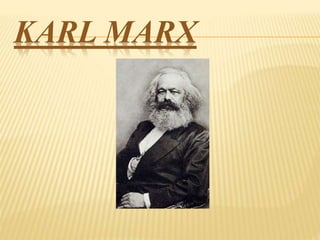
KARL MARX
HISTORICAL MATERIALISM
 According to Marx’s materialist theory, history is a series
of class struggles and revolutionary upheavals, leading
ultimately to freedom for all. Marx derived his views in
part from the philosophy of G.W.F. Hegel, who conceived
of history as the dialectical self-development of “spirit.” In
contrast to Hegel’s philosophical idealism, however, Marx
held that history is driven by the material or economic
conditions that prevail in a given age. “Before men can do
anything else,” Marx wrote, “they must first produce the
means of their subsistence.” Without material production
there would be no life and thus no human activity.
 According to Marx, material production requires two things: “material
forces of production”—roughly, raw materials and the tools required to
extract and process them—and “social relations of production”—
the division of labour through which raw materials are extracted and
processed. Human history is the story of both elements’ changing and
becoming ever more complex. In primitive societies the material forces
were few and simple—for example, grains and the stone tools used to
grind them into flour. With the growth of knowledge and technology came
successive upheavals, or “revolutions,” in the forces and relations of
production and in the complexity of both. For example, iron miners once
worked with pickaxes and shovels, which they owned, but the invention of
the steam shovel changed the way they extracted iron ore. Since no miner
could afford to buy a steam shovel, he had to work for someone who
could. Industrial capitalism, in Marx’s view, is an economic system in
which one class—the ruling bourgeoisie—owns the means of production
while the working class or proletariat effectively loses its independence,
the worker becoming part of the means of production, a mere “appendage
of the machine.”
CRITIQUE OF
CAPITALISM The second aspect of Marx’s theory is his critique of capitalism.
Marx held that human history had progressed through a series of
stages, from ancient slave society through feudalism to capitalism.
In each stage a dominant class uses its control of the means of
production to exploit the labour of a larger class of workers. But
internal tensions or “contradictions” in each stage eventually lead
to the overthrow and replacement of the ruling class by its successor.
Thus, the bourgeoisie overthrew the aristocracy and replaced
feudalism with capitalism; so too, Marx predicted, will the
proletariat overthrow the bourgeoisie and replace capitalism with
communism.
 Marx acknowledged that capitalism was a historically necessary stage of
development that had brought about remarkable scientific and
technological changes—changes that greatly increased aggregate wealth
by extending humankind’s power over nature. The problem, Marx
believed, was that this wealth—and the political power and economic
opportunities that went with it—was unfairly distributed. The capitalists
reap the profits while paying the workers a pittance for long hours of
hard labour. Yet it is the workers who create economic value, according
to Marx’s labour theory of value which holds that the worth of a
commodity is determined by the amount of labour required to produce it.
Under capitalism, Marx claimed, workers are not paid fully or fairly for
their labour because the capitalists siphon off surplus value which they
call profit. Thus, the bourgeois owners of the means of production
amass enormous wealth, while the proletariat falls further into poverty.
 This wealth also enables the bourgeoisie to control the government or
state, which does the bidding of the wealthy and the powerful to the
detriment of the poor and the powerless.
 The exploitation of one class by another remains hidden, however, by a set of ideas
that Marx called ideology. “The ruling ideas of every epoch,” he wrote in The
German Ideology, “are the ideas of the ruling class.” By this, Marx meant that the
conventional or mainstream ideas taught in classrooms, preached from pulpits, and
communicated through the mass media are ideas that serve the interests of the
dominant class. In slave societies, for example, slavery was depicted as normal,
natural, and just. In capitalist societies the free market is portrayed as operating
efficiently, fairly, and for the benefit of all, while alternative economic arrangements
such as socialism are derided or dismissed as false or fanciful. These ideas serve to
justify or legitimize the unequal distribution of economic and political power. Even
exploited workers may fail to understand their true interests and accept the dominant
ideology—a condition that later Marxists called “false consciousness.” One
particularly pernicious source of ideological obfuscation is religion, which Marx
called “the opium of the people” because it purportedly dulls the critical faculties and
leads workers to accept their wretched condition as part of God’s plan.
 Besides inequality, poverty, and false consciousness, capitalism also produces
alienation. By this, Marx meant that the worker is separated or estranged from, the
product of his labour, which he does not own, the process of production, which under
factory conditions makes him “an appendage of the machine, the sense of satisfaction
that he would derive from using his human capacities in unique and creative ways
and, other human beings, whom he sees as rivals competing for jobs and wages.
REVOLUTION AND COMMUNISM
 Marx believed that capitalism is a volatile economic system that will
suffer a series of ever-worsening crises—recessions and depressions that
will produce greater unemployment, lower wages, and increasing misery
among the industrial proletariat. These crises will convince the
proletariat that its interests as a class are implacably opposed to those of
the ruling bourgeoisie. Armed with revolutionary class consciousness,
the proletariat will seize the major means of production along with the
institutions of state power—police, courts, prisons, and so on—and
establish a socialist state that Marx called “the
revolutionary dictatorship of the proletariat.” The proletariat will thus
rule in its own class interest, as the bourgeoisie did before, in order to
prevent a counterrevolution by the displaced bourgeoisie. Once this
threat disappears, however, the need for the state will also disappear.
Thus, the interim state will wither away and be replaced by a classless
communist society
COMMUNISM AFTER MARX
 After Marx’s death in 1883, Engels became the chief expositor
of Marxist theory, which he simplified and in several respects
transformed. His version of Marxism, which he called “scientific
socialism,” made Marxist theory more rigid and deterministic
than Marx had intended. Thus, Marx’s historical materialism
became a variant of philosophical materialism—i.e., the doctrine
that only physical matter and its motions are real. According to
Engels’s science of “dialectics,” everything—nature, history,
even human thought—is reducible to matter moving in
accordance with the same timeless “iron laws” of motion. This
emendation of Marxist theory provided the basis for the
subsequent development of dialectical materialism in the Soviet
Union.
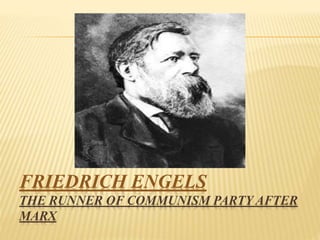
FRIEDRICH ENGELS
THE RUNNER OF COMMUNISM PARTY AFTER
MARX
CHINESE COMMUNISM
 The People’s Republic of China is the only global superpower still
ruled by a communist party, the Chinese Communist Party (CCP), as
it has been since the communists came to power in 1949. Even so, the
official Chinese version of communism—Maoism, or “Mao Zedong
thought”—is a far cry from Marx’s original vision. Mao Zedong, the
founder of the People’s Republic and China’s first communist leader,
claimed to have “creatively” amended Marxist theory and communist
practice to suit Chinese conditions. First, he invoked Lenin’s theory
of imperialism to explain Chinese “backwardness” and to justify a
revolution in a poor agricultural society without the sizable industrial
proletariat that Marx believed was generally necessary to instigate a
workers’ revolution.
 Second, Mao redefined or replaced key concepts of
Marx’s theory. Most notably, he replaced the
Marxist concept of a proletarian “class” of
industrial wage labouer exploited by the capitalist
ruling class with the idea of a proletarian “nation”
of agricultural peasants exploited by capitalist
countries such as the United States. Mao envisioned
the proletarian countries encircling the capitalist
countries and waging wars of national liberation to
cut off foreign sources of cheap labour and raw
materials, thereby depriving the capitalist countries
of the ever-expanding revenues that are the
lifeblood of their economies.
 Mao also planned and oversaw several
industrial and agricultural initiatives that
proved disastrous for the Chinese people.
Among the most important of these was the
Great Leap Forward (1958–60), his version
of Stalin’s policy of rapid, forced
industrialization. Aiming to produce steel in
backyard blast furnaces and to manufacture
other commodities in hastily erected small-
scale factories, it was a spectacular failure.
 As Mao consolidated his power, he became
increasingly concerned with ideological purity,
favouring ideologically dedicated cadres of “reds”
over technical “experts” in education,
engineering, factory management, and other
areas. The Cultural Revolution (1966–76)
attempted to enforce ideological orthodoxy, and it
too proved disastrous. Young Red Guards attacked
bureaucrats, managers, teachers, and others
whose ideological purity was suspect. Widespread
chaos ensued, and eventually the People’s
Liberation Army was called in to restore order.
 Mao also aspired to being the “great
helmsman” who would lead China out of
poverty and into a bright communist future.
His cult of personality, like Stalin’s, portrayed
him as larger than life and endowed with
unrivaled wisdom—as found, for example, in
the sayings and slogans in his “Little Red
Book” (Quotations from Chairman Mao).
After Mao’s death in 1976, the Chinese
communist leadership began to experiment
with limited free-market reforms in the
economy but continued to keep a tight lid on
political dissent.

Communism

  • 1.
  • 2.
  • 3.
    COMMUNISM Communism, political andeconomic doctrine that aims to replace private property and a profit-based economy with public ownership and communal control of at least the major means of production (e.g., mines, mills, and factories) and the natural resources of a society. Communism is thus a form of socialism—a higher and more advanced form, according to its advocates. Exactly how communism differs from socialism has long been a matter of debate, but the distinction rests largely on the communists’adherence to the revolutionary socialism of Karl Marx. Like most writers of the 19th century, Marx tended to use the terms communism and socialism interchangeably. In his Critique of the Gotha Programme (1875), however, Marx identified two phases of communism that would follow the predicted overthrow of capitalism: the first would be a transitional system in which the working class would control the government and economy yet still find it necessary to pay people according to how long, hard, or well they worked
  • 4.
    The second wouldbe fully realized communism—a society without class divisions or government, in which the production and distribution of goods would be based upon the principle “From each according to his ability, to each according to his needs.” Marx’s followers, especially the Russian revolutionary Vladimir Ilich Lenin, took up this distinction. In State and Revolution (1917), Lenin asserted that socialism corresponds to Marx’s first phase of communist society and communism proper to the second. Lenin and the Bolshevik wing of the Russian Social-Democratic Workers’ Party reinforced this distinction in 1918, the year after they seized power in Russia, by taking the name All-Russian Communist Party. Since then, communism has been largely, if not exclusively, identified with the form of political and economic organization developed in the Soviet Union and adopted subsequently in the People’s Republic of China and other countries ruled by communist parties.
  • 5.
    HISTORICAL BACKGROUND  Althoughthe term communism did not come into use until the 1840s—it is derived from the Latin commune's, meaning “shared” or “common”—visions of a society that may be considered communist appeared as long ago as the 4th century BCE. In the ideal state described in Plato’s Republic, the governing class of guardians devotes itself to serving the interests of the whole community. Because private ownership of goods would corrupt their owners by encouraging selfishness, Plato argued, the guardians must live as a large family that shares common ownership not only of material goods but also of spouses and children.
  • 6.
     Other earlyvisions of communism drew their inspiration from religion. The first Christians practiced a simple kind of communism—as described in Acts 4:32–37, for example—both as a form of solidarity and as a way of renouncing worldly possessions. Similar motives later inspired the formation of monastic orders in which monks took vows of poverty and promised to share their few worldly goods with each other and with the poor. The English humanist Sir Thomas More extended this monastic communism in Utopia (1516), which describes an imaginary society in which money is abolished and people share meals, houses, and other goods in common.  Other fictional communistic utopias followed, notably City of the Sun (1623), by the Italian philosopher Tommaso Campanella, as did attempts to put communist ideas into practice. Perhaps the most noteworthy (if not notorious) of the latter was the theocracy of the Anabaptists in the Westphalian city of Münster (1534–35), which ended with the military capture of the city and the execution of its leaders.
  • 7.
     The EnglishCivil Wars (1642–51) prompted the Diggers to advocate a kind of agrarian communism in which the Earth would be “a common treasury,” as Gerrard Winstanley envisioned in The Law of Freedom (1652) and other works. The vision was not shared by the Protectorate led by Oliver Cromwell, which harshly suppressed the Diggers in 1650.  It was neither a religious upheaval nor a civil war but a technological and economic revolution—the Industrial Revolution of the late 18th and early 19th centuries—that provided the impetus and inspiration for modern communism. This revolution, which achieved great gains in economic productivity at the expense of an increasingly miserable working class, encouraged Marx to think that the class struggles that dominated history were leading inevitably to a society in which prosperity would be shared by all through common ownership of the means of production.
  • 8.
    MARXIAN COMMUNISM  KarlMarx was born in the German Rhineland to middle-class parents of Jewish descent who had abandoned their religion in an attempt to assimilate into an anti-Semitic society. The young Marx studied philosophy at the University of Berlin and received a doctorate from the University of Jena in 1841, but he was unable, because of his Jewish ancestry and his liberal political views, to secure a teaching position. He then turned to journalism, where his investigations disclosed what he perceived as systematic injustice and corruption at all levels of German society. Convinced that German (and, more broadly, European) society could not be reformed from within but instead had to be remade from the ground up, Marx became a political radical. His views soon brought him to the attention of the police, and, fearing arrest and imprisonment, he left for Paris. There he renewed an acquaintance with his countryman Friedrich Engels, who became his friend and coauthor in a collaboration that was to last nearly 40 years
  • 9.
     The sonof the co-owner of a textile firm with factories in Germany and Britain, Engels was himself a capitalist who helped to manage the firm’s factory in Manchester. Like Marx, Engels was deeply disturbed by what he regarded as the injustices of a society divided by class. Appalled by the poverty and squalor in which ordinary workers lived and worked, he described their misery in grisly detail in The Condition of the English Working Class (1844).  Marx and Engels maintained that the poverty, disease, and early death that afflicted the proletariat (the industrial working class) were endemic to capitalism: they were systemic and structural problems that could be resolved only by replacing capitalism with communism.
  • 10.
     Under thisalternative system, the major means of industrial production—such as mines, mills, factories, and railroads—would be publicly owned and operated for the benefit of all. Marx and Engels presented this critique of capitalism and a brief sketch of a possible future communist society in Manifesto of the Communist Party (1848), which they wrote at the commission of a small group of radicals called the Communist League.  Marx, meanwhile, had begun to lay the theoretical and (he believed) scientific foundations of communism, first in The German Ideology (written 1845–46, published 1932) and later in Das Kapital (1867; Capital). His theory has three main aspects: first, a materialist conception of history; second, a critique of capitalism and its inner workings; and third, an account of the revolutionary overthrow of capitalism and its eventual replacement by communism.
  • 11.
  • 12.
    HISTORICAL MATERIALISM  Accordingto Marx’s materialist theory, history is a series of class struggles and revolutionary upheavals, leading ultimately to freedom for all. Marx derived his views in part from the philosophy of G.W.F. Hegel, who conceived of history as the dialectical self-development of “spirit.” In contrast to Hegel’s philosophical idealism, however, Marx held that history is driven by the material or economic conditions that prevail in a given age. “Before men can do anything else,” Marx wrote, “they must first produce the means of their subsistence.” Without material production there would be no life and thus no human activity.
  • 13.
     According toMarx, material production requires two things: “material forces of production”—roughly, raw materials and the tools required to extract and process them—and “social relations of production”— the division of labour through which raw materials are extracted and processed. Human history is the story of both elements’ changing and becoming ever more complex. In primitive societies the material forces were few and simple—for example, grains and the stone tools used to grind them into flour. With the growth of knowledge and technology came successive upheavals, or “revolutions,” in the forces and relations of production and in the complexity of both. For example, iron miners once worked with pickaxes and shovels, which they owned, but the invention of the steam shovel changed the way they extracted iron ore. Since no miner could afford to buy a steam shovel, he had to work for someone who could. Industrial capitalism, in Marx’s view, is an economic system in which one class—the ruling bourgeoisie—owns the means of production while the working class or proletariat effectively loses its independence, the worker becoming part of the means of production, a mere “appendage of the machine.”
  • 14.
    CRITIQUE OF CAPITALISM Thesecond aspect of Marx’s theory is his critique of capitalism. Marx held that human history had progressed through a series of stages, from ancient slave society through feudalism to capitalism. In each stage a dominant class uses its control of the means of production to exploit the labour of a larger class of workers. But internal tensions or “contradictions” in each stage eventually lead to the overthrow and replacement of the ruling class by its successor. Thus, the bourgeoisie overthrew the aristocracy and replaced feudalism with capitalism; so too, Marx predicted, will the proletariat overthrow the bourgeoisie and replace capitalism with communism.
  • 15.
     Marx acknowledgedthat capitalism was a historically necessary stage of development that had brought about remarkable scientific and technological changes—changes that greatly increased aggregate wealth by extending humankind’s power over nature. The problem, Marx believed, was that this wealth—and the political power and economic opportunities that went with it—was unfairly distributed. The capitalists reap the profits while paying the workers a pittance for long hours of hard labour. Yet it is the workers who create economic value, according to Marx’s labour theory of value which holds that the worth of a commodity is determined by the amount of labour required to produce it. Under capitalism, Marx claimed, workers are not paid fully or fairly for their labour because the capitalists siphon off surplus value which they call profit. Thus, the bourgeois owners of the means of production amass enormous wealth, while the proletariat falls further into poverty.  This wealth also enables the bourgeoisie to control the government or state, which does the bidding of the wealthy and the powerful to the detriment of the poor and the powerless.
  • 16.
     The exploitationof one class by another remains hidden, however, by a set of ideas that Marx called ideology. “The ruling ideas of every epoch,” he wrote in The German Ideology, “are the ideas of the ruling class.” By this, Marx meant that the conventional or mainstream ideas taught in classrooms, preached from pulpits, and communicated through the mass media are ideas that serve the interests of the dominant class. In slave societies, for example, slavery was depicted as normal, natural, and just. In capitalist societies the free market is portrayed as operating efficiently, fairly, and for the benefit of all, while alternative economic arrangements such as socialism are derided or dismissed as false or fanciful. These ideas serve to justify or legitimize the unequal distribution of economic and political power. Even exploited workers may fail to understand their true interests and accept the dominant ideology—a condition that later Marxists called “false consciousness.” One particularly pernicious source of ideological obfuscation is religion, which Marx called “the opium of the people” because it purportedly dulls the critical faculties and leads workers to accept their wretched condition as part of God’s plan.  Besides inequality, poverty, and false consciousness, capitalism also produces alienation. By this, Marx meant that the worker is separated or estranged from, the product of his labour, which he does not own, the process of production, which under factory conditions makes him “an appendage of the machine, the sense of satisfaction that he would derive from using his human capacities in unique and creative ways and, other human beings, whom he sees as rivals competing for jobs and wages.
  • 17.
    REVOLUTION AND COMMUNISM Marx believed that capitalism is a volatile economic system that will suffer a series of ever-worsening crises—recessions and depressions that will produce greater unemployment, lower wages, and increasing misery among the industrial proletariat. These crises will convince the proletariat that its interests as a class are implacably opposed to those of the ruling bourgeoisie. Armed with revolutionary class consciousness, the proletariat will seize the major means of production along with the institutions of state power—police, courts, prisons, and so on—and establish a socialist state that Marx called “the revolutionary dictatorship of the proletariat.” The proletariat will thus rule in its own class interest, as the bourgeoisie did before, in order to prevent a counterrevolution by the displaced bourgeoisie. Once this threat disappears, however, the need for the state will also disappear. Thus, the interim state will wither away and be replaced by a classless communist society
  • 18.
    COMMUNISM AFTER MARX After Marx’s death in 1883, Engels became the chief expositor of Marxist theory, which he simplified and in several respects transformed. His version of Marxism, which he called “scientific socialism,” made Marxist theory more rigid and deterministic than Marx had intended. Thus, Marx’s historical materialism became a variant of philosophical materialism—i.e., the doctrine that only physical matter and its motions are real. According to Engels’s science of “dialectics,” everything—nature, history, even human thought—is reducible to matter moving in accordance with the same timeless “iron laws” of motion. This emendation of Marxist theory provided the basis for the subsequent development of dialectical materialism in the Soviet Union.
  • 19.
    FRIEDRICH ENGELS THE RUNNEROF COMMUNISM PARTY AFTER MARX
  • 20.
    CHINESE COMMUNISM  ThePeople’s Republic of China is the only global superpower still ruled by a communist party, the Chinese Communist Party (CCP), as it has been since the communists came to power in 1949. Even so, the official Chinese version of communism—Maoism, or “Mao Zedong thought”—is a far cry from Marx’s original vision. Mao Zedong, the founder of the People’s Republic and China’s first communist leader, claimed to have “creatively” amended Marxist theory and communist practice to suit Chinese conditions. First, he invoked Lenin’s theory of imperialism to explain Chinese “backwardness” and to justify a revolution in a poor agricultural society without the sizable industrial proletariat that Marx believed was generally necessary to instigate a workers’ revolution.
  • 21.
     Second, Maoredefined or replaced key concepts of Marx’s theory. Most notably, he replaced the Marxist concept of a proletarian “class” of industrial wage labouer exploited by the capitalist ruling class with the idea of a proletarian “nation” of agricultural peasants exploited by capitalist countries such as the United States. Mao envisioned the proletarian countries encircling the capitalist countries and waging wars of national liberation to cut off foreign sources of cheap labour and raw materials, thereby depriving the capitalist countries of the ever-expanding revenues that are the lifeblood of their economies.
  • 22.
     Mao alsoplanned and oversaw several industrial and agricultural initiatives that proved disastrous for the Chinese people. Among the most important of these was the Great Leap Forward (1958–60), his version of Stalin’s policy of rapid, forced industrialization. Aiming to produce steel in backyard blast furnaces and to manufacture other commodities in hastily erected small- scale factories, it was a spectacular failure.
  • 23.
     As Maoconsolidated his power, he became increasingly concerned with ideological purity, favouring ideologically dedicated cadres of “reds” over technical “experts” in education, engineering, factory management, and other areas. The Cultural Revolution (1966–76) attempted to enforce ideological orthodoxy, and it too proved disastrous. Young Red Guards attacked bureaucrats, managers, teachers, and others whose ideological purity was suspect. Widespread chaos ensued, and eventually the People’s Liberation Army was called in to restore order.
  • 24.
     Mao alsoaspired to being the “great helmsman” who would lead China out of poverty and into a bright communist future. His cult of personality, like Stalin’s, portrayed him as larger than life and endowed with unrivaled wisdom—as found, for example, in the sayings and slogans in his “Little Red Book” (Quotations from Chairman Mao). After Mao’s death in 1976, the Chinese communist leadership began to experiment with limited free-market reforms in the economy but continued to keep a tight lid on political dissent.