•INTAN IZZANNA BINTI MARSUL 
•NUR SHAHEERA BINTI MOHAMED 
SALEH 
•NUR ‘IZZATI BINTI ABU BAKAR 
•NUR AZLIN SURIANI BINTI MAMAT
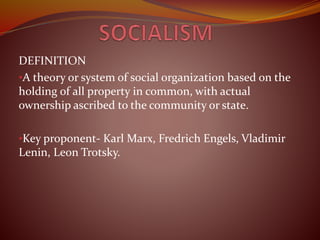
DEFINITION 
•A theory or system of social organization based on the 
holding of all property in common, with actual 
ownership ascribed to the community or state. 
•Key proponent- Karl Marx, Fredrich Engels, Vladimir 
Lenin, Leon Trotsky.
GENERAL GOAL OF SOCIALISM 
 To maximize wealth and opportunity 
 To minimize human suffering through public control 
of industry and social services. 
 The means and profits of production are privately 
held.
CHARACTERISTIC OF SOCIALISM 
 In socialism means of production are owned by the 
state 
 Economic activities are planned by the central 
planning authority 
 Absence of competition 
 Equal opportunites to all 
 No economic freedom to the people
ADVANTAGES OF SOCIALISM 
 Grater welfare- in social economy, there is less inequality 
of income as compared to capitalist economy because of 
the absence of private ownership of means of production. 
In socialist economic system every one works hard and paid 
as per his skills and ability 
 Absence of business fluctuations- superior to a 
capitalist economy that is free from business fluctuation. 
 Economic growth-a planned socialist economy functions 
right according to the plan in a systematic and orderly 
manners and marches rapidly on the road of economic 
progress
DISADVANTAGES OF SOCIALISM 
 Elimination of individualism- lack of economic 
freedom, everything is controlled by a centralized body. 
Individuals are not allowed to own any assets, everything 
belong to state. 
 Economic Equality- Socialists claim more equal 
distribution of wealth but practically it is proven that 
complete economic equality is virtually impossible. Since it 
is a planned economy the poor suffer even more. 
 An artificial system- since it is a planned economy, every 
aspect of the economy is to be determined by the 
government. Do not apply the forces of demand and 
supply.

Communism & Socialism

  • 1.
    •INTAN IZZANNA BINTIMARSUL •NUR SHAHEERA BINTI MOHAMED SALEH •NUR ‘IZZATI BINTI ABU BAKAR •NUR AZLIN SURIANI BINTI MAMAT
  • 8.
    DEFINITION •A theoryor system of social organization based on the holding of all property in common, with actual ownership ascribed to the community or state. •Key proponent- Karl Marx, Fredrich Engels, Vladimir Lenin, Leon Trotsky.
  • 9.
    GENERAL GOAL OFSOCIALISM  To maximize wealth and opportunity  To minimize human suffering through public control of industry and social services.  The means and profits of production are privately held.
  • 10.
    CHARACTERISTIC OF SOCIALISM  In socialism means of production are owned by the state  Economic activities are planned by the central planning authority  Absence of competition  Equal opportunites to all  No economic freedom to the people
  • 11.
    ADVANTAGES OF SOCIALISM  Grater welfare- in social economy, there is less inequality of income as compared to capitalist economy because of the absence of private ownership of means of production. In socialist economic system every one works hard and paid as per his skills and ability  Absence of business fluctuations- superior to a capitalist economy that is free from business fluctuation.  Economic growth-a planned socialist economy functions right according to the plan in a systematic and orderly manners and marches rapidly on the road of economic progress
  • 12.
    DISADVANTAGES OF SOCIALISM  Elimination of individualism- lack of economic freedom, everything is controlled by a centralized body. Individuals are not allowed to own any assets, everything belong to state.  Economic Equality- Socialists claim more equal distribution of wealth but practically it is proven that complete economic equality is virtually impossible. Since it is a planned economy the poor suffer even more.  An artificial system- since it is a planned economy, every aspect of the economy is to be determined by the government. Do not apply the forces of demand and supply.