EFFECTIVE COMMUNICATION
M.Rajendran
Training Associate (English)
Zonal Institute Of Education And Training
Mysuru
 Qualities of a Good Teacher
 Top skills of a Teacher
 What is Communication
 Types of Communication
 WHY Effective communication
 Who is a good Communicator
 Reason for poor Communication
 Tips for improving Communcation Skills
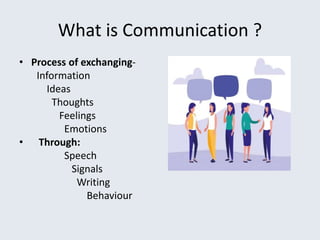
What is Communication ?
• Process of exchanging-
Information
Ideas
Thoughts
Feelings
Emotions
• Through:
Speech
Signals
Writing
Behaviour
Types of Communication
• Verbal Communication
• Nonverbal Communication
• facial expressions
• the tone and pitch of the voice,
• Gestures
• Visual Communication:
• signs, drawings, etc.
Communication
• All the four skills (LSRW) are a must for
effective communication skills
• A lot can be communicated without spoken
language.
• (Non-Verbal)
WHY Effective communication
• Effective communication helps us better to
understand a person or situation and enables us
to resolve differences and build trust and
respect
• Effective communication means that the
receiver fully understands and interprets
what the speaker and/or writer has conveyed.
Body Language
 Postures ( e.g., head up and alert, leaning forward)
 Gestures ( e.g., keeping arms uncrossed)
 Facial expression (e.g., smiling warmly)
 Eye contact ( e.g., making appropriate eye contact)
 Active movement (e.g., moving around)
 Physical distance ( e.g., not very far, not very close)
 Volume of voice (e.g., pleasant, audible volume)
 Tone of voice ( e.g., confident, assuring tone)
 Modulate voice (e.g., avoid high pitch)
Communication is all about:
• --How clear we are about what we want to
communicate
• --How well we understand our audience
• --How efficient we are in conveying what we want
to communicate
• --How well we understand the response given to
us /how receptive we are to the ideas of others.
• --how well we restructure our ideas to clarify the
missing links in our earlier communication
Our Questions
• Who do we communicate with?
• What are their qualities? Age group,back
ground,taste
• What is their need to listen to us.
A Good Communicator
• -is confident
• -is clear about his/her goals
• -is clear about the message
• -has a good command over the medium chosen for
communication including language
• -make use of support systems like body postures,
gestures to strengthen his/her presentation
• Has patience to listen to others and understand
what they say
• -does not dominate though assertive
• -builds communication based on situation
A Good Communicator
• -has respect to people he/she is communicating
with
• -can find suitable alternatives to make
communication more effective
• -can understand the point of view of others
• -can think of consequences of a situation
• -can react quickly to a message ,if required
• -Receive feed back from others without
hesitation
• -is polite and considerate
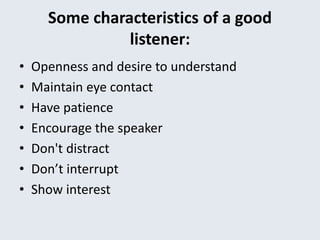
Some characteristics of a good
listener:
• Openness and desire to understand
• Maintain eye contact
• Have patience
• Encourage the speaker
• Don't distract
• Don’t interrupt
• Show interest
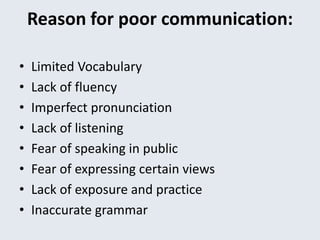
Reason for poor communication:
• Limited Vocabulary
• Lack of fluency
• Imperfect pronunciation
• Lack of listening
• Fear of speaking in public
• Fear of expressing certain views
• Lack of exposure and practice
• Inaccurate grammar
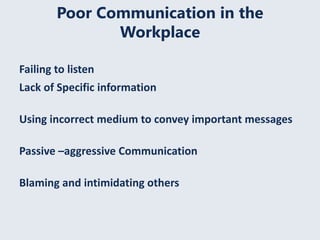
Poor Communication in the
Workplace
Failing to listen
Lack of Specific information
Using incorrect medium to convey important messages
Passive –aggressive Communication
Blaming and intimidating others
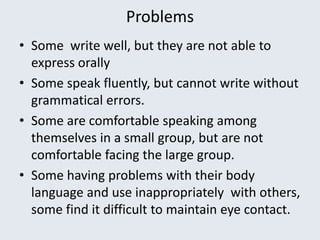
Problems
• Some write well, but they are not able to
express orally
• Some speak fluently, but cannot write without
grammatical errors.
• Some are comfortable speaking among
themselves in a small group, but are not
comfortable facing the large group.
• Some having problems with their body
language and use inappropriately with others,
some find it difficult to maintain eye contact.
Don'ts
• Do not react and mutter in anger.
• Avoid technical terms & terminologies not
understood by majority.
• Do not assume that everybody understands you.
• Avoid glancing here and there as it distracts the
listener.
• Do not interrupt the speaker.
Don'ts
• Do not jump to conclusion.
• Do not finish other’s sentences.
• Do not rush to prepare the response
before someone is done with
speaking.
• Do not speak for others.
Tips for….. communications
• Think & speak.
• Use simple words and phrases.
• Speak clear and loud.
• Maintain a moderate speed.
• Check twice with the listener if you are understood If
interrupted, do a little recap.
• Pay undivided attention to the speaker while listening.
• Make notes of important points.
• Ask for clarification if needed.
Tips for improving Communicating
Skills:
• Read a lot
• Language: Pronunciation, Accent, Modulation,
Intonation
• Vocabulary
• Appropriate Body Language
• Listen & observe more
• Practice meditation & good thoughts.
• Speak in natural tone for a warm rapport.
• Add appropriate humour to lighten the tension.
Tips to Improve Body Language
• : -
• Keep appropriate distance.
• Touch only when appropriate.
• Be aware - people may get false clues.
• Maintain eye contact.
• Be presentable & confident.
• Smile genuinely.
• Maintain eye contact.
1. Improve pronunciation and diction
• ~ Sing English songs out loud!
• ~ Watch news shows on channels like CNN
and BBC.
• ~Buy books on pronunciation and language
that come with audio cassettes-
• Better English Pronunciation by J D O'Connor.
It is part of the Cambridge series, and some of
those books come with cassettes.
3. Five exercises to practise every day!
• i. Pretend you are a newscaster and read out the
newspaper to your mirror.
• ii. Focus on national newspapers.
• iii. While reading a book, underline all the words
you do not know. Look them up in the dictionary.
• iv. Make a list of these words, and make sure you
use at least five of them in a conversation during
the day.
• v. Most important, make an effort to speak in
English to your friends and family.
Speaking Skills
• A good speaker is a good listener too
• Knowledge,confidence and delivery
are the basic elements of an effective
speech.
Reading Skills for Effective
Communication
 Tips while reading:
• Read inspirational books or motivational books
• Subscribe to newspaper, newsletters, and
periodicals journals of your interest.
• Underline the important points, note down the
difficult words and consult the dictionary.
• Improve vocabulary
• By reading books, one can improve one’s way of
expression
Writing Skills: For Effective Writing
Accuracy
Appropriateness
Attentiveness
Avoiding ambiguity.
Conciseness
Correctness
Clarity
Consistency
Concreteness
Important points to be covered.
Using simple language
There are four ways, and only four
ways, in which we have contact with
the world: what we do, how we look,
what we say, and how we say it
-Dale Camegie
Conclusion:
Master interpersonal communications
Identify and eliminate habits that block your message
Ensure your vocal, verbal and visual cues are all
consistent
Practise and apply all the skills of Communication.

Essentials of communications for students.pptx

  • 1.
    EFFECTIVE COMMUNICATION M.Rajendran Training Associate(English) Zonal Institute Of Education And Training Mysuru
  • 2.
     Qualities ofa Good Teacher  Top skills of a Teacher  What is Communication  Types of Communication  WHY Effective communication  Who is a good Communicator  Reason for poor Communication  Tips for improving Communcation Skills
  • 3.
    What is Communication? • Process of exchanging- Information Ideas Thoughts Feelings Emotions • Through: Speech Signals Writing Behaviour
  • 4.
    Types of Communication •Verbal Communication • Nonverbal Communication • facial expressions • the tone and pitch of the voice, • Gestures • Visual Communication: • signs, drawings, etc.
  • 5.
    Communication • All thefour skills (LSRW) are a must for effective communication skills • A lot can be communicated without spoken language. • (Non-Verbal)
  • 6.
    WHY Effective communication •Effective communication helps us better to understand a person or situation and enables us to resolve differences and build trust and respect • Effective communication means that the receiver fully understands and interprets what the speaker and/or writer has conveyed.
  • 7.
    Body Language  Postures( e.g., head up and alert, leaning forward)  Gestures ( e.g., keeping arms uncrossed)  Facial expression (e.g., smiling warmly)  Eye contact ( e.g., making appropriate eye contact)  Active movement (e.g., moving around)  Physical distance ( e.g., not very far, not very close)  Volume of voice (e.g., pleasant, audible volume)  Tone of voice ( e.g., confident, assuring tone)  Modulate voice (e.g., avoid high pitch)
  • 8.
    Communication is allabout: • --How clear we are about what we want to communicate • --How well we understand our audience • --How efficient we are in conveying what we want to communicate • --How well we understand the response given to us /how receptive we are to the ideas of others. • --how well we restructure our ideas to clarify the missing links in our earlier communication
  • 9.
    Our Questions • Whodo we communicate with? • What are their qualities? Age group,back ground,taste • What is their need to listen to us.
  • 10.
    A Good Communicator •-is confident • -is clear about his/her goals • -is clear about the message • -has a good command over the medium chosen for communication including language • -make use of support systems like body postures, gestures to strengthen his/her presentation • Has patience to listen to others and understand what they say • -does not dominate though assertive • -builds communication based on situation
  • 11.
    A Good Communicator •-has respect to people he/she is communicating with • -can find suitable alternatives to make communication more effective • -can understand the point of view of others • -can think of consequences of a situation • -can react quickly to a message ,if required • -Receive feed back from others without hesitation • -is polite and considerate
  • 12.
    Some characteristics ofa good listener: • Openness and desire to understand • Maintain eye contact • Have patience • Encourage the speaker • Don't distract • Don’t interrupt • Show interest
  • 13.
    Reason for poorcommunication: • Limited Vocabulary • Lack of fluency • Imperfect pronunciation • Lack of listening • Fear of speaking in public • Fear of expressing certain views • Lack of exposure and practice • Inaccurate grammar
  • 14.
    Poor Communication inthe Workplace Failing to listen Lack of Specific information Using incorrect medium to convey important messages Passive –aggressive Communication Blaming and intimidating others
  • 15.
    Problems • Some writewell, but they are not able to express orally • Some speak fluently, but cannot write without grammatical errors. • Some are comfortable speaking among themselves in a small group, but are not comfortable facing the large group. • Some having problems with their body language and use inappropriately with others, some find it difficult to maintain eye contact.
  • 16.
    Don'ts • Do notreact and mutter in anger. • Avoid technical terms & terminologies not understood by majority. • Do not assume that everybody understands you. • Avoid glancing here and there as it distracts the listener. • Do not interrupt the speaker.
  • 17.
    Don'ts • Do notjump to conclusion. • Do not finish other’s sentences. • Do not rush to prepare the response before someone is done with speaking. • Do not speak for others.
  • 18.
    Tips for….. communications •Think & speak. • Use simple words and phrases. • Speak clear and loud. • Maintain a moderate speed. • Check twice with the listener if you are understood If interrupted, do a little recap. • Pay undivided attention to the speaker while listening. • Make notes of important points. • Ask for clarification if needed.
  • 19.
    Tips for improvingCommunicating Skills: • Read a lot • Language: Pronunciation, Accent, Modulation, Intonation • Vocabulary • Appropriate Body Language • Listen & observe more • Practice meditation & good thoughts. • Speak in natural tone for a warm rapport. • Add appropriate humour to lighten the tension.
  • 20.
    Tips to ImproveBody Language • : - • Keep appropriate distance. • Touch only when appropriate. • Be aware - people may get false clues. • Maintain eye contact. • Be presentable & confident. • Smile genuinely. • Maintain eye contact.
  • 21.
    1. Improve pronunciationand diction • ~ Sing English songs out loud! • ~ Watch news shows on channels like CNN and BBC. • ~Buy books on pronunciation and language that come with audio cassettes- • Better English Pronunciation by J D O'Connor. It is part of the Cambridge series, and some of those books come with cassettes.
  • 22.
    3. Five exercisesto practise every day! • i. Pretend you are a newscaster and read out the newspaper to your mirror. • ii. Focus on national newspapers. • iii. While reading a book, underline all the words you do not know. Look them up in the dictionary. • iv. Make a list of these words, and make sure you use at least five of them in a conversation during the day. • v. Most important, make an effort to speak in English to your friends and family.
  • 23.
    Speaking Skills • Agood speaker is a good listener too • Knowledge,confidence and delivery are the basic elements of an effective speech.
  • 24.
    Reading Skills forEffective Communication  Tips while reading: • Read inspirational books or motivational books • Subscribe to newspaper, newsletters, and periodicals journals of your interest. • Underline the important points, note down the difficult words and consult the dictionary. • Improve vocabulary • By reading books, one can improve one’s way of expression
  • 25.
    Writing Skills: ForEffective Writing Accuracy Appropriateness Attentiveness Avoiding ambiguity. Conciseness Correctness Clarity Consistency Concreteness Important points to be covered. Using simple language
  • 26.
    There are fourways, and only four ways, in which we have contact with the world: what we do, how we look, what we say, and how we say it -Dale Camegie
  • 27.
    Conclusion: Master interpersonal communications Identifyand eliminate habits that block your message Ensure your vocal, verbal and visual cues are all consistent Practise and apply all the skills of Communication.