Subject:- Mass Media and
Communication
Presented by
Milan Parmar
pg14101026
Types of Communication
What is
Communication ?
o The word communication has originated from Latin
word “Communes” which means something common.
o Communication is the process of exchanging
information, ideas, thoughts, feeling and emotions
through speech signals, writing or behavior.
o Communication means the practice of encoding
information through sounds, symbols, and actions in
order to transmit that information to others.
Elements of Communication
Process
Source
Message
Channel
Receiver
Types of Communication
 There are several ways based on which we
can divide communication accordingly.
 Based on identity persons involved in the
process ?
 Based on the medium/ channel of the
communication
 ….numbers of person involved involves.
Based on Identity of the person
Informal
 Informal
– Usually used with friends
and family
– Contains shortened version
of words
– Contains slang words
– Talking with Friends,
classmates, family members
Formal
– Used in a Professional Setting
– No Slang
– Pronounce words correctly
– Interacting with teacher, with
boss, elders in house
Based on the Channel/ Medium
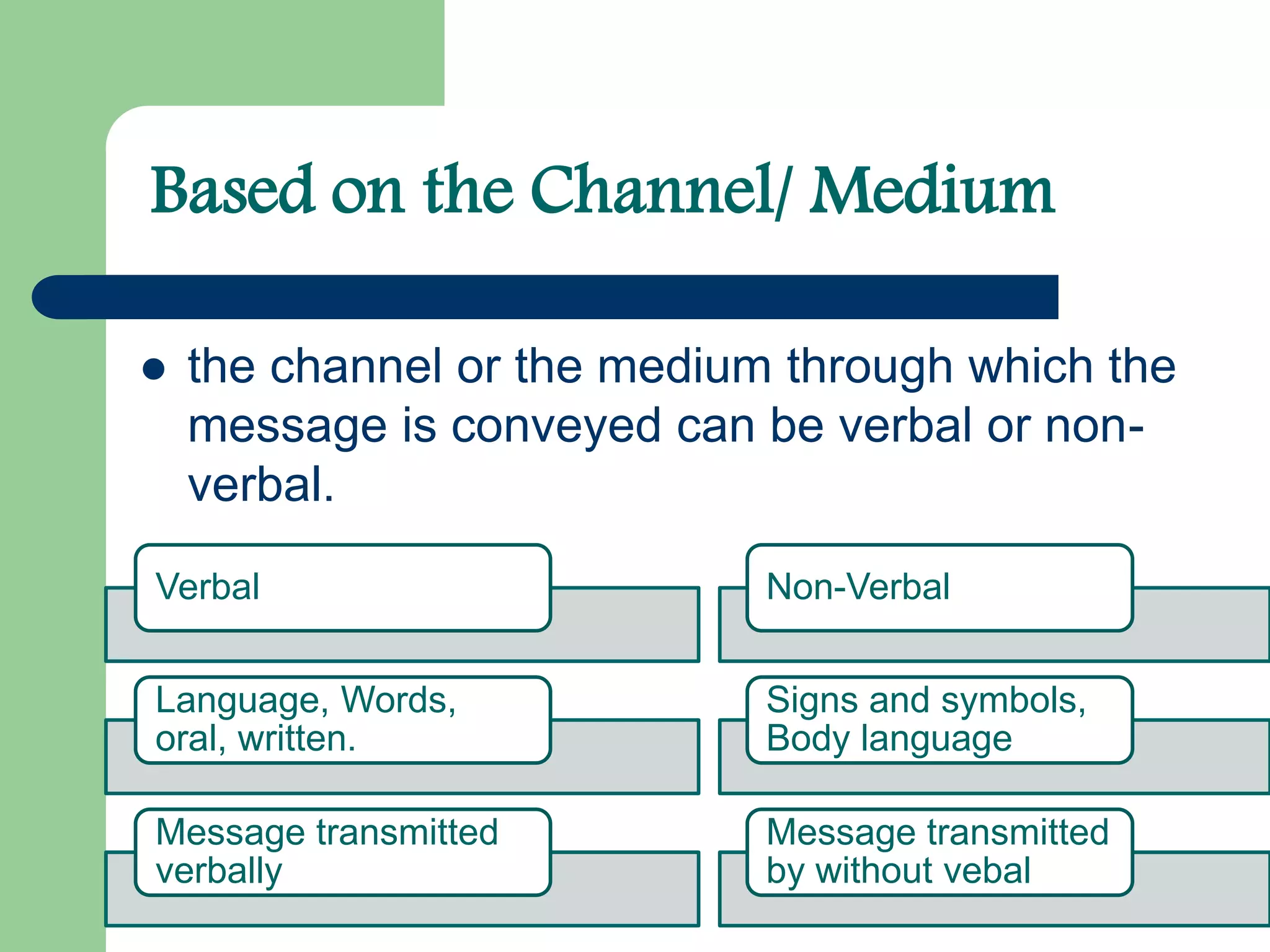
 the channel or the medium through which the
message is conveyed can be verbal or non-
verbal.
Verbal
Language, Words,
oral, written.
Message transmitted
verbally
Non-Verbal
Signs and symbols,
Body language
Message transmitted
by without vebal
Types of Communication
 There are different types of communications in
terms of numbers of participants involving.
Intrapersonal communication
• Interpersonal Communication
Group Communication
• Mass communication
Intrapersonal Communication
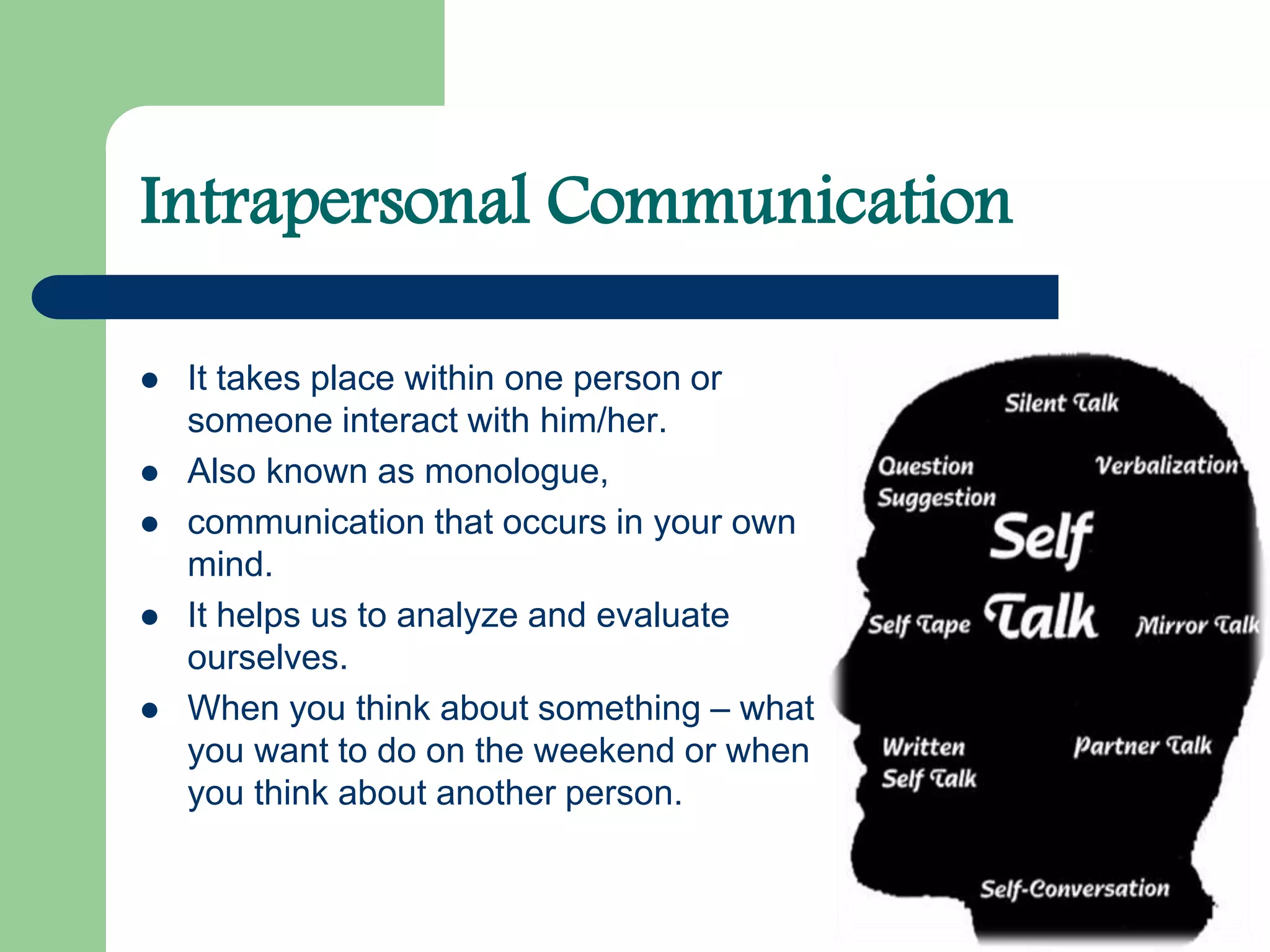
 It takes place within one person or
someone interact with him/her.
 Also known as monologue,
 communication that occurs in your own
mind.
 It helps us to analyze and evaluate
ourselves.
 When you think about something – what
you want to do on the weekend or when
you think about another person.
Interpersonal Communication
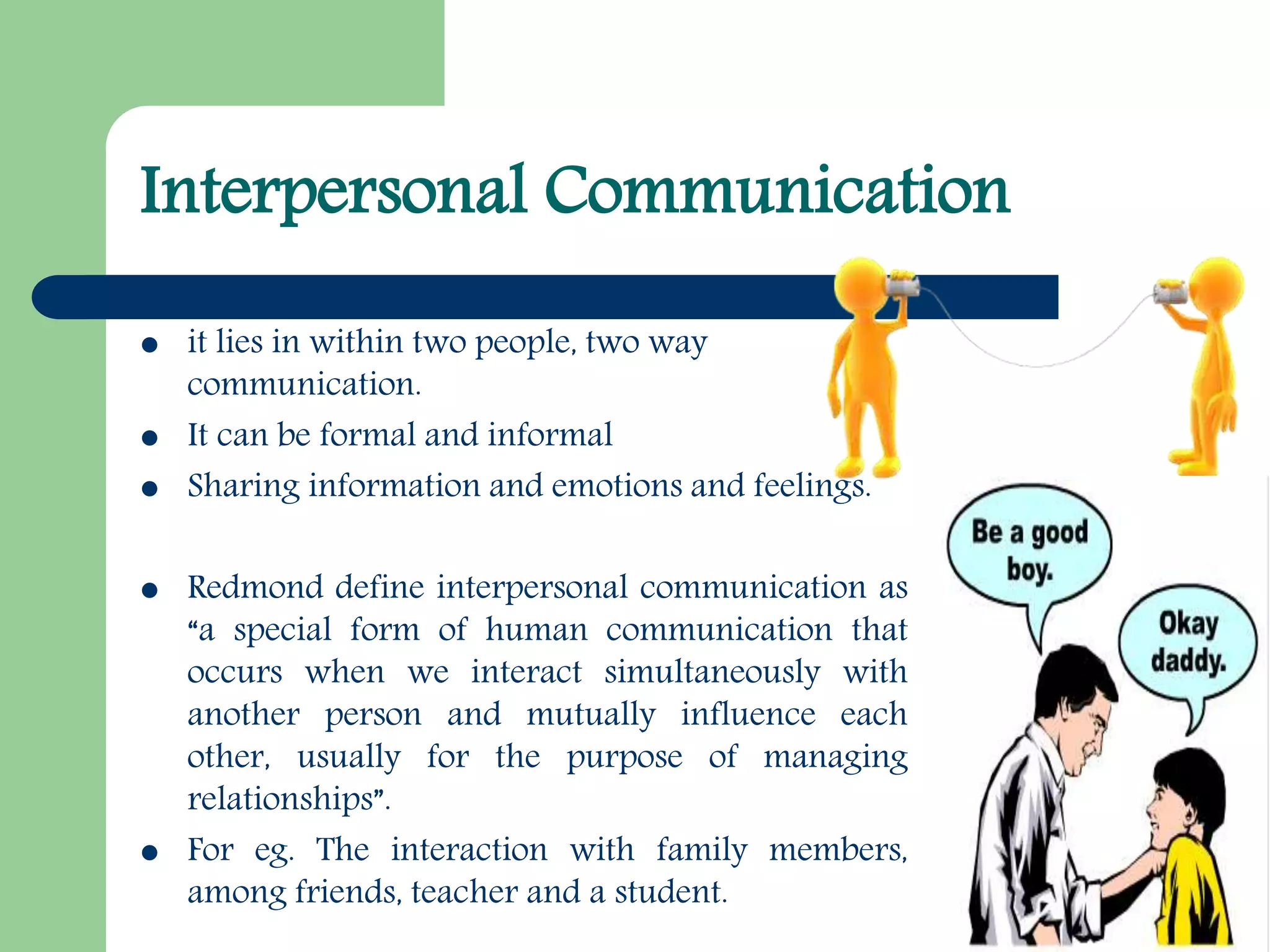
 it lies in within two people, two way
communication.
 It can be formal and informal
 Sharing information and emotions and feelings.
 Redmond define interpersonal communication as
“a special form of human communication that
occurs when we interact simultaneously with
another person and mutually influence each
other, usually for the purpose of managing
relationships”.
 For eg. The interaction with family members,
among friends, teacher and a student.
Group Communication
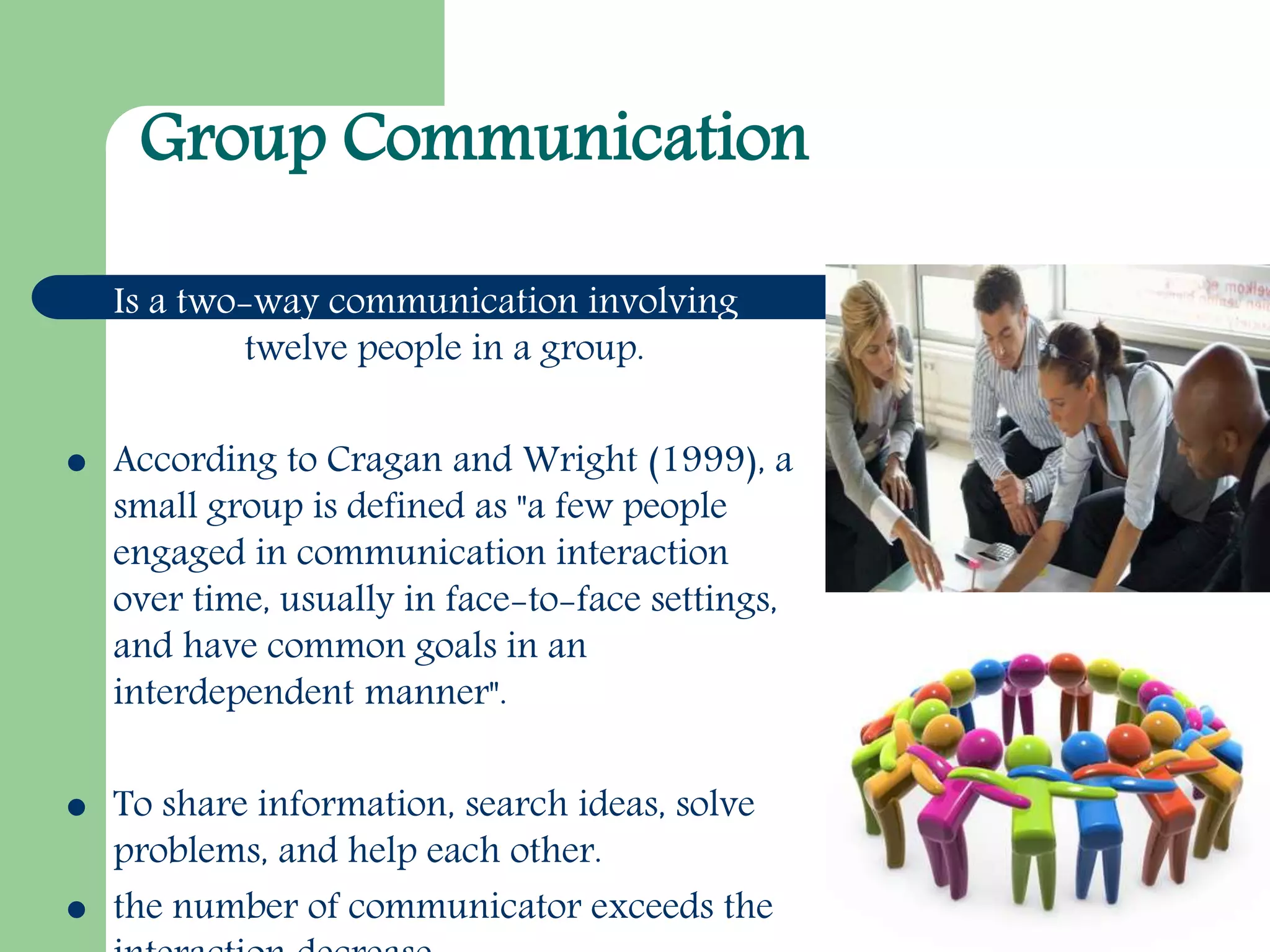
 Is a two-way communication involving
three to twelve people in a group.
 According to Cragan and Wright (1999), a
small group is defined as "a few people
engaged in communication interaction
over time, usually in face-to-face settings,
and have common goals in an
interdependent manner".
 To share information, search ideas, solve
problems, and help each other.
 the number of communicator exceeds the
Mass Communication
 Mass communication is the electronic or
print transmission of messages to the
general public. Outlets called mass media
include things like radio, television, film,
and printed materials designed to reach
large audiences.
 A television commercial. A magazine
article. Hearing a song on the radio.
Books, Newspapers, Billboards. The key is
that you are reaching a large amount of
people without it being face to face.
Feedback is generally delayed with mass
communication.
 For this kind of communication we require a mediator to transmit
information.
 "employs a technology as a medium to communicate with a large
audience" (Baran and Davies, 2000).
 Serves the functions of informing, persuading, entertaining, and
influencing (although very seldom) the masses.
 Characteristics
 Large reach
 Impersonality
 Presence of a gatekeeper.
Types of communication

Types of communication

  • 1.
    Subject:- Mass Mediaand Communication Presented by Milan Parmar pg14101026 Types of Communication
  • 2.
    What is Communication ? oThe word communication has originated from Latin word “Communes” which means something common. o Communication is the process of exchanging information, ideas, thoughts, feeling and emotions through speech signals, writing or behavior. o Communication means the practice of encoding information through sounds, symbols, and actions in order to transmit that information to others.
  • 3.
  • 4.
    Types of Communication There are several ways based on which we can divide communication accordingly.  Based on identity persons involved in the process ?  Based on the medium/ channel of the communication  ….numbers of person involved involves.
  • 5.
    Based on Identityof the person Informal  Informal – Usually used with friends and family – Contains shortened version of words – Contains slang words – Talking with Friends, classmates, family members Formal – Used in a Professional Setting – No Slang – Pronounce words correctly – Interacting with teacher, with boss, elders in house
  • 6.
    Based on theChannel/ Medium  the channel or the medium through which the message is conveyed can be verbal or non- verbal. Verbal Language, Words, oral, written. Message transmitted verbally Non-Verbal Signs and symbols, Body language Message transmitted by without vebal
  • 7.
    Types of Communication There are different types of communications in terms of numbers of participants involving. Intrapersonal communication • Interpersonal Communication Group Communication • Mass communication
  • 8.
    Intrapersonal Communication  Ittakes place within one person or someone interact with him/her.  Also known as monologue,  communication that occurs in your own mind.  It helps us to analyze and evaluate ourselves.  When you think about something – what you want to do on the weekend or when you think about another person.
  • 9.
    Interpersonal Communication  itlies in within two people, two way communication.  It can be formal and informal  Sharing information and emotions and feelings.  Redmond define interpersonal communication as “a special form of human communication that occurs when we interact simultaneously with another person and mutually influence each other, usually for the purpose of managing relationships”.  For eg. The interaction with family members, among friends, teacher and a student.
  • 10.
    Group Communication  Isa two-way communication involving three to twelve people in a group.  According to Cragan and Wright (1999), a small group is defined as "a few people engaged in communication interaction over time, usually in face-to-face settings, and have common goals in an interdependent manner".  To share information, search ideas, solve problems, and help each other.  the number of communicator exceeds the
  • 11.
    Mass Communication  Masscommunication is the electronic or print transmission of messages to the general public. Outlets called mass media include things like radio, television, film, and printed materials designed to reach large audiences.  A television commercial. A magazine article. Hearing a song on the radio. Books, Newspapers, Billboards. The key is that you are reaching a large amount of people without it being face to face. Feedback is generally delayed with mass communication.
  • 12.
     For thiskind of communication we require a mediator to transmit information.  "employs a technology as a medium to communicate with a large audience" (Baran and Davies, 2000).  Serves the functions of informing, persuading, entertaining, and influencing (although very seldom) the masses.  Characteristics  Large reach  Impersonality  Presence of a gatekeeper.