COMMUNICATION
Reshmi Naskar
Asst.Professor, NSMC
WHAT IS COMMUNICATION ???
Communication is the process by which
two or more people exchange ideas
,facts, feelings, information to reach to
a mutual understanding about a topic
or problem of mutual importance.
The term communication is derived form
the Latin word ‘COMMUNIS’ which means
common or community for good reason.
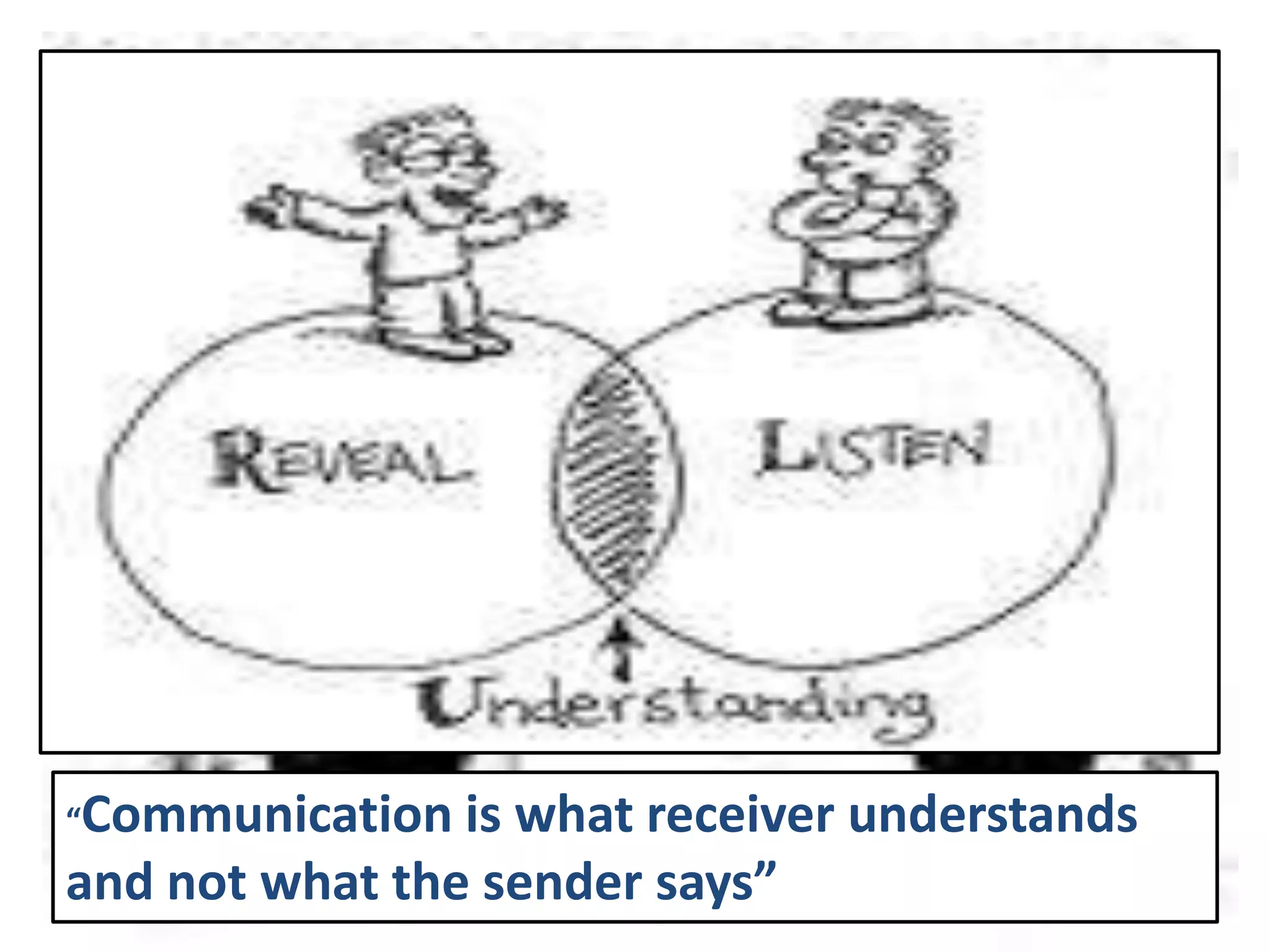
“Communication is what receiver understands
and not what the sender says”
‘Communication is the transfer of information and understanding from one
person to another.It is the way of reaching others with facts ,ideas, thoughts
and values –Keith Davis
‘Communication is any behaviour that results in an exchange of meaning” –
American Management Association.
Effective Communication is a purposive symbolic interchange resulting in a
workable understanding agreement between the sender and the receiver.” –
George T. Vardaman.
The process by which information is passed between people by means of
previously agreed symbols in order to produce a desired response. –Peter
Little
The process by which an idea is transferred from a source to a receiver with
the intention of changing his or her behavior –Rogers and Rogers
Communication is a process of sending meaningful messages from one
person to another .The messages could be oral , written, visual or olfactory. It
is a process which increases commonality but also requires elements of
commonality to occur. –Dennis Mac Quail
It is a process in which participants share information with one another
in order to reach mutual understanding about a topic or problem of
mutual importance. –D.Lawrence Kincaid
Communication arises out of the need to reduce uncertainty ,to act
effectively, to defend, or strengthen the ego…communication ceases
when meaning are adequate ,it is initiated as soon as new meanings are
required –D.C.Barnland
 It includes all procedures by which one mind may affect another. This
of course involves not only written and oral speech ,but also music ,
pictorial marts , the theatre ,the ballet and infact all human behavior. –
Shannon and Warren Weaver. A mechanism by which human relations
exist and develop and the symbols of mind together with means of
conveying them through space and preserving them in time –Charles
Cooley.
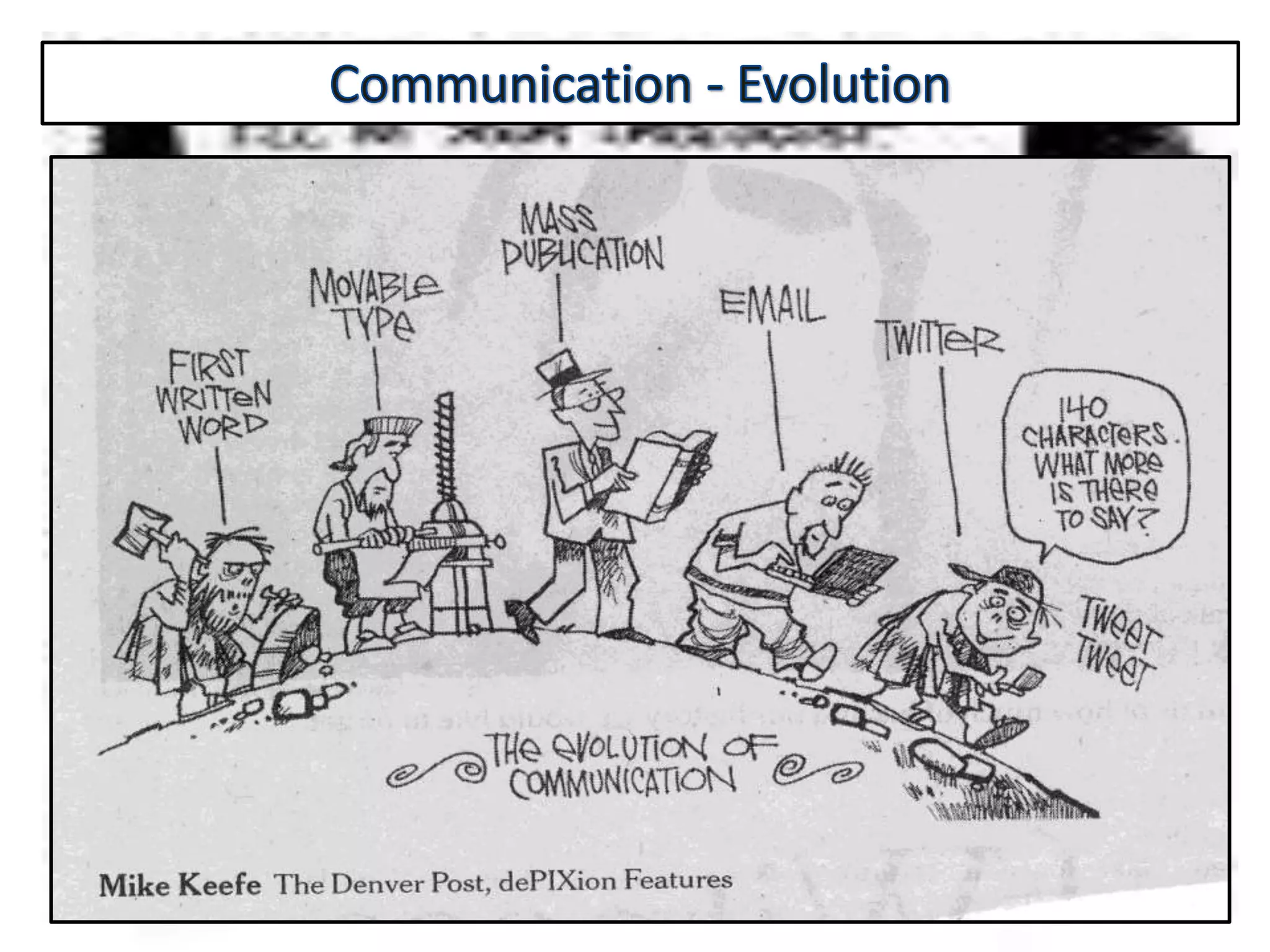
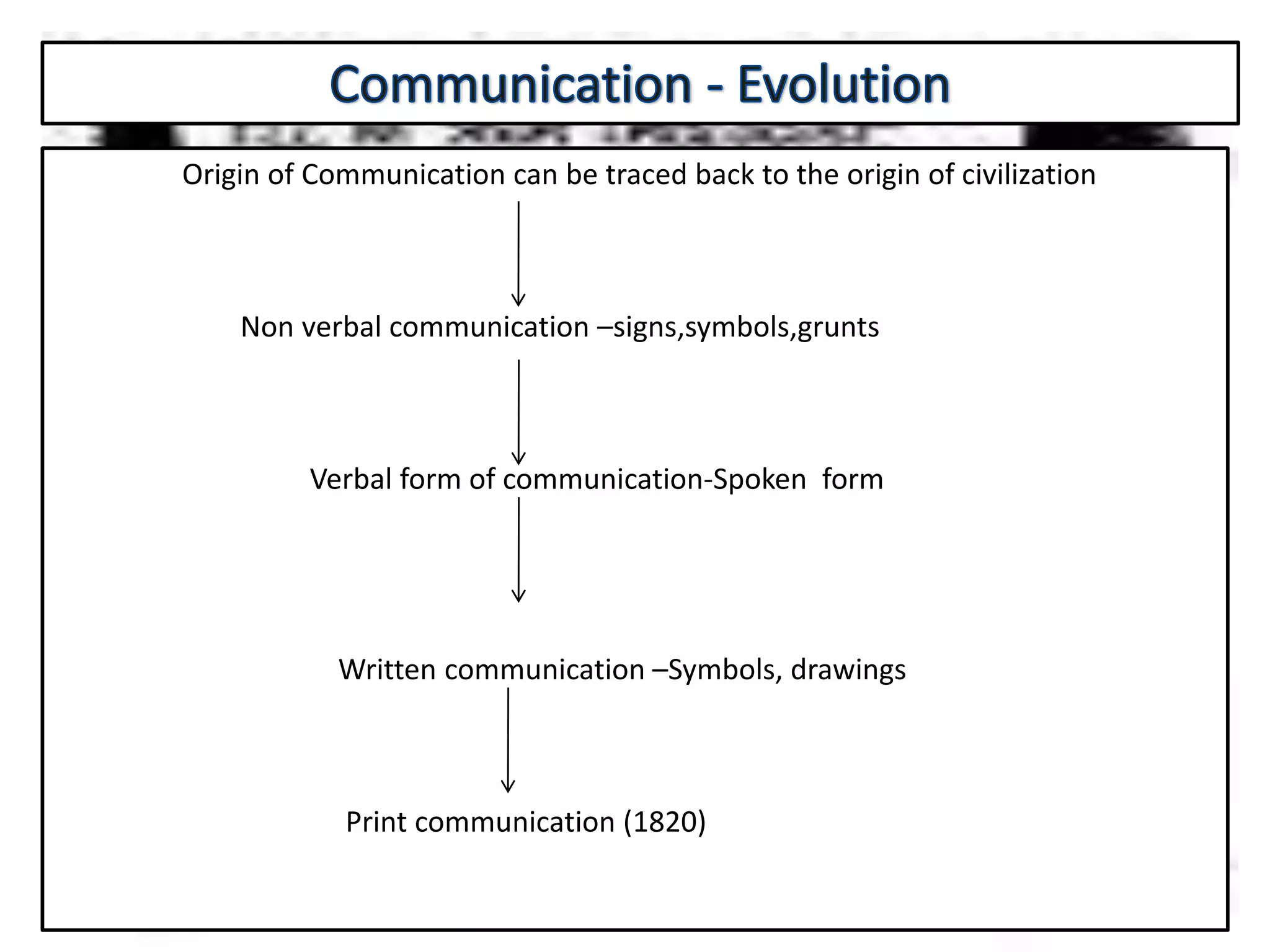
Origin of Communication can be traced back to the origin of civilization
Non verbal communication –signs,symbols,grunts
Verbal form of communication-Spoken form
Written communication –Symbols, drawings
Print communication (1820)
Electronic form of communication –Radio(1930)
Television (1959)
Digitalization of Communication Tools(1995)
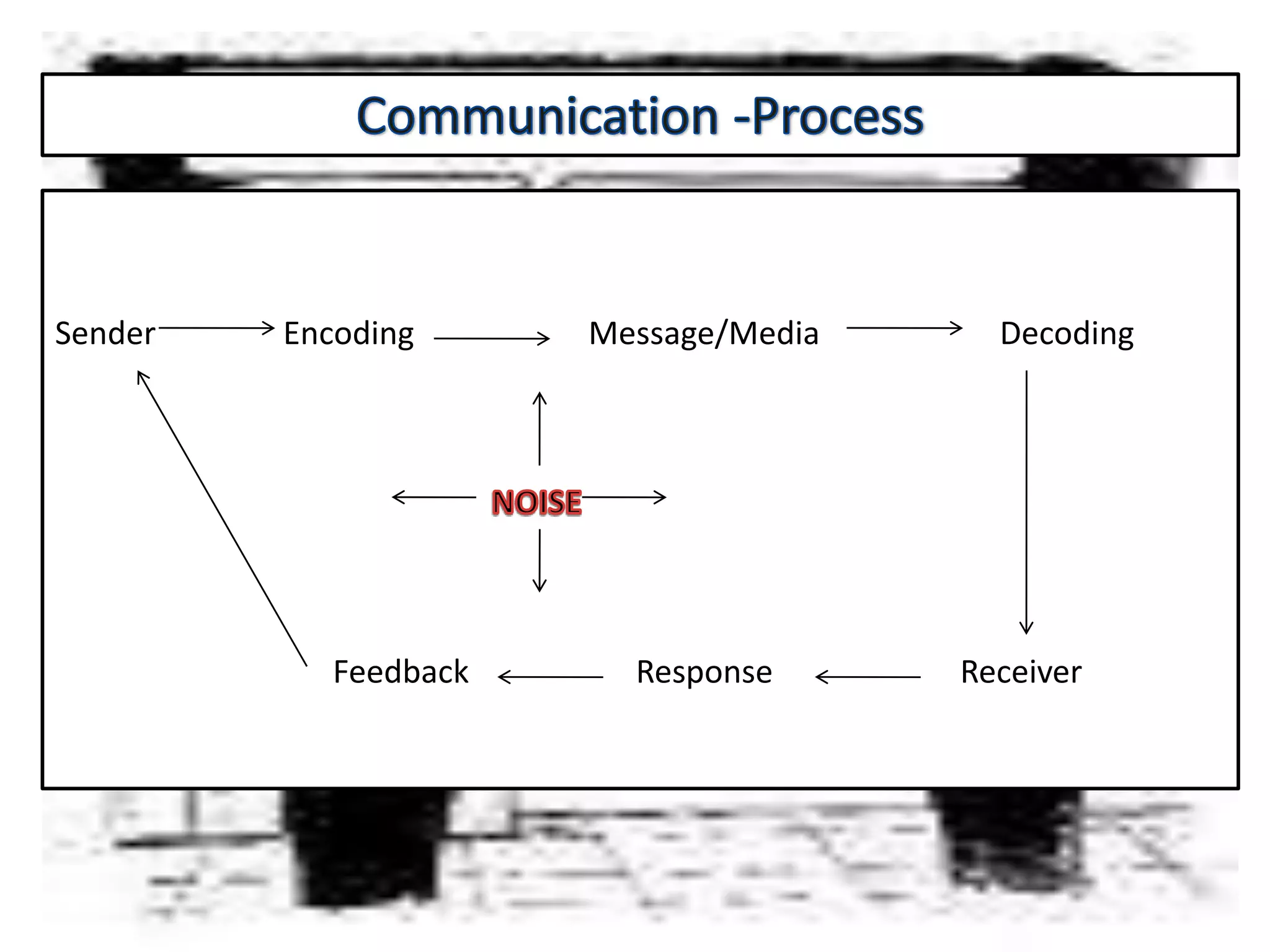
Sender Encoding Message/Media Decoding
Feedback Response Receiver
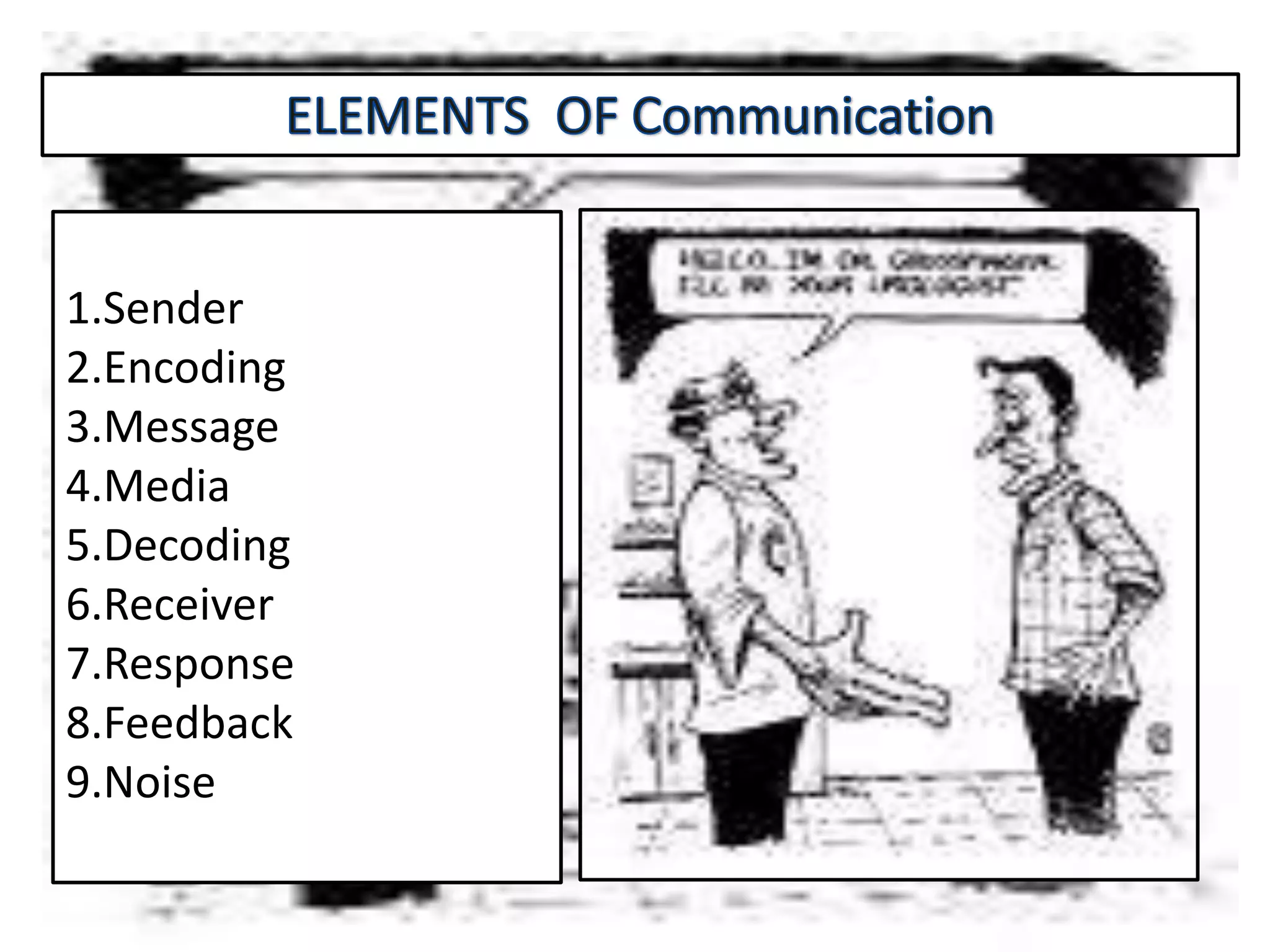
1.Sender
2.Encoding
3.Message
4.Media
5.Decoding
6.Receiver
7.Response
8.Feedback
9.Noise
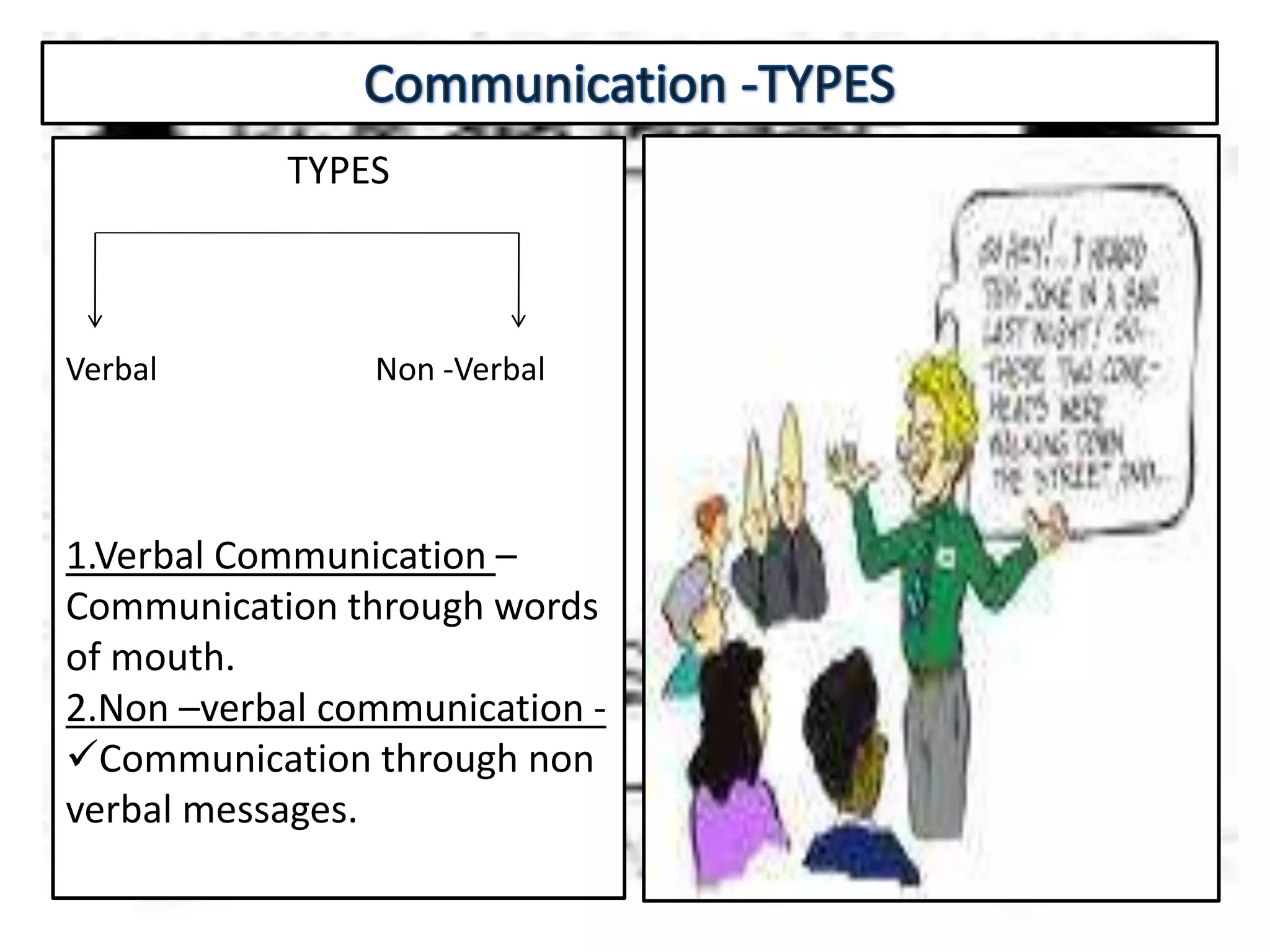
TYPES
Verbal Non -Verbal
1.Verbal Communication –
Communication through words
of mouth.
2.Non –verbal communication -
Communication through non
verbal messages.
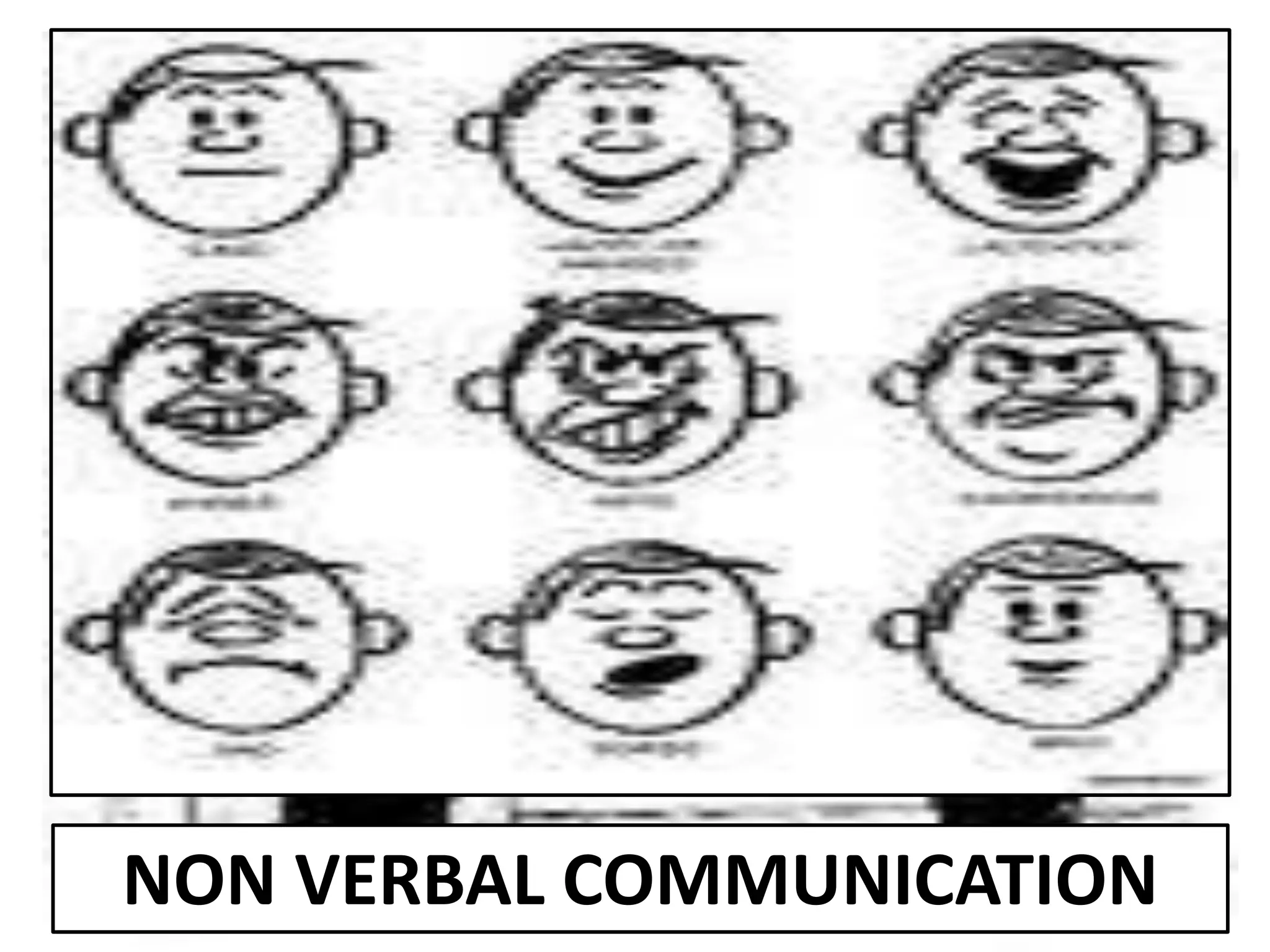
NON VERBAL COMMUNICATION
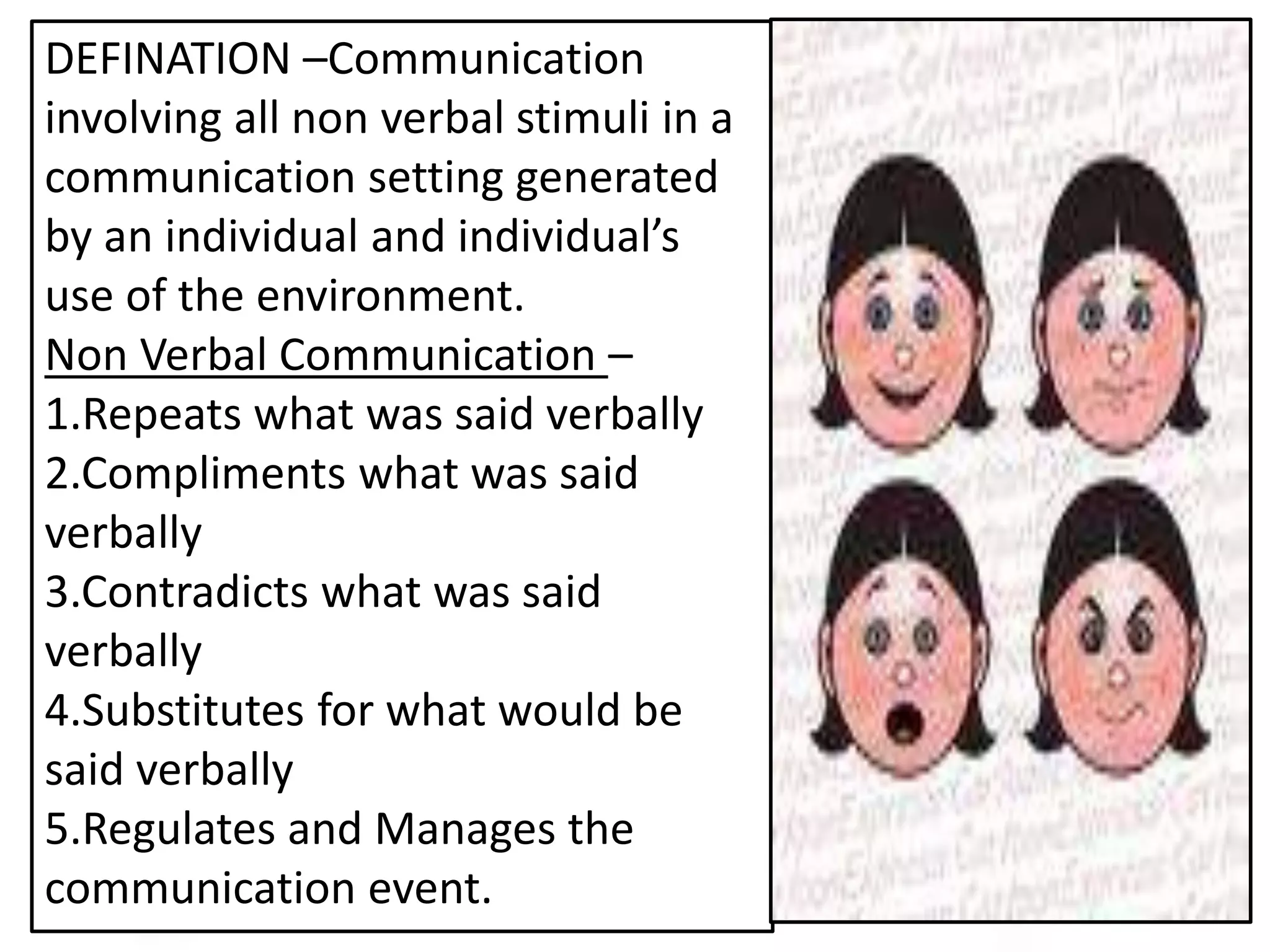
DEFINATION –Communication
involving all non verbal stimuli in a
communication setting generated
by an individual and individual’s
use of the environment.
Non Verbal Communication –
1.Repeats what was said verbally
2.Compliments what was said
verbally
3.Contradicts what was said
verbally
4.Substitutes for what would be
said verbally
5.Regulates and Manages the
communication event.
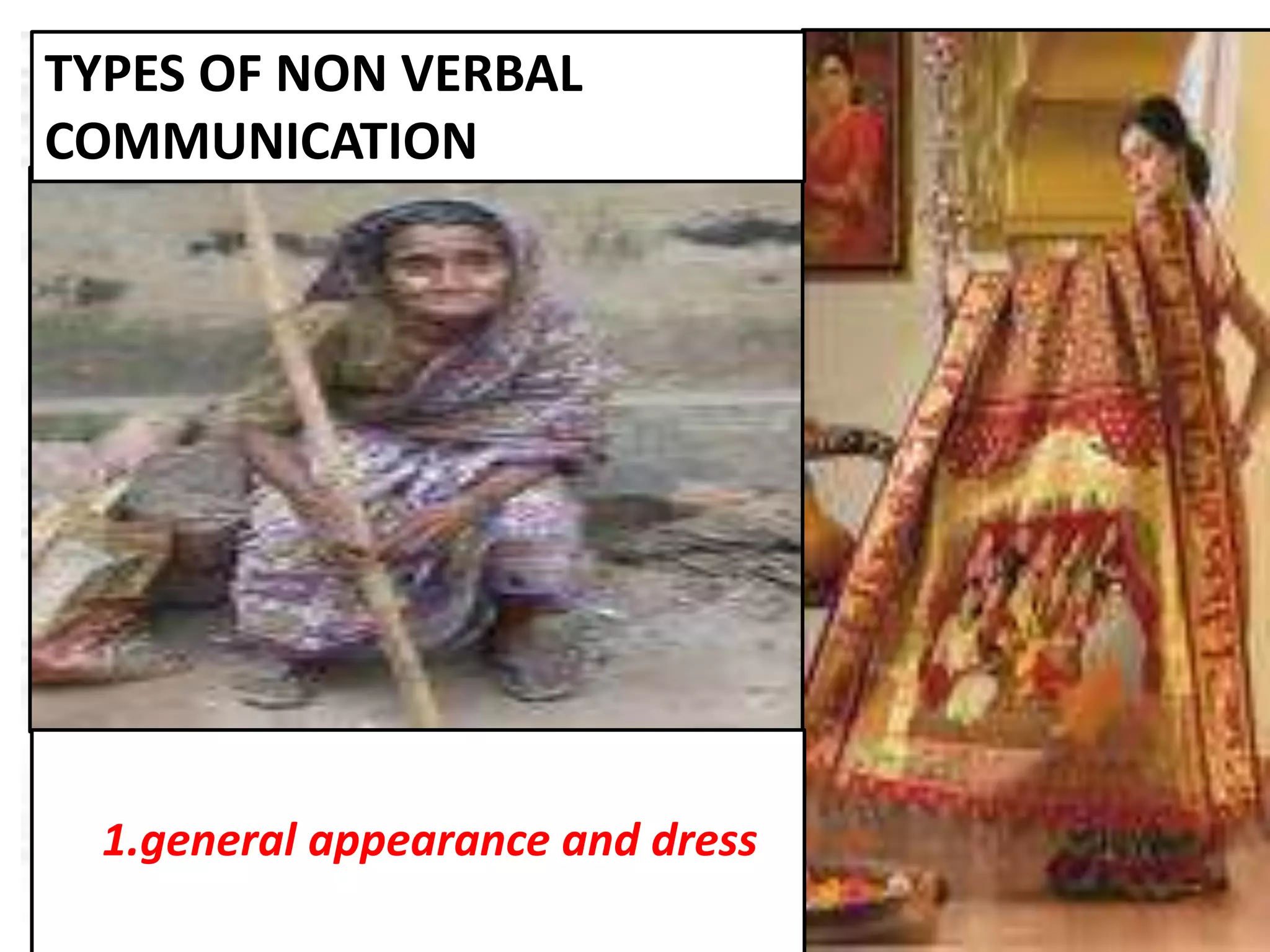
1.general appearance and dress
TYPES OF NON VERBAL
COMMUNICATION
TYPES OF NON VERBAL
COMMUNICATION
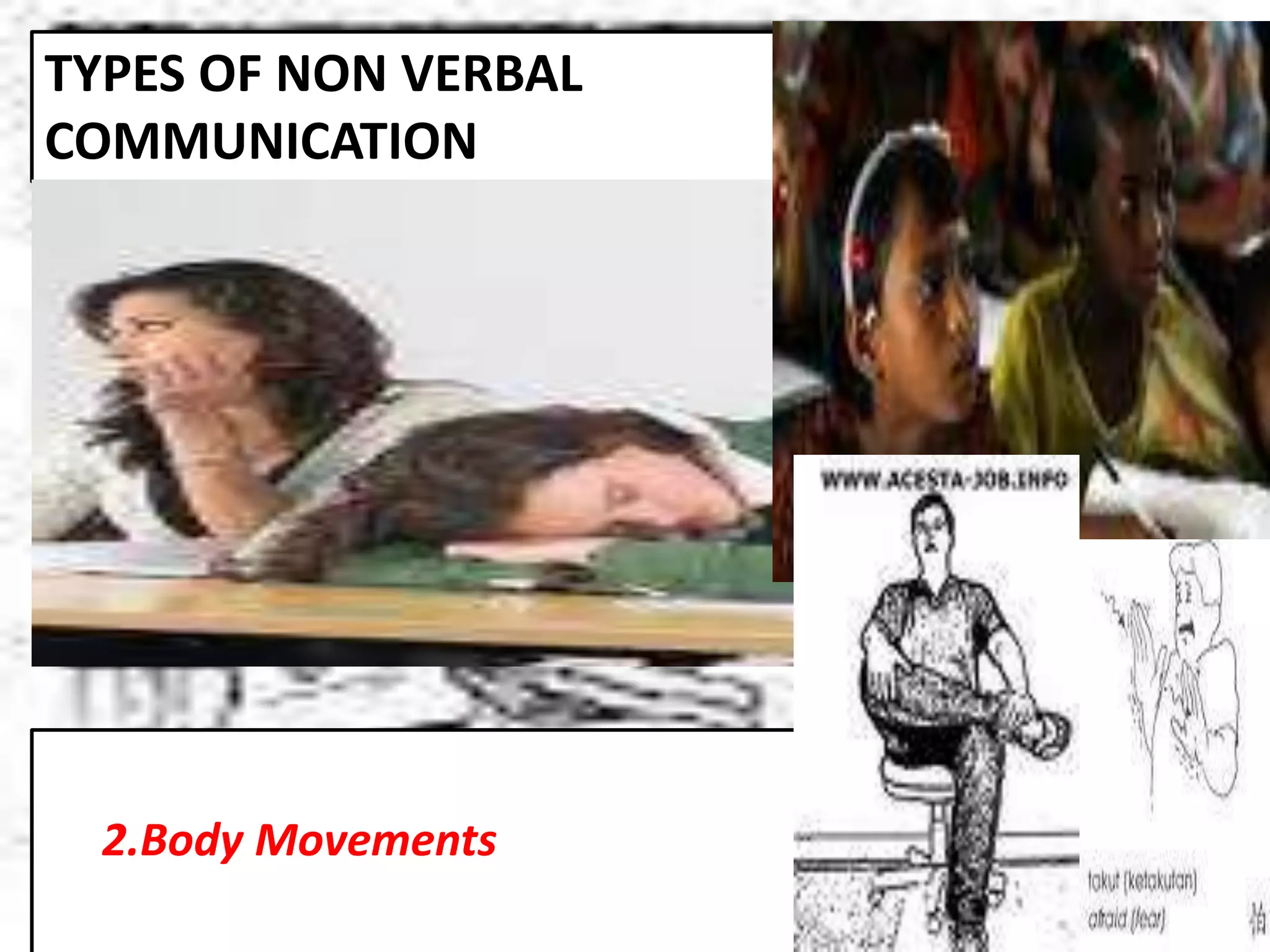
2.Body Movements
TYPES OF NON VERBAL
COMMUNICATION
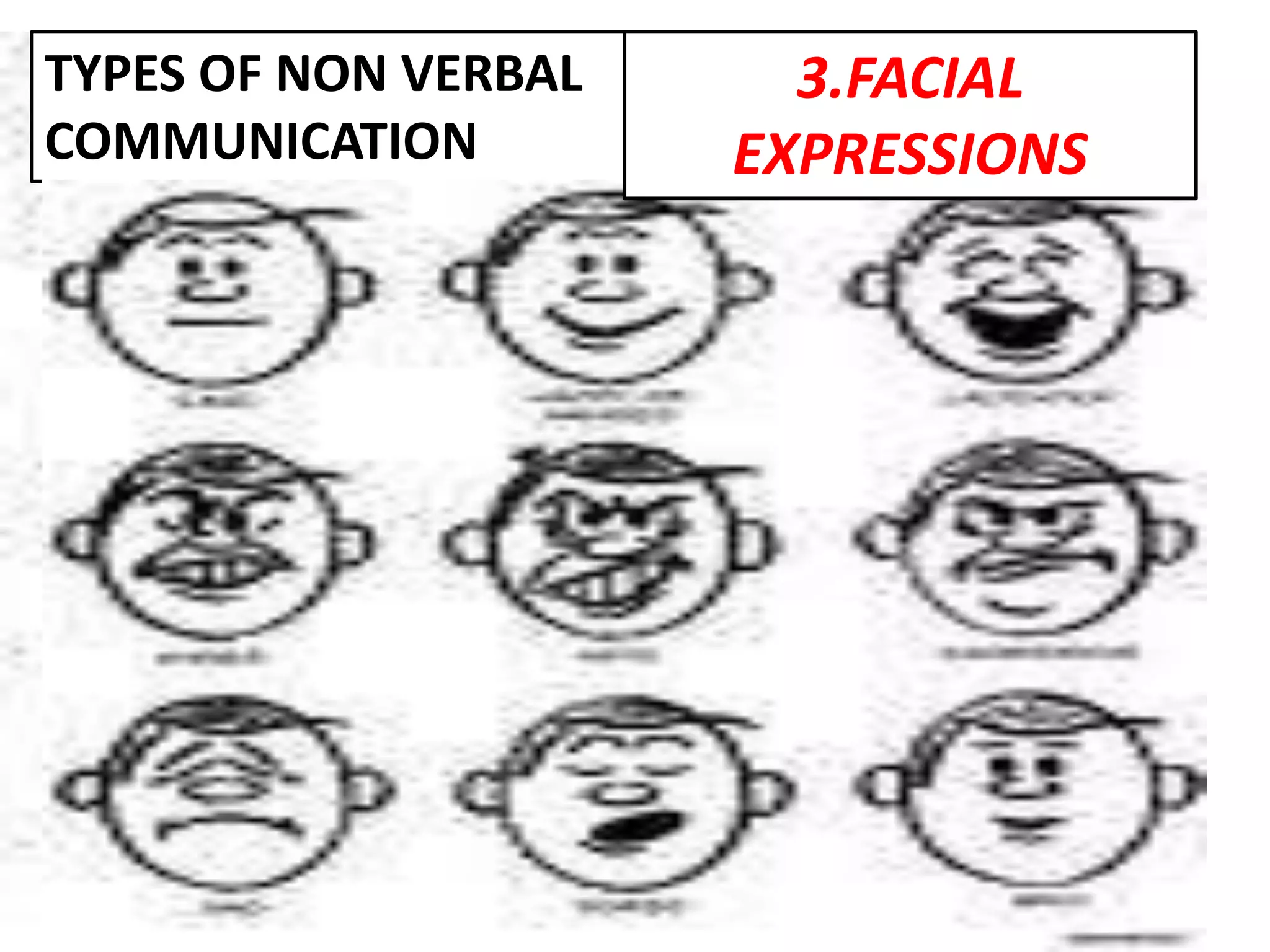
3.FACIAL
EXPRESSIONS
TYPES OF NON VERBAL
COMMUNICATION
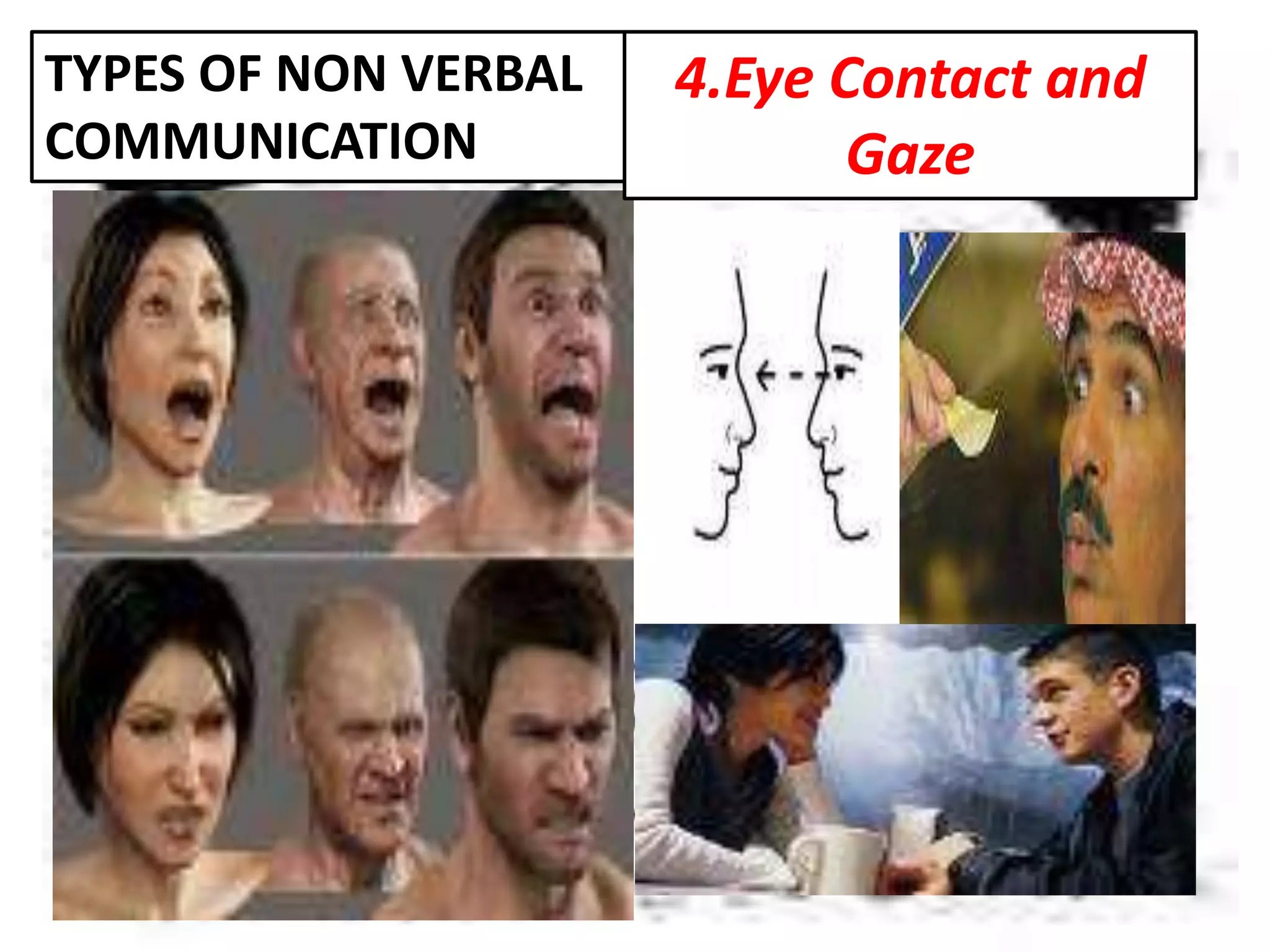
4.Eye Contact and
Gaze
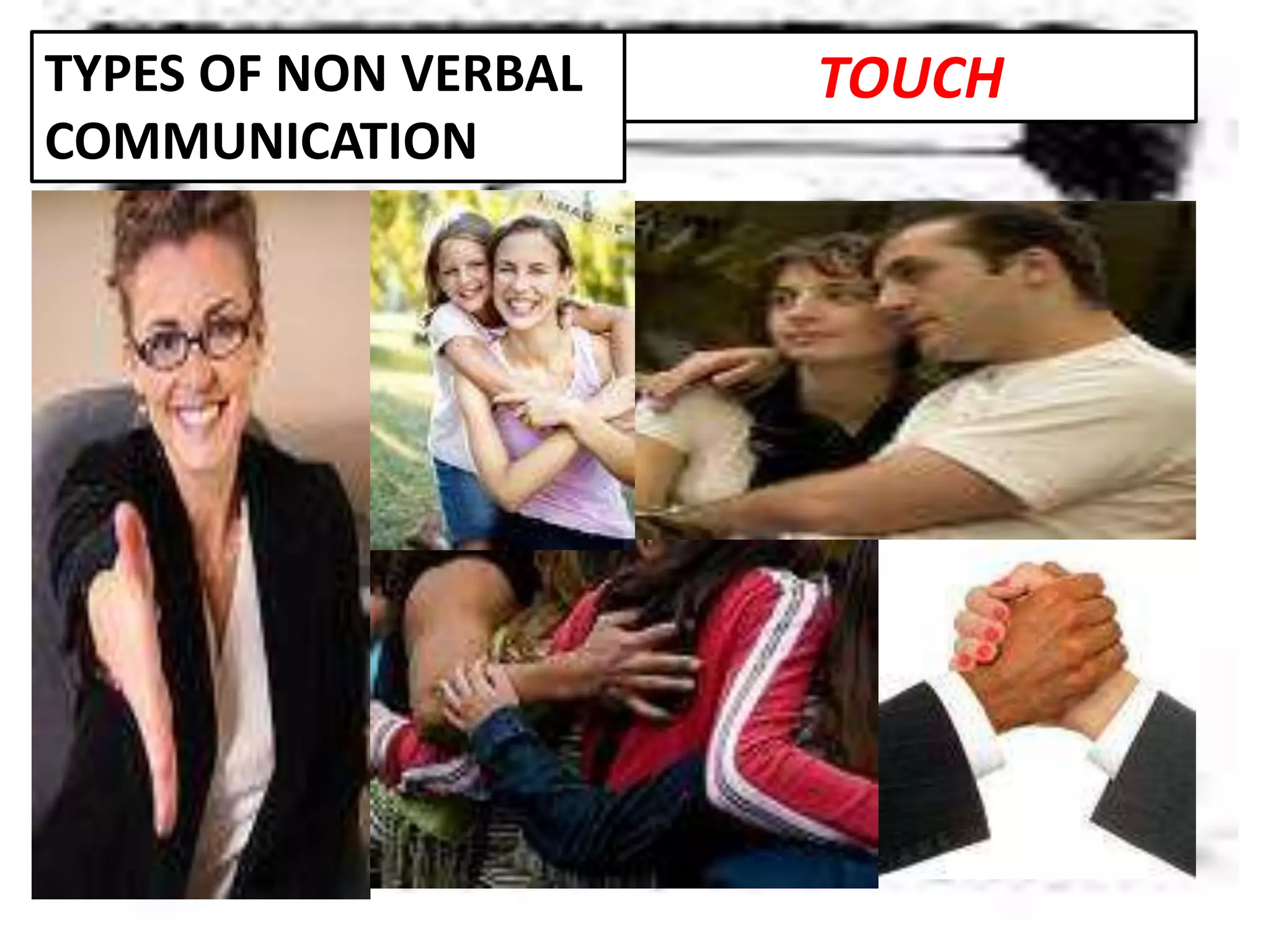
TOUCHTYPES OF NON VERBAL
COMMUNICATION
TYPES OF NON VERBAL
COMMUNICATION
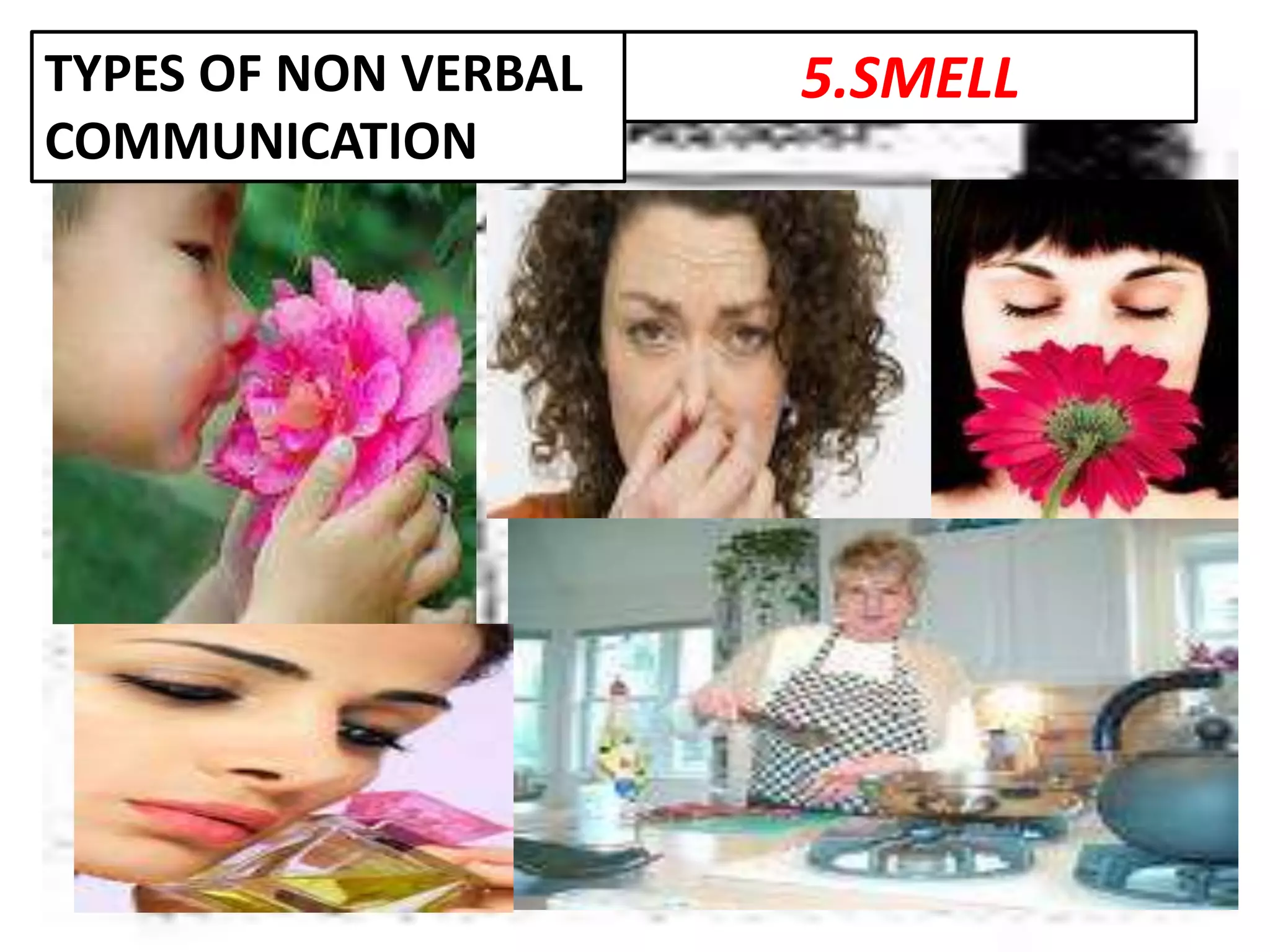
5.SMELL
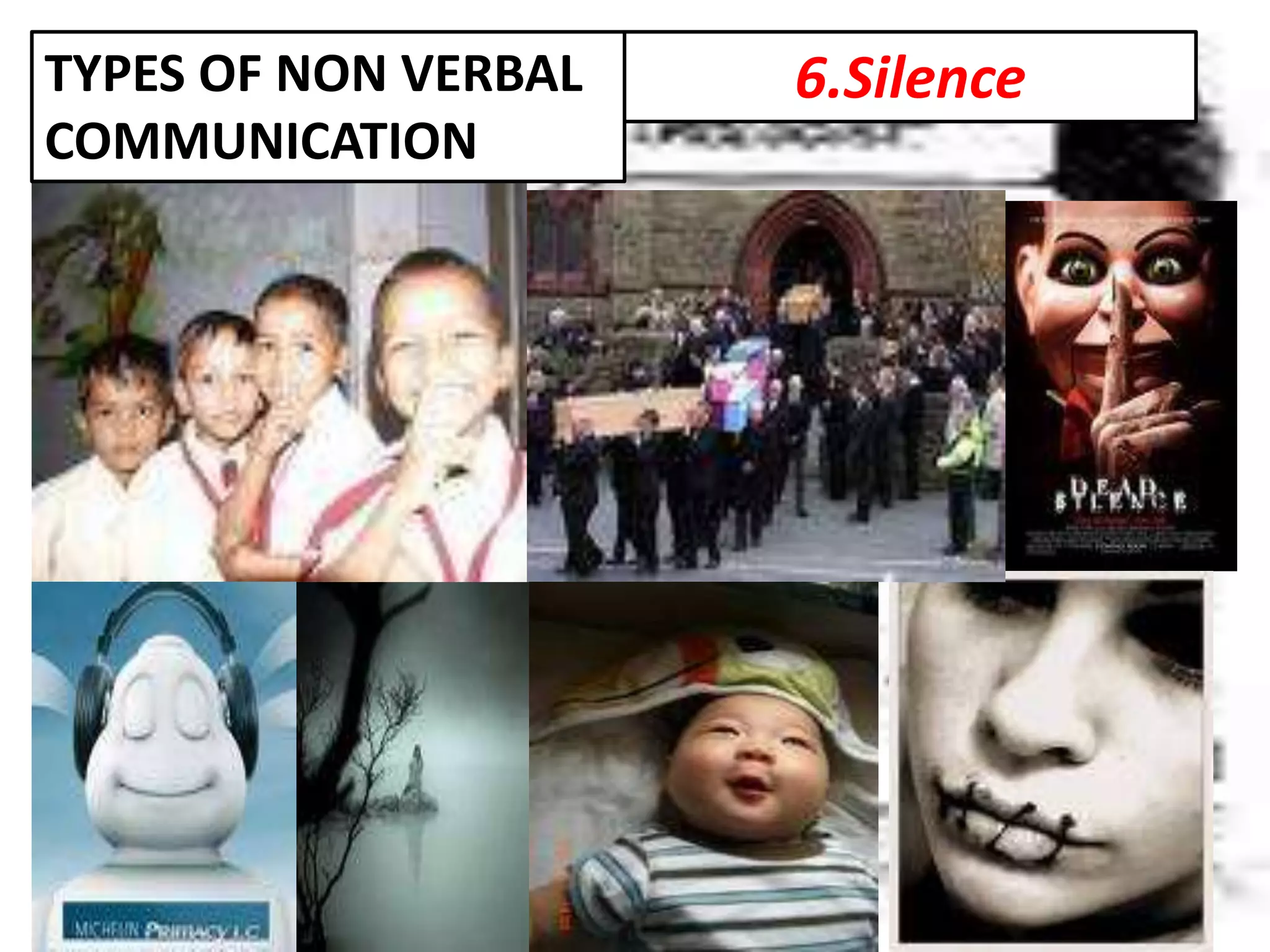
6.SilenceTYPES OF NON VERBAL
COMMUNICATION
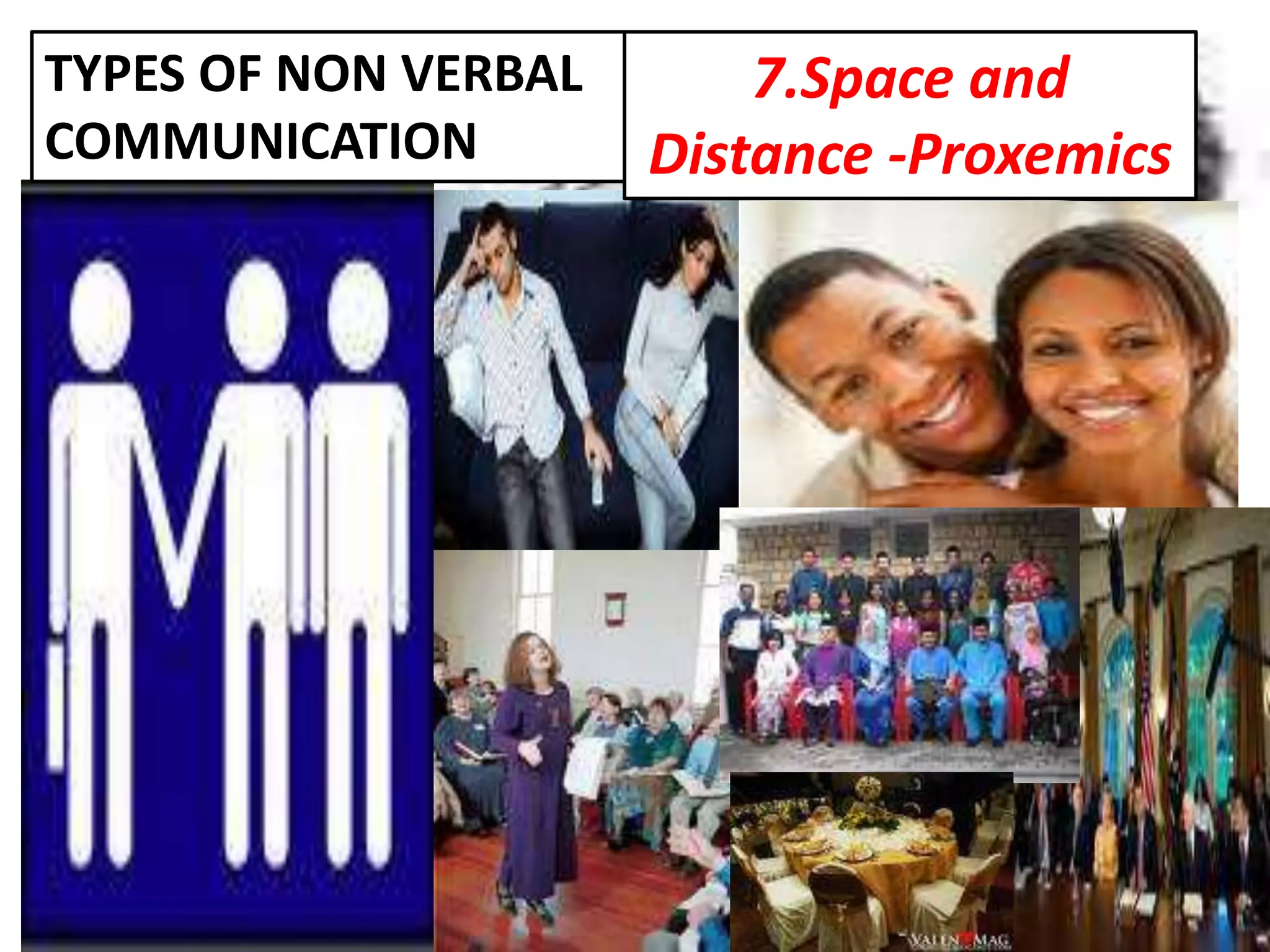
7.Space and
Distance -Proxemics
TYPES OF NON VERBAL
COMMUNICATION
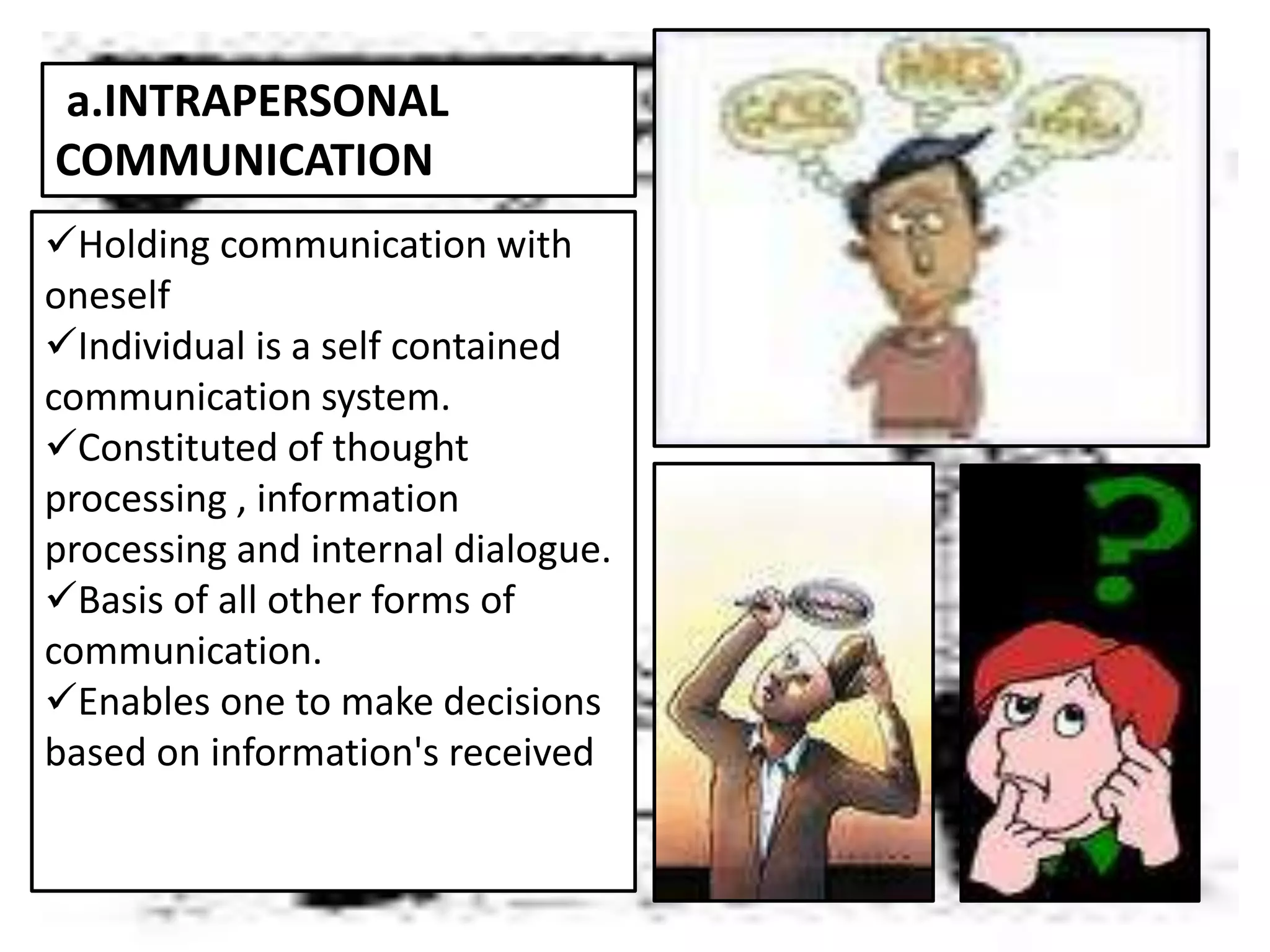
a.INTRAPERSONAL
COMMUNICATION
Holding communication with
oneself
Individual is a self contained
communication system.
Constituted of thought
processing , information
processing and internal dialogue.
Basis of all other forms of
communication.
Enables one to make decisions
based on information's received
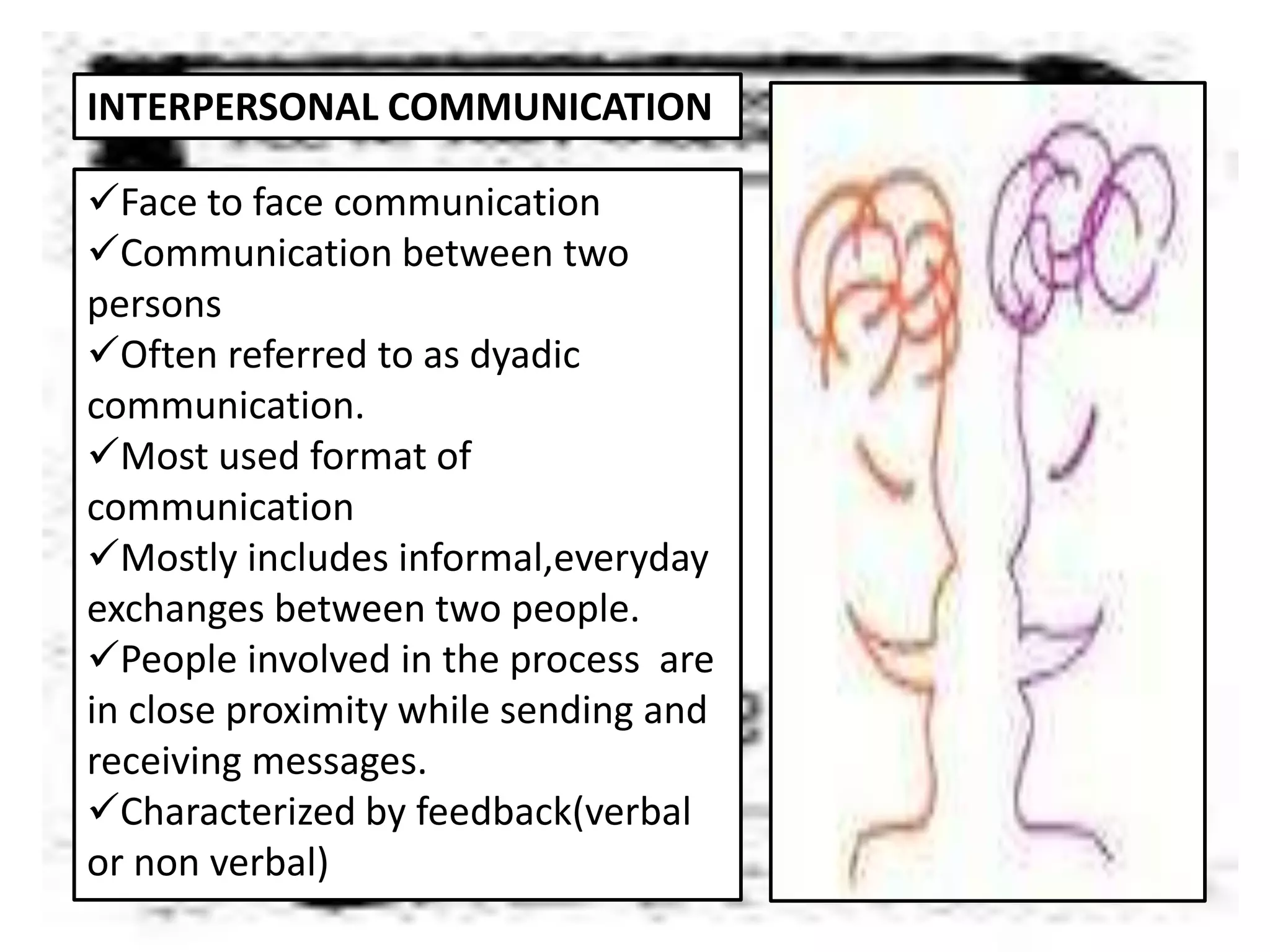
INTERPERSONAL COMMUNICATION
Face to face communication
Communication between two
persons
Often referred to as dyadic
communication.
Most used format of
communication
Mostly includes informal,everyday
exchanges between two people.
People involved in the process are
in close proximity while sending and
receiving messages.
Characterized by feedback(verbal
or non verbal)
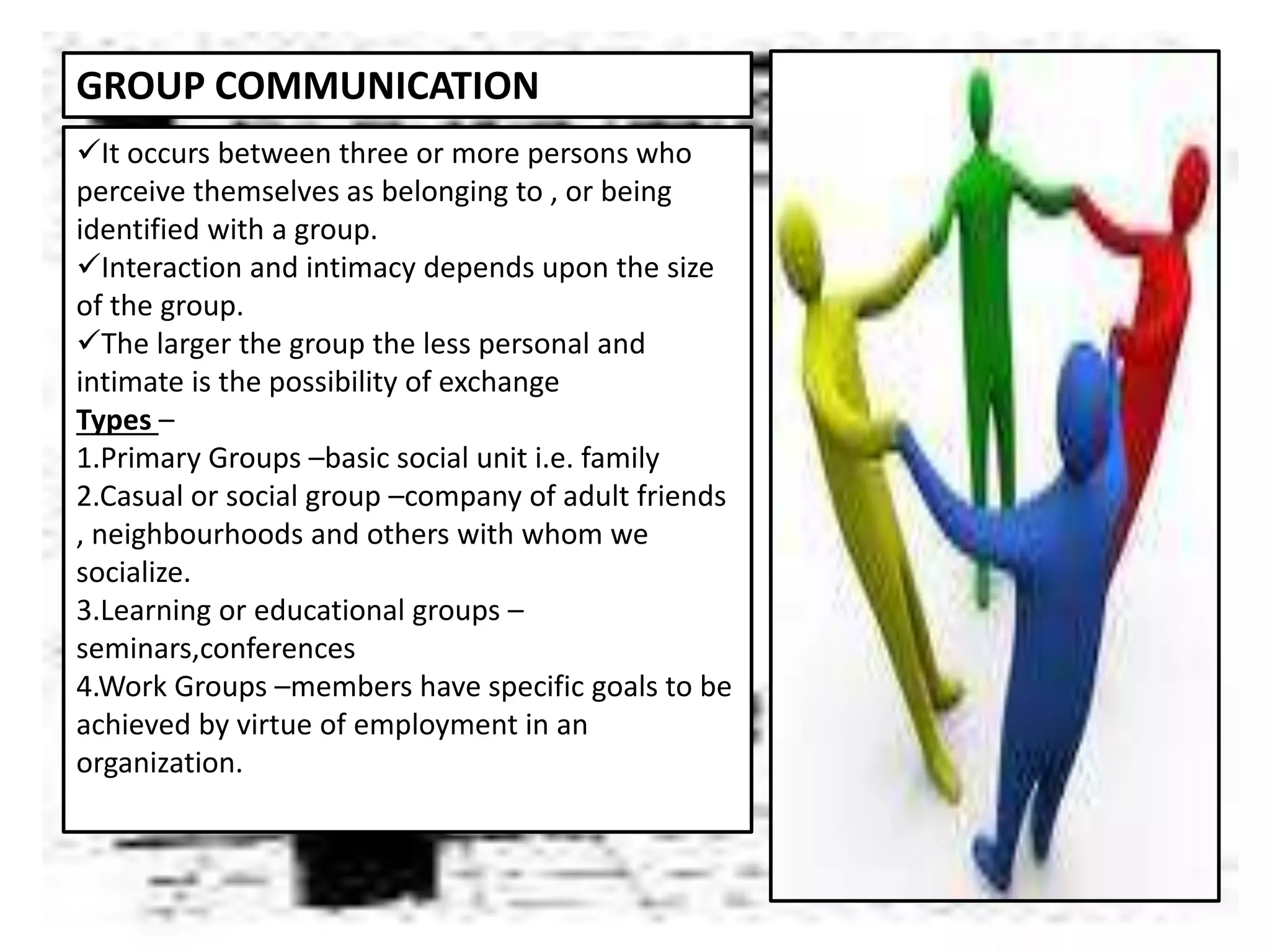
GROUP COMMUNICATION
It occurs between three or more persons who
perceive themselves as belonging to , or being
identified with a group.
Interaction and intimacy depends upon the size
of the group.
The larger the group the less personal and
intimate is the possibility of exchange
Types –
1.Primary Groups –basic social unit i.e. family
2.Casual or social group –company of adult friends
, neighbourhoods and others with whom we
socialize.
3.Learning or educational groups –
seminars,conferences
4.Work Groups –members have specific goals to be
achieved by virtue of employment in an
organization.
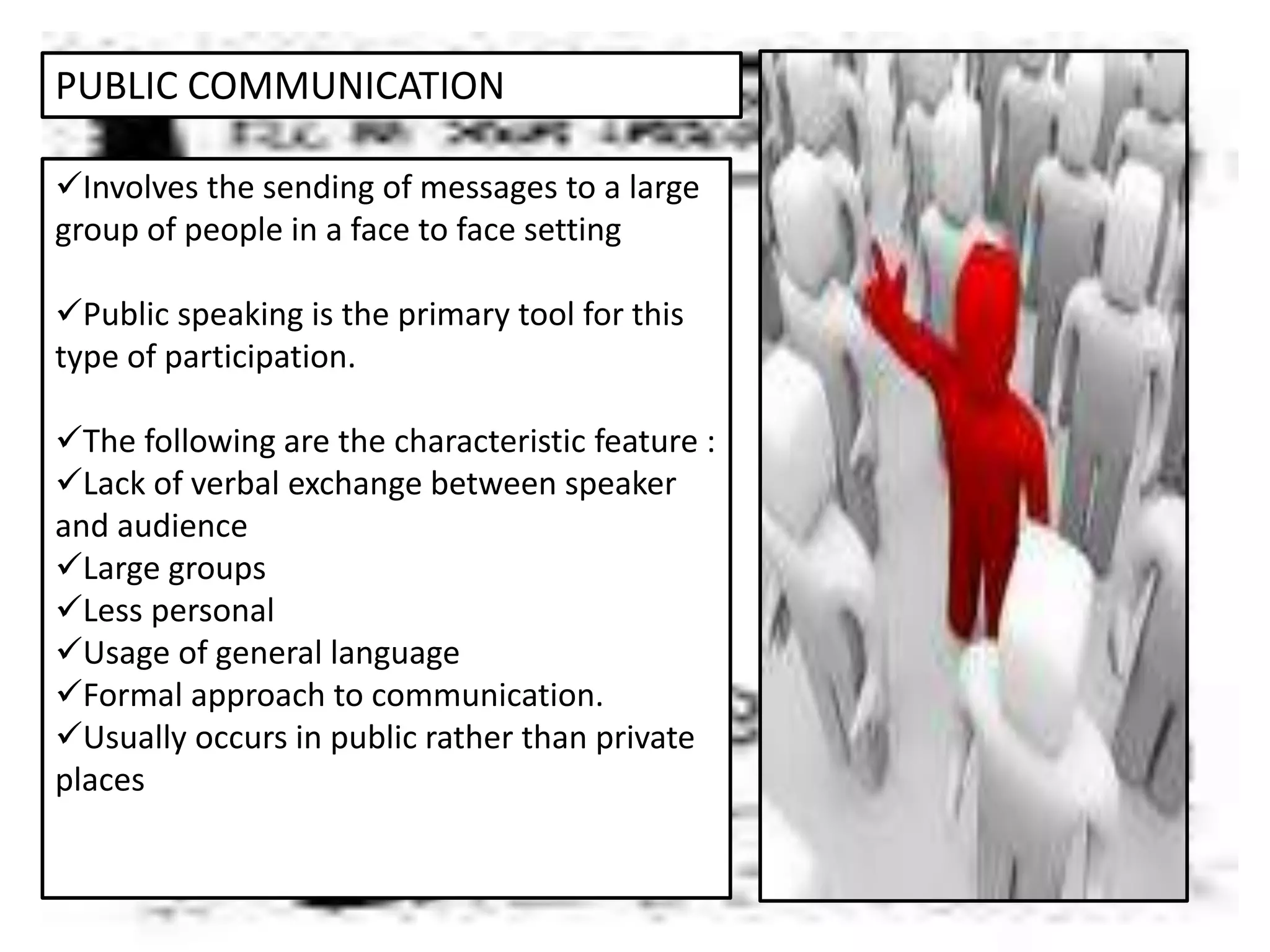
PUBLIC COMMUNICATION
Involves the sending of messages to a large
group of people in a face to face setting
Public speaking is the primary tool for this
type of participation.
The following are the characteristic feature :
Lack of verbal exchange between speaker
and audience
Large groups
Less personal
Usage of general language
Formal approach to communication.
Usually occurs in public rather than private
places
MASS COMMUNICATION
It is a process of delivering information , ideas
attitudes to a sizeable and diversified audience
through use of media developed for that purpose.
Also known as mediated communication.
MASS COMMUNICATION
MASS COMMUNICATION
(Large cross section of population)
Characteristics of Mass Communication
Large, Heterogeneous , Anonymous
audience
Mass Medium
Impersonal Communication
Gatekeeper
Delayed Feedback
Surveillance(Information) ,transmission of cultural
heritage , correlation of different parts of society
(Herald Lasswell)
Entertainment –(Wright,1960)
Interpret ,Connect and provide direction to an
interaction
Provide reward, relaxation and reduction of tension.
Mobilize the opinion of people
Advance National Interests and promote certain key
values and behavioral patterns.
Help in reaching decisions
Safeguarding of civil liberties .
1.Credibility of the communicator
2.Context of communication
3.Content of Communication
4.Clarity
5.Continuty and Consistency
6.Channel
7.Capability of Audience
Communication  intro

Communication intro

  • 1.
  • 2.
  • 3.
    Communication is theprocess by which two or more people exchange ideas ,facts, feelings, information to reach to a mutual understanding about a topic or problem of mutual importance. The term communication is derived form the Latin word ‘COMMUNIS’ which means common or community for good reason.
  • 4.
    “Communication is whatreceiver understands and not what the sender says”
  • 5.
    ‘Communication is thetransfer of information and understanding from one person to another.It is the way of reaching others with facts ,ideas, thoughts and values –Keith Davis ‘Communication is any behaviour that results in an exchange of meaning” – American Management Association. Effective Communication is a purposive symbolic interchange resulting in a workable understanding agreement between the sender and the receiver.” – George T. Vardaman. The process by which information is passed between people by means of previously agreed symbols in order to produce a desired response. –Peter Little The process by which an idea is transferred from a source to a receiver with the intention of changing his or her behavior –Rogers and Rogers Communication is a process of sending meaningful messages from one person to another .The messages could be oral , written, visual or olfactory. It is a process which increases commonality but also requires elements of commonality to occur. –Dennis Mac Quail
  • 6.
    It is aprocess in which participants share information with one another in order to reach mutual understanding about a topic or problem of mutual importance. –D.Lawrence Kincaid Communication arises out of the need to reduce uncertainty ,to act effectively, to defend, or strengthen the ego…communication ceases when meaning are adequate ,it is initiated as soon as new meanings are required –D.C.Barnland  It includes all procedures by which one mind may affect another. This of course involves not only written and oral speech ,but also music , pictorial marts , the theatre ,the ballet and infact all human behavior. – Shannon and Warren Weaver. A mechanism by which human relations exist and develop and the symbols of mind together with means of conveying them through space and preserving them in time –Charles Cooley.
  • 8.
    Origin of Communicationcan be traced back to the origin of civilization Non verbal communication –signs,symbols,grunts Verbal form of communication-Spoken form Written communication –Symbols, drawings Print communication (1820)
  • 9.
    Electronic form ofcommunication –Radio(1930) Television (1959) Digitalization of Communication Tools(1995)
  • 11.
    Sender Encoding Message/MediaDecoding Feedback Response Receiver
  • 12.
  • 13.
    TYPES Verbal Non -Verbal 1.VerbalCommunication – Communication through words of mouth. 2.Non –verbal communication - Communication through non verbal messages.
  • 14.
  • 15.
    DEFINATION –Communication involving allnon verbal stimuli in a communication setting generated by an individual and individual’s use of the environment. Non Verbal Communication – 1.Repeats what was said verbally 2.Compliments what was said verbally 3.Contradicts what was said verbally 4.Substitutes for what would be said verbally 5.Regulates and Manages the communication event.
  • 16.
    1.general appearance anddress TYPES OF NON VERBAL COMMUNICATION
  • 17.
    TYPES OF NONVERBAL COMMUNICATION 2.Body Movements
  • 18.
    TYPES OF NONVERBAL COMMUNICATION 3.FACIAL EXPRESSIONS
  • 19.
    TYPES OF NONVERBAL COMMUNICATION 4.Eye Contact and Gaze
  • 20.
    TOUCHTYPES OF NONVERBAL COMMUNICATION
  • 21.
    TYPES OF NONVERBAL COMMUNICATION 5.SMELL
  • 22.
    6.SilenceTYPES OF NONVERBAL COMMUNICATION
  • 23.
    7.Space and Distance -Proxemics TYPESOF NON VERBAL COMMUNICATION
  • 24.
    a.INTRAPERSONAL COMMUNICATION Holding communication with oneself Individualis a self contained communication system. Constituted of thought processing , information processing and internal dialogue. Basis of all other forms of communication. Enables one to make decisions based on information's received
  • 25.
    INTERPERSONAL COMMUNICATION Face toface communication Communication between two persons Often referred to as dyadic communication. Most used format of communication Mostly includes informal,everyday exchanges between two people. People involved in the process are in close proximity while sending and receiving messages. Characterized by feedback(verbal or non verbal)
  • 26.
    GROUP COMMUNICATION It occursbetween three or more persons who perceive themselves as belonging to , or being identified with a group. Interaction and intimacy depends upon the size of the group. The larger the group the less personal and intimate is the possibility of exchange Types – 1.Primary Groups –basic social unit i.e. family 2.Casual or social group –company of adult friends , neighbourhoods and others with whom we socialize. 3.Learning or educational groups – seminars,conferences 4.Work Groups –members have specific goals to be achieved by virtue of employment in an organization.
  • 27.
    PUBLIC COMMUNICATION Involves thesending of messages to a large group of people in a face to face setting Public speaking is the primary tool for this type of participation. The following are the characteristic feature : Lack of verbal exchange between speaker and audience Large groups Less personal Usage of general language Formal approach to communication. Usually occurs in public rather than private places
  • 28.
    MASS COMMUNICATION It isa process of delivering information , ideas attitudes to a sizeable and diversified audience through use of media developed for that purpose. Also known as mediated communication. MASS COMMUNICATION MASS COMMUNICATION (Large cross section of population)
  • 29.
    Characteristics of MassCommunication Large, Heterogeneous , Anonymous audience Mass Medium Impersonal Communication Gatekeeper Delayed Feedback
  • 30.
    Surveillance(Information) ,transmission ofcultural heritage , correlation of different parts of society (Herald Lasswell) Entertainment –(Wright,1960) Interpret ,Connect and provide direction to an interaction Provide reward, relaxation and reduction of tension. Mobilize the opinion of people Advance National Interests and promote certain key values and behavioral patterns. Help in reaching decisions Safeguarding of civil liberties .
  • 31.
    1.Credibility of thecommunicator 2.Context of communication 3.Content of Communication 4.Clarity 5.Continuty and Consistency 6.Channel 7.Capability of Audience