Communicating with others
What is communication?Joseph DeVitio says, “Communication refers to the act, by one or more persons, of sending and receiving message that are distorted by noise, occur within a context, have some, and provide some opportunity for feedback.”
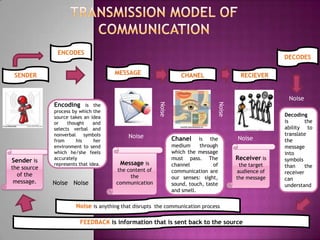
Transmission Model of communicationENCODESDECODESMESSAGESENDERRECIEVERCHANELNoiseEncodingis the process by which the source takes an idea or thought and selects verbal and nonverbal symbols from his her environment to send which he/she feels accurately represents that idea.NoiseNoiseDecoding is the ability to translate the message into symbols than the receiver can understandNoiseNoiseChanel is the medium through which the message must pass. The channel of communication are our senses: sight, sound, touch, taste and smell.Receiver is the target audience of the messageMessage is the content of the communicationSender is the source of the message.NoiseNoiseNoise is anything that disrupts  the communication processFEEDBACK is information that is sent back to the source
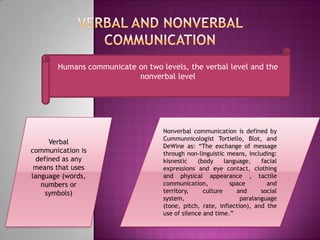
Verbal and nonverbal communicationHumans communicate on two levels, the verbal level and the nonverbal levelVerbal communication is defined as any means that uses language (words, numbers or symbols)Nonverbal communication is defined by CummunnicologistTortiello, Blot, and DeWine as: “The exchange of message through non-linguistic means, including: kisnestic (body language, facial expressions and eye contact, clothing and physical appearance , tactile communication, space and territory, culture and social system, paralanguage (tone, pitch, rate, inflection), and the use of silence and time.”
Communication environmentsIntrapersonal communication refers to the ability to the times you communicate with yourself.
Interpersonal communication occurs between people who have known each other for sometime.
Small group communicationMost researchers define a small group as having at least three and no more than twelve or fifteen members. A group members must be able to communicate freely and openly with all of the other members of the group.
Community is a group of people who interact with each other.A virtual communication is a group of people exchanging messages or other types of information without face to face contact.
Mass communication is the transmission of messages which may be processed by gate keepers or filters prior to being sent to large audience via a channel for broad diffusion.

Communicating with others.

  • 1.
  • 2.
    What is communication?JosephDeVitio says, “Communication refers to the act, by one or more persons, of sending and receiving message that are distorted by noise, occur within a context, have some, and provide some opportunity for feedback.”
  • 3.
    Transmission Model ofcommunicationENCODESDECODESMESSAGESENDERRECIEVERCHANELNoiseEncodingis the process by which the source takes an idea or thought and selects verbal and nonverbal symbols from his her environment to send which he/she feels accurately represents that idea.NoiseNoiseDecoding is the ability to translate the message into symbols than the receiver can understandNoiseNoiseChanel is the medium through which the message must pass. The channel of communication are our senses: sight, sound, touch, taste and smell.Receiver is the target audience of the messageMessage is the content of the communicationSender is the source of the message.NoiseNoiseNoise is anything that disrupts the communication processFEEDBACK is information that is sent back to the source
  • 4.
    Verbal and nonverbalcommunicationHumans communicate on two levels, the verbal level and the nonverbal levelVerbal communication is defined as any means that uses language (words, numbers or symbols)Nonverbal communication is defined by CummunnicologistTortiello, Blot, and DeWine as: “The exchange of message through non-linguistic means, including: kisnestic (body language, facial expressions and eye contact, clothing and physical appearance , tactile communication, space and territory, culture and social system, paralanguage (tone, pitch, rate, inflection), and the use of silence and time.”
  • 5.
    Communication environmentsIntrapersonal communicationrefers to the ability to the times you communicate with yourself.
  • 6.
    Interpersonal communication occursbetween people who have known each other for sometime.
  • 7.
    Small group communicationMostresearchers define a small group as having at least three and no more than twelve or fifteen members. A group members must be able to communicate freely and openly with all of the other members of the group.
  • 8.
    Community is agroup of people who interact with each other.A virtual communication is a group of people exchanging messages or other types of information without face to face contact.
  • 9.
    Mass communication isthe transmission of messages which may be processed by gate keepers or filters prior to being sent to large audience via a channel for broad diffusion.