Communicating with OthersCommunication Critical ThinkingBy Cynthia Bryan
“Communication refers to the act, by one or more persons, of sending and receiving messages that are distorted by noise, occur within a context, have some effect, and provide some opportunity for feedback.”~ Joseph DeVitio
What’s Involved?The transmission model of communicationVerbal and Nonverbal CommunicationCommunication EnvironmentsDefining argumentative communication
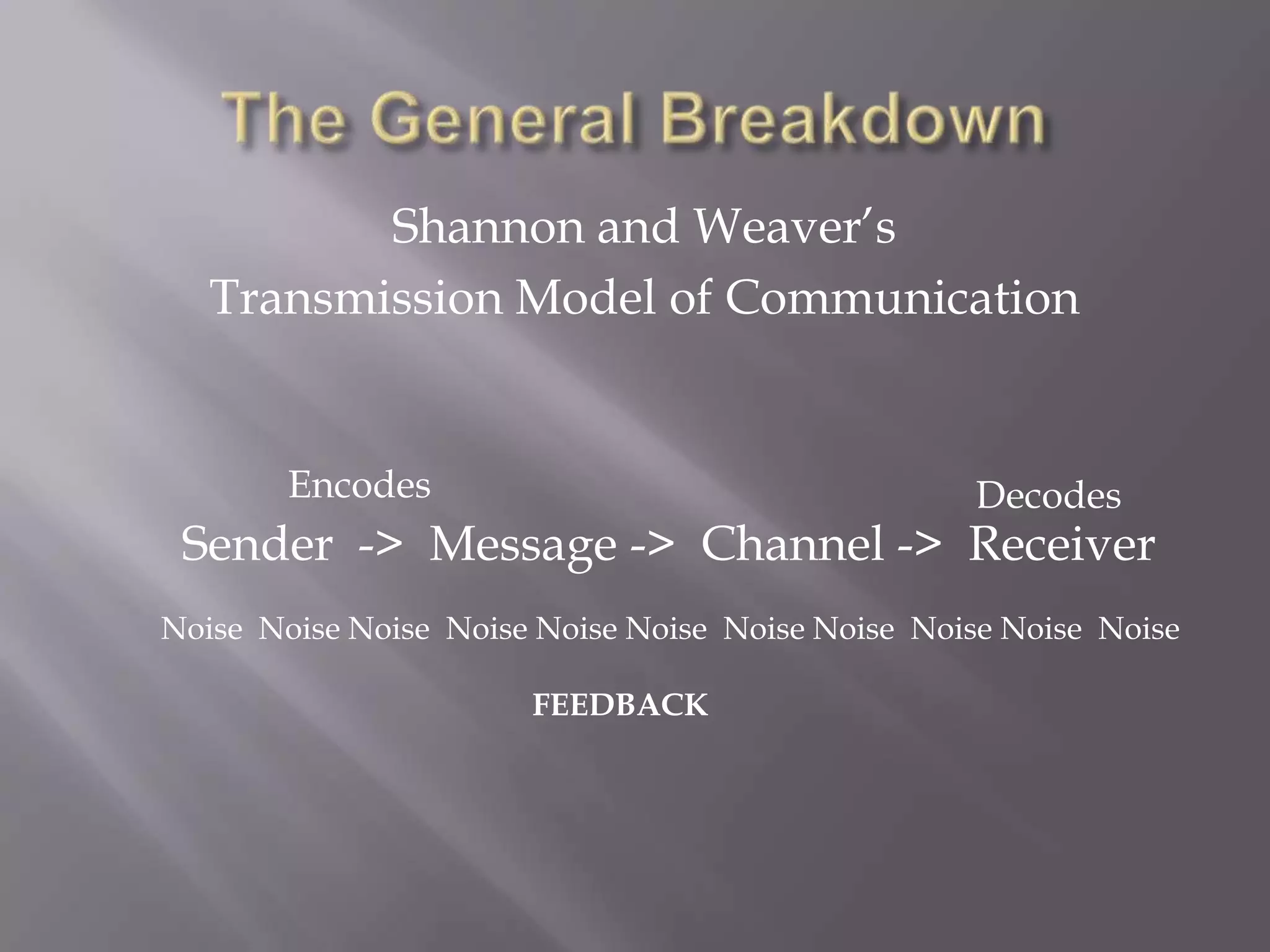
The General BreakdownShannon and Weaver’s Transmission Model of CommunicationEncodesDecodesSender  ->  Message ->  Channel ->  ReceiverNoise  NoiseNoiseNoiseNoiseNoiseNoiseNoiseNoiseNoiseNoiseFEEDBACK
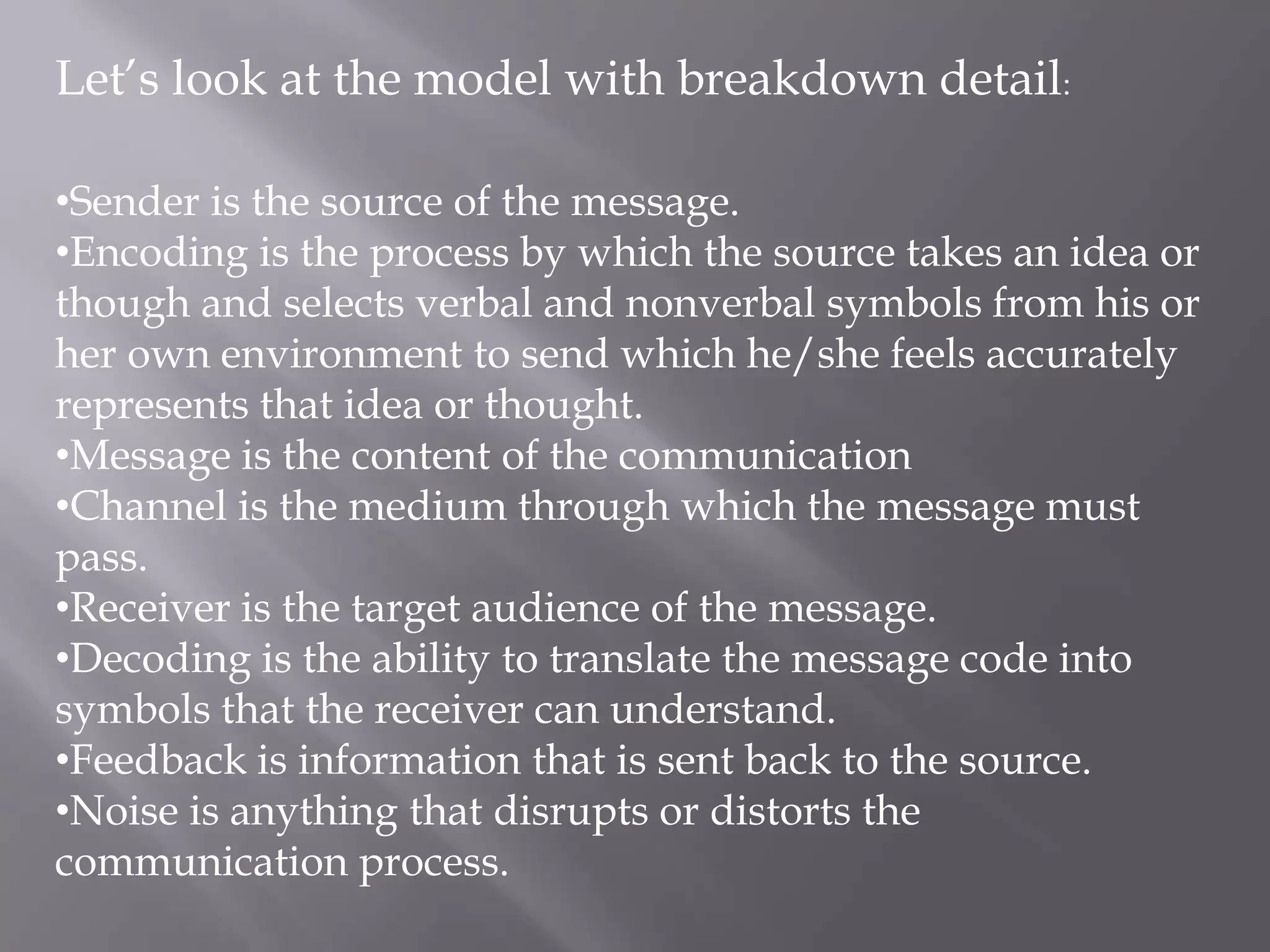
Let’s look at the model with breakdown detail:Sender is the source of the message.
Encoding is the process by which the source takes an idea or though and selects verbal and nonverbal symbols from his or her own environment to send which he/she feels accurately represents that idea or thought.
Message is the content of the communication
Channel is the medium through which the message must pass.

Communicating with Others

  • 1.
    Communicating with OthersCommunicationCritical ThinkingBy Cynthia Bryan
  • 2.
    “Communication refers tothe act, by one or more persons, of sending and receiving messages that are distorted by noise, occur within a context, have some effect, and provide some opportunity for feedback.”~ Joseph DeVitio
  • 3.
    What’s Involved?The transmissionmodel of communicationVerbal and Nonverbal CommunicationCommunication EnvironmentsDefining argumentative communication
  • 4.
    The General BreakdownShannonand Weaver’s Transmission Model of CommunicationEncodesDecodesSender -> Message -> Channel -> ReceiverNoise NoiseNoiseNoiseNoiseNoiseNoiseNoiseNoiseNoiseNoiseFEEDBACK
  • 5.
    Let’s look atthe model with breakdown detail:Sender is the source of the message.
  • 6.
    Encoding is theprocess by which the source takes an idea or though and selects verbal and nonverbal symbols from his or her own environment to send which he/she feels accurately represents that idea or thought.
  • 7.
    Message is thecontent of the communication
  • 8.
    Channel is themedium through which the message must pass.
  • 9.
    Receiver is thetarget audience of the message.
  • 10.
    Decoding is theability to translate the message code into symbols that the receiver can understand.
  • 11.
    Feedback is informationthat is sent back to the source.
  • 12.
    Noise is anythingthat disrupts or distorts the communication process.Verbal VS. NonverbalVerbal communication is defined as any means of comminicating that uses language (words, numbers, symbols).Nonverbal communication is defined by communicologistsTortoriello, Blott, and DeWine as: “The exchange of messages through non-linguistics means, including: kinesics (body language), facial expressions and eye contact, clothing and physical appearance, tactile communication, space and territory, culture and social system, paralanguage (tone, pitch, rate, inflection), and the use of the silence and time.”
  • 13.
    Communication EnvironmentsThere are5 main communication environments:Intrapersonal communication refers to the times you communicate with yourself, sometimes referred to as thinking or talking to yourself.Interpersonal communication differs from other forms of communication in that there are few participants involved.Small group is defined as a group having three and no more than fifteen members.Community (Public) communication is a set of more than fifteen people who exist together within some shared element.Mass communication is the transmission of messages which may be processed by gate keepers or filter prior to being sent to large audiences via a channel for broad diffusion.
  • 14.
    Defining Argumentative CommunicationAnargument is prompted by a disagreement,confusion, or ignorance about something whichthe arguers wish to resolve.Also, an important part of being an educatedcitizen is possessing the skill to recognize this irrationality, especially when it is posing as areasonable argument, since manipulating citizens through misleading arguments is a major feature of modern life.