Communication and
Technology in the Future
2021 A.D.


                    By: Melissa Herberger
The Umbrella Perspective of Communication
   The Umbrella Perspective requires you to investigate each area of a technology to fully
understand that technology. It breaks technology down into parts of an umbrella to explain it.

• The bottom of the umbrella consists of the hardware and software of the technology.
• The middle section of the umbrella is the organizational infrastructure: the group of
  organizations involved in the production and distribution of the technology.
• The top of the umbrella is the system level, including the political, economic, and media
  systems, as well as other groups of individuals or organizations serving a common set of
  functions in society.
• The handle of the umbrella is the individual user. This represents the relationship between
  the user and the technology. The relationship must be evaluated for the user to get a
  handle on the technology.


      Communication Technology Update by August E. Grant and Jennifer H. Meadows
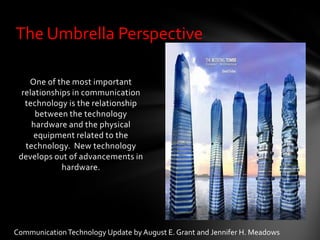
The Umbrella Perspective

    One of the most important
  relationships in communication
   technology is the relationship
      between the technology
     hardware and the physical
     equipment related to the
   technology. New technology
 develops out of advancements in
             hardware.


Communication Technology Update by August E. Grant and Jennifer H. Meadows
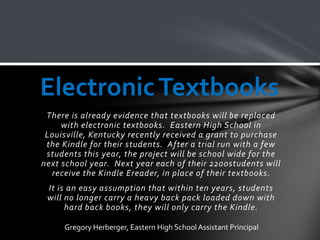
Electronic Textbooks
 There is already evidence that textbooks will be replaced
     with electronic textbooks. Eastern High School in
 Louisville, Kentucky recently received a grant to purchase
 the Kindle for their students. After a trial run with a few
 students this year, the project will be school wide for the
next school year. Next year each of their 2200students will
  receive the Kindle Ereader, in place of their textbooks.
 It is an easy assumption that within ten years, students
 will no longer carry a heavy back pack loaded down with
      hard back books, they will only carry the Kindle.

     Gregory Herberger, Eastern High School Assistant Principal
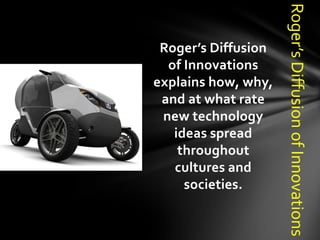
Roger’s Diffusion of Innovations
 Roger’s Diffusion
  of Innovations
explains how, why,
 and at what rate
 new technology
   ideas spread
    throughout
   cultures and
     societies.
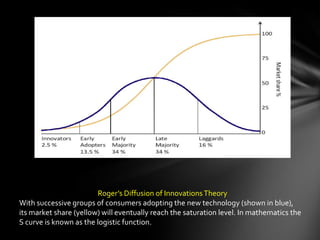
Roger’s Diffusion of Innovations Theory
With successive groups of consumers adopting the new technology (shown in blue),
its market share (yellow) will eventually reach the saturation level. In mathematics the
S curve is known as the logistic function.
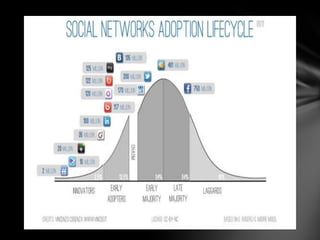
Moore’s Innovation Adoption Rate
  The rate of adoption is explained as the
  amount of time it takes for a culture of
  society to adopt a new technology
  “Geoffrey Moore (Crossing the Chasm,
  1991) proposed a variation on Rogers’
  model. He suggested that for
  discontinuous or disruptive innovations,
  there is a gap or chasm to cross
  between the first two adopter groups
  (innovators + early adopters) and the
  early majority.”
                                     Vincos Blog
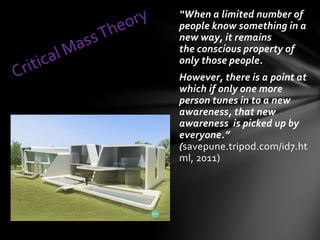
“When a limited number of
people know something in a
new way, it remains
the conscious property of
only those people.
However, there is a point at
which if only one more
person tunes in to a new
awareness, that new
awareness is picked up by
everyone.”
(savepune.tripod.com/id7.ht
ml, 2011)
Computers in Cars
Perez Hilton posted this on his website on January 24,
2011.
“A new European technology has been developed that will actually allow you to
eat, read, and SLEEP while driving.
Yes, you read that right.
SARTRE, or Safe Road Trains for the Environment, is a new program that has
partnered with Volvo that will install an advanced steering and sensory
technology inside of cars to create a way to let cars drive themselves.
The "road train" will be a line of cars that communicates with a leader car via Wi-
Fi that will allow drivers in the other cars to spend little time paying attention to
the road.
Um, terrifying!!!
Sources say that this technology will be fully developed by 2021 and will increase
fuel efficiency by as much as 20%.”
Uses and Gratifications Theory
                                 An approach to fully understand how
                                 mass media and mass communication
                                 relate to one another is the Uses and
                                 Gratifications Theory.
                                 The theory looks at how users search
                                 for media that will not only meet their
                                 needs, but also increase their
                                 knowledge, social interactions and
                                 diversion. It assumes that audience
                                 members are active in incorporating
                                 media into their lives. The Uses and
                                 Gratification Theory suggests that
                                 people are responsible for which media
                                 outlet fulfills their needs and wants.
                                 Media outlets must then compete to
                                 gain the attention of consumers.
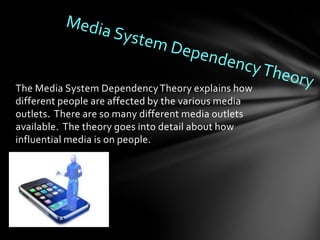
The Media System Dependency Theory explains how
different people are affected by the various media
outlets. There are so many different media outlets
available. The theory goes into detail about how
influential media is on people.
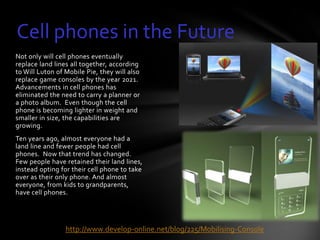
Cell phones in the Future
Not only will cell phones eventually
replace land lines all together, according
to Will Luton of Mobile Pie, they will also
replace game consoles by the year 2021.
Advancements in cell phones has
eliminated the need to carry a planner or
a photo album. Even though the cell
phone is becoming lighter in weight and
smaller in size, the capabilities are
growing.
Ten years ago, almost everyone had a
land line and fewer people had cell
phones. Now that trend has changed.
Few people have retained their land lines,
instead opting for their cell phone to take
over as their only phone. And almost
everyone, from kids to grandparents,
have cell phones.


                 http://www.develop-online.net/blog/225/Mobilising-Console
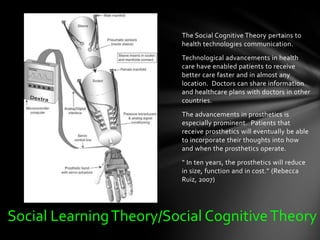
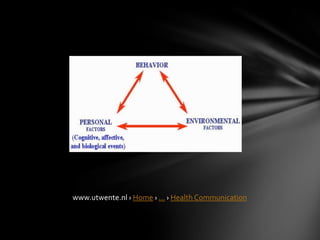
The Social Cognitive Theory pertains to
                         health technologies communication.
                         Technological advancements in health
                         care have enabled patients to receive
                         better care faster and in almost any
                         location. Doctors can share information
                         and healthcare plans with doctors in other
                         countries.
                         The advancements in prosthetics is
                         especially prominent. Patients that
                         receive prosthetics will eventually be able
                         to incorporate their thoughts into how
                         and when the prosthetics operate.
                         “ In ten years, the prosthetics will reduce
                         in size, function and in cost.” (Rebecca
                         Ruiz, 2007)


Social Learning Theory/Social Cognitive Theory
www.utwente.nl › Home › ... › Health Communication
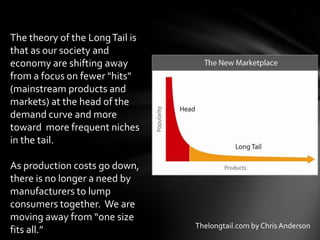
The Theory of the Long Tail
The theory of the Long Tail is
that as our society and
economy are shifting away
from a focus on fewer "hits"
(mainstream products and
markets) at the head of the
demand curve and more
toward more frequent niches
in the tail.

As production costs go down,
there is no longer a need by
manufacturers to lump
consumers together. We are
moving away from “one size
                                 Thelongtail.com by Chris Anderson
fits all.”
The Principle of Relative Constancy
analyzes financial cost spent by
advertisers versus consumer spending.


Is the amount of advertising by
manufacturers influencing how much
consumers are spending on technology
gadgets?
Economicsofadvertising.com by Andrew
Gaerig
Sources
•   Communication Technology Update by August E. Grant and Jennifer H. Meadows
•   en.wikipedia.org/wiki/Diffusion_of_innovations
•   Vincos Blog
•   savepune.tripod.com/id7.html
•   en.wikipedia.org/wiki/Uses_and_gratifications_theory
•   www.scripps.ohiou.edu/wjmcr/vol11/
•   www.utwente.nl › Home › ... › Health Communication
•   Thelongtail.com by Chris Anderson
•   Economicsofadvertising.com by Andrew Gaerig
•   Perezhilton.com
•   Gregory Herberger, Eastern High School Assitant Prinicpal
•   Youtube Clip of Mike Rowe and 2012 Ford Escape
•   Rebecca Ruiz msnbc.com contributor updated 11/27/2007

Communication and technology in the future

  • 1.
    Communication and Technology inthe Future 2021 A.D. By: Melissa Herberger
  • 2.
    The Umbrella Perspectiveof Communication The Umbrella Perspective requires you to investigate each area of a technology to fully understand that technology. It breaks technology down into parts of an umbrella to explain it. • The bottom of the umbrella consists of the hardware and software of the technology. • The middle section of the umbrella is the organizational infrastructure: the group of organizations involved in the production and distribution of the technology. • The top of the umbrella is the system level, including the political, economic, and media systems, as well as other groups of individuals or organizations serving a common set of functions in society. • The handle of the umbrella is the individual user. This represents the relationship between the user and the technology. The relationship must be evaluated for the user to get a handle on the technology. Communication Technology Update by August E. Grant and Jennifer H. Meadows
  • 3.
    The Umbrella Perspective One of the most important relationships in communication technology is the relationship between the technology hardware and the physical equipment related to the technology. New technology develops out of advancements in hardware. Communication Technology Update by August E. Grant and Jennifer H. Meadows
  • 4.
    Electronic Textbooks Thereis already evidence that textbooks will be replaced with electronic textbooks. Eastern High School in Louisville, Kentucky recently received a grant to purchase the Kindle for their students. After a trial run with a few students this year, the project will be school wide for the next school year. Next year each of their 2200students will receive the Kindle Ereader, in place of their textbooks. It is an easy assumption that within ten years, students will no longer carry a heavy back pack loaded down with hard back books, they will only carry the Kindle. Gregory Herberger, Eastern High School Assistant Principal
  • 5.
    Roger’s Diffusion ofInnovations Roger’s Diffusion of Innovations explains how, why, and at what rate new technology ideas spread throughout cultures and societies.
  • 6.
    Roger’s Diffusion ofInnovations Theory With successive groups of consumers adopting the new technology (shown in blue), its market share (yellow) will eventually reach the saturation level. In mathematics the S curve is known as the logistic function.
  • 7.
    Moore’s Innovation AdoptionRate The rate of adoption is explained as the amount of time it takes for a culture of society to adopt a new technology “Geoffrey Moore (Crossing the Chasm, 1991) proposed a variation on Rogers’ model. He suggested that for discontinuous or disruptive innovations, there is a gap or chasm to cross between the first two adopter groups (innovators + early adopters) and the early majority.” Vincos Blog
  • 9.
    “When a limitednumber of people know something in a new way, it remains the conscious property of only those people. However, there is a point at which if only one more person tunes in to a new awareness, that new awareness is picked up by everyone.” (savepune.tripod.com/id7.ht ml, 2011)
  • 10.
    Computers in Cars PerezHilton posted this on his website on January 24, 2011. “A new European technology has been developed that will actually allow you to eat, read, and SLEEP while driving. Yes, you read that right. SARTRE, or Safe Road Trains for the Environment, is a new program that has partnered with Volvo that will install an advanced steering and sensory technology inside of cars to create a way to let cars drive themselves. The "road train" will be a line of cars that communicates with a leader car via Wi- Fi that will allow drivers in the other cars to spend little time paying attention to the road. Um, terrifying!!! Sources say that this technology will be fully developed by 2021 and will increase fuel efficiency by as much as 20%.”
  • 12.
    Uses and GratificationsTheory An approach to fully understand how mass media and mass communication relate to one another is the Uses and Gratifications Theory. The theory looks at how users search for media that will not only meet their needs, but also increase their knowledge, social interactions and diversion. It assumes that audience members are active in incorporating media into their lives. The Uses and Gratification Theory suggests that people are responsible for which media outlet fulfills their needs and wants. Media outlets must then compete to gain the attention of consumers.
  • 13.
    The Media SystemDependency Theory explains how different people are affected by the various media outlets. There are so many different media outlets available. The theory goes into detail about how influential media is on people.
  • 14.
    Cell phones inthe Future Not only will cell phones eventually replace land lines all together, according to Will Luton of Mobile Pie, they will also replace game consoles by the year 2021. Advancements in cell phones has eliminated the need to carry a planner or a photo album. Even though the cell phone is becoming lighter in weight and smaller in size, the capabilities are growing. Ten years ago, almost everyone had a land line and fewer people had cell phones. Now that trend has changed. Few people have retained their land lines, instead opting for their cell phone to take over as their only phone. And almost everyone, from kids to grandparents, have cell phones. http://www.develop-online.net/blog/225/Mobilising-Console
  • 15.
    The Social CognitiveTheory pertains to health technologies communication. Technological advancements in health care have enabled patients to receive better care faster and in almost any location. Doctors can share information and healthcare plans with doctors in other countries. The advancements in prosthetics is especially prominent. Patients that receive prosthetics will eventually be able to incorporate their thoughts into how and when the prosthetics operate. “ In ten years, the prosthetics will reduce in size, function and in cost.” (Rebecca Ruiz, 2007) Social Learning Theory/Social Cognitive Theory
  • 16.
    www.utwente.nl › Home› ... › Health Communication
  • 17.
    The Theory ofthe Long Tail
  • 18.
    The theory ofthe Long Tail is that as our society and economy are shifting away from a focus on fewer "hits" (mainstream products and markets) at the head of the demand curve and more toward more frequent niches in the tail. As production costs go down, there is no longer a need by manufacturers to lump consumers together. We are moving away from “one size Thelongtail.com by Chris Anderson fits all.”
  • 19.
    The Principle ofRelative Constancy analyzes financial cost spent by advertisers versus consumer spending. Is the amount of advertising by manufacturers influencing how much consumers are spending on technology gadgets? Economicsofadvertising.com by Andrew Gaerig
  • 20.
    Sources • Communication Technology Update by August E. Grant and Jennifer H. Meadows • en.wikipedia.org/wiki/Diffusion_of_innovations • Vincos Blog • savepune.tripod.com/id7.html • en.wikipedia.org/wiki/Uses_and_gratifications_theory • www.scripps.ohiou.edu/wjmcr/vol11/ • www.utwente.nl › Home › ... › Health Communication • Thelongtail.com by Chris Anderson • Economicsofadvertising.com by Andrew Gaerig • Perezhilton.com • Gregory Herberger, Eastern High School Assitant Prinicpal • Youtube Clip of Mike Rowe and 2012 Ford Escape • Rebecca Ruiz msnbc.com contributor updated 11/27/2007