
The Future of technology

      Brittany Taylor
Welcome to 2022…
• WE all would love doing little work for the
  best benefit(profit), right? Finally in 2022,
  little will be the standard. Technology will
  literally rule the world in the future. Some of
  the most important aspects of our lives such
  as cars, education and communicative and
  entertainment devices will be totally
  transformed. Are you ready???
Vroom, Vroom. BEEP Beep
• Cars are some individuals most prized
  possessions.
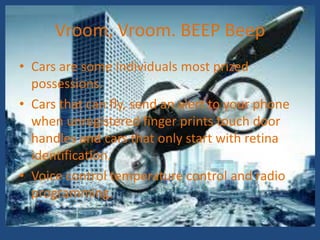
• Cars that can fly, send an alert to your phone
  when unregistered finger prints touch door
  handles and cars that only start with retina
  identification.
• Voice control temperature control and radio
  programming.
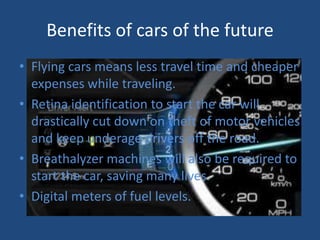
Benefits of cars of the future
• Flying cars means less travel time and cheaper
  expenses while traveling.
• Retina identification to start the car will
  drastically cut down on theft of motor vehicles
  and keep underage drivers off the road.
• Breathalyzer machines will also be required to
  start the car, saving many lives.
• Digital meters of fuel levels.
Roger’s Diffusion of Innovations
Rogers’ believed, “Diffusion is the process in
which an innovation is communicated through
certain channels overtime among the members
of a social system (Rogers)”
Diffusion of Innovations is a framework of
transformation.
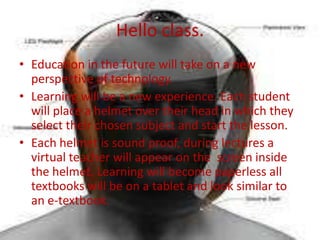
Hello class.
• Education in the future will take on a new
  perspective of technology.
• Learning will be a new experience. Each student
  will place a helmet over their head in which they
  select their chosen subject and start the lesson.
• Each helmet is sound proof, during lectures a
  virtual teacher will appear on the screen inside
  the helmet. Learning will become paperless all
  textbooks will be on a tablet and look similar to
  an e-textbook.
Purpose of education in 2022
• Benefits of education in the future appeal to each
  student. You have the choice of which subject you
  want to start on and the pace at which you move
  along in the lecture.
• Instead of the traditional raising your hand in
  class, you simply click on the professor link and
  speak or type your question, then the professor
  will appear on the screen and answer the
  question.
• This appeals to visual, audio and/or both types of
  learners.
Uses and Gratifications Theory
• “Uses and gratification theory suggests that media users
  play an active role in choosing and using the media. Users
  take an active part in the communication process and are
  goal oriented in their media use. The theorist say that a
  media user seeks out a media source that best fulfills the
  needs of the user. Uses and gratifications assume that the
  user has alternate choices to satisfy their need”.(Blumler
  and Katz )
• Uses and gratification theory is applicable to entertainment
  because there are many choices available.
• This drives manufacturers to produce the most appealing
  products to consumers with updated technology with many
  unique features.
Entertainment devices
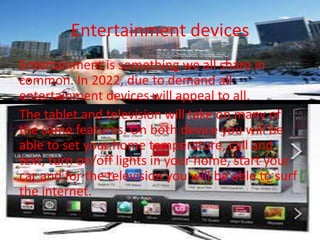
Entertainment is something we all share in
common. In 2022, due to demand all
entertainment devices will appeal to all.
The tablet and television will take on many of
the same features. On both device you will be
able to set your home temperature, call and
text, turn on/off lights in your home, start your
car and for the television you will be able to surf
the internet.
Moore’s Innovation Adoption Rate
• “The rate of adoption is defined as the relative
  speed with which members of a social system
  adopt an innovation. It is usually measured by the
  length of time required for a certain percentage
  of the members of a social system to adopt an
  innovation”(Vincos).
• In our society if five people like a product over
  time five million will. This trend will always be the
  norm especially if a celebrity endorses a product.
Communicative devices
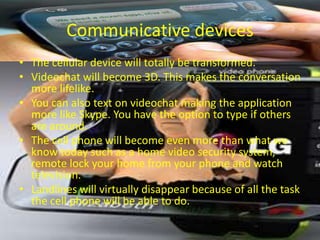
• The cellular device will totally be transformed.
• Videochat will become 3D. This makes the conversation
  more lifelike.
• You can also text on videochat making the application
  more like Skype. You have the option to type if others
  are around.
• The cell phone will become even more than what we
  know today such as a home video security system,
  remote lock your home from your phone and watch
  television.
• Landlines will virtually disappear because of all the task
  the cell phone will be able to do.
Communicative device takeover.
• As discussed, the cellphone, television and
  tablet will be the reason behind many devices
  disappearing such as landlines and computers.
• On all devices you will be able to
  communicate orally(voice and video chat) and
  written(text, email, etc)
• Along with many added features these will
  become the three most compatible,
  convenient and popular products in 2022.
References
• Blumler J.G. & Katz, E. (1974). The uses of
  mass communications: Current perspectives
  on gratifications research. Beverly Hills, CA:
  Sage.
• Rogers,E.(1995). Elements of diffusion. In
  diffusions of innovations (4th ed.) New
  York, Ny. The Free Press.
• Vincos Blog. Media Social Statistics. Web.
  Retrieved 6 December 2012.

Technology in 2022

  • 1.
    The Future oftechnology Brittany Taylor
  • 2.
    Welcome to 2022… •WE all would love doing little work for the best benefit(profit), right? Finally in 2022, little will be the standard. Technology will literally rule the world in the future. Some of the most important aspects of our lives such as cars, education and communicative and entertainment devices will be totally transformed. Are you ready???
  • 3.
    Vroom, Vroom. BEEPBeep • Cars are some individuals most prized possessions. • Cars that can fly, send an alert to your phone when unregistered finger prints touch door handles and cars that only start with retina identification. • Voice control temperature control and radio programming.
  • 4.
    Benefits of carsof the future • Flying cars means less travel time and cheaper expenses while traveling. • Retina identification to start the car will drastically cut down on theft of motor vehicles and keep underage drivers off the road. • Breathalyzer machines will also be required to start the car, saving many lives. • Digital meters of fuel levels.
  • 5.
    Roger’s Diffusion ofInnovations Rogers’ believed, “Diffusion is the process in which an innovation is communicated through certain channels overtime among the members of a social system (Rogers)” Diffusion of Innovations is a framework of transformation.
  • 6.
    Hello class. • Educationin the future will take on a new perspective of technology. • Learning will be a new experience. Each student will place a helmet over their head in which they select their chosen subject and start the lesson. • Each helmet is sound proof, during lectures a virtual teacher will appear on the screen inside the helmet. Learning will become paperless all textbooks will be on a tablet and look similar to an e-textbook.
  • 7.
    Purpose of educationin 2022 • Benefits of education in the future appeal to each student. You have the choice of which subject you want to start on and the pace at which you move along in the lecture. • Instead of the traditional raising your hand in class, you simply click on the professor link and speak or type your question, then the professor will appear on the screen and answer the question. • This appeals to visual, audio and/or both types of learners.
  • 8.
    Uses and GratificationsTheory • “Uses and gratification theory suggests that media users play an active role in choosing and using the media. Users take an active part in the communication process and are goal oriented in their media use. The theorist say that a media user seeks out a media source that best fulfills the needs of the user. Uses and gratifications assume that the user has alternate choices to satisfy their need”.(Blumler and Katz ) • Uses and gratification theory is applicable to entertainment because there are many choices available. • This drives manufacturers to produce the most appealing products to consumers with updated technology with many unique features.
  • 9.
    Entertainment devices Entertainment issomething we all share in common. In 2022, due to demand all entertainment devices will appeal to all. The tablet and television will take on many of the same features. On both device you will be able to set your home temperature, call and text, turn on/off lights in your home, start your car and for the television you will be able to surf the internet.
  • 10.
    Moore’s Innovation AdoptionRate • “The rate of adoption is defined as the relative speed with which members of a social system adopt an innovation. It is usually measured by the length of time required for a certain percentage of the members of a social system to adopt an innovation”(Vincos). • In our society if five people like a product over time five million will. This trend will always be the norm especially if a celebrity endorses a product.
  • 11.
    Communicative devices • Thecellular device will totally be transformed. • Videochat will become 3D. This makes the conversation more lifelike. • You can also text on videochat making the application more like Skype. You have the option to type if others are around. • The cell phone will become even more than what we know today such as a home video security system, remote lock your home from your phone and watch television. • Landlines will virtually disappear because of all the task the cell phone will be able to do.
  • 12.
    Communicative device takeover. •As discussed, the cellphone, television and tablet will be the reason behind many devices disappearing such as landlines and computers. • On all devices you will be able to communicate orally(voice and video chat) and written(text, email, etc) • Along with many added features these will become the three most compatible, convenient and popular products in 2022.
  • 14.
    References • Blumler J.G.& Katz, E. (1974). The uses of mass communications: Current perspectives on gratifications research. Beverly Hills, CA: Sage. • Rogers,E.(1995). Elements of diffusion. In diffusions of innovations (4th ed.) New York, Ny. The Free Press. • Vincos Blog. Media Social Statistics. Web. Retrieved 6 December 2012.