What Will the Communication
Technology Landscape Look Like in 2022
A.D.?
Selena Thompson
COMM 303-50
Final Project
Innovation, what is it?
According to dictionary.com, the definition of
innovation is the introduction of new things or
methods or ideas. Innovation has had an impact
on many technological advances already and
come the year of 2022 A.D. it will be even more.
“Every one in awhile, a new technology, an old
problem, and a big idea turn into an innovation.”
–Dean Kamen
Several Years
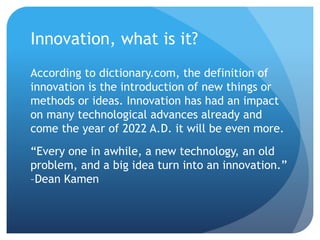
 When you take a look back to
communication technology a
decade ago compared to
today, you will see how
advanced it has become
already and it doesn't’t stop
there. Every year there is
something that is newer,
more advanced, and
ultimately better that
surfaces that everyone will
obsesses over until the next
on comes. It’s an ongoing
process. It’s honestly crazy
to think what communication
technology will like come
2022.
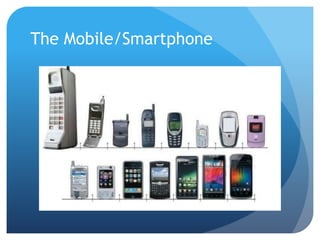
The Mobile/Smartphone
Today’s Smartphone:
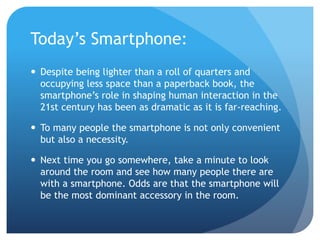
 Despite being lighter than a roll of quarters and
occupying less space than a paperback book, the
smartphone’s role in shaping human interaction in the
21st century has been as dramatic as it is far-reaching.
 To many people the smartphone is not only convenient
but also a necessity.
 Next time you go somewhere, take a minute to look
around the room and see how many people there are
with a smartphone. Odds are that the smartphone will
be the most dominant accessory in the room.
Uses of the Smartphone
 Smartphones are used in so many ways for many different things.
Each owner of one uses it for there own personal preference and
own needs.
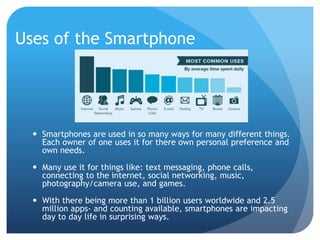
 Many use it for things like: text messaging, phone calls,
connecting to the internet, social networking, music,
photography/camera use, and games.
 With there being more than 1 billion users worldwide and 2.5
million apps- and counting available, smartphones are impacting
day to day life in surprising ways.
Uses and Gratifications Theory
 This theory is an approach to understanding why and how
people actively seek out specific media to satisfy needs.
 This is an Audience-centered approach to understanding mass
communication. It focuses on “what do people do with
media?”.
 If there are no consumers of a product, how can a product
persist? It can be improved or altered into something that
people will want.
 Smartphones haven't evolved without the regard to how and
why people use them. Mobile phones are satisfying peoples
needs to have communication where they may go and that is
why land lines are something that has become a thing of the
past for many people.
Future of the Smartphone
 The Uses and gratifications theory is most likely to play a role
in the smartphone people will endure in 2022.
 The question is what will it do, that it doesn’t already do?
How will it become more advanced than it is now? We don’t
know how but we know it will, seems limitless.
 New smartphones are released every year. You see people
standing outside Apple stores everywhere the day the new
iPhone comes out and why? Because it is seen as an upgrade
and improvement from the model the year before. It’s an
improvement which makes it better.
 As people come more and more dependent on smartphones,
smartphones will continue to advance and grow.
Smartphone Today vs. Future
Smartphone
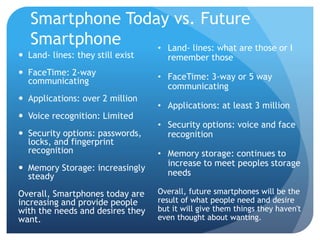
 Land- lines: they still exist
 FaceTime: 2-way
communicating
 Applications: over 2 million
 Voice recognition: Limited
 Security options: passwords,
locks, and fingerprint
recognition
 Memory Storage: increasingly
steady
Overall, Smartphones today are
increasing and provide people
with the needs and desires they
want.
• Land- lines: what are those or I
remember those
• FaceTime: 3-way or 5 way
communicating
• Applications: at least 3 million
• Security options: voice and face
recognition
• Memory storage: continues to
increase to meet peoples storage
needs
Overall, future smartphones will be the
result of what people need and desire
but it will give them things they haven't
even thought about wanting.
Education changes
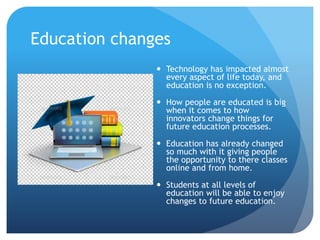
 Technology has impacted almost
every aspect of life today, and
education is no exception.
 How people are educated is big
when it comes to how
innovators change things for
future education processes.
 Education has already changed
so much with it giving people
the opportunity to there classes
online and from home.
 Students at all levels of
education will be able to enjoy
changes to future education.
Education
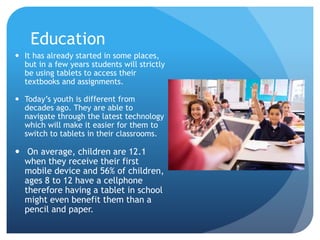
 It has already started in some places,
but in a few years students will strictly
be using tablets to access their
textbooks and assignments.
 Today’s youth is different from
decades ago. They are able to
navigate through the latest technology
which will make it easier for them to
switch to tablets in their classrooms.
 On average, children are 12.1
when they receive their first
mobile device and 56% of children,
ages 8 to 12 have a cellphone
therefore having a tablet in school
might even benefit them than a
pencil and paper.
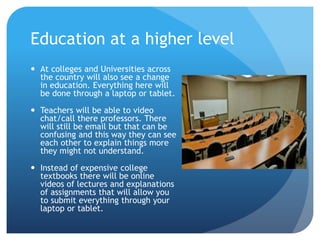
Education at a higher level
 At colleges and Universities across
the country will also see a change
in education. Everything here will
be done through a laptop or tablet.
 Teachers will be able to video
chat/call there professors. There
will still be email but that can be
confusing and this way they can see
each other to explain things more
they might not understand.
 Instead of expensive college
textbooks there will be online
videos of lectures and explanations
of assignments that will allow you
to submit everything through your
laptop or tablet.
The Umbrella Perspective
 Hardware- the communication technology itself
 Software- the message/content of the communication
technology
 Organizational infrastructure- those involved in the
production/distribution
 Social System- the political, economic and media
systems
 Individual Users- actual and potential
Factors that affect all levels in this: Enabling, Limiting,
Motivating, and Inhibiting.
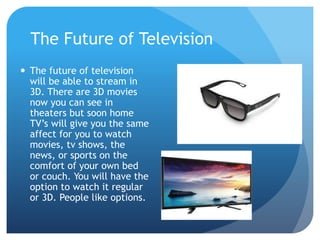
The Future of Television
 The future of television
will be able to stream in
3D. There are 3D movies
now you can see in
theaters but soon home
TV’s will give you the same
affect for you to watch
movies, tv shows, the
news, or sports on the
comfort of your own bed
or couch. You will have the
option to watch it regular
or 3D. People like options.
Roger’s Diffusion of Innovations
Diffusion of Inovations
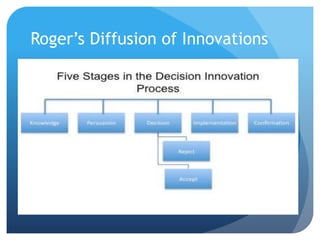
 Diffusion of Innovations is a theory that seeks to explain
how, why, and at what rate new ideas and technology
spread. It occurs through a five step process:
Knowledge, Persuasion, Decision, implementation, and
Confirmation.
 Rogers, argues that diffusion is the process by which
innovation is communicated over time among
participants in a social system.
Sources
 http://www.govtech.com/products/How-Smartphones-
Revolutionized-Society-in-Less-than-a-Decade.html
 http://www.growingwireless.com/get-the-facts/quick-
facts
 https://online.purdue.edu/ldt/learning-design-
technology/resources/how-has-technology-changed-
education
 https://en.wikipedia.org/wiki/Diffusion_of_innovations

Final project

  • 1.
    What Will theCommunication Technology Landscape Look Like in 2022 A.D.? Selena Thompson COMM 303-50 Final Project
  • 2.
    Innovation, what isit? According to dictionary.com, the definition of innovation is the introduction of new things or methods or ideas. Innovation has had an impact on many technological advances already and come the year of 2022 A.D. it will be even more. “Every one in awhile, a new technology, an old problem, and a big idea turn into an innovation.” –Dean Kamen
  • 3.
    Several Years  Whenyou take a look back to communication technology a decade ago compared to today, you will see how advanced it has become already and it doesn't’t stop there. Every year there is something that is newer, more advanced, and ultimately better that surfaces that everyone will obsesses over until the next on comes. It’s an ongoing process. It’s honestly crazy to think what communication technology will like come 2022.
  • 4.
  • 5.
    Today’s Smartphone:  Despitebeing lighter than a roll of quarters and occupying less space than a paperback book, the smartphone’s role in shaping human interaction in the 21st century has been as dramatic as it is far-reaching.  To many people the smartphone is not only convenient but also a necessity.  Next time you go somewhere, take a minute to look around the room and see how many people there are with a smartphone. Odds are that the smartphone will be the most dominant accessory in the room.
  • 6.
    Uses of theSmartphone  Smartphones are used in so many ways for many different things. Each owner of one uses it for there own personal preference and own needs.  Many use it for things like: text messaging, phone calls, connecting to the internet, social networking, music, photography/camera use, and games.  With there being more than 1 billion users worldwide and 2.5 million apps- and counting available, smartphones are impacting day to day life in surprising ways.
  • 7.
    Uses and GratificationsTheory  This theory is an approach to understanding why and how people actively seek out specific media to satisfy needs.  This is an Audience-centered approach to understanding mass communication. It focuses on “what do people do with media?”.  If there are no consumers of a product, how can a product persist? It can be improved or altered into something that people will want.  Smartphones haven't evolved without the regard to how and why people use them. Mobile phones are satisfying peoples needs to have communication where they may go and that is why land lines are something that has become a thing of the past for many people.
  • 8.
    Future of theSmartphone  The Uses and gratifications theory is most likely to play a role in the smartphone people will endure in 2022.  The question is what will it do, that it doesn’t already do? How will it become more advanced than it is now? We don’t know how but we know it will, seems limitless.  New smartphones are released every year. You see people standing outside Apple stores everywhere the day the new iPhone comes out and why? Because it is seen as an upgrade and improvement from the model the year before. It’s an improvement which makes it better.  As people come more and more dependent on smartphones, smartphones will continue to advance and grow.
  • 9.
    Smartphone Today vs.Future Smartphone  Land- lines: they still exist  FaceTime: 2-way communicating  Applications: over 2 million  Voice recognition: Limited  Security options: passwords, locks, and fingerprint recognition  Memory Storage: increasingly steady Overall, Smartphones today are increasing and provide people with the needs and desires they want. • Land- lines: what are those or I remember those • FaceTime: 3-way or 5 way communicating • Applications: at least 3 million • Security options: voice and face recognition • Memory storage: continues to increase to meet peoples storage needs Overall, future smartphones will be the result of what people need and desire but it will give them things they haven't even thought about wanting.
  • 10.
    Education changes  Technologyhas impacted almost every aspect of life today, and education is no exception.  How people are educated is big when it comes to how innovators change things for future education processes.  Education has already changed so much with it giving people the opportunity to there classes online and from home.  Students at all levels of education will be able to enjoy changes to future education.
  • 11.
    Education  It hasalready started in some places, but in a few years students will strictly be using tablets to access their textbooks and assignments.  Today’s youth is different from decades ago. They are able to navigate through the latest technology which will make it easier for them to switch to tablets in their classrooms.  On average, children are 12.1 when they receive their first mobile device and 56% of children, ages 8 to 12 have a cellphone therefore having a tablet in school might even benefit them than a pencil and paper.
  • 12.
    Education at ahigher level  At colleges and Universities across the country will also see a change in education. Everything here will be done through a laptop or tablet.  Teachers will be able to video chat/call there professors. There will still be email but that can be confusing and this way they can see each other to explain things more they might not understand.  Instead of expensive college textbooks there will be online videos of lectures and explanations of assignments that will allow you to submit everything through your laptop or tablet.
  • 13.
    The Umbrella Perspective Hardware- the communication technology itself  Software- the message/content of the communication technology  Organizational infrastructure- those involved in the production/distribution  Social System- the political, economic and media systems  Individual Users- actual and potential Factors that affect all levels in this: Enabling, Limiting, Motivating, and Inhibiting.
  • 14.
    The Future ofTelevision  The future of television will be able to stream in 3D. There are 3D movies now you can see in theaters but soon home TV’s will give you the same affect for you to watch movies, tv shows, the news, or sports on the comfort of your own bed or couch. You will have the option to watch it regular or 3D. People like options.
  • 15.
  • 16.
    Diffusion of Inovations Diffusion of Innovations is a theory that seeks to explain how, why, and at what rate new ideas and technology spread. It occurs through a five step process: Knowledge, Persuasion, Decision, implementation, and Confirmation.  Rogers, argues that diffusion is the process by which innovation is communicated over time among participants in a social system.
  • 17.
    Sources  http://www.govtech.com/products/How-Smartphones- Revolutionized-Society-in-Less-than-a-Decade.html  http://www.growingwireless.com/get-the-facts/quick- facts https://online.purdue.edu/ldt/learning-design- technology/resources/how-has-technology-changed- education  https://en.wikipedia.org/wiki/Diffusion_of_innovations