The Future of Communication
           Technology


 What will
communication
technology
look like in
   2022?
Telecommunications

Highlights in Development
•1834 Carl F.Gauss and Ernst H. Weber build the
electromagnetic telegraph
•1860 Philipp Reis develops a “telephon.”
•1874 Alexander Graham Bell discovers the principle of
the telephone.
•1891 The first automatic dial system was patented by a
Kansas City undertaker. Switchboard operators were no
longer necessary to make a telephone call.
•1963 Bell System introduces the touch tone phone.
•1989 "Pocket" cellular telephone is introduced by
Motorola.
•1990's Digital signal processing of all telecommunication
equipment (including ISDNs and HDTV) A television can
now be used as a television, telephone, computer and
video game center all in one place.
Telecommunications

What does the future hold?
•In 2022 telephone technology could look like:
•All commands can be voice directed, eliminating the need for
keypads, except when desired.
•There will no longer be a need for any wired devices.
•Computer and phone will become even more integrated, possibly
eliminating the use of a keyboard because of the voice command
capabilities.
•Cell phone imaging can be completely 3D, especially helpful in using
GPS while traveling.
•Wi-fi will be universal, eliminating the need for 3G.
Critical Mass Theory in Relation
       to Telecommunication
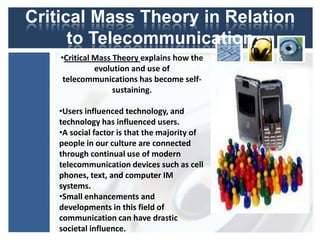
     •Critical Mass Theory explains how the
                 Development
               evolution and use of
     telecommunications has become self-
                sustaining.

     •Users influenced technology, and
     technology has influenced users.
     •A social factor is that the majority of
     people in our culture are connected
     through continual use of modern
     telecommunication devices such as cell
     phones, text, and computer IM
     systems.
     •Small enhancements and
     developments in this field of
     communication can have drastic
     societal influence.
Internet
                        The Future of the Internet
•With machine to machine technology, where there's no human
intervention, just smart sensors, smart computers, smart analytics, the
way people work may drastically change. The methods of operations
companies use will completely change. People may never have to go to
an office again.
•The internet is EVERYWHERE: on every person, accessible at every
location, in our personal devices. A computer is no longer necessary.
•At the store, you may simply touch a screen, and the computer can
identify you, and deliver personal information. You may shop by voice
command and products will be retrieved and brought directly to you.
•We may have “chips” inserted, and can command actions with our
minds.
•These ideas may seem like science fiction, but I believe are possible in
the future.
Media System Dependency in
Relation to Internet Development
       • “An audience needs-based approach to
                      media use”

    • The users are goal oriented in their selection of media.
      Users have a vested interest in the internet to continue
      evolving.
    • The more the internet can do for people, the more the
      people will use the internet.
    • The more users rely on the internet, the more the
      internet will be developed to satisfy the users’ needs
      and desires.
Social Media


   HISTORY

             Facebook was launched on February 4, 2004.
    It was originally used by college students at Harvard, then
    expanded to be used widely by college students to network. In
    2006, the network was extended beyond educational
    institutions to anyone with a registered email address. Now, it is
    estimated that there are nearly 000000 facebook users
    worldwide. According to digitalbuzzblog.com, in
    2011, Facebook had over 500 million users, and is now used by
    1 in every 13 people on earth, with over 250 million of them
    (over 50%) who log in every day. The average user still has over
    130 friends.
Social Media


   TWITTER
   Twitter was launched in July, 2006.
   Users send and read posts of up to 140 characters known as "tweets".
   According to the globeandmail.com, almost 200 million users worldwide.
   About 460,000 new Twitter accounts are opened daily.
   More than 140 million tweets are sent daily. That’s one billion weekly.
   Twitter has changed the media, business, and politics. The one-way
   transmission of information is vast, and reaches many people at once.

    “This is what the naysayers fail to understand: it's just as easy to use
    Twitter to spread the word about a brilliant 10,000-word New Yorker
    article as it is to spread the word about your Lucky Charms habit.” –
    Steven Johnson, author of The Invention of Air
The Future in Social Media

            What might Facebook and Twitter look like in the 2022?
      •The use of social media will not likely slow down, however, it’s types of
      uses may change.
      • As social media networks gain access to consumers’ personal
      information and interests, social media will target specific audiences to
      advertise specific products and ideas. Businesses will increase marketing
      in these venues.
      •Mobile technology will become more prevalent enabling offers of
      promotions, coupons and tips based on our geographical location and
      personal interests.
      •Relationships will not be as physically dependent and we will be friends
      with people from all over the world, creating a global melting pot.
      •We will all become members of a virtual that is not yet known to us.
      •We will be able to access social media in our living rooms on one device –
      that device will combine computer, video, phone, and social interaction.
      Live video time will be included in social media where you can login and
      “virtually” talk to your “friends.
Uses and Gratifications Theory


      Individuals actively seek out certain media outlets
      for their own gratification. Social Media is a prime
      example. People actively seek to interact with
      their friends and family. Also, people follow their
      particular interests through social media. Users
      are not passive- they are interacting with social
      media. Several gratifications in social media are
      socializing, entertainment, and seeking
      information.
Works Cited
• (n.d.). Retrieved from
  http://www.internetsociety.org/internet/how-it’s-
  evolving/future-scenarios?gclid=CNPzh-
  mf2K8CFRNS7AodwQ0rDw
•   (n.d.). Retrieved from
    http://curiosity.discovery.com/question/future-of-internet
•   . (n.d.). Retrieved from
    http://www.schoelles.com/Telephone/teltimeline.htm
•   (n.d.). Retrieved from http://www.businessinsider.com/how-
    facebook-was-founded-2010-3
•   (n.d.). Retrieved from
    http://www.guardian.co.uk/technology/2007/jul/25/media.new
    media
•   (n.d.). Retrieved from
    http://www.theglobeandmail.com/news/technology/tech-
    news/the-history-of-twitter-140-characters-at-a-
    time/article1949299/

Comm.tech

  • 1.
    The Future ofCommunication Technology What will communication technology look like in 2022?
  • 2.
    Telecommunications Highlights in Development •1834Carl F.Gauss and Ernst H. Weber build the electromagnetic telegraph •1860 Philipp Reis develops a “telephon.” •1874 Alexander Graham Bell discovers the principle of the telephone. •1891 The first automatic dial system was patented by a Kansas City undertaker. Switchboard operators were no longer necessary to make a telephone call. •1963 Bell System introduces the touch tone phone. •1989 "Pocket" cellular telephone is introduced by Motorola. •1990's Digital signal processing of all telecommunication equipment (including ISDNs and HDTV) A television can now be used as a television, telephone, computer and video game center all in one place.
  • 3.
    Telecommunications What does thefuture hold? •In 2022 telephone technology could look like: •All commands can be voice directed, eliminating the need for keypads, except when desired. •There will no longer be a need for any wired devices. •Computer and phone will become even more integrated, possibly eliminating the use of a keyboard because of the voice command capabilities. •Cell phone imaging can be completely 3D, especially helpful in using GPS while traveling. •Wi-fi will be universal, eliminating the need for 3G.
  • 4.
    Critical Mass Theoryin Relation to Telecommunication •Critical Mass Theory explains how the Development evolution and use of telecommunications has become self- sustaining. •Users influenced technology, and technology has influenced users. •A social factor is that the majority of people in our culture are connected through continual use of modern telecommunication devices such as cell phones, text, and computer IM systems. •Small enhancements and developments in this field of communication can have drastic societal influence.
  • 5.
    Internet The Future of the Internet •With machine to machine technology, where there's no human intervention, just smart sensors, smart computers, smart analytics, the way people work may drastically change. The methods of operations companies use will completely change. People may never have to go to an office again. •The internet is EVERYWHERE: on every person, accessible at every location, in our personal devices. A computer is no longer necessary. •At the store, you may simply touch a screen, and the computer can identify you, and deliver personal information. You may shop by voice command and products will be retrieved and brought directly to you. •We may have “chips” inserted, and can command actions with our minds. •These ideas may seem like science fiction, but I believe are possible in the future.
  • 6.
    Media System Dependencyin Relation to Internet Development • “An audience needs-based approach to media use” • The users are goal oriented in their selection of media. Users have a vested interest in the internet to continue evolving. • The more the internet can do for people, the more the people will use the internet. • The more users rely on the internet, the more the internet will be developed to satisfy the users’ needs and desires.
  • 7.
    Social Media HISTORY Facebook was launched on February 4, 2004. It was originally used by college students at Harvard, then expanded to be used widely by college students to network. In 2006, the network was extended beyond educational institutions to anyone with a registered email address. Now, it is estimated that there are nearly 000000 facebook users worldwide. According to digitalbuzzblog.com, in 2011, Facebook had over 500 million users, and is now used by 1 in every 13 people on earth, with over 250 million of them (over 50%) who log in every day. The average user still has over 130 friends.
  • 9.
    Social Media TWITTER Twitter was launched in July, 2006. Users send and read posts of up to 140 characters known as "tweets". According to the globeandmail.com, almost 200 million users worldwide. About 460,000 new Twitter accounts are opened daily. More than 140 million tweets are sent daily. That’s one billion weekly. Twitter has changed the media, business, and politics. The one-way transmission of information is vast, and reaches many people at once. “This is what the naysayers fail to understand: it's just as easy to use Twitter to spread the word about a brilliant 10,000-word New Yorker article as it is to spread the word about your Lucky Charms habit.” – Steven Johnson, author of The Invention of Air
  • 10.
    The Future inSocial Media What might Facebook and Twitter look like in the 2022? •The use of social media will not likely slow down, however, it’s types of uses may change. • As social media networks gain access to consumers’ personal information and interests, social media will target specific audiences to advertise specific products and ideas. Businesses will increase marketing in these venues. •Mobile technology will become more prevalent enabling offers of promotions, coupons and tips based on our geographical location and personal interests. •Relationships will not be as physically dependent and we will be friends with people from all over the world, creating a global melting pot. •We will all become members of a virtual that is not yet known to us. •We will be able to access social media in our living rooms on one device – that device will combine computer, video, phone, and social interaction. Live video time will be included in social media where you can login and “virtually” talk to your “friends.
  • 11.
    Uses and GratificationsTheory Individuals actively seek out certain media outlets for their own gratification. Social Media is a prime example. People actively seek to interact with their friends and family. Also, people follow their particular interests through social media. Users are not passive- they are interacting with social media. Several gratifications in social media are socializing, entertainment, and seeking information.
  • 12.
    Works Cited • (n.d.).Retrieved from http://www.internetsociety.org/internet/how-it’s- evolving/future-scenarios?gclid=CNPzh- mf2K8CFRNS7AodwQ0rDw • (n.d.). Retrieved from http://curiosity.discovery.com/question/future-of-internet • . (n.d.). Retrieved from http://www.schoelles.com/Telephone/teltimeline.htm • (n.d.). Retrieved from http://www.businessinsider.com/how- facebook-was-founded-2010-3 • (n.d.). Retrieved from http://www.guardian.co.uk/technology/2007/jul/25/media.new media • (n.d.). Retrieved from http://www.theglobeandmail.com/news/technology/tech- news/the-history-of-twitter-140-characters-at-a- time/article1949299/