COMMON BARRIERS TO
COMMUNICATION

1. SEMANTICS
Definition of words
Choice of words
COMMON BARRIERS TO
COMMUNICATION
2. POOR CHOICE, USE OF CHANNELS
 When to use certain channel

Oral alone:
• Simple reprimand
• Settle simple dispute

Written alone:
• Don’t need immediate feedback
• Need record
COMMON BARRIERS TO
COMMUNICATION

2. USE OF CHANNELS
Both channels:
• Commendation
• Serious reprimand
• Important policy change

Nonverbal
• Be aware of it.
COMMON BARRIERS TO
COMMUNICATION

3. PHYSICAL DISTRACTIONS
4. NOISE, PHYSICAL,
PSYCHOLOGICAL
5. STATUS DIFFERENCE

6. EFFECTS OF EMOTIONS
COMMON BARRIERS TO
COMMUNICATION

7. PERCEPTIONS
Stereotypes
Halo effects
Selective perception
• See and hear what we expect
• Ignore if conflicts with “what we know.”

Projection
COMMON BARRIERS TO
COMMUNICATION

8. FILTERING, SCREENING
NEGATIVE INFORMTAION
9. EVALUATING THE SOURCE
10.ABSENCE OF FEEDBACK,
POOR FEEDBACK
COMMON BARRIERS TO
COMMUNICATION

11. INFORMATION, DATA
OVERLOAD
12. POOR LISTENING
LISTEN TO RESPOND
LISTEN TO UNDERSTAND
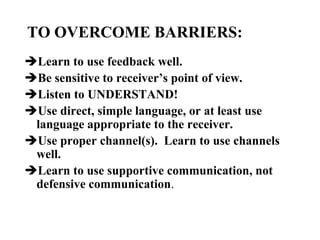
TO OVERCOME BARRIERS:
Learn to use feedback well.
Be sensitive to receiver’s point of view.
Listen to UNDERSTAND!
Use direct, simple language, or at least use
language appropriate to the receiver.
Use proper channel(s). Learn to use channels
well.
Learn to use supportive communication, not
defensive communication.
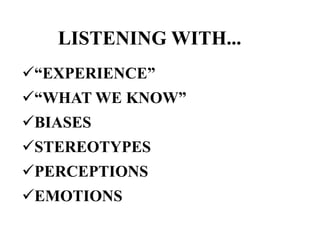
LISTENING WITH...
“EXPERIENCE”
“WHAT WE KNOW”
BIASES
STEREOTYPES
PERCEPTIONS

EMOTIONS
LISTENING
LISTEN TO RESPOND
LISTEN TO UNDERSTAND
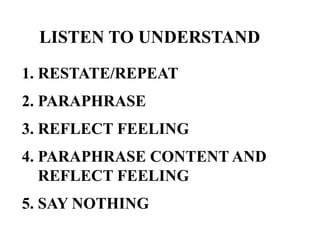
LISTEN TO UNDERSTAND
1. RESTATE/REPEAT
2. PARAPHRASE
3. REFLECT FEELING
4. PARAPHRASE CONTENT AND
REFLECT FEELING
5. SAY NOTHING
LISTEN TO UNDERSTAND

Before I can walk in
another person’s shoes,
I must remove my own.
Unknown
LISTEN TO UNDERSTAND
ASSUMES WIN-WIN

1. ASK PERMISSION
2. ESTIMTE TIME LIMIT
3. STATE BOUNDARIES
STATE WHAT IS NOT ACCEPTABLE

4. USE RESPECT, GENTLENESS
5. USE COURAGE
LISTEN TO UNDERSTAND
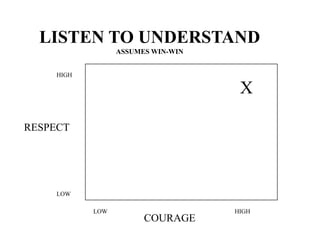
ASSUMES WIN-WIN
HIGH

X
RESPECT

LOW
LOW

COURAGE

HIGH
LISTEN TO UNDERSTAND
ASSUMES WIN-WIN

BE DIRECT
BE CLEAR
BE SPECIFIC
BE HONEST
BE RESPECTFUL
BE TACTFUL
TAKE RESPONSIBILITY
FOR YOURSELF
LISTEN TO UNDERSTAND
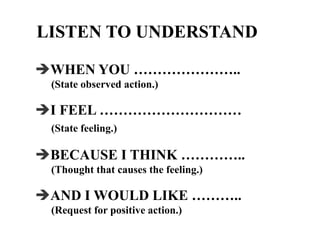
WHEN YOU …………………..
(State observed action.)

I FEEL …………………………
(State feeling.)

BECAUSE I THINK …………..
(Thought that causes the feeling.)

AND I WOULD LIKE ………..
(Request for positive action.)
LISTEN TO UNDERSTAND
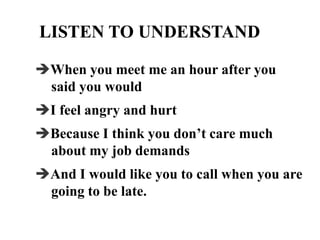
When you meet me an hour after you
said you would
I feel angry and hurt

Because I think you don’t care much
about my job demands
And I would like you to call when you are
going to be late.
LISTEN TO UNDERSTAND
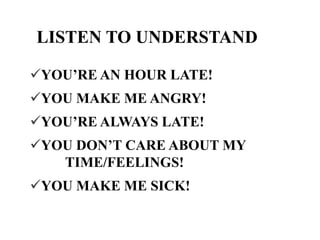
YOU’RE AN HOUR LATE!
YOU MAKE ME ANGRY!
YOU’RE ALWAYS LATE!
YOU DON’T CARE ABOUT MY
TIME/FEELINGS!

YOU MAKE ME SICK!
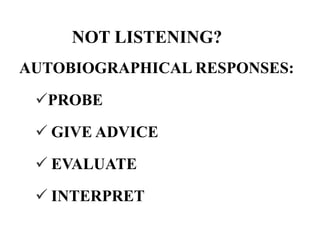
NOT LISTENING?
AUTOBIOGRAPHICAL RESPONSES:
PROBE

 GIVE ADVICE
 EVALUATE

 INTERPRET
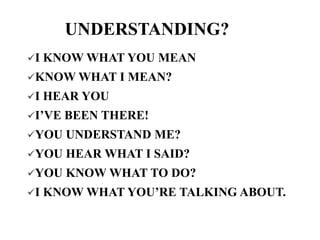
UNDERSTANDING?
I

KNOW WHAT YOU MEAN

KNOW WHAT I
I

MEAN?

HEAR YOU

I’VE

BEEN THERE!

YOU

UNDERSTAND ME?

YOU

HEAR WHAT I SAID?

YOU

KNOW WHAT TO DO?

I

KNOW WHAT YOU’RE TALKING ABOUT.
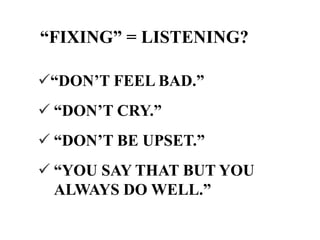
“FIXING” = LISTENING?
“DON’T FEEL BAD.”
 “DON’T CRY.”

 “DON’T BE UPSET.”
 “YOU SAY THAT BUT YOU
ALWAYS DO WELL.”
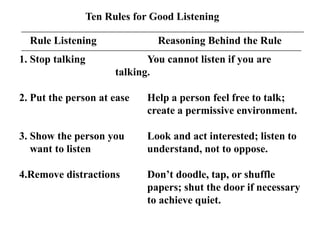
Ten Rules for Good Listening
Rule Listening
1. Stop talking

Reasoning Behind the Rule
You cannot listen if you are
talking.

2. Put the person at ease

Help a person feel free to talk;
create a permissive environment.

3. Show the person you
want to listen

Look and act interested; listen to
understand, not to oppose.

4.Remove distractions

Don’t doodle, tap, or shuffle
papers; shut the door if necessary
to achieve quiet.
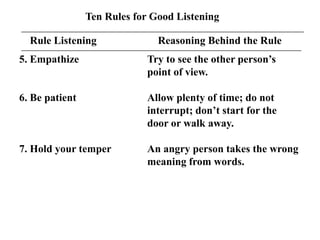
Ten Rules for Good Listening
Rule Listening

Reasoning Behind the Rule

5. Empathize

Try to see the other person’s
point of view.

6. Be patient

Allow plenty of time; do not
interrupt; don’t start for the
door or walk away.

7. Hold your temper

An angry person takes the wrong
meaning from words.
Ten Rules for Good Listening
Rule Listening

Reasoning Behind the Rule

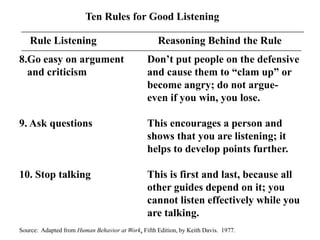
8.Go easy on argument
and criticism

Don’t put people on the defensive
and cause them to “clam up” or
become angry; do not argueeven if you win, you lose.

9. Ask questions

This encourages a person and
shows that you are listening; it
helps to develop points further.

10. Stop talking

This is first and last, because all
other guides depend on it; you
cannot listen effectively while you
are talking.

Source: Adapted from Human Behavior at Work, Fifth Edition, by Keith Davis. 1977.
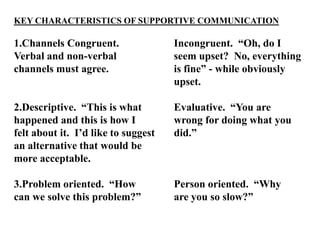
KEY CHARACTERISTICS OF SUPPORTIVE COMMUNICATION

1.Channels Congruent.
Verbal and non-verbal
channels must agree.

Incongruent. “Oh, do I
seem upset? No, everything
is fine” - while obviously
upset.

2.Descriptive. “This is what
happened and this is how I
felt about it. I’d like to suggest
an alternative that would be
more acceptable.

Evaluative. “You are
wrong for doing what you
did.”

3.Problem oriented. “How
can we solve this problem?”

Person oriented. “Why
are you so slow?”
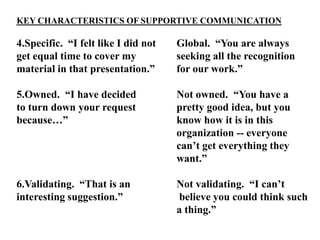
KEY CHARACTERISTICS OF SUPPORTIVE COMMUNICATION

4.Specific. “I felt like I did not
get equal time to cover my
material in that presentation.”

Global. “You are always
seeking all the recognition
for our work.”

5.Owned. “I have decided
to turn down your request
because…”

Not owned. “You have a
pretty good idea, but you
know how it is in this
organization -- everyone
can’t get everything they
want.”

6.Validating. “That is an
interesting suggestion.”

Not validating. “I can’t
believe you could think such
a thing.”
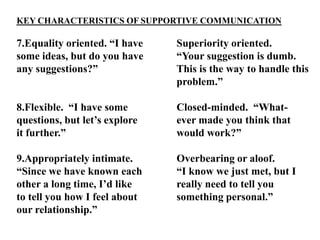
KEY CHARACTERISTICS OF SUPPORTIVE COMMUNICATION

7.Equality oriented. “I have
some ideas, but do you have
any suggestions?”

Superiority oriented.
“Your suggestion is dumb.
This is the way to handle this
problem.”

8.Flexible. “I have some
questions, but let’s explore
it further.”

Closed-minded. “Whatever made you think that
would work?”

9.Appropriately intimate.
“Since we have known each
other a long time, I’d like
to tell you how I feel about
our relationship.”

Overbearing or aloof.
“I know we just met, but I
really need to tell you
something personal.”
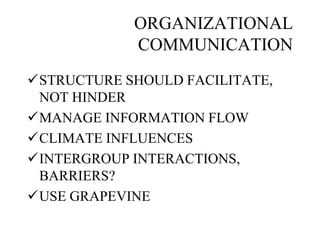
ORGANIZATIONAL
COMMUNICATION
STRUCTURE SHOULD FACILITATE,
NOT HINDER
MANAGE INFORMATION FLOW
CLIMATE INFLUENCES
INTERGROUP INTERACTIONS,
BARRIERS?
USE GRAPEVINE
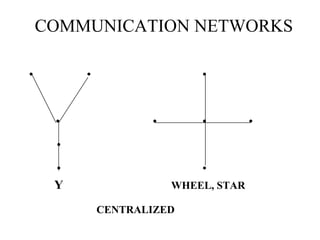
COMMUNICATION NETWORKS
.

.
.
.
.
Y

.
.

.
.
WHEEL, STAR

CENTRALIZED

.
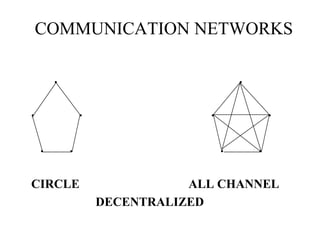
COMMUNICATION NETWORKS
.

.

.

.
.

.

CIRCLE

.

.
.

.

ALL CHANNEL
DECENTRALIZED
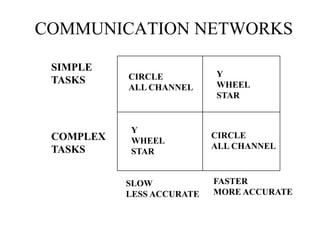
COMMUNICATION NETWORKS
SIMPLE
TASKS

COMPLEX
TASKS

CIRCLE
ALL CHANNEL

Y
WHEEL
STAR

SLOW
LESS ACCURATE

Y
WHEEL
STAR

CIRCLE
ALL CHANNEL

FASTER
MORE ACCURATE

Communication

  • 1.
    COMMON BARRIERS TO COMMUNICATION 1.SEMANTICS Definition of words Choice of words
  • 2.
    COMMON BARRIERS TO COMMUNICATION 2.POOR CHOICE, USE OF CHANNELS  When to use certain channel Oral alone: • Simple reprimand • Settle simple dispute Written alone: • Don’t need immediate feedback • Need record
  • 3.
    COMMON BARRIERS TO COMMUNICATION 2.USE OF CHANNELS Both channels: • Commendation • Serious reprimand • Important policy change Nonverbal • Be aware of it.
  • 4.
    COMMON BARRIERS TO COMMUNICATION 3.PHYSICAL DISTRACTIONS 4. NOISE, PHYSICAL, PSYCHOLOGICAL 5. STATUS DIFFERENCE 6. EFFECTS OF EMOTIONS
  • 5.
    COMMON BARRIERS TO COMMUNICATION 7.PERCEPTIONS Stereotypes Halo effects Selective perception • See and hear what we expect • Ignore if conflicts with “what we know.” Projection
  • 6.
    COMMON BARRIERS TO COMMUNICATION 8.FILTERING, SCREENING NEGATIVE INFORMTAION 9. EVALUATING THE SOURCE 10.ABSENCE OF FEEDBACK, POOR FEEDBACK
  • 7.
    COMMON BARRIERS TO COMMUNICATION 11.INFORMATION, DATA OVERLOAD 12. POOR LISTENING LISTEN TO RESPOND LISTEN TO UNDERSTAND
  • 8.
    TO OVERCOME BARRIERS: Learnto use feedback well. Be sensitive to receiver’s point of view. Listen to UNDERSTAND! Use direct, simple language, or at least use language appropriate to the receiver. Use proper channel(s). Learn to use channels well. Learn to use supportive communication, not defensive communication.
  • 9.
    LISTENING WITH... “EXPERIENCE” “WHAT WEKNOW” BIASES STEREOTYPES PERCEPTIONS EMOTIONS
  • 10.
  • 11.
    LISTEN TO UNDERSTAND 1.RESTATE/REPEAT 2. PARAPHRASE 3. REFLECT FEELING 4. PARAPHRASE CONTENT AND REFLECT FEELING 5. SAY NOTHING
  • 12.
    LISTEN TO UNDERSTAND BeforeI can walk in another person’s shoes, I must remove my own. Unknown
  • 13.
    LISTEN TO UNDERSTAND ASSUMESWIN-WIN 1. ASK PERMISSION 2. ESTIMTE TIME LIMIT 3. STATE BOUNDARIES STATE WHAT IS NOT ACCEPTABLE 4. USE RESPECT, GENTLENESS 5. USE COURAGE
  • 14.
    LISTEN TO UNDERSTAND ASSUMESWIN-WIN HIGH X RESPECT LOW LOW COURAGE HIGH
  • 15.
    LISTEN TO UNDERSTAND ASSUMESWIN-WIN BE DIRECT BE CLEAR BE SPECIFIC BE HONEST BE RESPECTFUL BE TACTFUL TAKE RESPONSIBILITY FOR YOURSELF
  • 16.
    LISTEN TO UNDERSTAND WHENYOU ………………….. (State observed action.) I FEEL ………………………… (State feeling.) BECAUSE I THINK ………….. (Thought that causes the feeling.) AND I WOULD LIKE ……….. (Request for positive action.)
  • 17.
    LISTEN TO UNDERSTAND Whenyou meet me an hour after you said you would I feel angry and hurt Because I think you don’t care much about my job demands And I would like you to call when you are going to be late.
  • 18.
    LISTEN TO UNDERSTAND YOU’REAN HOUR LATE! YOU MAKE ME ANGRY! YOU’RE ALWAYS LATE! YOU DON’T CARE ABOUT MY TIME/FEELINGS! YOU MAKE ME SICK!
  • 19.
    NOT LISTENING? AUTOBIOGRAPHICAL RESPONSES: PROBE GIVE ADVICE  EVALUATE  INTERPRET
  • 20.
    UNDERSTANDING? I KNOW WHAT YOUMEAN KNOW WHAT I I MEAN? HEAR YOU I’VE BEEN THERE! YOU UNDERSTAND ME? YOU HEAR WHAT I SAID? YOU KNOW WHAT TO DO? I KNOW WHAT YOU’RE TALKING ABOUT.
  • 21.
    “FIXING” = LISTENING? “DON’TFEEL BAD.”  “DON’T CRY.”  “DON’T BE UPSET.”  “YOU SAY THAT BUT YOU ALWAYS DO WELL.”
  • 22.
    Ten Rules forGood Listening Rule Listening 1. Stop talking Reasoning Behind the Rule You cannot listen if you are talking. 2. Put the person at ease Help a person feel free to talk; create a permissive environment. 3. Show the person you want to listen Look and act interested; listen to understand, not to oppose. 4.Remove distractions Don’t doodle, tap, or shuffle papers; shut the door if necessary to achieve quiet.
  • 23.
    Ten Rules forGood Listening Rule Listening Reasoning Behind the Rule 5. Empathize Try to see the other person’s point of view. 6. Be patient Allow plenty of time; do not interrupt; don’t start for the door or walk away. 7. Hold your temper An angry person takes the wrong meaning from words.
  • 24.
    Ten Rules forGood Listening Rule Listening Reasoning Behind the Rule 8.Go easy on argument and criticism Don’t put people on the defensive and cause them to “clam up” or become angry; do not argueeven if you win, you lose. 9. Ask questions This encourages a person and shows that you are listening; it helps to develop points further. 10. Stop talking This is first and last, because all other guides depend on it; you cannot listen effectively while you are talking. Source: Adapted from Human Behavior at Work, Fifth Edition, by Keith Davis. 1977.
  • 25.
    KEY CHARACTERISTICS OFSUPPORTIVE COMMUNICATION 1.Channels Congruent. Verbal and non-verbal channels must agree. Incongruent. “Oh, do I seem upset? No, everything is fine” - while obviously upset. 2.Descriptive. “This is what happened and this is how I felt about it. I’d like to suggest an alternative that would be more acceptable. Evaluative. “You are wrong for doing what you did.” 3.Problem oriented. “How can we solve this problem?” Person oriented. “Why are you so slow?”
  • 26.
    KEY CHARACTERISTICS OFSUPPORTIVE COMMUNICATION 4.Specific. “I felt like I did not get equal time to cover my material in that presentation.” Global. “You are always seeking all the recognition for our work.” 5.Owned. “I have decided to turn down your request because…” Not owned. “You have a pretty good idea, but you know how it is in this organization -- everyone can’t get everything they want.” 6.Validating. “That is an interesting suggestion.” Not validating. “I can’t believe you could think such a thing.”
  • 27.
    KEY CHARACTERISTICS OFSUPPORTIVE COMMUNICATION 7.Equality oriented. “I have some ideas, but do you have any suggestions?” Superiority oriented. “Your suggestion is dumb. This is the way to handle this problem.” 8.Flexible. “I have some questions, but let’s explore it further.” Closed-minded. “Whatever made you think that would work?” 9.Appropriately intimate. “Since we have known each other a long time, I’d like to tell you how I feel about our relationship.” Overbearing or aloof. “I know we just met, but I really need to tell you something personal.”
  • 28.
    ORGANIZATIONAL COMMUNICATION STRUCTURE SHOULD FACILITATE, NOTHINDER MANAGE INFORMATION FLOW CLIMATE INFLUENCES INTERGROUP INTERACTIONS, BARRIERS? USE GRAPEVINE
  • 29.
  • 30.
  • 31.
    COMMUNICATION NETWORKS SIMPLE TASKS COMPLEX TASKS CIRCLE ALL CHANNEL Y WHEEL STAR SLOW LESSACCURATE Y WHEEL STAR CIRCLE ALL CHANNEL FASTER MORE ACCURATE