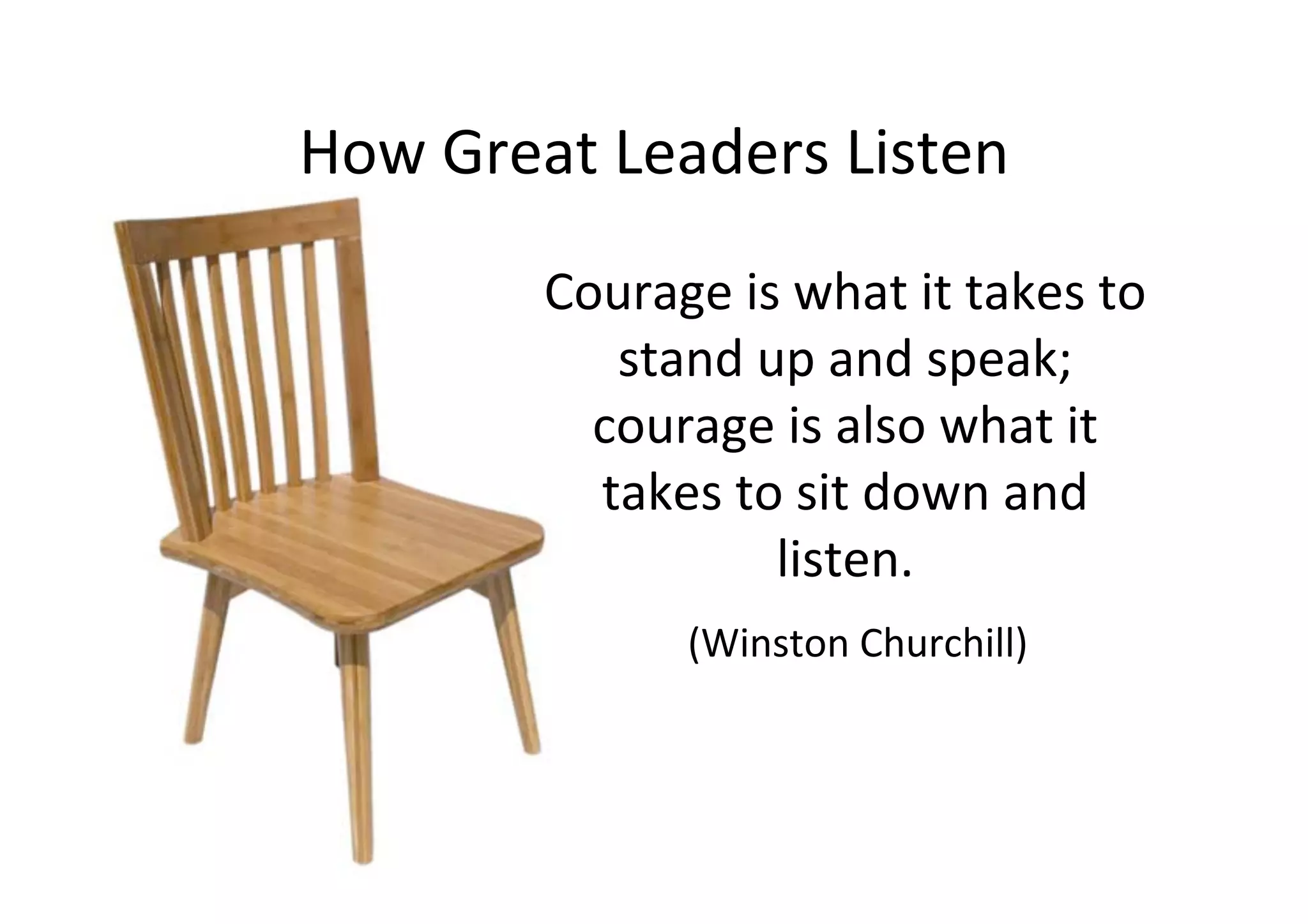



Courage	
  is	
  what	
  it	
  takes	
  to	
  
stand	
  up	
  and	
  speak;	
  
courage	
  is	
  also	
  what	
  it	
  
takes	
  to	
  sit	
  down	
  and	
  
listen.	


  (Winston	
  Churchill)	
  
How	
  Great	
  Leaders	
  Listen	
  
Two	
  key	
  ingredients	
  
“I have no special talents. I
am only passionately
curious.”
(Albert Einstein)
“Imagination was given to
us to compensate for what
we are not; a sense of
humor was given to us to
console us for what we
are.”
(Mack McGinnis)
Try	
  it	
  out	
  
How	
  was	
  that?	
  
•  What	
  were	
  some	
  of	
  the	
  quesBons	
  that	
  
people	
  asked?	
  
•  What	
  was	
  the	
  very	
  best	
  listening	
  you	
  heard?	


•  What	
  made	
  it	
  feel	
  that	
  way?	
  	
  
A	
  thought	
  experiment…	
  
On	
  a	
  quiet	
  Sunday	
  aJernoon,	
  when	
  your	
  partner	
  says:	


“I	
  hate	
  Sundays!	
  I	
  get	
  so	
  stressed	
  on	
  Sundays	
  because	
  Monday	
  
comes	
  next!	
  I	
  hate	
  my	
  job!	
  I	
  wish	
  I	
  could	
  figure	
  out	
  how	
  I	
  could	
  not	
  
have	
  to	
  work	
  there	
  ever	
  again.”	
  
What	
  do	
  you	
  say	
  back?	
  
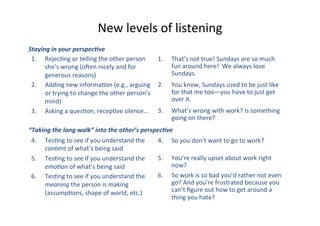
New	
  levels	
  of	
  listening	
  
1.  RejecBng	
  or	
  telling	
  the	
  other	
  person	
  
she’s	
  wrong	
  (oJen	
  nicely	
  and	
  for	
  
generous	
  reasons)	
  
2.  Adding	
  new	
  informaBon	
  (e.g.,	
  arguing	
  
or	
  trying	
  to	
  change	
  the	
  other	
  person’s	
  
mind)	
  	
  
3.  Asking	
  a	
  quesBon,	
  recepBve	
  silence…	
  
1.  That’s	
  not	
  true!	
  Sundays	
  are	
  so	
  much	
  
fun	
  around	
  here!	
  	
  We	
  always	
  love	
  
Sundays.	
  
2.  You	
  know,	
  Sundays	
  used	
  to	
  be	
  just	
  like	
  
for	
  that	
  me	
  too—you	
  have	
  to	
  just	
  get	
  
over	
  it.	
  
3.  What’s	
  wrong	
  with	
  work?	
  Is	
  something	
  
going	
  on	
  there?	
  
4.  So	
  you	
  don’t	
  want	
  to	
  go	
  to	
  work?	
  
5.  You’re	
  really	
  upset	
  about	
  work	
  right	
  
now?	
  
6.  So	
  work	
  is	
  so	
  bad	
  you’d	
  rather	
  not	
  even	
  
go?	
  And	
  you’re	
  frustrated	
  because	
  you	
  
can’t	
  figure	
  out	
  how	
  to	
  get	
  around	
  a	
  
thing	
  you	
  hate?	
  
4.  TesBng	
  to	
  see	
  if	
  you	
  understand	
  the	
  
content	
  of	
  what’s	
  being	
  said	
  
5.  TesBng	
  to	
  see	
  if	
  you	
  understand	
  the	
  
emo'on	
  of	
  what’s	
  being	
  said	
  
6.  TesBng	
  to	
  see	
  if	
  you	
  understand	
  the	
  
meaning	
  the	
  person	
  is	
  making	
  
(assumpBons,	
  shape	
  of	
  world,	
  etc.)	
  
“Taking	
  the	
  long	
  walk”	
  into	
  the	
  other’s	
  perspec5ve	
  
Staying	
  in	
  your	
  perspec5ve	
  
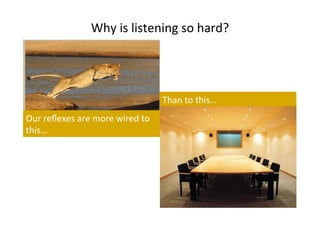
Our	
  reflexes	
  are	
  more	
  wired	
  to	
  
this…	
  
Than	
  to	
  this…	
  
Why	
  is	
  listening	
  so	
  hard?	
  
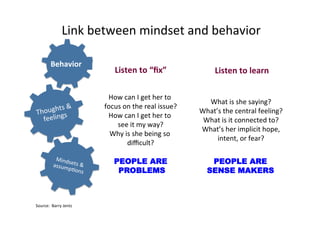
How	
  can	
  I	
  get	
  her	
  to	
  
focus	
  on	
  the	
  real	
  issue?	
  
How	
  can	
  I	
  get	
  her	
  to	
  
see	
  it	
  my	
  way?	
  
Why	
  is	
  she	
  being	
  so	
  
difficult?	
  
PEOPLE ARE
PROBLEMS
Listen	
  to	
  “fix”	
  
What	
  is	
  she	
  saying?	
  
What’s	
  the	
  central	
  feeling?	
  
What	
  is	
  it	
  connected	
  to?	
  
What’s	
  her	
  implicit	
  hope,	
  
intent,	
  or	
  fear?	
  
PEOPLE ARE
SENSE MAKERS
Listen	
  to	
  learn	
  
Link	
  between	
  mindset	
  and	
  behavior	
  	
  
Mindsets	
  &	
  assumpBons	
  
Behavior	
  
Thoughts	
  &	
  
feelings	
  
Source:	
  	
  Barry	
  Jentz	
  
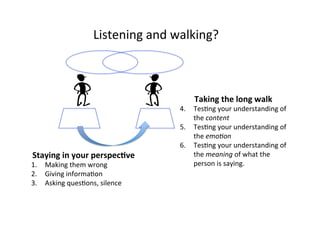
Staying	
  in	
  your	
  perspec9ve	
  
1.  Making	
  them	
  wrong	
  
2.  Giving	
  informaBon	
  
3.  Asking	
  quesBons,	
  silence	
  	
  
Listening	
  and	
  walking?	
  
Taking	
  the	
  long	
  walk	
  
4.  TesBng	
  your	
  understanding	
  of	
  
the	
  content	
  	
  
5.  TesBng	
  your	
  understanding	
  of	
  
the	
  emo'on	
  	
  
6.  TesBng	
  your	
  understanding	
  of	
  
the	
  meaning	
  of	
  what	
  the	
  
person	
  is	
  saying.	
  
Try	
  it	
  again…	
  
•  Try	
  your	
  conversaBon	
  again,	
  this	
  Bme	
  
doing	
  your	
  best	
  Level	
  6	
  listening	
  
•  5	
  minutes	
  each	
  
During	
  break	
  
Take	
  Bme	
  to	
  recall	
  a	
  situaBon	
  (that’s	
  real	
  for	
  you	
  
right	
  now)	
  where:	


•  You	
  disagree	
  with	
  an	
  important	
  person	
  about	
  
something	
  that	
  needs	
  to	
  be	
  done	
  
•  You	
  have	
  a	
  hard	
  feedback	
  message	
  to	
  deliver	
  
and	
  you’re	
  worried	
  about	
  the	
  response	
  
•  You’re	
  generally	
  “stuck”	
  in	
  a	
  difficult	
  pafern	
  
Set	
  up	
  your	
  case…	
  
1.  What	
  is	
  the	
  context?	
  	
  How	
  will	
  you	
  
explain	
  it	
  in	
  two	
  minutes?	
  
2.  What	
  will	
  you	
  say	
  to	
  the	
  other?	
  	
  Write	
  
it	
  down.	
  
–  When…,	
  I	
  feel…,	
  because…	
  
–  Here’s	
  what	
  I	
  believe	
  and	
  why	
  I	
  believe	
  it	
  
(both	
  data	
  and	
  emoBon)	
  
3.  What	
  are	
  you	
  most	
  afraid	
  you’ll	
  hear	
  
back?	
  	
  Write	
  down	
  1-­‐3	
  sentences	
  for	
  
your	
  partner.	
  
DirecBons	
  
•  Get	
  in	
  trios	
  (mix	
  it	
  up	
  from	
  the	
  pairs	
  you	
  were	
  in	
  before)	
  
•  Three	
  roles:	


–  Case	
  owner	
  
•  Set	
  up	
  context	
  in	
  3	
  minutes	
  or	
  less	
  
•  Hand	
  role	
  player	
  their	
  “lines”	
  
–  Role	
  player	
  
•  Only	
  job	
  is,	
  aJer	
  CO	
  has	
  said	
  his	
  piece,	
  to	
  read	
  your	
  lines	
  
•  Then	
  just	
  be	
  you	
  
–  Observer/videographer	
  
•  Video	
  conversaBon	
  
•  Guide	
  debrief	
  
•  15	
  minutes	
  per	
  person,	
  roughly	
  as	
  follows:	
  
–  3	
  minutes	
  context	
  
–  4	
  minutes	
  role-­‐play	
  conversaBon	
  
–  8	
  minutes	
  debrief,	
  including	
  playing	
  back	
  all	
  or	
  part	
  of	
  video	
  	
  
Debrief:	
  
•  Start	
  with	
  case	
  owner:	
  	
  How	
  did	
  that	
  go?	
  	
  How	
  are	
  you	
  feeling	
  
about	
  it?	
  	
  How	
  did	
  you	
  listen?	
  
•  Then	
  to	
  role	
  player:	
  	
  How	
  are	
  you	
  feeling?	
  	
  What	
  worked	
  there?	
  	
  
Are	
  you	
  more/less	
  inclined	
  to	
  look	
  for	
  common	
  ground	
  than	
  you	
  
were	
  at	
  the	
  beginning?	
  
•  Watch	
  all/part	
  of	
  video:	
  
–  How	
  did	
  case	
  owner	
  present	
  his/her	
  informaBon?	
  
–  How	
  did	
  he/she	
  listen?	
  
•  Is	
  there	
  evidence	
  of	
  a	
  compeBBon	
  for	
  listening?	
  	
  
CompeBBon	
  for	
  Speaking	
  
and	
  
Listening	
  to	
  reload	
  
Source:	
  	
  Barry	
  Jentz	
  
The	
  stellar	
  universe	
  is	
  not	
  so	
  difficult	
  of	
  comprehension	
  as	
  
the	
  real	
  acBons	
  of	
  other	
  people. 	
  	
  
Marcel	
  Proust	
  
A	
  good	
  listener	
  is	
  not	
  only	
  
popular	
  everywhere,	
  but	
  
aJer	
  awhile,	
  he	
  knows	
  
something.	


Wilson	
  Mizner	
  
Purposeful	
  Mindset	
  
	
  •  Lets	
  go	
  of	
  the	
  idea	
  that	
  I	
  have	
  the	
  truth	
  
•  Yet	
  acknowledges	
  that	
  I	
  have	
  important	
  data	
  and	
  
perspecBve	
  (When,	
  I	
  feel,	
  Because)	
  
•  Is	
  genuinely	
  puzzled	
  or	
  curious	
  (listens	
  purposefully)	
  
•  Changes:	


–  Here’s	
  what	
  you	
  did	
  wrong;	
  here’s	
  how	
  to	
  fix	
  it	
  to	
  
–  Here’s	
  what	
  I	
  saw	
  that	
  puzzles	
  me,	
  let’s	
  figure	
  it	
  out	
  
together	
  
•  Allows	
  us	
  both	
  to	
  be	
  problem	
  solvers	
  together	
  

How Great Leaders Listen

  • 1.
    Courage  is  what  it  takes  to   stand  up  and  speak;   courage  is  also  what  it   takes  to  sit  down  and   listen.      (Winston  Churchill)   How  Great  Leaders  Listen  
  • 2.
    Two  key  ingredients   “I have no special talents. I am only passionately curious.” (Albert Einstein) “Imagination was given to us to compensate for what we are not; a sense of humor was given to us to console us for what we are.” (Mack McGinnis)
  • 3.
  • 4.
    How  was  that?   •  What  were  some  of  the  quesBons  that   people  asked?   •  What  was  the  very  best  listening  you  heard?       •  What  made  it  feel  that  way?    
  • 5.
    A  thought  experiment…   On  a  quiet  Sunday  aJernoon,  when  your  partner  says:     “I  hate  Sundays!  I  get  so  stressed  on  Sundays  because  Monday   comes  next!  I  hate  my  job!  I  wish  I  could  figure  out  how  I  could  not   have  to  work  there  ever  again.”   What  do  you  say  back?  
  • 6.
    New  levels  of  listening   1.  RejecBng  or  telling  the  other  person   she’s  wrong  (oJen  nicely  and  for   generous  reasons)   2.  Adding  new  informaBon  (e.g.,  arguing   or  trying  to  change  the  other  person’s   mind)     3.  Asking  a  quesBon,  recepBve  silence…   1.  That’s  not  true!  Sundays  are  so  much   fun  around  here!    We  always  love   Sundays.   2.  You  know,  Sundays  used  to  be  just  like   for  that  me  too—you  have  to  just  get   over  it.   3.  What’s  wrong  with  work?  Is  something   going  on  there?   4.  So  you  don’t  want  to  go  to  work?   5.  You’re  really  upset  about  work  right   now?   6.  So  work  is  so  bad  you’d  rather  not  even   go?  And  you’re  frustrated  because  you   can’t  figure  out  how  to  get  around  a   thing  you  hate?   4.  TesBng  to  see  if  you  understand  the   content  of  what’s  being  said   5.  TesBng  to  see  if  you  understand  the   emo'on  of  what’s  being  said   6.  TesBng  to  see  if  you  understand  the   meaning  the  person  is  making   (assumpBons,  shape  of  world,  etc.)   “Taking  the  long  walk”  into  the  other’s  perspec5ve   Staying  in  your  perspec5ve  
  • 7.
    Our  reflexes  are  more  wired  to   this…   Than  to  this…   Why  is  listening  so  hard?  
  • 8.
    How  can  I  get  her  to   focus  on  the  real  issue?   How  can  I  get  her  to   see  it  my  way?   Why  is  she  being  so   difficult?   PEOPLE ARE PROBLEMS Listen  to  “fix”   What  is  she  saying?   What’s  the  central  feeling?   What  is  it  connected  to?   What’s  her  implicit  hope,   intent,  or  fear?   PEOPLE ARE SENSE MAKERS Listen  to  learn   Link  between  mindset  and  behavior     Mindsets  &  assumpBons   Behavior   Thoughts  &   feelings   Source:    Barry  Jentz  
  • 9.
    Staying  in  your  perspec9ve   1.  Making  them  wrong   2.  Giving  informaBon   3.  Asking  quesBons,  silence     Listening  and  walking?   Taking  the  long  walk   4.  TesBng  your  understanding  of   the  content     5.  TesBng  your  understanding  of   the  emo'on     6.  TesBng  your  understanding  of   the  meaning  of  what  the   person  is  saying.  
  • 10.
    Try  it  again…   •  Try  your  conversaBon  again,  this  Bme   doing  your  best  Level  6  listening   •  5  minutes  each  
  • 11.
    During  break   Take  Bme  to  recall  a  situaBon  (that’s  real  for  you   right  now)  where:     •  You  disagree  with  an  important  person  about   something  that  needs  to  be  done   •  You  have  a  hard  feedback  message  to  deliver   and  you’re  worried  about  the  response   •  You’re  generally  “stuck”  in  a  difficult  pafern  
  • 12.
    Set  up  your  case…   1.  What  is  the  context?    How  will  you   explain  it  in  two  minutes?   2.  What  will  you  say  to  the  other?    Write   it  down.   –  When…,  I  feel…,  because…   –  Here’s  what  I  believe  and  why  I  believe  it   (both  data  and  emoBon)   3.  What  are  you  most  afraid  you’ll  hear   back?    Write  down  1-­‐3  sentences  for   your  partner.  
  • 13.
    DirecBons   •  Get  in  trios  (mix  it  up  from  the  pairs  you  were  in  before)   •  Three  roles:       –  Case  owner   •  Set  up  context  in  3  minutes  or  less   •  Hand  role  player  their  “lines”   –  Role  player   •  Only  job  is,  aJer  CO  has  said  his  piece,  to  read  your  lines   •  Then  just  be  you   –  Observer/videographer   •  Video  conversaBon   •  Guide  debrief   •  15  minutes  per  person,  roughly  as  follows:   –  3  minutes  context   –  4  minutes  role-­‐play  conversaBon   –  8  minutes  debrief,  including  playing  back  all  or  part  of  video    
  • 14.
    Debrief:   •  Start  with  case  owner:    How  did  that  go?    How  are  you  feeling   about  it?    How  did  you  listen?   •  Then  to  role  player:    How  are  you  feeling?    What  worked  there?     Are  you  more/less  inclined  to  look  for  common  ground  than  you   were  at  the  beginning?   •  Watch  all/part  of  video:   –  How  did  case  owner  present  his/her  informaBon?   –  How  did  he/she  listen?   •  Is  there  evidence  of  a  compeBBon  for  listening?    
  • 15.
    CompeBBon  for  Speaking   and   Listening  to  reload   Source:    Barry  Jentz  
  • 16.
    The  stellar  universe  is  not  so  difficult  of  comprehension  as   the  real  acBons  of  other  people.     Marcel  Proust  
  • 17.
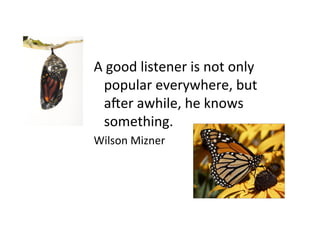
    A  good  listener  is  not  only   popular  everywhere,  but   aJer  awhile,  he  knows   something.       Wilson  Mizner  
  • 18.
    Purposeful  Mindset    •  Lets  go  of  the  idea  that  I  have  the  truth   •  Yet  acknowledges  that  I  have  important  data  and   perspecBve  (When,  I  feel,  Because)   •  Is  genuinely  puzzled  or  curious  (listens  purposefully)   •  Changes:       –  Here’s  what  you  did  wrong;  here’s  how  to  fix  it  to   –  Here’s  what  I  saw  that  puzzles  me,  let’s  figure  it  out   together   •  Allows  us  both  to  be  problem  solvers  together