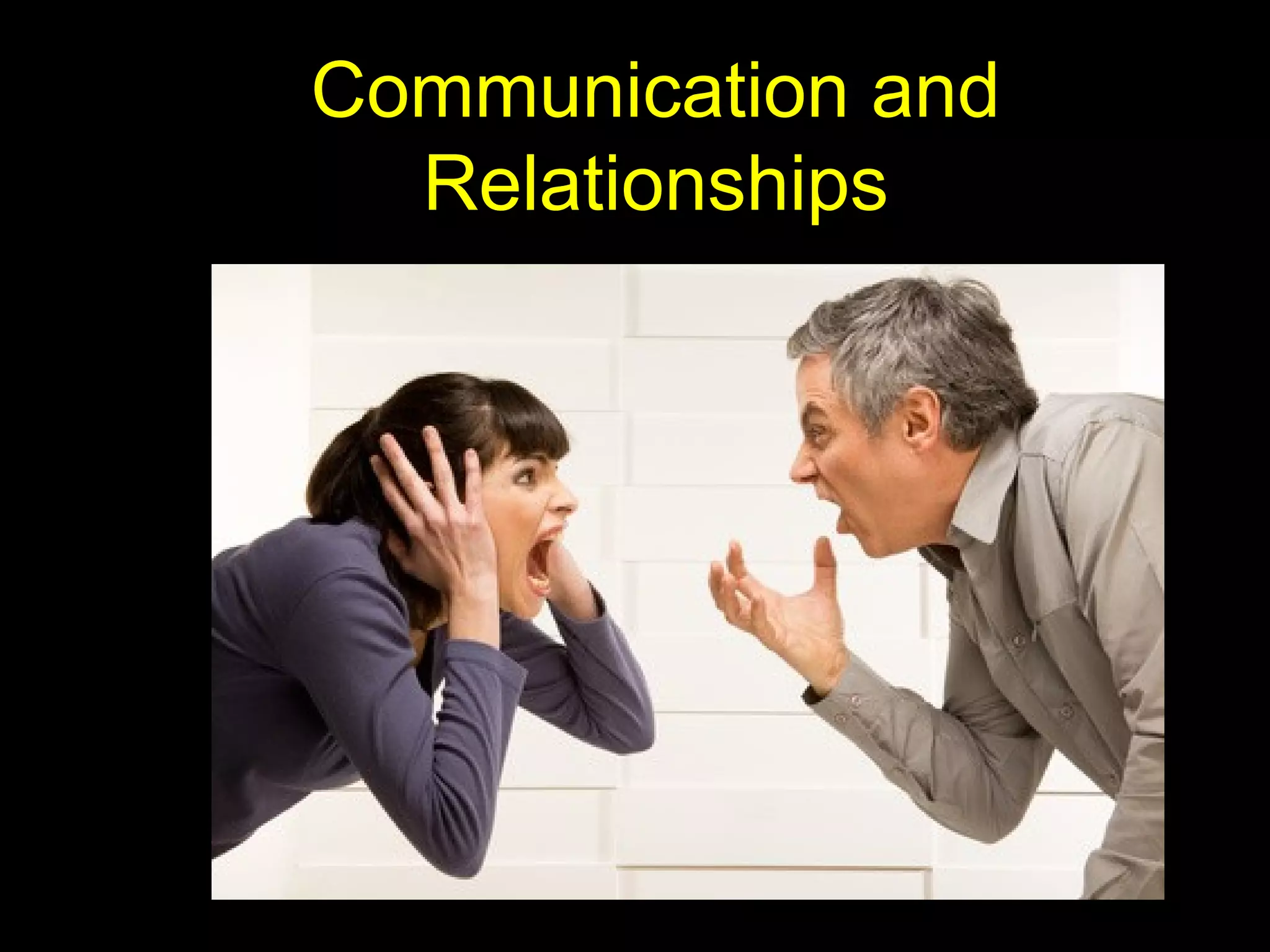
Communication andCommunication and
RelationshipsRelationships
What is your personalWhat is your personal
communication style?communication style?
ExtrovertExtrovert
Social typesSocial types
Start conversations easilyStart conversations easily
Energized by talking to peopleEnergized by talking to people
Find it easy to start a conversation orFind it easy to start a conversation or
ask someone for a dateask someone for a date
In conflict situations, they talk louderIn conflict situations, they talk louder
and fasterand faster
IntrovertIntrovert
Rehearse what they are going to say beforeRehearse what they are going to say before
they say itthey say it
Need quiet for concentrationNeed quiet for concentration
Enjoy peace and quietEnjoy peace and quiet
Often labeled as “quiet” or “shy”Often labeled as “quiet” or “shy”
Find it difficult to start a conversation or askFind it difficult to start a conversation or ask
someone for a datesomeone for a date
Withdraw from conflict situations to think itWithdraw from conflict situations to think it
overover
To improve communication,To improve communication,
extroverts need to:extroverts need to:
Pause to give the introvert time to thinkPause to give the introvert time to think
Avoid monopolizing the conversationAvoid monopolizing the conversation
To improve communication,To improve communication,
introverts need to:introverts need to:
Make an effort to communicateMake an effort to communicate
Sensing and Intuitive TypesSensing and Intuitive Types
Sensing types need intuitive types toSensing types need intuitive types to
bring up new possibilities, deal withbring up new possibilities, deal with
changes and understand differentchanges and understand different
perspectives.perspectives.
Intuitive types need sensing types toIntuitive types need sensing types to
deal with facts and details.deal with facts and details.
Feeling and Thinking TypesFeeling and Thinking Types
Feeling types need thinking types toFeeling types need thinking types to
analyze, organize, follow policy andanalyze, organize, follow policy and
weigh the evidence.weigh the evidence.
Thinking types need feeling types toThinking types need feeling types to
understand how others feel and tounderstand how others feel and to
establish harmony in the family andestablish harmony in the family and
business environments.business environments.
Judging and perceptive typesJudging and perceptive types
need each other.need each other.
Judging types need perceptive types toJudging types need perceptive types to
relax and have fun.relax and have fun.
Perceptive types need judging types toPerceptive types need judging types to
be more organized and productive.be more organized and productive.
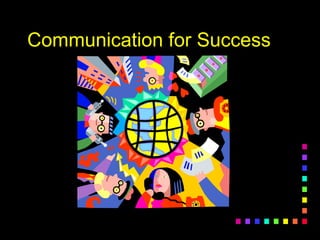
Communication for SuccessCommunication for Success
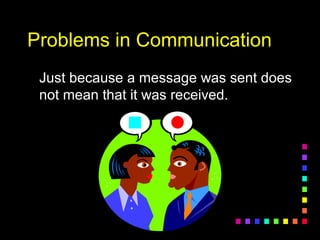
Problems in CommunicationProblems in Communication
Just because a message was sent doesJust because a message was sent does
not mean that it was received.not mean that it was received.
ProblemsProblems
Message OverloadMessage Overload
Worries and AnxietyWorries and Anxiety
Rapid ThoughtRapid Thought
Being a Good ListenerBeing a Good Listener
AssumptionsAssumptions
Hearing ProblemsHearing Problems
Talking Too MuchTalking Too Much
How to Be a Good ListenerHow to Be a Good Listener
Talk LessTalk Less
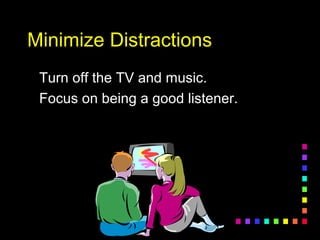
Minimize DistractionsMinimize Distractions
Turn off the TV and music.Turn off the TV and music.
Focus on being a good listener.Focus on being a good listener.
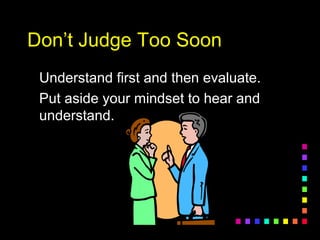
Don’t Judge Too SoonDon’t Judge Too Soon
Understand first and then evaluate.Understand first and then evaluate.
Put aside your mindset to hear andPut aside your mindset to hear and
understand.understand.
Listen for the Main PointListen for the Main Point
Ask QuestionsAsk Questions
Feedback MeaningFeedback Meaning
Speakers often:Speakers often:
Say one thing and mean another.Say one thing and mean another.
Say something and not mean it.Say something and not mean it.
Speak in a way that causesSpeak in a way that causes
confusion.confusion.
How to Feedback MeaningHow to Feedback Meaning
Restate what has been saidRestate what has been said
Ask for clarificationAsk for clarification
Reword the message to checkReword the message to check
understandingunderstanding
Listen for feelingsListen for feelings
Use your own words to rephrase theUse your own words to rephrase the
message to check understandingmessage to check understanding
Tips for Good ListeningTips for Good Listening
Let the person talk. TalkingLet the person talk. Talking
helps to clarify thinking.helps to clarify thinking.
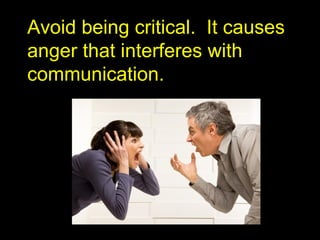
Avoid being critical. It causesAvoid being critical. It causes
anger that interferes withanger that interferes with
communication.communication.
Share your experiences butShare your experiences but
resist giving advice.resist giving advice.
Ask questions to clarify.Ask questions to clarify.
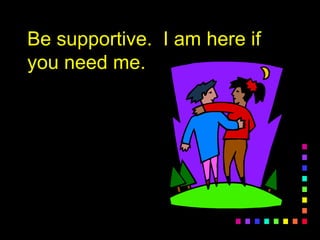
Be supportive. I am here ifBe supportive. I am here if
you need me.you need me.
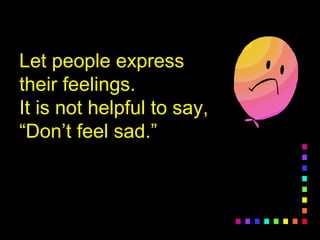
Let people expressLet people express
their feelings.their feelings.
It is not helpful to say,It is not helpful to say,
“Don’t feel sad.”“Don’t feel sad.”
Replace pity withReplace pity with
understanding.understanding.
The Language ofThe Language of
Responsibility. “I” and “You”Responsibility. “I” and “You”
Statements.Statements.
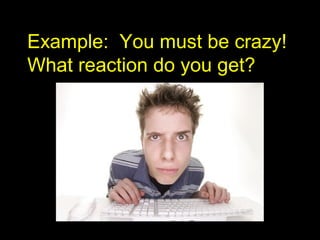
Example: You must be crazy!Example: You must be crazy!
What reaction do you get?What reaction do you get?
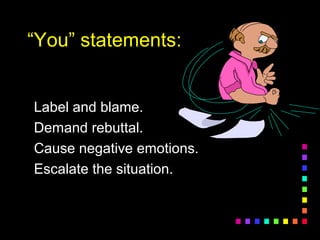
““You” statements:You” statements:
Label and blame.Label and blame.
Demand rebuttal.Demand rebuttal.
Cause negative emotions.Cause negative emotions.
Escalate the situation.Escalate the situation.
““I” Statement:I” Statement:
Instead of: You must be crazy.Instead of: You must be crazy.
I don’t understand.I don’t understand.
““I” StatementsI” Statements
You accept responsibility for yourself.You accept responsibility for yourself.
Better communication is possible.Better communication is possible.
Ways to Make an “I” StatementWays to Make an “I” Statement
Make an observation.Make an observation.
State your feelings.State your feelings.
Share your thoughts.Share your thoughts.
Say what you want.Say what you want.
State your intentions.State your intentions.
Example: Instead of “You’re a Slob!”:Example: Instead of “You’re a Slob!”:
Your things are all over the floor.Your things are all over the floor.
I get angry when I step over your things.I get angry when I step over your things.
I think it is time to clean up.I think it is time to clean up.
Please pick up your things.Please pick up your things.
I will pay your allowance when yourI will pay your allowance when your
room is clean.room is clean.
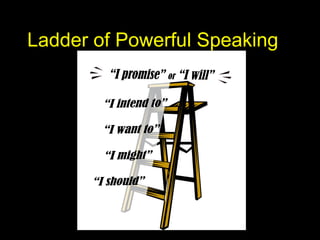
Ladder of Powerful SpeakingLadder of Powerful Speaking
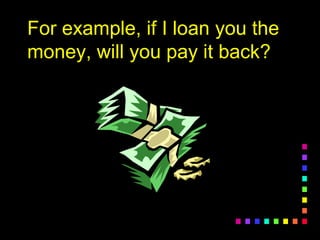
For example, if I loan you theFor example, if I loan you the
money, will you pay it back?money, will you pay it back?
I should pay it back.I should pay it back.
I might pay it back.I might pay it back.
I want to pay it back.I want to pay it back.
I intend to pay it back.I intend to pay it back.
I promise to pay it back.I promise to pay it back.
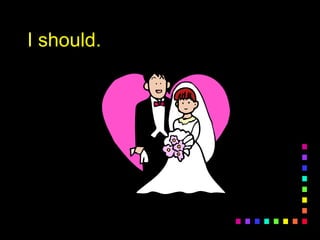
Will you marry me and be trueWill you marry me and be true
to me?to me?
I should.I should.
I might.I might.
You know, I really want to.You know, I really want to.
I intend to.I intend to.
Yes, I do. I promise.Yes, I do. I promise.
Will you finish your careerWill you finish your career
paper on time? Be carefulpaper on time? Be careful
about the language you use.about the language you use.
Be Aware of Negative Self-Talk.Be Aware of Negative Self-Talk.
Do You Recognize any ofDo You Recognize any of
These?These?
I have to be perfectI have to be perfect
I need the approval of everyoneI need the approval of everyone
That’s always the way it is.That’s always the way it is.
You made me feel that way.You made me feel that way.
I’m helpless in this situation.I’m helpless in this situation.
If something bad can happen, it willIf something bad can happen, it will
happen. (Murphy’s Law)happen. (Murphy’s Law)
Barriers to Effective CommunicationBarriers to Effective Communication
CriticizingCriticizing
Name-calling or labelingName-calling or labeling
Giving adviceGiving advice
Ordering or commandingOrdering or commanding
ThreateningThreatening
MoralizingMoralizing
DivertingDiverting
Logical arguingLogical arguing
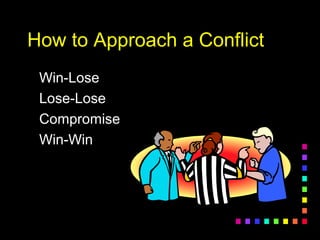
How to Approach a ConflictHow to Approach a Conflict
Win-LoseWin-Lose
Lose-LoseLose-Lose
CompromiseCompromise
Win-WinWin-Win
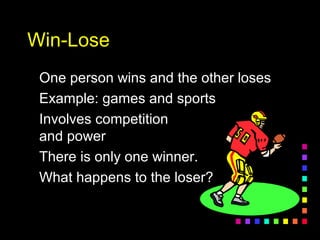
Win-LoseWin-Lose
One person wins and the other losesOne person wins and the other loses
Example: games and sportsExample: games and sports
Involves competitionInvolves competition
and powerand power
There is only one winner.There is only one winner.
What happens to the loser?What happens to the loser?
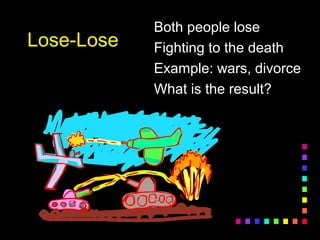
Lose-LoseLose-Lose
Both people loseBoth people lose
Fighting to the deathFighting to the death
Example: wars, divorceExample: wars, divorce
What is the result?What is the result?
CompromiseCompromise
Both parties in the conflict have some ofBoth parties in the conflict have some of
their needs mettheir needs met
Example: Buyer and seller of a used carExample: Buyer and seller of a used car
As long as both are satisfied, theAs long as both are satisfied, the
outcome is positiveoutcome is positive
Problems arise when people are askedProblems arise when people are asked
to compromise their valuesto compromise their values
Win-WinWin-Win
Both parties work together to find aBoth parties work together to find a
solution in which both winsolution in which both win
There is no loserThere is no loser
Steps in a Win-Win SolutionSteps in a Win-Win Solution
Identify the problemIdentify the problem
Set a good time to discuss the issueSet a good time to discuss the issue
Describe your problem and needsDescribe your problem and needs
Look at the other point of viewLook at the other point of view
Look for alternatives that work for bothLook for alternatives that work for both
parties.parties.
Group Discussion:Group Discussion:
1. What are the1. What are the
qualities of aqualities of a
good friend?good friend?
2. What are the five most2. What are the five most
important qualities of a goodimportant qualities of a good
relationship?relationship?
Surviving the Loss of aSurviving the Loss of a
RelationshipRelationship
Stages of Recovery from LossStages of Recovery from Loss
Shock or denialShock or denial
Anger or depressionAnger or depression
Understanding or acceptanceUnderstanding or acceptance
Suggestions for RecoverySuggestions for Recovery
It takes time.It takes time.
It is OK to feel sad and cry.It is OK to feel sad and cry.
Talk or write about it.Talk or write about it.
Take care of yourselfTake care of yourself
Get plenty of rest and eat wellGet plenty of rest and eat well
Avoid addictive behaviorsAvoid addictive behaviors
Relax and exerciseRelax and exercise
Keys to Success:Keys to Success:
Failure is an Opportunity forFailure is an Opportunity for
LearningLearning
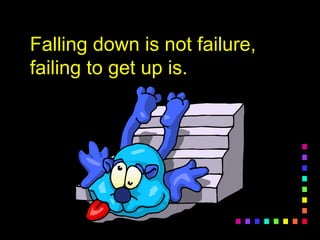
Falling down is not failure,Falling down is not failure,
failing to get up is.failing to get up is.
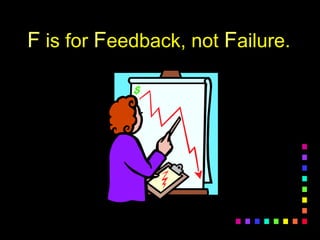
FF is foris for FFeedback, noteedback, not FFailure.ailure.
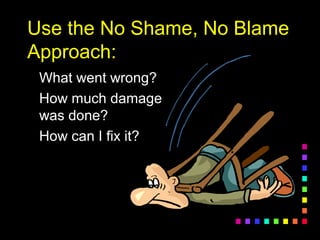
Use the No Shame, No BlameUse the No Shame, No Blame
Approach:Approach:
What went wrong?What went wrong?
How much damageHow much damage
was done?was done?
How can I fix it?How can I fix it?

Chapter 10

  • 1.
  • 2.
    What is yourpersonalWhat is your personal communication style?communication style?
  • 3.
    ExtrovertExtrovert Social typesSocial types Startconversations easilyStart conversations easily Energized by talking to peopleEnergized by talking to people Find it easy to start a conversation orFind it easy to start a conversation or ask someone for a dateask someone for a date In conflict situations, they talk louderIn conflict situations, they talk louder and fasterand faster
  • 4.
    IntrovertIntrovert Rehearse what theyare going to say beforeRehearse what they are going to say before they say itthey say it Need quiet for concentrationNeed quiet for concentration Enjoy peace and quietEnjoy peace and quiet Often labeled as “quiet” or “shy”Often labeled as “quiet” or “shy” Find it difficult to start a conversation or askFind it difficult to start a conversation or ask someone for a datesomeone for a date Withdraw from conflict situations to think itWithdraw from conflict situations to think it overover
  • 5.
    To improve communication,Toimprove communication, extroverts need to:extroverts need to: Pause to give the introvert time to thinkPause to give the introvert time to think Avoid monopolizing the conversationAvoid monopolizing the conversation
  • 6.
    To improve communication,Toimprove communication, introverts need to:introverts need to: Make an effort to communicateMake an effort to communicate
  • 7.
    Sensing and IntuitiveTypesSensing and Intuitive Types Sensing types need intuitive types toSensing types need intuitive types to bring up new possibilities, deal withbring up new possibilities, deal with changes and understand differentchanges and understand different perspectives.perspectives. Intuitive types need sensing types toIntuitive types need sensing types to deal with facts and details.deal with facts and details.
  • 8.
    Feeling and ThinkingTypesFeeling and Thinking Types Feeling types need thinking types toFeeling types need thinking types to analyze, organize, follow policy andanalyze, organize, follow policy and weigh the evidence.weigh the evidence. Thinking types need feeling types toThinking types need feeling types to understand how others feel and tounderstand how others feel and to establish harmony in the family andestablish harmony in the family and business environments.business environments.
  • 9.
    Judging and perceptivetypesJudging and perceptive types need each other.need each other. Judging types need perceptive types toJudging types need perceptive types to relax and have fun.relax and have fun. Perceptive types need judging types toPerceptive types need judging types to be more organized and productive.be more organized and productive.
  • 10.
  • 11.
    Problems in CommunicationProblemsin Communication Just because a message was sent doesJust because a message was sent does not mean that it was received.not mean that it was received.
  • 12.
    ProblemsProblems Message OverloadMessage Overload Worriesand AnxietyWorries and Anxiety Rapid ThoughtRapid Thought Being a Good ListenerBeing a Good Listener AssumptionsAssumptions Hearing ProblemsHearing Problems Talking Too MuchTalking Too Much
  • 13.
    How to Bea Good ListenerHow to Be a Good Listener
  • 14.
  • 15.
    Minimize DistractionsMinimize Distractions Turnoff the TV and music.Turn off the TV and music. Focus on being a good listener.Focus on being a good listener.
  • 16.
    Don’t Judge TooSoonDon’t Judge Too Soon Understand first and then evaluate.Understand first and then evaluate. Put aside your mindset to hear andPut aside your mindset to hear and understand.understand.
  • 17.
    Listen for theMain PointListen for the Main Point
  • 18.
  • 19.
    Feedback MeaningFeedback Meaning Speakersoften:Speakers often: Say one thing and mean another.Say one thing and mean another. Say something and not mean it.Say something and not mean it. Speak in a way that causesSpeak in a way that causes confusion.confusion.
  • 20.
    How to FeedbackMeaningHow to Feedback Meaning Restate what has been saidRestate what has been said Ask for clarificationAsk for clarification Reword the message to checkReword the message to check understandingunderstanding Listen for feelingsListen for feelings Use your own words to rephrase theUse your own words to rephrase the message to check understandingmessage to check understanding
  • 21.
    Tips for GoodListeningTips for Good Listening
  • 22.
    Let the persontalk. TalkingLet the person talk. Talking helps to clarify thinking.helps to clarify thinking.
  • 23.
    Avoid being critical.It causesAvoid being critical. It causes anger that interferes withanger that interferes with communication.communication.
  • 24.
    Share your experiencesbutShare your experiences but resist giving advice.resist giving advice.
  • 25.
    Ask questions toclarify.Ask questions to clarify.
  • 26.
    Be supportive. Iam here ifBe supportive. I am here if you need me.you need me.
  • 27.
    Let people expressLetpeople express their feelings.their feelings. It is not helpful to say,It is not helpful to say, “Don’t feel sad.”“Don’t feel sad.”
  • 28.
    Replace pity withReplacepity with understanding.understanding.
  • 29.
    The Language ofTheLanguage of Responsibility. “I” and “You”Responsibility. “I” and “You” Statements.Statements.
  • 30.
    Example: You mustbe crazy!Example: You must be crazy! What reaction do you get?What reaction do you get?
  • 31.
    ““You” statements:You” statements: Labeland blame.Label and blame. Demand rebuttal.Demand rebuttal. Cause negative emotions.Cause negative emotions. Escalate the situation.Escalate the situation.
  • 32.
    ““I” Statement:I” Statement: Insteadof: You must be crazy.Instead of: You must be crazy. I don’t understand.I don’t understand.
  • 33.
    ““I” StatementsI” Statements Youaccept responsibility for yourself.You accept responsibility for yourself. Better communication is possible.Better communication is possible.
  • 34.
    Ways to Makean “I” StatementWays to Make an “I” Statement Make an observation.Make an observation. State your feelings.State your feelings. Share your thoughts.Share your thoughts. Say what you want.Say what you want. State your intentions.State your intentions.
  • 35.
    Example: Instead of“You’re a Slob!”:Example: Instead of “You’re a Slob!”: Your things are all over the floor.Your things are all over the floor. I get angry when I step over your things.I get angry when I step over your things. I think it is time to clean up.I think it is time to clean up. Please pick up your things.Please pick up your things. I will pay your allowance when yourI will pay your allowance when your room is clean.room is clean.
  • 36.
    Ladder of PowerfulSpeakingLadder of Powerful Speaking
  • 37.
    For example, ifI loan you theFor example, if I loan you the money, will you pay it back?money, will you pay it back?
  • 38.
    I should payit back.I should pay it back.
  • 39.
    I might payit back.I might pay it back.
  • 40.
    I want topay it back.I want to pay it back.
  • 41.
    I intend topay it back.I intend to pay it back.
  • 42.
    I promise topay it back.I promise to pay it back.
  • 43.
    Will you marryme and be trueWill you marry me and be true to me?to me?
  • 44.
  • 45.
  • 46.
    You know, Ireally want to.You know, I really want to.
  • 47.
    I intend to.Iintend to.
  • 48.
    Yes, I do.I promise.Yes, I do. I promise.
  • 49.
    Will you finishyour careerWill you finish your career paper on time? Be carefulpaper on time? Be careful about the language you use.about the language you use.
  • 50.
    Be Aware ofNegative Self-Talk.Be Aware of Negative Self-Talk. Do You Recognize any ofDo You Recognize any of These?These? I have to be perfectI have to be perfect I need the approval of everyoneI need the approval of everyone That’s always the way it is.That’s always the way it is. You made me feel that way.You made me feel that way. I’m helpless in this situation.I’m helpless in this situation. If something bad can happen, it willIf something bad can happen, it will happen. (Murphy’s Law)happen. (Murphy’s Law)

  • 51.
    Barriers to EffectiveCommunicationBarriers to Effective Communication CriticizingCriticizing Name-calling or labelingName-calling or labeling Giving adviceGiving advice Ordering or commandingOrdering or commanding ThreateningThreatening MoralizingMoralizing DivertingDiverting Logical arguingLogical arguing
  • 52.
    How to Approacha ConflictHow to Approach a Conflict Win-LoseWin-Lose Lose-LoseLose-Lose CompromiseCompromise Win-WinWin-Win
  • 53.
    Win-LoseWin-Lose One person winsand the other losesOne person wins and the other loses Example: games and sportsExample: games and sports Involves competitionInvolves competition and powerand power There is only one winner.There is only one winner. What happens to the loser?What happens to the loser?
  • 54.
    Lose-LoseLose-Lose Both people loseBothpeople lose Fighting to the deathFighting to the death Example: wars, divorceExample: wars, divorce What is the result?What is the result?
  • 55.
    CompromiseCompromise Both parties inthe conflict have some ofBoth parties in the conflict have some of their needs mettheir needs met Example: Buyer and seller of a used carExample: Buyer and seller of a used car As long as both are satisfied, theAs long as both are satisfied, the outcome is positiveoutcome is positive Problems arise when people are askedProblems arise when people are asked to compromise their valuesto compromise their values
  • 56.
    Win-WinWin-Win Both parties worktogether to find aBoth parties work together to find a solution in which both winsolution in which both win There is no loserThere is no loser
  • 57.
    Steps in aWin-Win SolutionSteps in a Win-Win Solution Identify the problemIdentify the problem Set a good time to discuss the issueSet a good time to discuss the issue Describe your problem and needsDescribe your problem and needs Look at the other point of viewLook at the other point of view Look for alternatives that work for bothLook for alternatives that work for both parties.parties.
  • 58.
    Group Discussion:Group Discussion: 1.What are the1. What are the qualities of aqualities of a good friend?good friend? 2. What are the five most2. What are the five most important qualities of a goodimportant qualities of a good relationship?relationship?
  • 59.
    Surviving the Lossof aSurviving the Loss of a RelationshipRelationship
  • 60.
    Stages of Recoveryfrom LossStages of Recovery from Loss Shock or denialShock or denial Anger or depressionAnger or depression Understanding or acceptanceUnderstanding or acceptance
  • 61.
    Suggestions for RecoverySuggestionsfor Recovery It takes time.It takes time. It is OK to feel sad and cry.It is OK to feel sad and cry. Talk or write about it.Talk or write about it. Take care of yourselfTake care of yourself Get plenty of rest and eat wellGet plenty of rest and eat well Avoid addictive behaviorsAvoid addictive behaviors Relax and exerciseRelax and exercise
  • 62.
    Keys to Success:Keysto Success: Failure is an Opportunity forFailure is an Opportunity for LearningLearning
  • 63.
    Falling down isnot failure,Falling down is not failure, failing to get up is.failing to get up is.
  • 64.
    FF is forisfor FFeedback, noteedback, not FFailure.ailure.
  • 65.
    Use the NoShame, No BlameUse the No Shame, No Blame Approach:Approach: What went wrong?What went wrong? How much damageHow much damage was done?was done? How can I fix it?How can I fix it?