ListeningListening
Presented By:Presented By:
Usman HashmiUsman Hashmi
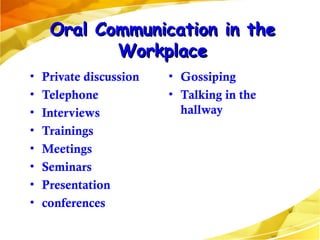
Oral Communication in theOral Communication in the
WorkplaceWorkplace
• Private discussion
• Telephone
• Interviews
• Trainings
• Meetings
• Seminars
• Presentation
• conferences
• Gossiping
• Talking in the
hallway
The Listening ProcessThe Listening Process
3. Remembering3. Remembering
2. Interpretation2. Interpretation
1.Receiving1.Receiving
4. Evaluating4. Evaluating
The Listening ProcessThe Listening Process
6. Acting6. Acting
5. Responding5. Responding
Listening Process BarriersListening Process Barriers
Mental Barriers
• Prejudgment
• Closed-mindedness
• Selfishness
• Selective Listening
Improving Listening in the Workplace
• Prepare to listen
• Control external and internal distractions.
• Separate facts from opinions.
• Identify important facts.
• Ask clarifying questions.
• Avoid pre-judgment.
• Establish eye contact
• Take notes to ensure retention.
• Watch for signals
• Give feedback
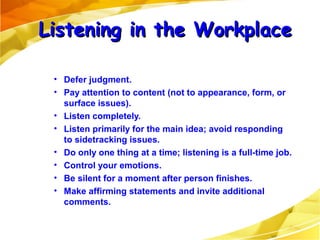
Listening in the WorkplaceListening in the Workplace
• Defer judgment.
• Pay attention to content (not to appearance, form, or
surface issues).
• Listen completely.
• Listen primarily for the main idea; avoid responding
to sidetracking issues.
• Do only one thing at a time; listening is a full-time job.
• Control your emotions.
• Be silent for a moment after person finishes.
• Make affirming statements and invite additional
comments.
Listening in the WorkplaceListening in the Workplace
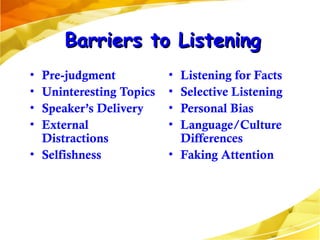
Barriers to ListeningBarriers to Listening
• Pre-judgment
• Uninteresting Topics
• Speaker’s Delivery
• External
Distractions
• Selfishness
• Listening for Facts
• Selective Listening
• Personal Bias
• Language/Culture
Differences
• Faking Attention
Most Irritating ListeningMost Irritating Listening
HabitsHabits
1. Rushing the speaker and making
him feel he is wasting the listener’s
time.
2. Interrupting the speaker.
3. Not looking at the speaker.
4. Getting ahead of the speaker
(finishing her thoughts).
5. Not responding to the speaker’s
requests.
Most Irritating ListeningMost Irritating Listening
HabitsHabits
6. Showing interest in something
other than what the speaker is
saying.
7. Saying “Yes, but . . .,” as if the
listener’s mind is made up.
8. Topping the speaker’s story with
“That reminds me . . .” or “That’s
nothing; let me tell you about. . . .”
Most Irritating ListeningMost Irritating Listening
HabitsHabits
9. Forgetting what was talked about
previously.
10. Asking too many questions about
details.

Listening

  • 1.
  • 2.
    Oral Communication intheOral Communication in the WorkplaceWorkplace • Private discussion • Telephone • Interviews • Trainings • Meetings • Seminars • Presentation • conferences • Gossiping • Talking in the hallway
  • 3.
    The Listening ProcessTheListening Process 3. Remembering3. Remembering 2. Interpretation2. Interpretation 1.Receiving1.Receiving 4. Evaluating4. Evaluating
  • 4.
    The Listening ProcessTheListening Process 6. Acting6. Acting 5. Responding5. Responding
  • 5.
    Listening Process BarriersListeningProcess Barriers Mental Barriers • Prejudgment • Closed-mindedness • Selfishness • Selective Listening
  • 6.
    Improving Listening inthe Workplace • Prepare to listen • Control external and internal distractions. • Separate facts from opinions. • Identify important facts. • Ask clarifying questions. • Avoid pre-judgment. • Establish eye contact • Take notes to ensure retention. • Watch for signals • Give feedback Listening in the WorkplaceListening in the Workplace
  • 7.
    • Defer judgment. •Pay attention to content (not to appearance, form, or surface issues). • Listen completely. • Listen primarily for the main idea; avoid responding to sidetracking issues. • Do only one thing at a time; listening is a full-time job. • Control your emotions. • Be silent for a moment after person finishes. • Make affirming statements and invite additional comments. Listening in the WorkplaceListening in the Workplace
  • 8.
    Barriers to ListeningBarriersto Listening • Pre-judgment • Uninteresting Topics • Speaker’s Delivery • External Distractions • Selfishness • Listening for Facts • Selective Listening • Personal Bias • Language/Culture Differences • Faking Attention
  • 9.
    Most Irritating ListeningMostIrritating Listening HabitsHabits 1. Rushing the speaker and making him feel he is wasting the listener’s time. 2. Interrupting the speaker. 3. Not looking at the speaker. 4. Getting ahead of the speaker (finishing her thoughts). 5. Not responding to the speaker’s requests.
  • 10.
    Most Irritating ListeningMostIrritating Listening HabitsHabits 6. Showing interest in something other than what the speaker is saying. 7. Saying “Yes, but . . .,” as if the listener’s mind is made up. 8. Topping the speaker’s story with “That reminds me . . .” or “That’s nothing; let me tell you about. . . .”
  • 11.
    Most Irritating ListeningMostIrritating Listening HabitsHabits 9. Forgetting what was talked about previously. 10. Asking too many questions about details.