Importance of Effective
Communication
Mark Ronnes Reyes
Nursing Educator
Abha International Private Hospital
Communication in Healthcare
• Nurses must constantly express
patient needs to physicians, write
clear yet concise notes and highlight
the events of the shift and how
patients are responding to treatment
and care. Thus, effective
communication is most important
during patient interactions.
WHAT IS COMMUNICATION
• A process of exchanging
information and the
process of generating
and transmitting
messages between two
or more individuals. It is
the most primary aspect
of a nurse-patient
interaction.
SMCR-SENDER-MESSAGES-CHANNEL-RECEIVER
PURPOSES OF COMMUNICATION IN NURSING
• 1. Motivation, Collaboration, Coordination in the
employees and patients
• 2. Improve Nurse-Patient relationships
• 3. Transfer information between patients and all
classes of employees
• 4. To interpret and adopt policies in the organization
SMCR-SENDER-MESSAGES-CHANNEL-RECEIVER
PURPOSES OF COMMUNICATION IN NURSING
• 5. To recruit, select, train and develop the personnel
in the organization.
• 6. Encourage the participation in decision making.
• 7. To boost group morale of workers
• 8. Ensure patient’s safety and job satisfaction
• 9. Help grievance procedure and disciplinary action
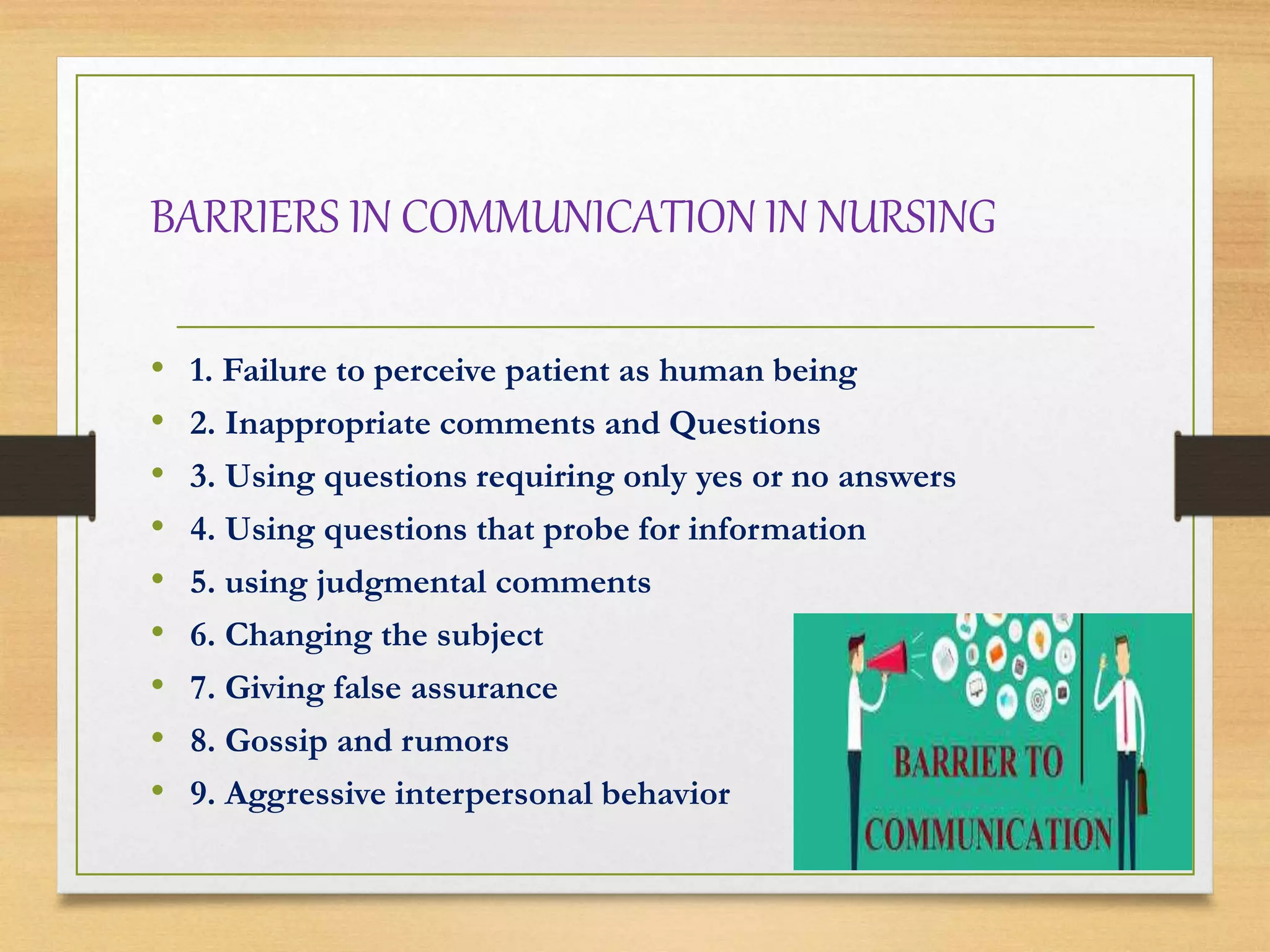
BARRIERS IN COMMUNICATION IN NURSING
• 1. Failure to perceive patient as human being
• 2. Inappropriate comments and Questions
• 3. Using questions requiring only yes or no answers
• 4. Using questions that probe for information
• 5. using judgmental comments
• 6. Changing the subject
• 7. Giving false assurance
• 8. Gossip and rumors
• 9. Aggressive interpersonal behavior
IMPACT OF GOOD COMMUNICATION IN
NURSING
To be a successful nurse,
excellent communication skills
are required. The ability to
communicate and connect with
patients and other health care
professionals can help build
relationship, prevent mistakes
and provide a higher level of
care.
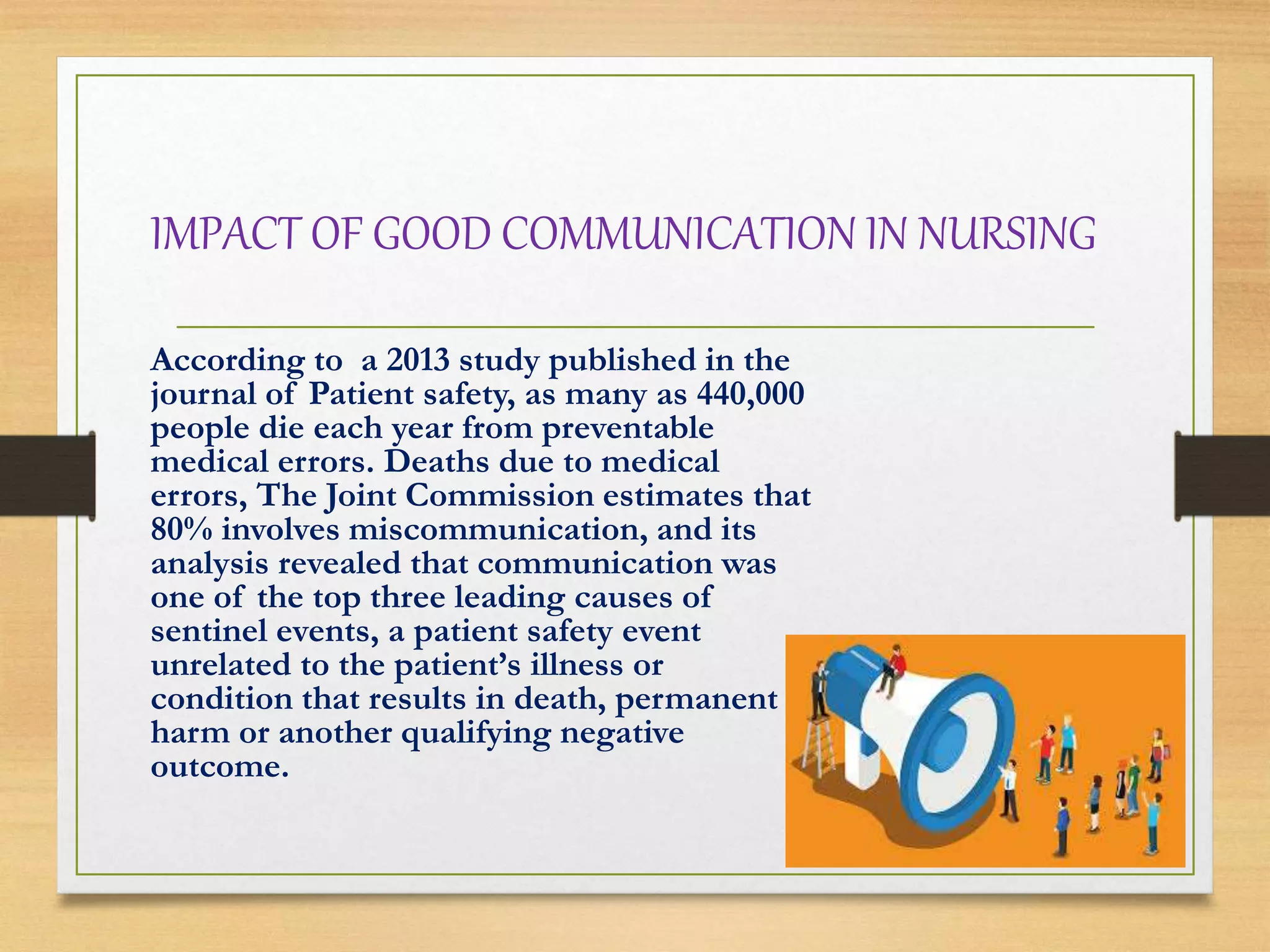
According to a 2013 study published in the
journal of Patient safety, as many as 440,000
people die each year from preventable
medical errors. Deaths due to medical
errors, The Joint Commission estimates that
80% involves miscommunication, and its
analysis revealed that communication was
one of the top three leading causes of
sentinel events, a patient safety event
unrelated to the patient’s illness or
condition that results in death, permanent
harm or another qualifying negative
outcome.
IMPACT OF GOOD COMMUNICATION IN NURSING
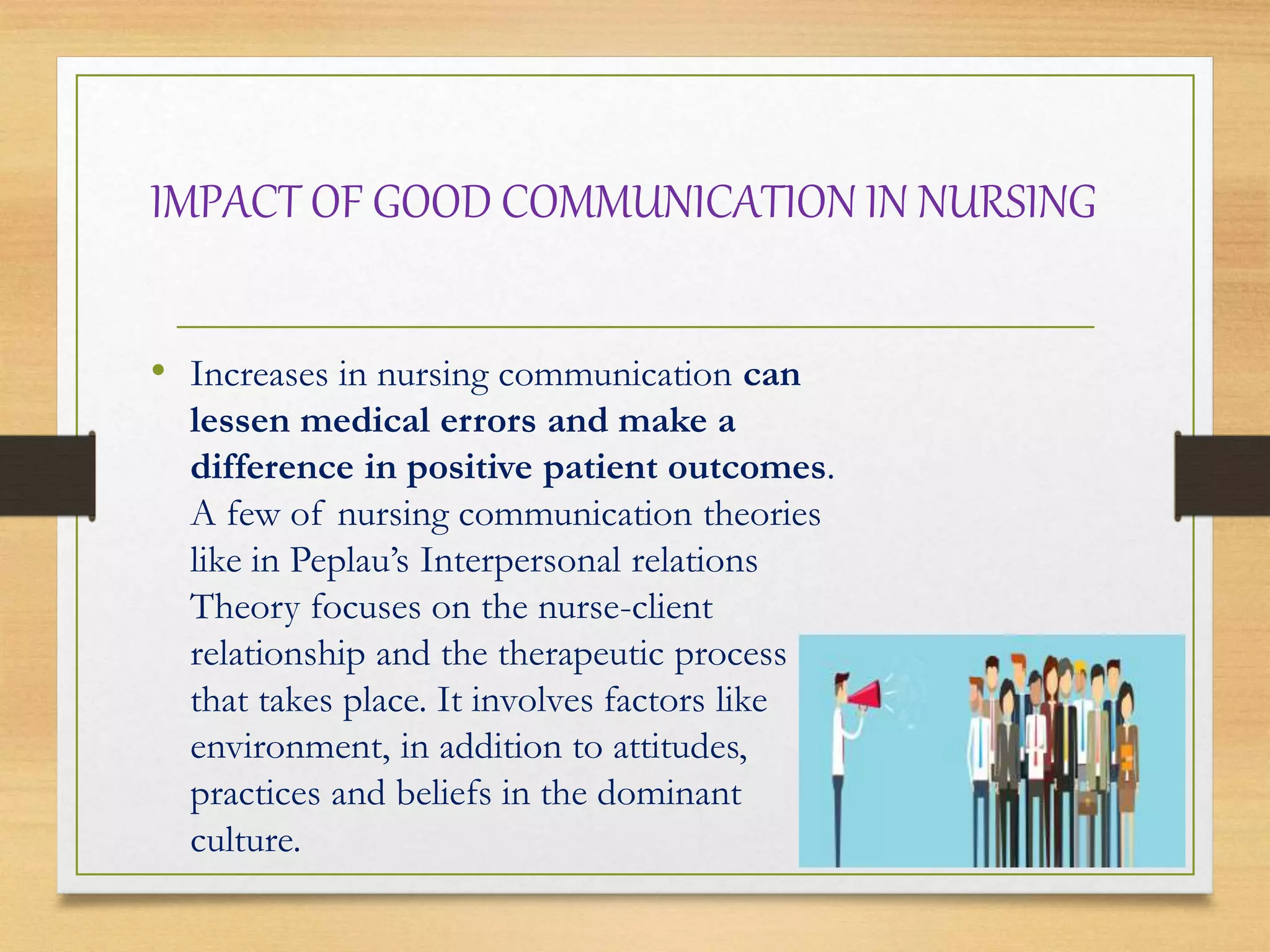
• Increases in nursing communication can
lessen medical errors and make a
difference in positive patient outcomes.
A few of nursing communication theories
like in Peplau’s Interpersonal relations
Theory focuses on the nurse-client
relationship and the therapeutic process
that takes place. It involves factors like
environment, in addition to attitudes,
practices and beliefs in the dominant
culture.
IMPACT OF GOOD COMMUNICATION IN NURSING
Peplau’s Interpersonal relations Theory STAGES
• Orientation Phase- The nurses engages the patient in treatment
and the patient can ask question and receives explanation and
information.
• Identification Phase- The patient and nurse begin to work
together and this interaction provides trust, and acceptance as the
patient becomes an active participant in treatment.
• Exploitation Phase- the patient takes advantage of all the
services offered, exploiting the nurse-patient relationship to
address treatment goals.
• Resolution Phase- due to effective communication the patient
needs are met and moves toward full independence. The patient
no longer needs help and relationship ends, after discharge..
PRINCIPLES OF COMMUNICATION
COMMUNICATION- can be defined as a transaction
and message creation. It assists in the performance of
accurate, consistent and easy nursing work, ensuring
both the satisfaction of the patient and the
protection of the health professional. When health
care professionals are not trained in communication
skills, they face more difficulties separating work from
their personal life, tending to transfer problems from one
side to the other. Nobody can be said that he/she cannot
communicate.
• By listening, the nurses assess the situation and
the problems of the patient and improve the
process of care needed. When there is good
personal relationship between the nurse and
the patient it may lead to things with kindness
like questioning and information is provided
by patient openly. It does not scare the patient
instead it demonstrates interests, creates feelings of
acceptance, trust and harmonious relationship.
PRINCIPLES OF COMMUNICATION
Communication can happen without words.
This is Non-verbal communication and is expressed
by facial expressions, gestures and posture.
Listening is important in communication. It is
responsible nursing practice and requires
concentration of attention and mobilization of
all the senses for the perception of verbal and
non-verbal messages made by the patient.
PRINCIPLES OF COMMUNICATION
• The Therapeutic relationship is an
important prerequisite to effective
communication between health care
providers and the patient. This
relationship between the two include the
ability to express sincere concern for the
care of the patient and the patient
becomes partaker of this interest.
PRINCIPLES OF COMMUNICATION
SPEAKINGWITH THE PATIENT
• The communication which initially started by
the nurse and the patient is a process that
begins with the first contact of the two and
lasts as long as the therapeutic relationship is
present. The nurse who wants to create the
right relationship with the patient must win
him/her from the first moment when the
conversation is held appropriately.
BARRIERS TO EFFECTIVE COMMUNICATION
Common Barriers to Effective Communication for
Patient and Healthcare Providers
-FOR PATIENTS-
• to include noise, lack of privacy and lack of
control over who is present,
• Fear and Anxiety- related to being judged,
becoming emotional or becoming weak
• Inability in explaining feelings and attempting to
appear strong for someone’s else benefit
Common Barriers to Effective Communication for
Patient and Healthcare providers
-FOR HEALTHCARE PROFESSIONAL
BARRIERS-
• include environmental items like time or support staff
conflict and high workload
• Fear and Anxiety related to causing the patient to be
distressed by talking or responding to questions
• Lack of skills or strategies for coping with difficult
emotions, reactions or questions.
BARRIERS TO EFFECTIVE COMMUNICATION
EFFECTIVE COMMUNICATIONSKILLS
1. NON VERBAL
COMMUNICATION
• characterized by facial
expressions, gestures, posture and
physical barriers such as distance
from interlocutor. Non verbal
communication must agree with
verbal communication.
2. LISTENING
• -Responsible nursing practice and requires
concentration of attention and mobilization
of all senses for the perception of verbal and
nonverbal messages made by the patient. By
listening, nurses can be attentive to the needs
of the patient and integrate care according to
the patient’s evolving needs.
EFFECTIVE COMMUNICATIONSKILLS
3. PERSONAL RELATIONSHIP
• Compassion and care, nurses can develop good
personal relationships with the ability to ASK
questions with kindness and provide information
that does not scare, that demonstrates interest,
creates feelings of acceptance, trust and a
harmonious relationship
EFFECTIVE COMMUNICATIONSKILLS
TEN COMMUNICATION SKILLS FOR NURSES TO
MASTER
• 1. SPEAK SLOWLY-Take time to speak slowly and
carefully and the words maybe less mistakes by others
• 2. SPEAK CLEARLY NOT LOUDLY- When
communicating with some people, especially those who
are older, the inclination might be to raise your voice
dramatically in an effort to make them understand you.
Instead of speaking louder, try to speak with clarity
especially when communicating with older patients.
• 3. AVOID USING SLANG WORDS- A common
mistake that many health professionals make is to use
bigger and more complicated words. Slang words are
not fitting or appropriate as to their age and
situation.
• 4. REMEMBER YOUR AUDIENCE- Choose
your words to fit the situation and audience. ( like in
the words drug and medication)
TEN COMMUNICATION SKILLS FOR NURSES TO
MASTER
• 5. STOP AND LISTEN- One of the most
important skills is the ability to stop and listen actively
and ethically to what being said by the other person.
• 6. REFLECT- To make sure that the communication
is flowing, learn the simple trick of reflecting on what
the person is saying to you. Simply repeat what has
been said in your own words, back to the person.
TEN COMMUNICATION SKILLS FOR NURSES TO
MASTER
• 7. USE BODY LANGUAGE- Despite the words
you use, the majority of human communication is
through the body language in your face, hands and
posture etc.
• 8. KNOW YOUR COMMUNICATION
ROADBLOCK- If you know that a person crying
will effectively make your communication
disintegrate then to try to actively practice ways to
manage these situations better.
TEN COMMUNICATION SKILLS FOR NURSES TO
MASTER
• 9 CONSIDER LEARNING A FOREIGN
LANGUAGE- Learning a new language puts you in
better touch with your native tongue and can open
your eyes to the way you use the words you already
know.
• 10. DON’T FORGET THE METHODS OF
COMMUNICATION- In addition to speaking and
listening, don’t forget that there are other skills that
you should work on, such as reading and writing.
TEN COMMUNICATION SKILLS FOR NURSES TO
MASTER
• It’s not all about Talking, it’s how you
Express and Deliver what you want,
then things are done with knowledge,
skills and right attitude on the part of the
nurse.
THANK YOU VERY MUCH.

Importance of Effective Communication in Nursing

  • 1.
    Importance of Effective Communication MarkRonnes Reyes Nursing Educator Abha International Private Hospital
  • 3.
    Communication in Healthcare •Nurses must constantly express patient needs to physicians, write clear yet concise notes and highlight the events of the shift and how patients are responding to treatment and care. Thus, effective communication is most important during patient interactions.
  • 4.
    WHAT IS COMMUNICATION •A process of exchanging information and the process of generating and transmitting messages between two or more individuals. It is the most primary aspect of a nurse-patient interaction.
  • 6.
    SMCR-SENDER-MESSAGES-CHANNEL-RECEIVER PURPOSES OF COMMUNICATIONIN NURSING • 1. Motivation, Collaboration, Coordination in the employees and patients • 2. Improve Nurse-Patient relationships • 3. Transfer information between patients and all classes of employees • 4. To interpret and adopt policies in the organization
  • 7.
    SMCR-SENDER-MESSAGES-CHANNEL-RECEIVER PURPOSES OF COMMUNICATIONIN NURSING • 5. To recruit, select, train and develop the personnel in the organization. • 6. Encourage the participation in decision making. • 7. To boost group morale of workers • 8. Ensure patient’s safety and job satisfaction • 9. Help grievance procedure and disciplinary action
  • 8.
    BARRIERS IN COMMUNICATIONIN NURSING • 1. Failure to perceive patient as human being • 2. Inappropriate comments and Questions • 3. Using questions requiring only yes or no answers • 4. Using questions that probe for information • 5. using judgmental comments • 6. Changing the subject • 7. Giving false assurance • 8. Gossip and rumors • 9. Aggressive interpersonal behavior
  • 9.
    IMPACT OF GOODCOMMUNICATION IN NURSING To be a successful nurse, excellent communication skills are required. The ability to communicate and connect with patients and other health care professionals can help build relationship, prevent mistakes and provide a higher level of care.
  • 10.
    According to a2013 study published in the journal of Patient safety, as many as 440,000 people die each year from preventable medical errors. Deaths due to medical errors, The Joint Commission estimates that 80% involves miscommunication, and its analysis revealed that communication was one of the top three leading causes of sentinel events, a patient safety event unrelated to the patient’s illness or condition that results in death, permanent harm or another qualifying negative outcome. IMPACT OF GOOD COMMUNICATION IN NURSING
  • 11.
    • Increases innursing communication can lessen medical errors and make a difference in positive patient outcomes. A few of nursing communication theories like in Peplau’s Interpersonal relations Theory focuses on the nurse-client relationship and the therapeutic process that takes place. It involves factors like environment, in addition to attitudes, practices and beliefs in the dominant culture. IMPACT OF GOOD COMMUNICATION IN NURSING
  • 12.
    Peplau’s Interpersonal relationsTheory STAGES • Orientation Phase- The nurses engages the patient in treatment and the patient can ask question and receives explanation and information. • Identification Phase- The patient and nurse begin to work together and this interaction provides trust, and acceptance as the patient becomes an active participant in treatment. • Exploitation Phase- the patient takes advantage of all the services offered, exploiting the nurse-patient relationship to address treatment goals. • Resolution Phase- due to effective communication the patient needs are met and moves toward full independence. The patient no longer needs help and relationship ends, after discharge..
  • 13.
    PRINCIPLES OF COMMUNICATION COMMUNICATION-can be defined as a transaction and message creation. It assists in the performance of accurate, consistent and easy nursing work, ensuring both the satisfaction of the patient and the protection of the health professional. When health care professionals are not trained in communication skills, they face more difficulties separating work from their personal life, tending to transfer problems from one side to the other. Nobody can be said that he/she cannot communicate.
  • 14.
    • By listening,the nurses assess the situation and the problems of the patient and improve the process of care needed. When there is good personal relationship between the nurse and the patient it may lead to things with kindness like questioning and information is provided by patient openly. It does not scare the patient instead it demonstrates interests, creates feelings of acceptance, trust and harmonious relationship. PRINCIPLES OF COMMUNICATION
  • 15.
    Communication can happenwithout words. This is Non-verbal communication and is expressed by facial expressions, gestures and posture. Listening is important in communication. It is responsible nursing practice and requires concentration of attention and mobilization of all the senses for the perception of verbal and non-verbal messages made by the patient. PRINCIPLES OF COMMUNICATION
  • 16.
    • The Therapeuticrelationship is an important prerequisite to effective communication between health care providers and the patient. This relationship between the two include the ability to express sincere concern for the care of the patient and the patient becomes partaker of this interest. PRINCIPLES OF COMMUNICATION
  • 17.
    SPEAKINGWITH THE PATIENT •The communication which initially started by the nurse and the patient is a process that begins with the first contact of the two and lasts as long as the therapeutic relationship is present. The nurse who wants to create the right relationship with the patient must win him/her from the first moment when the conversation is held appropriately.
  • 18.
    BARRIERS TO EFFECTIVECOMMUNICATION Common Barriers to Effective Communication for Patient and Healthcare Providers -FOR PATIENTS- • to include noise, lack of privacy and lack of control over who is present, • Fear and Anxiety- related to being judged, becoming emotional or becoming weak • Inability in explaining feelings and attempting to appear strong for someone’s else benefit
  • 19.
    Common Barriers toEffective Communication for Patient and Healthcare providers -FOR HEALTHCARE PROFESSIONAL BARRIERS- • include environmental items like time or support staff conflict and high workload • Fear and Anxiety related to causing the patient to be distressed by talking or responding to questions • Lack of skills or strategies for coping with difficult emotions, reactions or questions. BARRIERS TO EFFECTIVE COMMUNICATION
  • 21.
    EFFECTIVE COMMUNICATIONSKILLS 1. NONVERBAL COMMUNICATION • characterized by facial expressions, gestures, posture and physical barriers such as distance from interlocutor. Non verbal communication must agree with verbal communication.
  • 22.
    2. LISTENING • -Responsiblenursing practice and requires concentration of attention and mobilization of all senses for the perception of verbal and nonverbal messages made by the patient. By listening, nurses can be attentive to the needs of the patient and integrate care according to the patient’s evolving needs. EFFECTIVE COMMUNICATIONSKILLS
  • 23.
    3. PERSONAL RELATIONSHIP •Compassion and care, nurses can develop good personal relationships with the ability to ASK questions with kindness and provide information that does not scare, that demonstrates interest, creates feelings of acceptance, trust and a harmonious relationship EFFECTIVE COMMUNICATIONSKILLS
  • 24.
    TEN COMMUNICATION SKILLSFOR NURSES TO MASTER • 1. SPEAK SLOWLY-Take time to speak slowly and carefully and the words maybe less mistakes by others • 2. SPEAK CLEARLY NOT LOUDLY- When communicating with some people, especially those who are older, the inclination might be to raise your voice dramatically in an effort to make them understand you. Instead of speaking louder, try to speak with clarity especially when communicating with older patients.
  • 25.
    • 3. AVOIDUSING SLANG WORDS- A common mistake that many health professionals make is to use bigger and more complicated words. Slang words are not fitting or appropriate as to their age and situation. • 4. REMEMBER YOUR AUDIENCE- Choose your words to fit the situation and audience. ( like in the words drug and medication) TEN COMMUNICATION SKILLS FOR NURSES TO MASTER
  • 26.
    • 5. STOPAND LISTEN- One of the most important skills is the ability to stop and listen actively and ethically to what being said by the other person. • 6. REFLECT- To make sure that the communication is flowing, learn the simple trick of reflecting on what the person is saying to you. Simply repeat what has been said in your own words, back to the person. TEN COMMUNICATION SKILLS FOR NURSES TO MASTER
  • 27.
    • 7. USEBODY LANGUAGE- Despite the words you use, the majority of human communication is through the body language in your face, hands and posture etc. • 8. KNOW YOUR COMMUNICATION ROADBLOCK- If you know that a person crying will effectively make your communication disintegrate then to try to actively practice ways to manage these situations better. TEN COMMUNICATION SKILLS FOR NURSES TO MASTER
  • 28.
    • 9 CONSIDERLEARNING A FOREIGN LANGUAGE- Learning a new language puts you in better touch with your native tongue and can open your eyes to the way you use the words you already know. • 10. DON’T FORGET THE METHODS OF COMMUNICATION- In addition to speaking and listening, don’t forget that there are other skills that you should work on, such as reading and writing. TEN COMMUNICATION SKILLS FOR NURSES TO MASTER
  • 30.
    • It’s notall about Talking, it’s how you Express and Deliver what you want, then things are done with knowledge, skills and right attitude on the part of the nurse. THANK YOU VERY MUCH.